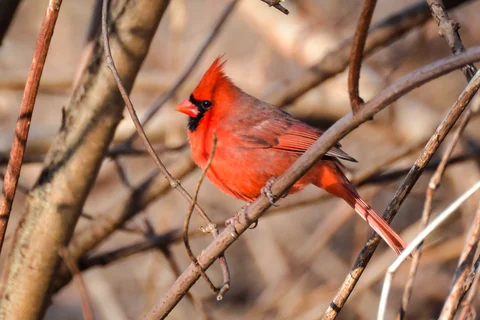
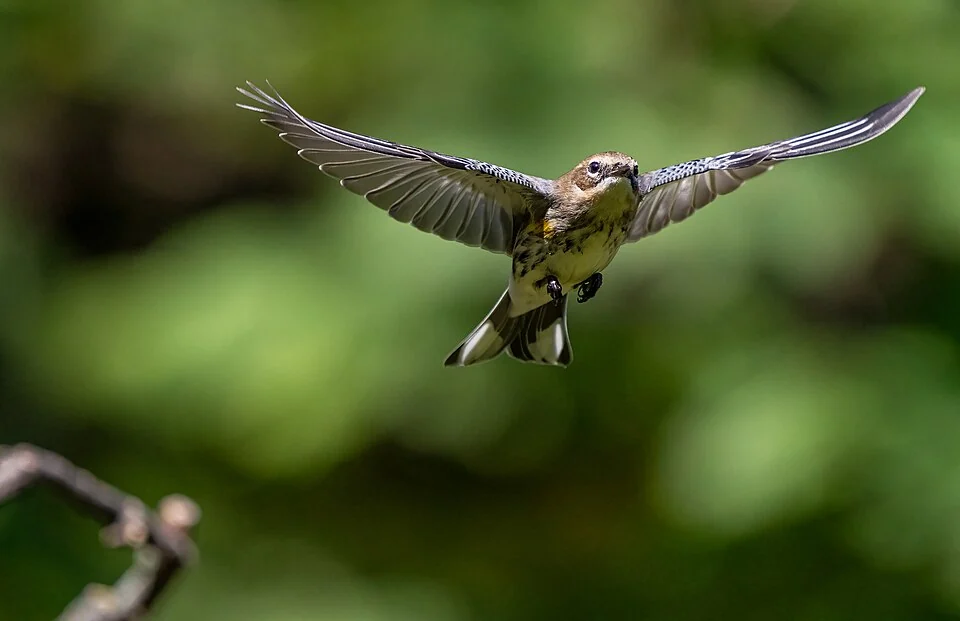
Photo: Hugh Sansom · Yellow-rumped Warbler During Autumn Migration.jpg · CC BY-SA 4.0. Resized for this guide.
The short answer
Use local records and repeated observation to understand fall movement. Support stopover habitat with suitable plants, natural food, and clean water, reduce unnecessary nighttime lighting, and treat dangerous glass. Forecasts describe regional movement, not a promise of birds in one yard.
Look for a changing cast of birds
Fall migration can transform a familiar yard without producing a dramatic flock overhead. A sparrow appears beneath the hedge, a warbler moves through a tree for one morning, and the hummingbird feeder receives a brief visitor after several quiet days. The change may be noticeable only because you know what was there before.
Start with that local baseline. Which birds are present through summer? Which usually appear as the weather and daylight change? A short repeatable watch can reveal arrivals, departures, and changes in habitat use more clearly than an occasional long session focused only on the feeder.
Migration is not one event with a national start date. Species, populations, age groups, routes, and local conditions differ. Some birds travel long distances, some make shorter movements, and others remain in the region. Cornell's migration overview explains this broader pattern.
This guide turns that background into a practical fall routine. You will learn how to read local information, watch different parts of the yard, keep records, and reduce hazards for birds passing through. You do not need to identify every visitor or predict the next big movement to make the season rewarding.
Replace one calendar date with a local season
Use local records to understand the range of weeks when different birds pass through. A national article may combine movements that occur at very different times in different regions. Even within one state, elevation, coastlines, and habitat can change what you see.
Begin with a nearby bird organization, regional checklist, or eBird seasonal information. Look for repeated patterns over several years rather than the earliest or latest exceptional record. An unusual observation is interesting, but it should not become the main calendar for your yard.
Keep arrivals and departures separate. A bird absent from your feeder may still be nearby in natural habitat, and the last day you saw it is not necessarily the day it left. Write “last observed” rather than claiming a confirmed departure unless you have evidence that supports it.
Your own record becomes more useful when you note effort. A ten-minute watch before work and a full afternoon in the garden provide different opportunities to detect a visitor. The bird journal guide offers a simple format for dates, duration, species, and uncertainty. Consistency matters more than a complicated system.
Understand why birds move without oversimplifying
Migration allows birds to use resources and breeding opportunities in different places through the year. Changing day length, inherited timing, weather, and food conditions contribute to the movement patterns of different species. “They leave because it gets cold” is too simple to explain the full picture.
Some birds that tolerate cold still migrate because the foods they use become less available. Other birds remain by using resources that persist. The broad distinction helps explain why a seed feeder can remain busy while many insect-eating summer visitors become less common.
Do not infer a bird's entire route from its presence in your yard. A robin in October may be a local bird, a regional mover, or part of a broader passage. Without individual tracking, the observation establishes where you saw it, not where it began or will end.
Cornell's flyway guide explains major movement routes while showing why species differ. Use flyways as geographic context, not narrow invisible highways that determine every backyard visitor. Birds can occur away from the most familiar lines on a migration map.
Your visual action map

Read the visual as text
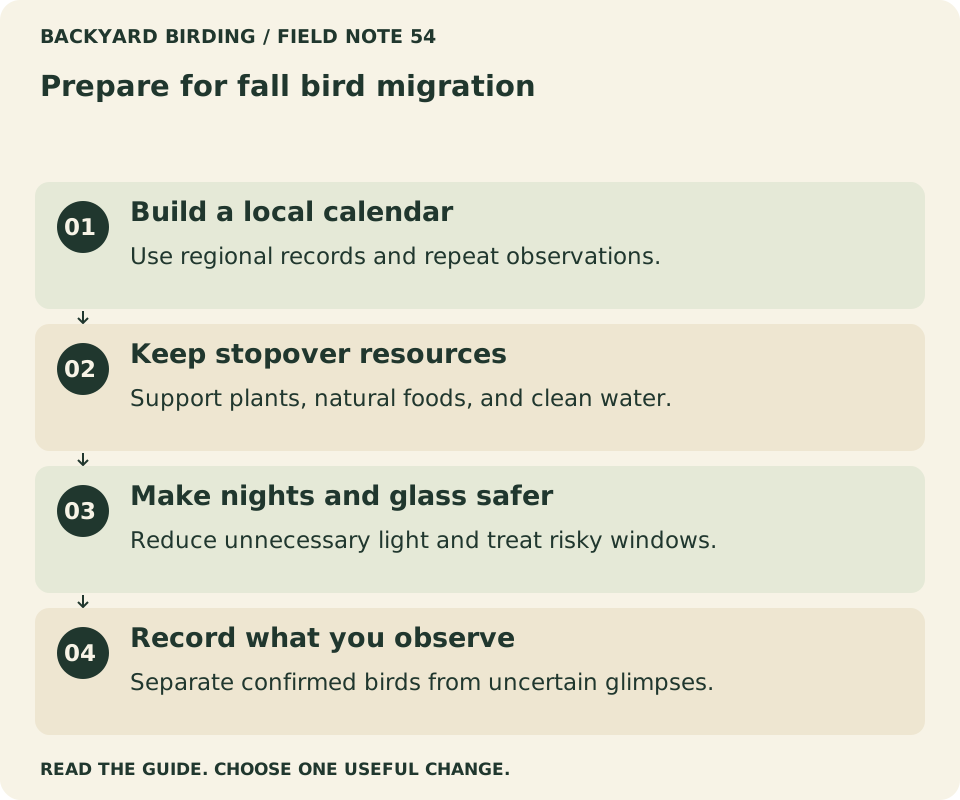
- Build a local calendar. Use regional records and repeat observations.
- Keep stopover resources. Support plants, natural foods, and clean water.
- Make nights and glass safer. Reduce unnecessary light and treat risky windows.
- Record what you observe. Separate confirmed birds from uncertain glimpses.
Learn what a stopover means for a yard
A stopover gives a migrating bird an opportunity to rest and obtain food before continuing. A yard may contribute a small part of that opportunity within a much larger landscape. Trees, shrubs, flowers, seed heads, leaf litter, and water can serve different birds.
Cornell's account of stopover choices describes the importance of these places. The practical lesson for a household is to maintain useful resources and reduce hazards, not to assume a feeder alone can replace habitat.
A bird may use your yard briefly without eating supplied food. Watch foliage, branches, and the ground as well as feeding ports. A warbler searching leaves or a sparrow working a brushy edge may be the clearest sign of migration that morning.
Avoid trying to hold birds in place for longer viewing. Do not use repeated playback, chase a visitor through the garden, or continually rearrange food around it. A short undisturbed visit can be a successful use of the site. Your observation should fit within the bird's activity rather than become an obstacle to it.
Use BirdCast for context, not a backyard promise
BirdCast provides migration information derived from weather radar and related analysis. Its forecasts and dashboard can help you recognize nights with substantial movement over a broad area. They do not identify every bird over your home or guarantee that particular species will land in your yard.
Cornell's guide to BirdCast maps and the dashboard explains the tools and their coverage. Check the current interface and definitions when using a number; a forecast, an observed movement estimate, and a local species suggestion are different kinds of information.
Use the information to make a practical plan. After a night of substantial regional movement, you might allow an extra quiet morning watch, inspect risky glass, and make sure the bath is clean. Those are useful actions even if the yard remains relatively quiet.
Keep a note of what you expected and what you actually observed. A busy radar night followed by few backyard sightings is not necessarily a failed forecast. Birds may pass overhead, stop elsewhere, or use habitat outside your viewing area. The scale of the tool and the scale of your observation need to stay distinct.
Read weather as context rather than a formula
Wind, cloud, rain, and larger weather systems influence migration, but a simple rule such as “north wind means many birds tomorrow” is not dependable everywhere. Geography, species, and the position of a weather system all matter.
Use forecasts to plan safe observation and habitat checks. After wind or rain, inspect mounts, window treatments, and water containers. A storm may change the yard's condition even if it does not produce an unusual visitor.
Avoid interpreting every grounded or quiet bird as an exhausted migrant. Resting, feeding, injury, and normal fledgling behavior can look different but overlap in a brief view. If a bird shows concerning signs or has struck glass, follow appropriate wildlife guidance instead of assuming it only needs food and a rest.
Keep weather notes concise: wind direction and strength as observed, rain, approximate conditions, and any major change. Over time, you may notice patterns in your own yard. Treat those as local observations that deserve further comparison, not universal predictions. A useful birding habit is to remain ready for surprises without turning a weather chart into a promise.
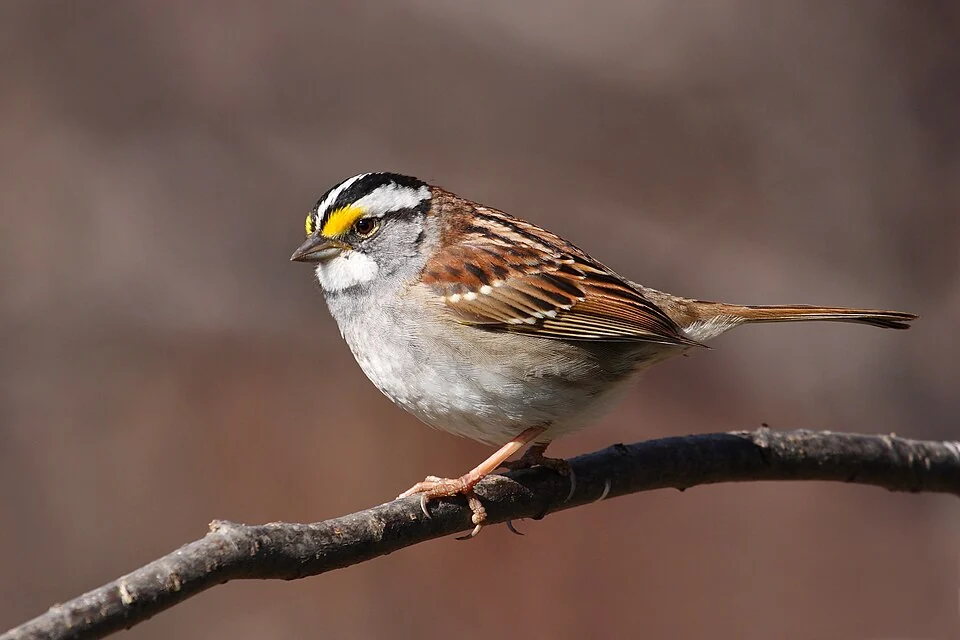
Photo: Cephas · Zonotrichia albicollis CT1.jpg · CC BY-SA 3.0. Resized for this guide.
Watch the yard in layers
Divide a short watch among ground, shrubs, trunks, and canopy. A feeder-only view samples one resource and can miss birds that never approach it. Start with a slow scan, then settle on movement or sound rather than swinging binoculars rapidly between every branch.
At ground level, look along edges and beneath vegetation where birds can move between cover and open patches. In shrubs, watch for a leaf twitch or a brief shape in an opening. Higher up, follow one bird long enough to note how it moves and where it searches.
| Yard layer | What to watch | Useful note |
|---|---|---|
| Ground and leaf litter | Hopping, scratching, seed or invertebrate feeding | Surface used and visible behavior |
| Shrubs and low branches | Short movements between cover and openings | Face, breast, and tail views |
| Trunks and large limbs | Climbing and bark inspection | Direction of movement and body shape |
| Canopy | Small active birds among leaves | Wing pattern and foraging position |
| Open sky | Passing flocks and directional movement | Count estimate and direction, with uncertainty |
Do not expect to cover every layer equally from one window. Choose two safe viewing points if needed, and keep the route quiet. A modest consistent method makes comparisons between days more meaningful.
Expect unfamiliar plumage and imperfect views
Fall birds may not match the bright breeding adults featured in familiar illustrations. Young birds and seasonal plumages can make an ordinary species look new. Begin with shape, bill, pattern, and behavior rather than searching only for a remembered color.
For small active birds, collect a few useful details before consulting an app. Note wingbars, eyebrow, throat, breast pattern, tail shape, and where the bird was feeding. You may only see some of these, and that limitation should remain part of the record.
Use a regional field guide and compare the correct age or season when possible. Do not assume every dull warbler is the same species or every streaked brown bird is a sparrow. Our sparrow comparison guide and finch comparison cover two common sources of confusion.
A photograph can help, but keep the original frame and avoid heavy color correction. A broad view may preserve proportions and habitat that a tight crop removes. If the image cannot settle the question, leave the bird at a broader identification level. Migration is interesting even when some visitors remain unnamed.
Separate residents, passage birds, and winter arrivals
Three patterns can overlap in fall: familiar residents remain, passage migrants appear briefly, and winter visitors begin using the area. Your yard may show all three during the same week. A change in numbers does not automatically indicate the arrival of a new species.
Use repeated observations to distinguish patterns cautiously. A bird seen once might be passing through, but it may also be a local bird you rarely notice. A species seen regularly for weeks is using the area, yet that does not prove every sighting is the same individual.
Learn a few likely local winter arrivals before the season becomes busy. In many regions, birds such as juncos or particular sparrows become more noticeable as the year changes. Elsewhere, the expected list differs. Let regional records guide the shortlist.
Keep individual stories modest. “White-throated Sparrows returned to the hedge” is more defensible than “the same pair returned” when you have no identifying evidence. The distinction preserves the pleasure of seasonal familiarity while keeping the record accurate enough to be useful later.
Find your situation

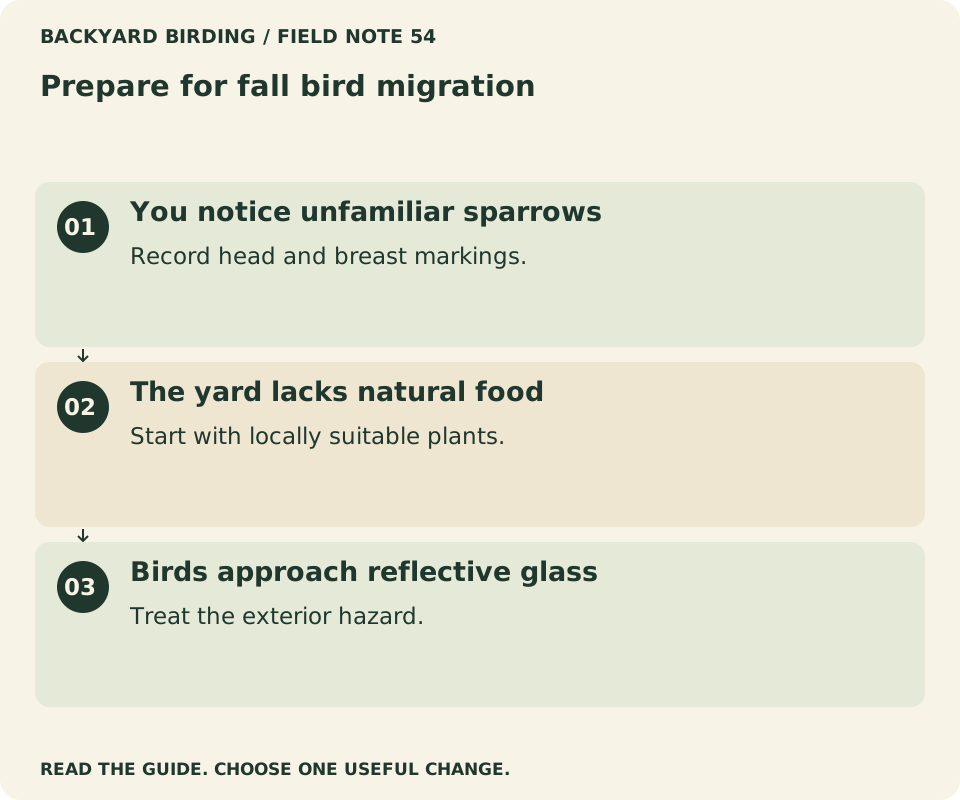
Read the visual as text
- You notice unfamiliar sparrows. Record head and breast markings.
- The yard lacks natural food. Start with locally suitable plants.
- Birds approach reflective glass. Treat the exterior hazard.
Keep natural seed heads where they are practical
Seed-bearing plants can contribute food and structure after flowering ends. Before cutting everything down, identify plants that are appropriate to retain and consider how the area functions. Paths, drainage, invasive plants, disease concerns, and local fire guidance may require specific management.
Leave a defined patch where practical rather than treating the whole property identically. A clear edge or maintained path can make the choice easier to live with while retaining resources elsewhere. The garden can look intentional without removing every spent stem.
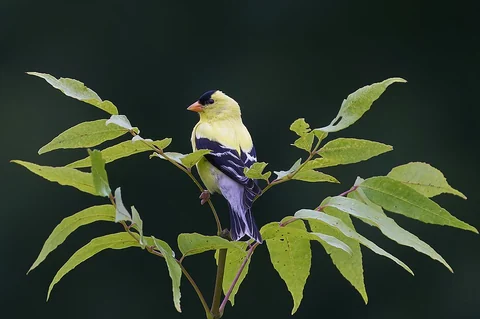
Watch actual use. A bird perched on a seed head is not necessarily eating the seed, so note pecking, handling, and other visible behavior. Our American Goldfinch guide offers an example of how seasonal appearance and feeding observations connect.
When adding plants, choose locally appropriate species for the site rather than buying a generic wildlife mixture without checking its contents. The native-plant guide explains the selection process. A useful fall resource should be part of a sustainable planting plan, not a temporary patch that introduces an unsuitable plant or creates a maintenance problem next year.
Preserve fruit and insect resources thoughtfully
Fruiting shrubs and trees may draw birds that ignore seed feeders. Observe which plants receive visits and when their fruit becomes available. A species that fruits in summer may not fill the same role as one used later in your region.
Audubon's migration planting guidance connects native plants with food for traveling birds. Use local plant resources to choose species suited to soil, moisture, mature space, and household use.
Avoid assuming that berries eaten by birds are safe for people or pets. Identify plants separately and keep edibility questions outside a casual wildlife observation. A bird's diet is not a household food-safety test.
Review unnecessary pesticide use and aggressive tidying in suitable planting areas. Invertebrate food can be present in foliage, bark, and leaf litter even when it is not obvious from a window. If treatment or cleanup is needed, address the specific problem. A thoughtful habitat plan makes room for ordinary natural processes while respecting safety, access, and local land-management guidance.
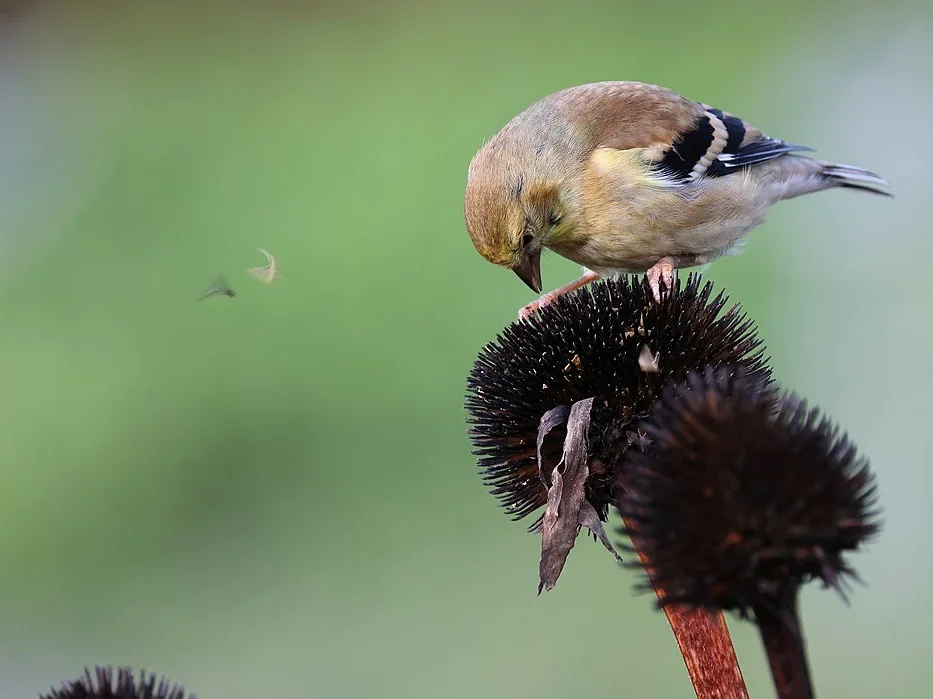
Photo: Cephas · Echinacea purpurea Spinus tristis JRVdH 05.jpg · CC BY-SA 4.0. Resized from the credited adaptation.
Offer clean water through changing conditions
Water can serve birds that do not use your feeder. Keep a stable shallow basin with secure footing, and place it where you can empty and clean it. A hidden bowl beneath dense vegetation may be difficult to maintain and may expose birds to concealed approaches by cats.
Check after wind and falling leaves. Debris can collect quickly in autumn, and topping up the basin leaves the underlying material in place. Empty, scrub, rinse, and refill as conditions require. Our birdbath-cleaning guide covers the routine.
As freezing weather approaches, assess the basin and any pump separately. Not all materials or devices tolerate freezing. A removable bowl can be a manageable option, while a heated bath requires appropriately rated equipment and safe power. The winter-birdbath guide explains those choices.
Review nearby glass before adding or moving water. A clean bath can still draw birds into a hazardous reflection. Watch the approach and departure routes during ordinary use, then address the panes involved. Habitat quality includes what happens between resources, not just the condition of each resource by itself.
Keep supplemental food proportional to actual use
Fall feeding should respond to the birds present and the condition of the station. Start with manageable portions and inspect the feeder, tray, and ground. More food does not necessarily attract more migrant species, especially those that mainly use insects or fruit.
Do not change several foods at once in response to a quiet morning. Check freshness, moisture, and placement first. Then observe the wider yard. A passing bird may find what it needs in a tree without ever entering the feeder camera's view.
If you offer nectar where hummingbirds occur, keep it fresh through the appropriate local season. Leaving a properly maintained feeder available in fall does not force birds to delay migration. Our hummingbird timing guide explains local arrival and departure observations and the reason to avoid one national takedown date.
Pause feeding when local wildlife advice, disease concerns, bear activity, or your own inability to maintain the station calls for it. A seasonal desire to help does not justify old food or an unmanaged conflict. Habitat, safer glass, and reduced unnecessary lighting remain useful actions when a feeder is not appropriate.
Make glass visible before migration becomes busy
Inspect windows and glass barriers from the outside where safe. Reflections of trees and sky, transparent corners, and views through a building can create hazardous apparent routes. New fall light angles and changing foliage may alter the reflection.
Treat the whole risky exterior surface using a suitable closely spaced pattern or barrier. The American Bird Conservancy's home solutions explain options. A single silhouette leaves most of the pane looking open and should not be treated as a complete solution.
Check treatments after cleaning, storms, or seasonal maintenance. Missing marks, loose screens, or a newly exposed pane can create a gap in a previously useful arrangement. Include glass railings and outbuildings where birds travel, not only the living-room window.
If a bird strikes glass, contact a licensed rehabilitator for guidance rather than assuming that flying away immediately proves recovery. Our window-collision guide covers response and prevention. Record the exact pane and circumstances so the event leads to a practical correction instead of remaining an unexplained accident.
Small mistakes. Better moves.

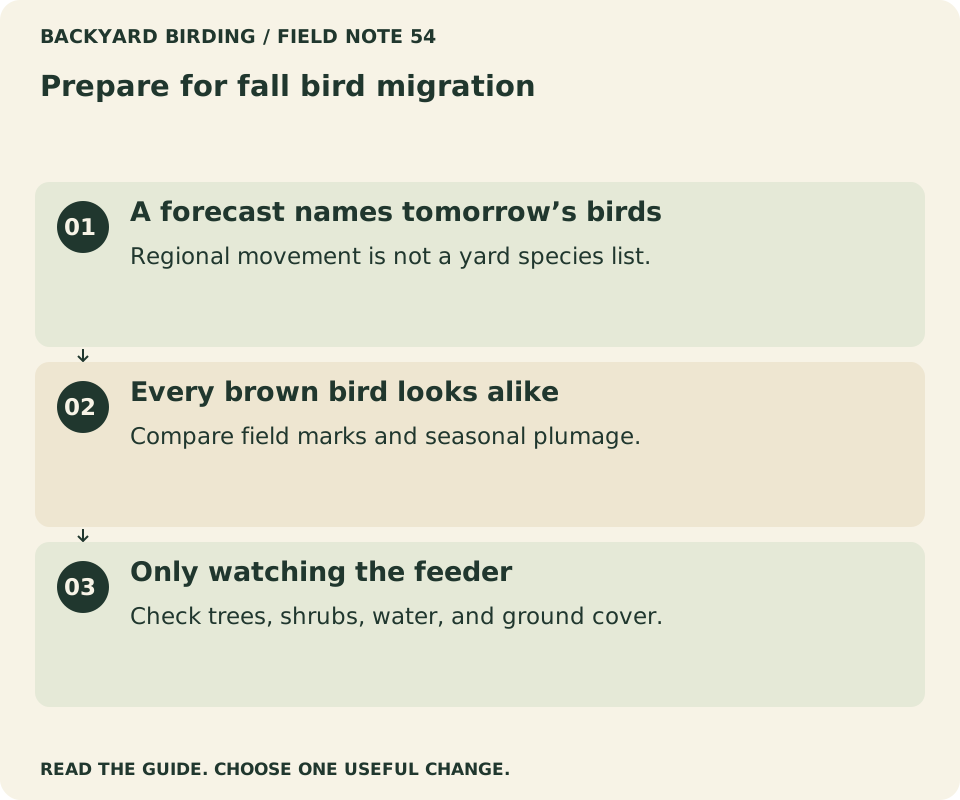
Read the visual as text
- A forecast names tomorrow’s birds. Regional movement is not a yard species list.
- Every brown bird looks alike. Compare field marks and seasonal plumage.
- Only watching the feeder. Check trees, shrubs, water, and ground cover.
Reduce unnecessary light at night
Many migrating birds travel at night, and artificial light can create hazards along the way. Audubon's Lights Out program describes steps buildings and households can take during migration.
Begin with lights that are not needed: decorative uplighting, unused exterior fixtures, and bright indoor light spilling through uncovered windows. Turn them off or reduce their duration where safe. Use appropriate shielding and controls for necessary lighting rather than leaving every fixture on throughout the night.
Keep safety and access needs clear. The goal is to reduce unnecessary light, not to make an occupied path hazardous. A focused, appropriately timed light can serve a practical task with less spill than a broad decorative beam.
Review the house from outside after dark. A room that seems modestly lit indoors may create a bright opening through large glass. Closing curtains or blinds where appropriate can be a simple step. Coordinate shared-building changes with the people responsible for the property. Your household can make useful improvements without claiming that one darkened window solves the wider migration problem.
Keep cats and disturbance out of the stopover plan
Keep cats indoors or in a secure outdoor enclosure. A yard designed to draw birds should not simultaneously provide a free-roaming cat access to their feeding and resting places. Moving a feeder slightly does not remove the broader risk.
Give newly arrived birds space. Avoid repeated playback to bring an unfamiliar bird into view, and do not pursue it from shrub to shrub. Use binoculars and a fixed viewing point so the bird can continue feeding or resting.
If a rare bird appears, consider the effect of sharing the exact location. A small private yard may not accommodate visitors without disturbance or conflict with neighbors. A regional report can be useful while still respecting access and the bird's needs.
Keep pets and household activity away from an injured or unusually weak bird while obtaining advice. Do not assume it is simply a tired migrant that should be fed by hand. Describe what you see and any known collision or cat contact to a qualified wildlife professional. Appropriate care depends on the individual situation, not the season alone.
Count birds without multiplying the same visitors
For an ordinary backyard watch, record the largest number of a species visible at one time when repeated arrivals make individual tracking impossible. Adding every landing can count the same bird again and again. If you use a formal community-science project, follow that project's specific counting instructions.
Separate perched birds from directional flyovers in your notes. A flock passing overhead is part of the observation, but it is not evidence that the birds used your garden. Record direction and an approximate number when an exact count is unrealistic.
Keep uncertain identifications at the level the view supports. “Three unidentified sparrows” is better than distributing them among species based on what you expected. Add a photograph or a short description when useful, and retain the uncertainty after the excitement of the sighting fades.
Choose a repeatable observation duration that fits your day. Ten attentive minutes can produce a useful local record if repeated, while a longer watch is welcome when time allows. The value comes from knowing what the count represents, not from making every day's number larger than the last.
Build a fall notebook that answers real questions
Use columns for date, time, duration, weather, species, number, behavior, and habitat used. Add a short note for the plant or resource involved when you can identify it confidently. Keep the record simple enough that you will continue after the first exciting week.
At the end of each week, ask one practical question. Did unfamiliar birds use the hedge more than the feeder? Did fruiting begin before the robin flock arrived? Did a particular window produce a concerning approach? These questions connect observation to an action you can take.
Do not interpret correlation as proof. A bird arriving after you installed a bath may have arrived because of migration timing rather than the bath itself. You can record the sequence without claiming causation. Repeated observations across seasons may strengthen a pattern, but the wider landscape still matters.
Keep a short list of next-year improvements. One locally appropriate shrub, a better cleaning route for water, or a complete glass treatment may be enough. A notebook is most useful when it supports a clear decision rather than becoming a collection of numbers with no connection to the yard.
Adapt the plan to a small or mostly paved space
A small courtyard or balcony can still be an observation point, but its contribution differs from that of a wooded property. Begin with safer glass and a view of nearby habitat. Appropriate container plants may add resources where building rules and structural limits allow them.
Do not concentrate food simply to compensate for limited vegetation. Spill, crowding, and neighboring properties can make a large feeding station unsuitable. Our balcony guide explains the permission, mounting, containment, and maintenance checks.
Watch street trees, planted courtyards, roofs, and open sky from a safe location. A passing flock or a bird in a neighboring tree is still a valid observation. You do not need to claim every visitor as a bird attracted by your own setup.
Consider a nearby public green space as an extension of your learning, while respecting its rules and habitat. Comparing a short home watch with an occasional park visit can reveal how different vegetation supports different birds. Keep the locations distinct in your records so the comparison remains meaningful.
Compare two mornings after a migration forecast
Imagine checking a regional migration forecast that suggests substantial overnight movement. You reduce unnecessary lights and plan a short morning watch. The next day brings only the usual feeder birds. Record the result without treating it as proof that no migration occurred.
Scan beyond the feeder before ending the watch. A bird may be working the canopy, resting in a neighboring tree, or passing overhead. If the yard still seems quiet, note the duration and conditions and continue your normal routine. Do not add excessive food to force the morning to match the forecast.
On another day, the regional movement estimate is less striking, yet a shrub holds several unfamiliar sparrows. Document the visible marks and count carefully. Local habitat use can make a modest movement noticeable at one small site, while a much larger movement remains mostly overhead or elsewhere.
The two mornings illustrate the difference between regional context and local observation. Both records are valuable when their scale stays clear. A forecast helps you decide when to pay attention; the yard tells you what you actually encountered.
Use that distinction when sharing results. “Several sparrows used the hedge during a fifteen-minute watch” is a strong local observation. “The migration forecast was wrong” requires evidence far beyond one yard. Good birding becomes more informative when expectations remain separate from the record.
Choose one improvement from the season's evidence
At the end of fall, review the notes for a recurring resource or problem. Perhaps birds used a fruiting shrub repeatedly, the bath filled with leaves too quickly to maintain, or an untreated side window produced concerning approaches. Choose the finding with a clear practical response.
If vegetation was important, identify the plant and its role before adding another. The next plant should fit the site and complement the existing season, not merely resemble the one that received visits. If water care was difficult, improve access or use a smaller removable basin before adding a pump.
If glass was the problem, make the treatment complete and maintainable. Do not wait for another collision to confirm that the pane can be hazardous. Review the approach from the bird's side and include nearby panes that create the same apparent route.
Keep the improvement small enough to finish before the next migration season. A completed treatment or established suitable plant is more useful than an ambitious redesign that remains a shopping list. Save a short note about what you changed and why, then watch how the site functions next year without promising a particular number of birds.
Questions about fall backyard migration
When is peak migration at my house?
There is no single answer for all birds. Use local seasonal records and current migration information to identify likely periods, then watch consistently. Different species may peak weeks apart, and not every regional movement produces a busy yard.
Will a full feeder make migrants stay too long?
Do not use feeder removal to force departure. Maintain appropriate food only while you can keep it fresh and local guidance allows it. Migration timing involves more than one household food source, and nectar feeders do not hold hummingbirds back from leaving.
Why do I hear birds at night but see few the next morning?
Birds may pass over without stopping, land elsewhere, or use parts of the landscape outside your view. Night movement and backyard sightings measure different things. Treat the contrast as information rather than proof that one observation was wrong.
What if I cannot identify a fall warbler?
Record shape, pattern, behavior, date, and any useful image. Compare appropriate seasonal plumages later, and leave the identification open if the view is insufficient. Uncertainty is a normal part of careful birding.
What is the most useful action tonight?
Reduce unnecessary lighting, check that hazardous glass is treated, and prepare a clean water source if you maintain one. Tomorrow, watch the whole yard for a short consistent period. Those actions support birds and improve your observations without requiring a prediction of exactly what will arrive.
Watch it. Then try it.
Review the steps and common mistakes in two short, silent animations. Each has a complete text transcript below.
Your four-step action map
Read the complete video transcript
Prepare for fall bird migration.
- Build a local calendar. Use regional records and repeat observations.
- Keep stopover resources. Support plants, natural foods, and clean water.
- Make nights and glass safer. Reduce unnecessary light and treat risky windows.
- Record what you observe. Separate confirmed birds from uncertain glimpses.
Try the steps, then note any problem that still needs attention.
Three mistakes to avoid
Read the complete video transcript
Prepare for fall bird migration.
- A forecast names tomorrow’s birds. Regional movement is not a yard species list.
- Every brown bird looks alike. Compare field marks and seasonal plumage.
- Only watching the feeder. Check trees, shrubs, water, and ground cover.
Try the steps, then note any problem that still needs attention.
Both animations use this real photograph by Hugh Sansom. Photo source · CC BY-SA 4.0. The photo is adapted into original educational animations, not recordings of a field test.
At a glance
| First check | Useful response |
|---|---|
| Build a local calendar | Use regional records and repeat observations. |
| Keep stopover resources | Support plants, natural foods, and clean water. |
| Make nights and glass safer | Reduce unnecessary light and treat risky windows. |
| Record what you observe | Separate confirmed birds from uncertain glimpses. |
Sources & evidence
- migration overview
- flyway guide
- account of stopover choices
- guide to BirdCast maps and the dashboard
- migration planting guidance
- American Bird Conservancy's home solutions
- Lights Out program
Our standard: real evidence before ratings. Corrections follow our editorial process.
Our verdict & your next actions
Choose the row that describes your setup, then follow the suggested check or adjustment.
| Your situation | Our verdict | Your next action |
|---|---|---|
| You notice unfamiliar sparrows | Record head and breast markings. | Compare sparrow field marks |
| The yard lacks natural food | Start with locally suitable plants. | Plan habitat planting |
| Birds approach reflective glass | Treat the exterior hazard. | Reduce window collisions |
Your pocket field checklist
Tick off the steps as you go.
0 of 4 steps completed
Keep building your knowledge in birds, or search the full backyard library.