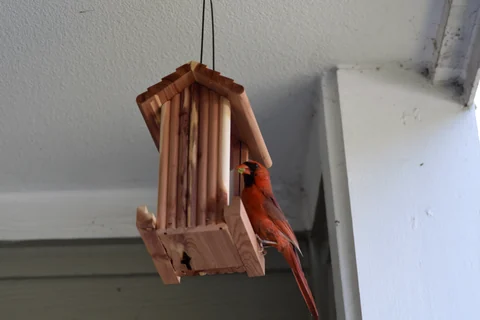
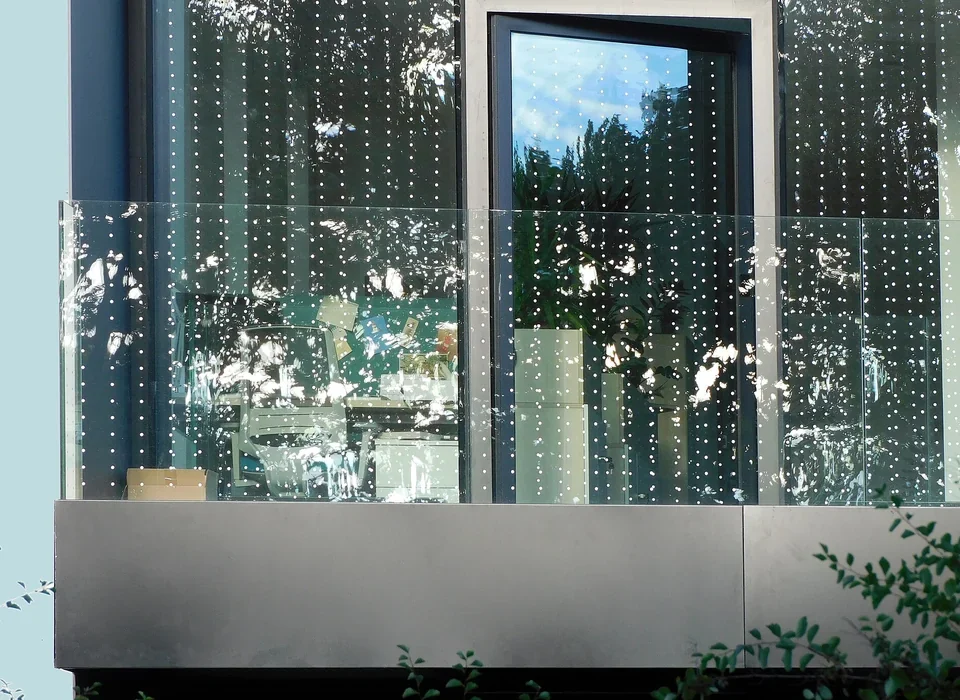
Photo: Panek · Dotted glass bird collision deterrent wwf poland.jpg · CC BY-SA 4.0. Resized from the credited adaptation.
The short answer
Check building rules first, address glass hazards, and choose a mount that suits the structure and product instructions. Start with one small, easy-to-clean feeder. Keep seed and water from falling onto people or neighboring balconies, and pause if the setup becomes unsafe or unmanageable.
Decide whether feeding fits the balcony
A balcony can offer a close view of birds, but it is a shared-building environment as much as an outdoor space. Food may fall onto another home, glass may surround the approach, and wind can move equipment that seems secure on a calm morning. Start with those conditions before choosing a feeder.
Check the building's rules and any applicable local feeding restrictions. Ask the owner or manager about mounting, railings, drainage, and the permitted use of the space when those details are unclear. This is especially important for rented homes and buildings with exterior-maintenance requirements.
Then decide whether you can contain the food and clean the area. A balcony directly above a neighbor's dining table creates a different problem from a sheltered ground-level terrace. If routine spill cannot be prevented and removed, seed feeding may not be suitable there.
You still have options. Locally appropriate container plants, safer glass, and quiet observation can make a balcony useful for birds without an active food station. Audubon's balcony and patio planting guide is a helpful alternative. The aim is a small space that works for birds and the people who share the building, not a feeder installed at any cost.
Survey the space before buying equipment
Sketch the balcony from above. Mark the door, windows, glass railings, drains, furniture, plant containers, and any area that must remain clear. Add the direction of prevailing wind and the places where rain reaches the floor. A rough drawing is enough to reveal competing uses.
Look beyond your own railing. What lies below, beside, and above the proposed station? Food, water, and loose equipment should not fall into neighboring spaces or onto a public route. Do not assume a catch tray will prevent every fragment from escaping in wind.
Consider how you will carry and clean the feeder. Can you remove it while standing safely inside the balcony? Is there a place to contain waste before bringing it indoors? A mount that requires leaning outside the rail is unsuitable even if it produces a good camera angle.
Do not estimate structural capacity from appearance. Large planters, water containers, and heavy supports add load, and building-specific limits require appropriate advice. This guide does not establish that a particular balcony can carry them. Work within the building's instructions and choose a modest arrangement whose servicing does not compromise access or safety.
Treat balcony glass as the first bird question
Balconies often combine sliding doors, side panels, and transparent railings. To a bird, those surfaces can reflect habitat or suggest a clear route through the space. Adding food may increase approaches to glass that previously received little bird traffic.
Inspect the surfaces from outside where you can do so safely. Look at reflections during different parts of the day. A pane that appears transparent in the morning may strongly reflect trees later. Glass corners and panels opposite another window deserve attention because they can create an apparent passage.
Use an appropriate treatment over the whole hazardous exterior surface. The American Bird Conservancy's solutions for homes describe patterns and barriers that make glass visible. One small silhouette or a few widely spaced decorations leave large untreated areas.
Coordinate any treatment of shared or inaccessible exterior glass with the building manager. Do not climb over railings or reach dangerously to apply it. If the hazardous approach cannot be addressed, choose a different way to watch birds. Our window-collision guide explains why moving food alone does not resolve every glass problem.
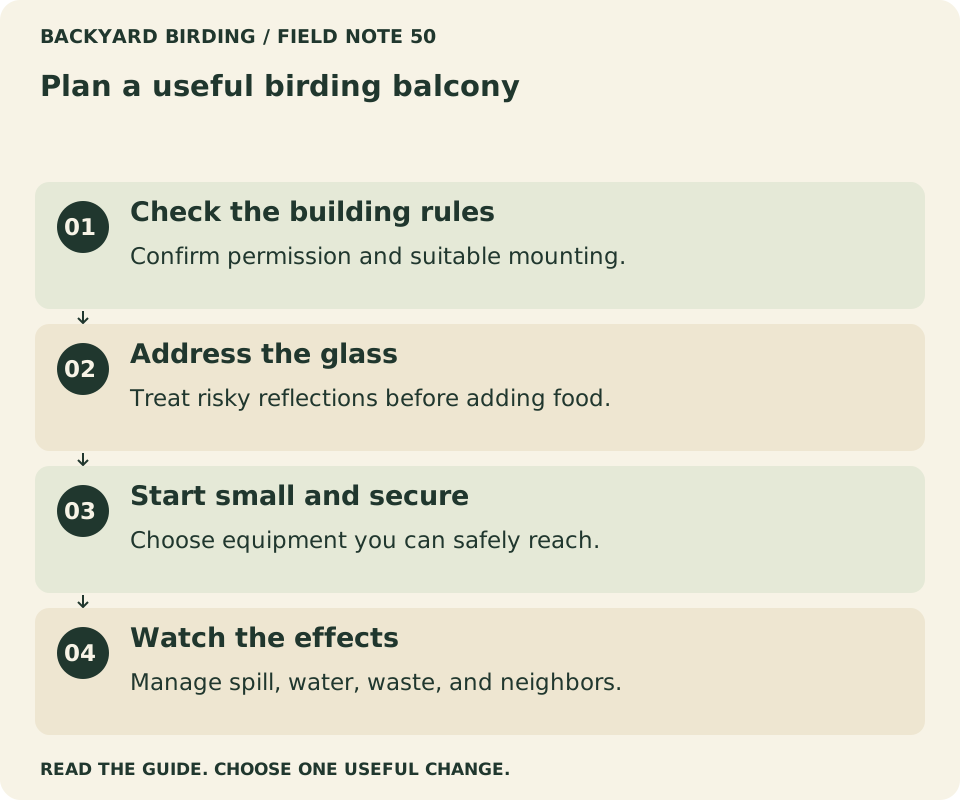
Your visual action map

Read the visual as text
- Check the building rules. Confirm permission and suitable mounting.
- Address the glass. Treat risky reflections before adding food.
- Start small and secure. Choose equipment you can safely reach.
- Watch the effects. Manage spill, water, waste, and neighbors.
Match expectations to the surrounding habitat
The birds likely to visit depend on the neighborhood as well as the balcony. Trees, nearby gardens, open ground, water, and the building's height and exposure all influence what birds encounter. There is no reliable floor number above which bird feeding always fails or below which it always succeeds.
Watch the area before setting out food. Which birds already perch on nearby trees or roofs? Do they pass the balcony or stay well below it? Record actual species when possible. A generic list of “balcony birds” may have little relevance to your city or region.
Begin with a realistic purpose: observe familiar local birds from a fixed place, provide a manageable resource if suitable, or grow plants that support seasonal use. Avoid expecting a small exposed balcony to reproduce the variety of a wooded backyard.
Keep the observation enjoyable even when visits are brief. A bird using a nearby tree may provide a better view than a bird entering a narrow feeder behind furniture. Binoculars can extend the useful viewing area without moving the food closer to glass. Our binocular guide explains fit and close-focus considerations for this kind of watching.
Choose one feeder with a clear purpose
Start with one food type and one feeder you can remove easily. Multiple stations make it harder to identify the source of spill, inspect food condition, and determine whether the arrangement fits the space. Add another only after the first has a manageable routine.
For seed, inspect drainage, access to the base, and whether the feeding area contains waste. A large hopper may store more than your local visitors use promptly. A small tube feeder may limit the landing space for larger birds but still drop hulls. Neither design is automatically clean or suitable for every balcony.
Project FeederWatch's feeder-type guide explains the broad differences. Use it with the actual constraints of your mount and cleaning route. Product photographs rarely show how awkward a full feeder becomes when it must be lifted around a railing.
Check for removable parts before purchase. Can the base come off without tools? Are there recesses that trap food? Can all surfaces be reached by a brush? A simple feeder with a smaller capacity may offer a better experience than a more elaborate design that you hesitate to take apart.
Make mounting secure and serviceable
Use equipment intended for the specific mounting surface and follow its instructions. A railing clamp, wall bracket, and window attachment have different requirements. Do not assume a mount is appropriate simply because it can be tightened onto something.
Check the complete assembly, including the support, fasteners, feeder connection, and any removable tray. Wind applies changing forces, and a wet or full feeder may behave differently from an empty one. Inspect after storms and whenever you refill.
Keep equipment inside the permitted space and away from a position where it could fall onto people or property. Do not improvise loose safety lines that could entangle birds. If secondary retention is required, use the manufacturer's specified arrangement or obtain qualified building advice.
A good mounting location lets you stand securely while removing the feeder. Rehearse the motion empty before adding food. If you need to lean beyond the railing, reach around glass, or balance on furniture, change the plan. The routine will be repeated many times, and a small inconvenience on day one can become a reason to skip essential cleaning later.
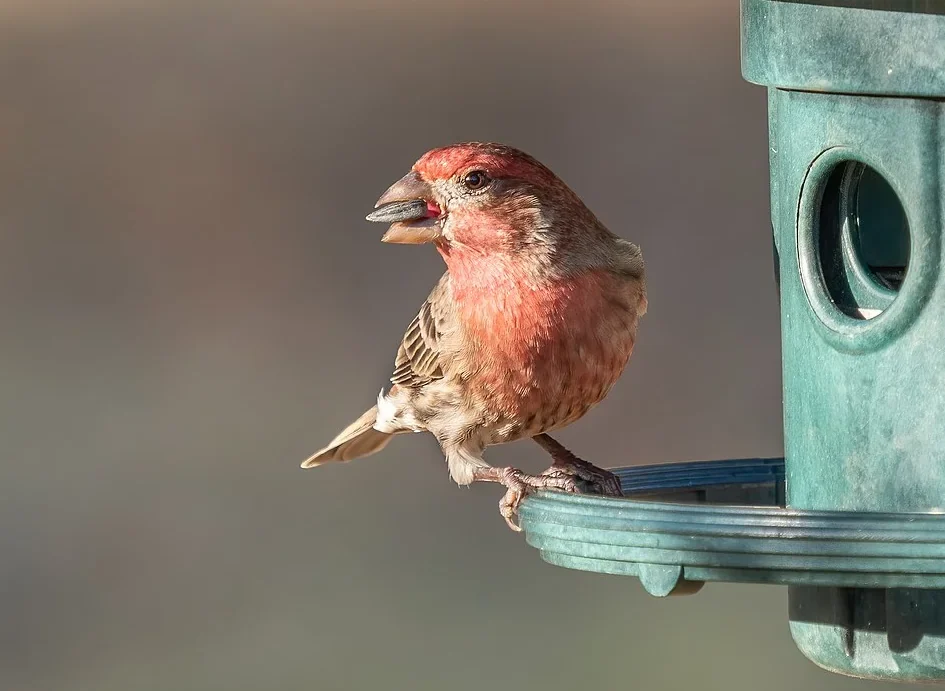
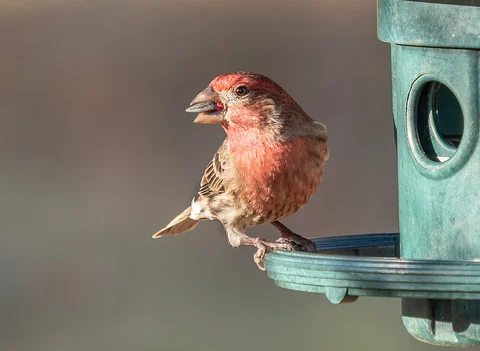
Photo: Rhododendrites · House finch (33687)2.jpg · CC BY-SA 4.0. Resized from the credited adaptation.
Understand the limits of window feeders
A window feeder can provide a close view, but attachment strength and glass risk still need attention. Follow the product instructions for the exact surface, preparation, loading, and inspection. Suction attachments are not a permanent structural fastening, and their condition can change with weather and age.
Positioning food close to a window may reduce the speed of some approaches, but it does not make all nearby glass safe. Birds may arrive from another direction or leave toward an untreated pane. Treat the wider glass environment, not only the small patch behind the feeder.
Remove the feeder for cleaning from a safe position. Do not reach out over a drop to retrieve a loose part. If the window cannot be opened or serviced safely, a window-mounted feeder may be the wrong choice for that location.
Watch the first uses carefully. Can birds land without crowding? Does food collect against the glass? Can you see moisture beneath the tray? A feeder that looks appealing from indoors may be difficult to maintain outside. The close view is a benefit only when the whole arrangement remains secure, clean, and compatible with the building.
Choose food with spill and moisture in mind
Food selection changes the cleanup task. Sunflower hearts leave fewer shells than whole sunflower seed, but they are still food that can become wet, fall below the feeder, and attract other animals. “No mess” is a product description to evaluate, not a promise that no cleaning is needed.
Begin with a small quantity of a suitable food for the birds actually visiting. Avoid a large mixed bag before you know which ingredients remain uneaten. Project FeederWatch's food-type guidance helps explain common options.
Inspect the floor after each observation period. Separate empty hulls from intact discarded food. A feeding bird may open a seed and drop the shell, while another may reject ingredients. Those situations call for different adjustments. Our seed-waste guide explains how to tell them apart.
Keep the stored supply in a dry secure container indoors where appropriate. Do not leave an open bag on the balcony, even under a chair. Rain, humidity, and unwanted visitors can reach it. Buy quantities that match the modest scale of the station rather than using bulk price as the main decision.
Treat catch trays as feeders that need cleaning
A catch tray can reduce the amount of material reaching the floor, but it also collects rain, droppings, and edible food. Birds may stand and feed in it. Give it the same attention as the main feeder rather than treating it as a passive accessory.
Choose a size that fits within the permitted space and remains stable in wind. An oversized tray can create a larger wind-catching surface and may still allow fragments to escape. Check drainage and make sure food cannot lodge in inaccessible seams.
Empty the tray promptly when it contains wet or contaminated material. Do not let the bottom layer remain because fresh seed is still being added above it. Rinse and clean according to the equipment's care instructions, then allow appropriate drying before reuse.
If spill continues to reach a neighbor's space, reduce the serving or stop seed feeding. Adding a second tray beneath the first may create a cumbersome structure without solving the underlying exposure. A balcony arrangement needs to work under ordinary wind and rain, not only during a still morning chosen for a photograph.
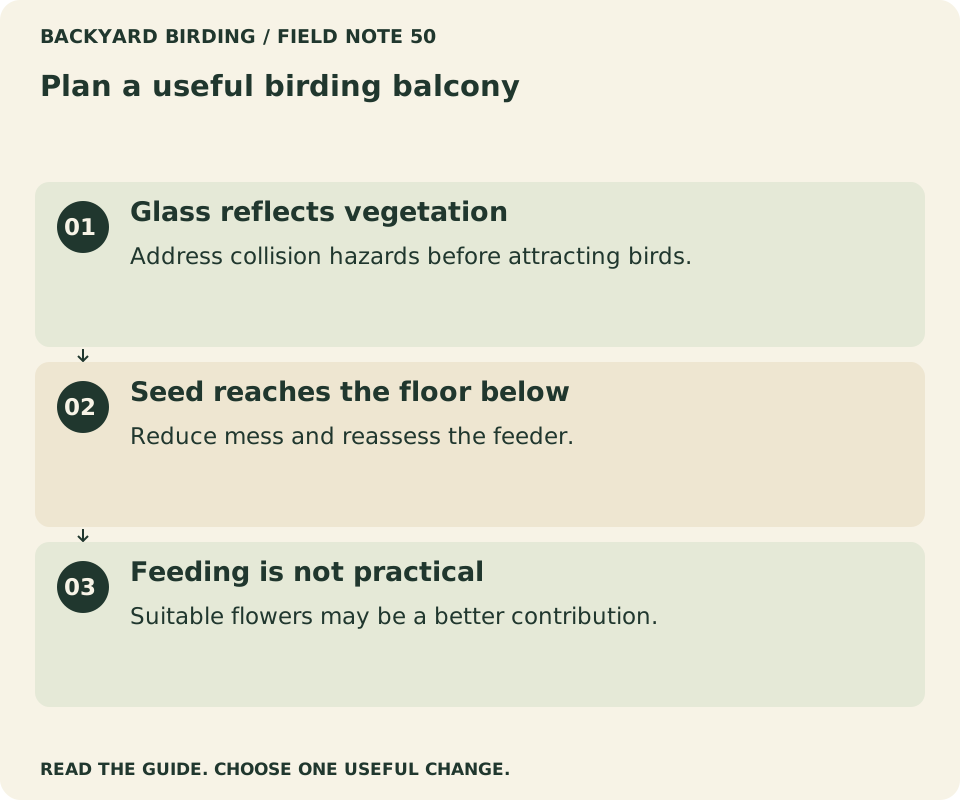
Find your situation

Read the visual as text
- Glass reflects vegetation. Address collision hazards before attracting birds.
- Seed reaches the floor below. Reduce mess and reassess the feeder.
- Feeding is not practical. Suitable flowers may be a better contribution.
Establish a cleanup route that contains waste
Prepare the cleanup method before filling the feeder. Use a dedicated container for waste and a brush or other suitable tool for the balcony surface. Collect material rather than sweeping it over the edge or washing it into a shared drain.
Check corners, planter bases, and the area beneath furniture. Fine seed fragments can move well beyond the feeder, especially in wind. A quick look directly below the tray may miss the places where food accumulates.
Follow building guidance for washing and drainage. Do not use a hose in a way that sends dirty water onto another balcony or creates a slipping hazard. Bring removable feeder parts to a suitable cleaning location while keeping them separate from kitchen food-preparation equipment.
Cornell's feeder-cleaning guide gives the general sanitation principles. If the cleaning route is too awkward to follow regularly, redesign the station or stop feeding. The ability to leave the floor and equipment clean is a core requirement of balcony feeding, not an optional finishing touch.
Consider a hummingbird feeder only with a care plan
Where hummingbirds occur locally, a small nectar feeder may fit a balcony better than loose seed, but it brings its own demands. Nectar can spill, ferment, attract insects, and require frequent replacement in hot weather. A clear floor does not mean a maintenance-free station.
Use the standard white-sugar-and-water mixture described in our nectar recipe guide, without dye or substitutes. Choose a feeder that opens fully for washing and keep the fill modest.
Inspect nearby glass and the mounting as carefully as for seed feeding. A hovering bird still needs a safe approach and exit. Keep the feeder away from doors that people open abruptly into the feeding space, while retaining easy access for cleaning.
Check local seasonality before expecting visits. Our hummingbird timing guide explains why local records are more useful than one national date. If you cannot replace nectar and clean the feeder during heat or travel, remove it temporarily. A suitable flowering container may be a better long-term contribution for your routine.
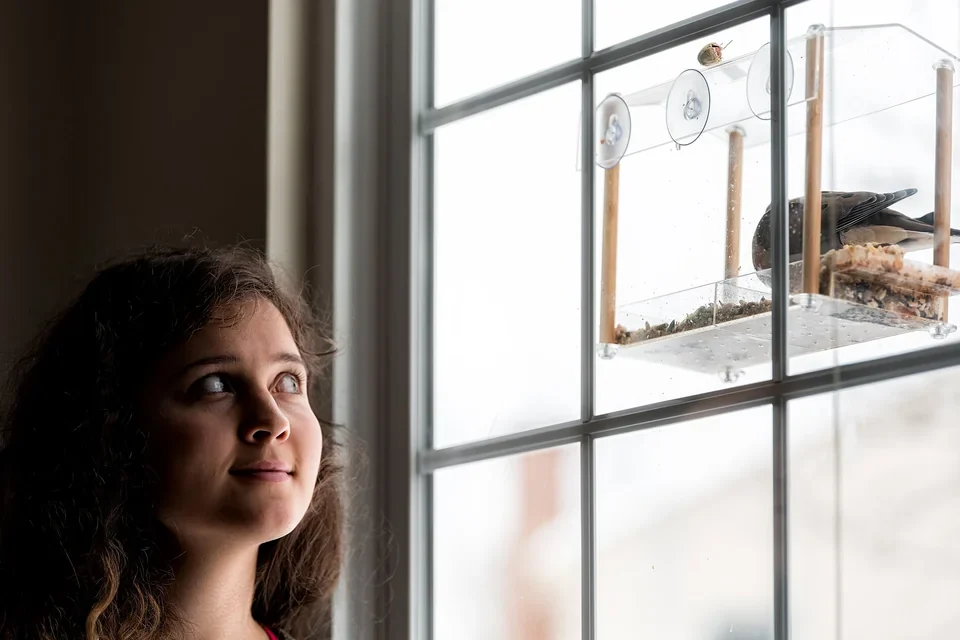
Photo: USFWS Headquarters · Mourning dove bird perched on a bird feeder on a window with young girl watching inside (54182122110).jpg · Public domain. Resized from the credited adaptation.
Use water only where you can manage it safely
A small shallow water dish can be an option, but water adds weight and creates spill and drainage questions. Follow building limits and avoid balancing a basin on a narrow rail. The container must remain stable and accessible for emptying and cleaning.
Check the dish frequently. Wind, sun, bird use, and debris can change its condition quickly. Replacing only the water lost to evaporation leaves accumulated material behind; empty and clean the basin as needed.
Do not place a water source where splashes affect a neighbor, electrical equipment, or a slippery doorway. A fountain adds pump care and can throw water outside a small basin, especially in wind. A plain dish is often easier to assess on a compact balcony.
Our birdbath-depth guide explains shallow access and footing. If a water dish is impractical, leave it out. A balcony does not need to supply every habitat resource. Safer glass and appropriate planting can still contribute while avoiding a water feature you cannot maintain or contain.
Grow locally appropriate plants in workable containers
Container plants can provide flowers, seeds, insects, and places to pause. Choose plants for your region and the balcony's actual light, wind, and moisture conditions. A native species suited to a garden bed may still struggle in a hot shallow pot.
Record the scientific name and mature size before buying. Ask a local native-plant nursery or extension service about container suitability, winter survival, and establishment watering. Building load and placement rules still apply to the container, wet growing medium, and support.
Audubon's container-garden guidance offers a starting point. Our flowers-for-hummingbirds guide shows how to compare flowering periods and site requirements without assuming every red flower fits every region.
Leave enough room to reach the plants and clean around them. A dense arrangement that blocks the door or hides spilled seed creates a different problem. Start with one or two suitable plants and learn how the space behaves through the season. A healthy manageable planting is more useful than a crowded display that repeatedly dries out or must be replaced.
Keep neighbors part of the practical plan
The best time to notice a potential conflict is before food reaches someone else's space. Look at the likely path of hulls, seed, water, and droppings, and be prepared to stop or adjust if the arrangement causes a problem.
If you discuss the station with a neighbor, describe the concrete plan: small servings, contained equipment, regular cleanup, and no waste swept over the edge. Do not promise that no bird will perch elsewhere or that a product will eliminate every trace of feeding.
Treat a complaint as information to inspect, not as proof that the other person dislikes wildlife. A balcony below yours may reveal spill you cannot see from above. Reducing food or choosing plants instead can preserve a good relationship while keeping bird observation enjoyable.
Keep any camera aimed at your own feeding area. Avoid recording neighboring windows or private outdoor spaces, and follow applicable building and privacy rules. A feeder camera's wide field of view can include more than the bird. Check the actual image after mounting rather than assuming the lens points only where the housing appears to face.
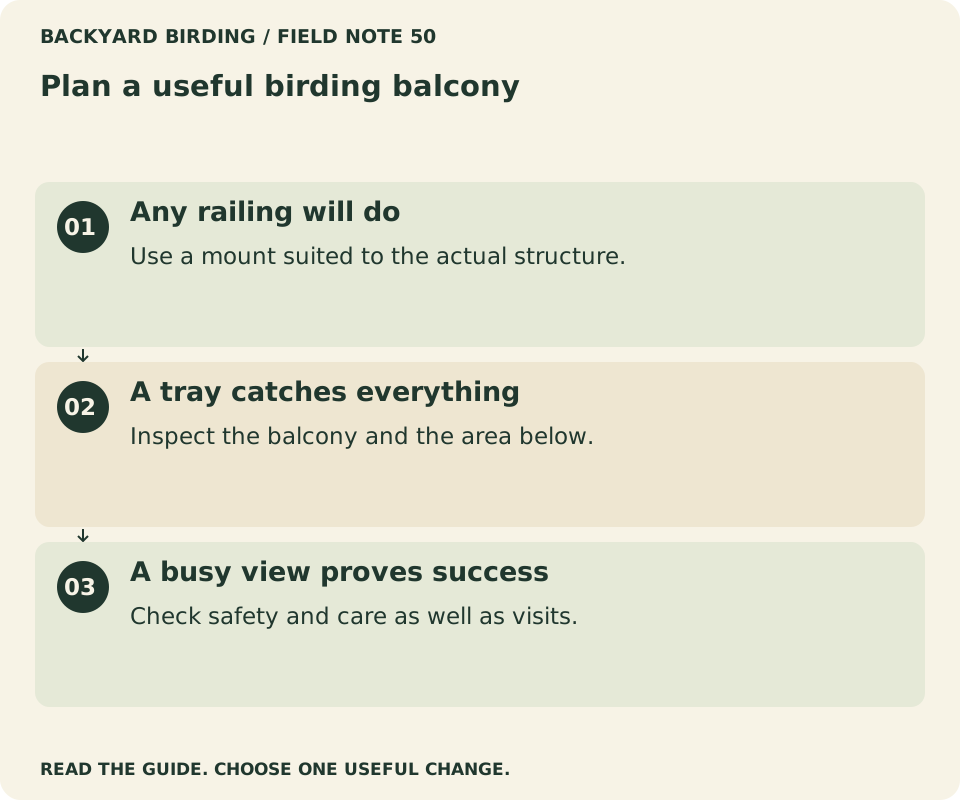
Small mistakes. Better moves.

Read the visual as text
- Any railing will do. Use a mount suited to the actual structure.
- A tray catches everything. Inspect the balcony and the area below.
- A busy view proves success. Check safety and care as well as visits.
Respond to unwanted visitors by removing the attraction
If rodents or other unwanted animals appear, inspect stored food, spill, and the timing of access. Do not assume the feeder itself is the only source. A bag beneath a chair or seed trapped behind a planter can sustain the problem.
Remove food and clean the area while you reassess. An attended small serving is easier to understand than a full feeder left available around the clock. If the conflict cannot be managed within building rules and humane practice, stop feeding.
Avoid poisons, sticky coatings, loose netting, and improvised lines around a balcony feeder. These can injure birds or create hazards beyond your own space. Do not use an active bird nest as a reason for casual removal; seek appropriate local advice when nesting conflicts arise.
A bird you did not hope to attract is not automatically a problem requiring deterrence. Learn its identity and assess the actual issue: crowding, waste, noise, or access. The sparrow comparison guide is useful when several small brown birds arrive together and a quick label would be unreliable.
Run a two-week trial with clear stopping points
Treat the first installation as a trial. Start with one feeder and a small serving, check it at predictable times, and record bird use and cleanup. Include a few windy or wet days if the weather provides them; a calm-day success does not establish that the arrangement works throughout the season.
Decide in advance what would make you stop: food falling into another property, a loose mount, repeated wet leftovers, a glass hazard you cannot address, or cleaning that cannot be completed safely. These are practical limits, not obstacles to overcome by adding more equipment.
| Observation | What it suggests | Next step |
|---|---|---|
| Food is used and contained | The scale may be workable | Keep the serving modest and continue checks |
| Whole seed accumulates | Too much food or poor fit | Reduce the amount and review ingredients |
| Wind scatters waste | The location is too exposed | Reposition safely or stop seed feeding |
| Birds approach untreated glass | A flight-route hazard remains | Address the glass before continuing |
| Servicing requires leaning out | The mount is unsuitable | Remove the setup safely and redesign |
At the end, keep only the parts that work. A successful trial may lead to a smaller station or a plant-only balcony. Either outcome is useful if it reflects the actual conditions rather than the original shopping plan.
Solve a quiet-feeder problem without escalating it
A new feeder may take time to be discovered, but waiting does not justify leaving old food outdoors. Continue small fresh servings only while the trial remains clean and manageable. Watch the surrounding trees and rooftops to see whether birds are present at all.
Check visibility and disturbance. A feeder behind a solid panel may be hard to notice, while one beside a frequently opened door may receive few calm approaches. Move only within safe mounting and glass constraints. Do not extend the feeder beyond the railing to make it more conspicuous.
Change one thing at a time and keep notes. If you alter food, location, and feeder design simultaneously, you will not know which mattered. Even a well-planned change may have no effect when nearby habitat or seasonal bird movement is the main factor.
Our quiet-feeder guide provides a broader sequence. If the balcony remains unused, expand your observation area rather than the food supply. A chair with a view of a street tree can become a rewarding birding place without any feeder directly in front of it.
Plan for storms, travel, and seasonal changes
Follow the equipment and building instructions for removing or securing items before severe weather. Do not wait until strong wind makes reaching the feeder difficult. Empty food, collect loose parts, and keep the route to the door clear.
Before travel, either arrange a caretaker who can carry out the full routine or remove food and clean the equipment. A large fill is not a substitute for checking moisture, attachment, and spill. Nectar feeders especially require a reliable replacement schedule.
When seasons change, reassess sunlight, wind, and bird use. A sheltered summer position may become exposed after nearby leaves fall. A planter may obstruct cleaning after vigorous growth. The original sketch is worth revisiting when the space behaves differently.
Keep the final arrangement easy to reverse. A modest removable setup allows you to respond to repairs, new building rules, a neighbor's concern, or a change in your own schedule. Balcony birding should fit the home you live in. Its value comes from attentive observation and responsible care, not from keeping a feeder active regardless of circumstances.
Compare two realistic balcony plans
Consider a sheltered balcony with an opaque lower railing, a safely reachable mounting point, and a floor that can be cleaned without sending waste elsewhere. If building rules allow feeding and nearby glass can be treated appropriately, a small seed feeder with a removable tray may be worth a limited trial. The plan still needs modest portions and inspection after wind or rain.
Now consider a narrow glass-railed balcony directly above another resident's patio, with strong wind and no safe exterior access for a glass treatment. The same feeder is a poor match. A larger tray or longer arm does not resolve the combination of spill, glass, and servicing problems. A plant-based observation space is the more workable direction if approved containers can be supported safely.
These examples illustrate why a product recommendation cannot come before the site assessment. The attractive photograph on the box may resemble neither balcony. Start with the actual constraints, then choose equipment only if it fits them.
For the first balcony, the trial should include a clear stop condition: any repeated spill beyond the space or attachment problem ends feeding until corrected. For the second, success might be a suitable container plant, a comfortable view of a nearby tree, and fewer unnecessary lights at night. Both plans can support enjoyable birdwatching without forcing the same equipment into different settings.
If your balcony falls between the examples, list the unresolved point rather than guessing. Perhaps the mount is suitable but drainage rules are unclear, or the food can be contained but the glass treatment needs building approval. Resolve that specific issue before putting out food. The rest of the observation plan can proceed while the feeding decision remains open.
Make a compact maintenance kit
Keep the few items needed for care together: a dedicated scoop, a sealable waste container, a suitable brush, and the instructions for disassembly and mounting. Add a second removable feeding dish only if it makes washing and drying easier. The kit should simplify the routine, not encourage a larger station.
Choose a place to set the feeder while it is being serviced. A stable tray or container can catch loose food before it reaches the indoor floor. Keep bird-feeding tools separate from utensils used for human food, and wash your hands after handling equipment and waste.
Inspect the mount while the feeder is empty. That is often the easiest time to notice a loose clamp, damaged attachment, or worn part. Replace components only with suitable compatible items; do not improvise a repair simply to avoid taking the feeder out of use.
Before putting everything back, look along the entire route from storage to mounting point. Is a chair blocking access? Has a plant grown into the space? Is the floor wet? Small changes can make a previously manageable task awkward. Restore safe access before refilling.
Finally, keep the cleanup tools available when another household member takes over. A plan that depends on one person remembering hidden supplies is fragile. Clear equipment, a modest serving, and an obvious waste route make responsible care easier to repeat without turning the balcony into a workshop.
Balcony bird-feeding questions
Can birds find a feeder on a high floor?
Some birds use elevated urban spaces, but visits depend on surrounding habitat, exposure, species, and the particular building. No floor number guarantees success. Observe existing flight and perching patterns before investing in equipment.
Is sunflower heart feeding completely mess-free?
No. Removing shells reduces one kind of waste, but edible fragments, droppings, and wet food still require cleanup. Use small servings and inspect where material travels in wind.
Can I hang a feeder outside the railing?
Do not assume that is permitted or safe. Follow building rules and the mount's instructions, and avoid any arrangement that can fall or requires unsafe servicing. A position wholly within the allowed space is usually easier to inspect and maintain.
What if my building does not allow feeding?
Respect the rule and choose other ways to enjoy birds. Appropriate container plants, approved glass treatments, and watching nearby habitat can make the balcony rewarding without supplied food. A local park or community garden may offer additional opportunities.
What should I buy first?
Buy nothing until you have checked permission, glass, mounting, spill, and cleanup. If those conditions support feeding, start with one small cleanable feeder. If they do not, a suitable plant or a comfortable viewing spot may be the better first step.
Watch it. Then try it.
Review the steps and common mistakes in two short, silent animations. Each has a complete text transcript below.
Your four-step action map
Read the complete video transcript
Plan a useful birding balcony.
- Check the building rules. Confirm permission and suitable mounting.
- Address the glass. Treat risky reflections before adding food.
- Start small and secure. Choose equipment you can safely reach.
- Watch the effects. Manage spill, water, waste, and neighbors.
Try the steps, then note any problem that still needs attention.
Three mistakes to avoid
Read the complete video transcript
Plan a useful birding balcony.
- Any railing will do. Use a mount suited to the actual structure.
- A tray catches everything. Inspect the balcony and the area below.
- A busy view proves success. Check safety and care as well as visits.
Try the steps, then note any problem that still needs attention.
Both animations use this real photograph by Panek. Photo source · CC BY-SA 4.0. The photo is adapted into original educational animations, not recordings of a field test.
At a glance
| First check | Useful response |
|---|---|
| Check the building rules | Confirm permission and suitable mounting. |
| Address the glass | Treat risky reflections before adding food. |
| Start small and secure | Choose equipment you can safely reach. |
| Watch the effects | Manage spill, water, waste, and neighbors. |
Sources & evidence
- balcony and patio planting guide
- American Bird Conservancy's solutions for homes
- feeder-type guide
- food-type guidance
- feeder-cleaning guide
Our standard: real evidence before ratings. Corrections follow our editorial process.
Our verdict & your next actions
Choose the row that describes your setup, then follow the suggested check or adjustment.
| Your situation | Our verdict | Your next action |
|---|---|---|
| Glass reflects vegetation | Address collision hazards before attracting birds. | Make windows safer |
| Seed reaches the floor below | Reduce mess and reassess the feeder. | Troubleshoot scattered seed |
| Feeding is not practical | Suitable flowers may be a better contribution. | Plan hummingbird plants |
Your pocket field checklist
Tick off the steps as you go.
0 of 4 steps completed
Keep building your knowledge in bird feeders, or search the full backyard library.