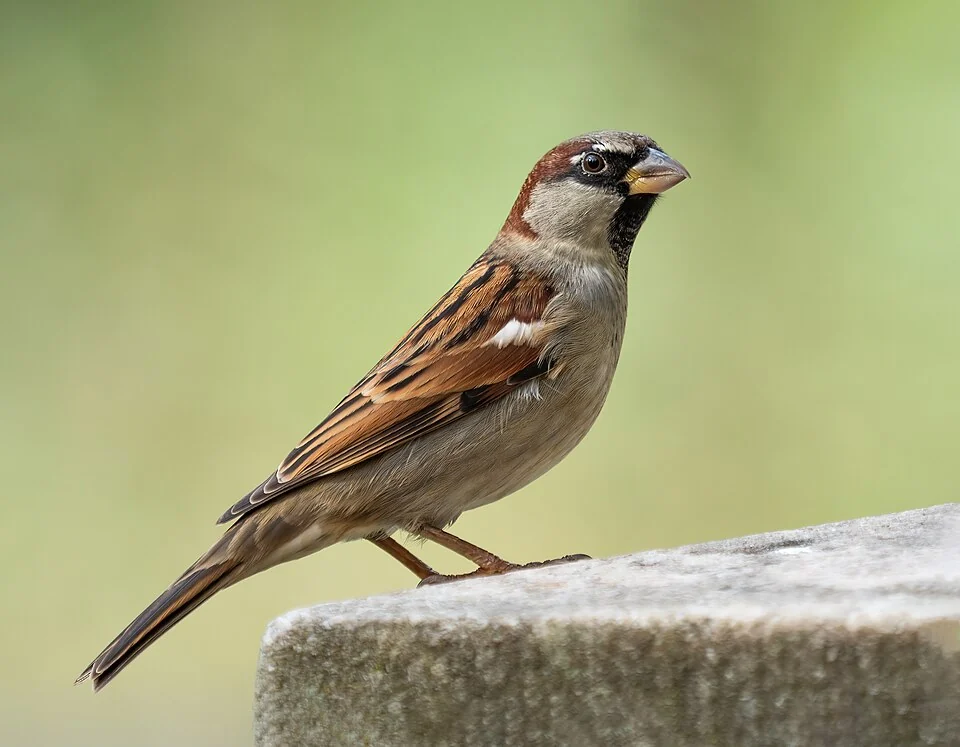
Photo: Rhododendrites · House sparrow male in Prospect Park (53532).jpg · CC BY-SA 4.0. Resized for this guide.
The short answer
Use several marks together. Adult male House Sparrows have a dark bib and gray crown; females are plainer, with a pale eyebrow and stout bill. Native sparrows vary widely, so compare the head, breast, tail, location, and season before naming the bird.
A brown bird deserves more than a quick label
“Sparrow” is often the first name given to a small brown bird at a feeder. Sometimes it is correct. Sometimes the visitor is a female finch, a young bird of another family, or one of several sparrows with very different patterns. Even when the bird is a sparrow, calling it a House Sparrow without checking can hide the most interesting part of the observation.
The House Sparrow is an introduced species in North America. Many other birds called sparrows are native members of a different family. That distinction matters for understanding the birds around a home, but it does not make identification a contest between good and bad birds. Start by learning what is present. Management decisions, especially around nests, require more certainty than a glance at brown plumage.
This guide compares House Sparrows with several familiar native sparrows found around North American yards. It is a starting framework, not a list of every possible species. Your region, season, and habitat determine which additional birds belong in the comparison.
The method is simple: describe the shape, face, underparts, wings, and tail; check local plausibility; then decide how specific the evidence allows you to be. A record of “unidentified sparrow” is more useful than an incorrect name attached to a confident story.
Make the first ten seconds count
When a bird appears, resist opening an identification app immediately. The bird may leave before you have looked at the marks the app needs. Use the first few seconds to collect a small set of observations: bill shape, breast pattern, eyebrow or head stripes, and tail proportions.
Start with shape because it remains visible when color is poor. Is the bird compact and thick-necked or relatively slim and long-tailed? Is the bill stout and triangular, or finer than expected? Does it stand upright on a feeder rim or stay low while moving through vegetation? These impressions help organize the next comparison, even when they do not identify the species alone.
Then look for the strongest contrast. A clear breast versus a heavily streaked breast often narrows the possibilities faster than deciding whether a back is reddish brown or grayish brown. A bright white throat or broad pale eyebrow may be more useful than several small wing feathers.
Keep the order flexible. If the bird is facing away, use the view you have instead of waiting for a perfect pose. Note the head pattern and tail, then seek a side view when it moves. Do not chase it out of cover merely to complete the checklist. The missing mark becomes a question for the next visit.
Recognize an adult male House Sparrow
An adult male House Sparrow commonly combines a gray crown, chestnut along the sides of the head, pale cheeks, and a black throat or bib. Its sturdy bill and compact body help establish the overall shape. The back is patterned, while the underparts are much less streaked than those of a typical Song Sparrow.
The black bib can look more or less conspicuous with season, feather position, and viewing angle. Do not require every bird to match the most strongly marked breeding male in a field-guide photograph. Cornell's House Sparrow identification account includes multiple appearances rather than one idealized portrait.
A dark throat by itself is insufficient. Shadows beneath the bill can imitate a bib, and other species can carry dark face or throat markings. Seek the complete combination of crown, cheek, chestnut, bill, and underparts.
If several birds feed together, identify one individual carefully before applying the label to the group. Mixed gatherings occur, and the obvious adult male can distract from a native sparrow standing behind it. Move your attention from bird to bird, using the same short sequence. A familiar species can be present without accounting for every brown bird on the tray.
Your visual action map

Read the visual as text
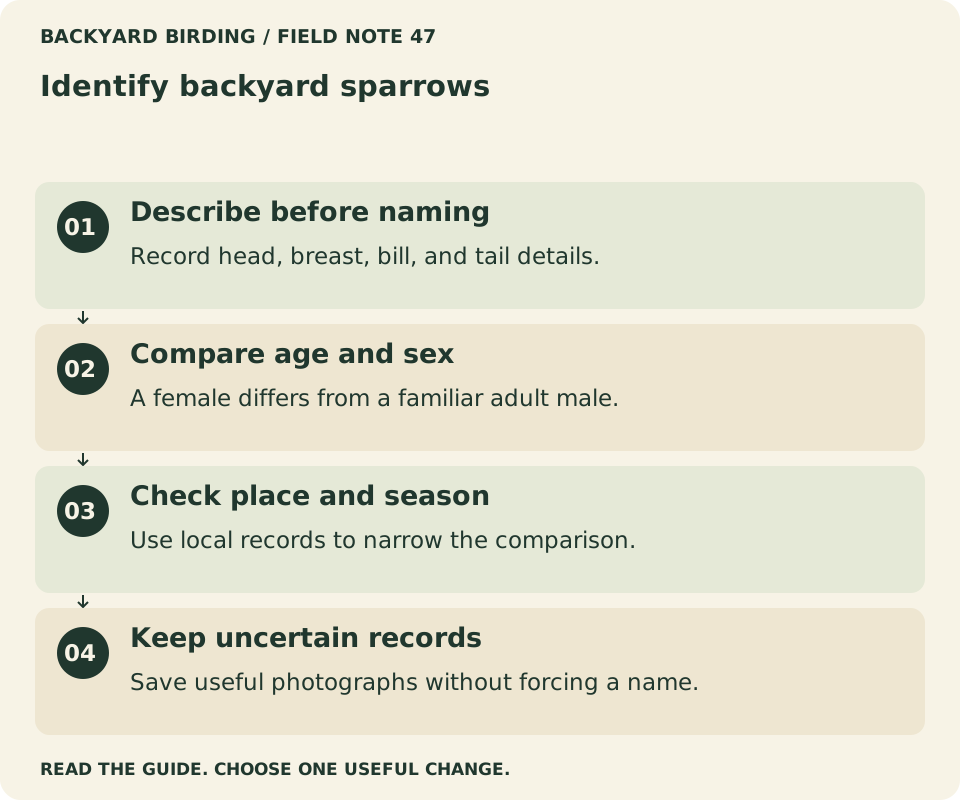
- Describe before naming. Record head, breast, bill, and tail details.
- Compare age and sex. A female differs from a familiar adult male.
- Check place and season. Use local records to narrow the comparison.
- Keep uncertain records. Save useful photographs without forcing a name.
Give female and young House Sparrows a fair comparison
Female and young House Sparrows lack the adult male's obvious black bib. Their plainer brown-and-buff appearance is exactly why they are often confused with native sparrows. Look for the broad pale eyebrow, a relatively plain face below it, an unstreaked or weakly marked underside, and the stout bill and compact proportions.
Do not identify a female only because she stands beside a male. Association is useful context, but birds of different species share feeders. Check her own marks. A clear side view of the face and breast is especially valuable.
Young birds can add uncertainty because feather edges and proportions change as they develop. Instead of forcing a precise age, describe what is visible: pale eyebrow, plain breast, buff wingbar, or short tail. A good description remains useful even if the age label changes after comparison.
Photograph the whole bird if possible. A very tight crop of the head removes the body proportions and underpart pattern that may settle the question. Keep one uncropped frame and one closer detail. If the only photograph shows a head behind a feeder wall, leave room for uncertainty rather than relying on an app's confident suggestion.
Compare a Song Sparrow by pattern, not one spot
Song Sparrows are variable across their range, but a streaked breast and a strongly patterned face are common starting points. Many show streaks converging into a central breast spot. That spot is helpful when present and visible, yet it should not become the only identification rule.
Look at the full underside and the face together. Dark streaks extend along the breast and sides, while the head has contrasting stripes around the cheek and throat. The tail often looks relatively long. Cornell's Song Sparrow account illustrates regional variation and the way posture changes the bird's appearance.
Compare it directly with a female House Sparrow: one often presents a more patterned face and streaked breast, while the other is plainer below. If the breast is hidden by a railing, do not pretend the decisive comparison has been completed. Wait for a better angle or keep the identification provisional.
Behavior can guide where to look. A sparrow moving along a brushy edge may repeatedly emerge into the same small opening. Watch that opening from a fixed point rather than following the bird through vegetation. The extra patience often produces a clearer view of the face and chest than a rapid series of photographs taken while both observer and bird are moving.
Separate Chipping and American Tree Sparrows
A rusty cap is memorable, but it belongs to more than one sparrow. A breeding-plumaged Chipping Sparrow typically has a crisp dark eye line, pale eyebrow, rusty crown, and relatively plain grayish underparts. Outside breeding plumage, the head pattern can be softer and the crown less cleanly colored.
American Tree Sparrows also show a rusty cap, but useful clues include a rusty eye line, a small central breast spot, and a bill with a darker upper part and yellowish lower part. Compare Cornell's Chipping Sparrow and American Tree Sparrow photographs in the appropriate season.
Local timing helps. In many areas these birds are most familiar at different times of year, but broad seasonal expectations are not a substitute for marks. Check your region rather than applying a calendar from another part of the continent.
Use a three-question comparison: what color is the line through the eye, is the breast plain or marked, and can you see both parts of the bill? A single blurry view may answer only one. Record that limitation. The aim is not to memorize a slogan about rusty caps but to gather a combination that survives a change in light or posture.
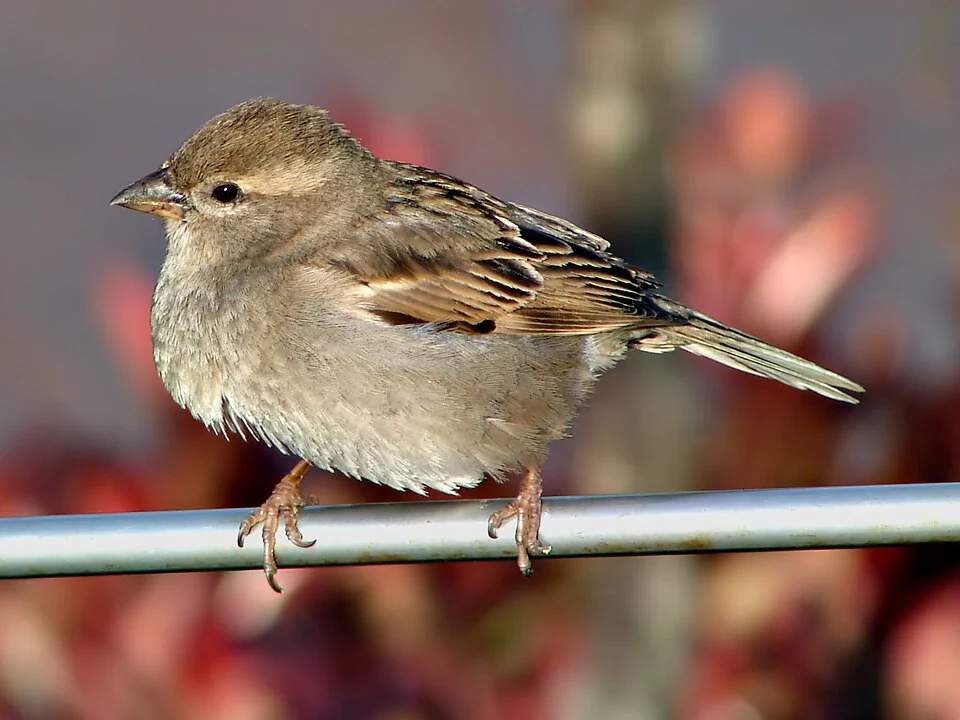
Photo: Nevit Dilmen ( talk ) · Passer domesticus female 02831-nevit.jpg · CC BY-SA 3.0. Resized for this guide.
Learn White-throated and White-crowned Sparrows together
White-throated Sparrows often show a distinct pale throat patch and yellow near the front of the eye, together with a striped head. Some adults have strong black-and-white head stripes; others have a browner, tan-striped appearance. Both patterns belong in your mental picture of the species.
White-crowned Sparrows have a different head pattern and usually lack the sharply defined white throat patch of a White-throated Sparrow. Adults show bold head stripes, while immature birds can have brown-and-tan stripes. Bill color also varies among populations, so avoid relying on a single illustration as the universal model.
Read the photographs in Cornell's White-throated Sparrow account and White-crowned Sparrow account side by side. Pay particular attention to immature and less strongly contrasted birds. Those are the views most likely to slow a backyard identification.
When the bird is low in cover, look for the throat when it raises its head. A backlit crown may show stripes clearly while hiding the yellow facial area. Absence of a visible mark in poor light is weaker evidence than a clear view showing that the mark is not there. That distinction is useful across bird identification, not just for these two sparrows.
Use a compact comparison table correctly
The table below is a field prompt, not a complete identification key. Use it to decide which view you need next. Read the qualifiers, especially around age and season, before treating a feature as definitive.
| Candidate | Underparts | Head clues | Important caution |
|---|---|---|---|
| Male House Sparrow | Mostly plain, with dark throat bib | Gray crown and chestnut sides | Bib prominence changes |
| Female House Sparrow | Mostly plain | Broad pale eyebrow, plainer face | Do not identify by association alone |
| Song Sparrow | Usually strongly streaked | Contrasting face stripes | Regional variation is substantial |
| Chipping Sparrow | Usually plain grayish breast | Breeding adult has rusty cap and dark eye line | Nonbreeding birds look less crisp |
| American Tree Sparrow | Usually plain with central spot | Rusty cap and eye line | Check bill pattern and local season |
| White-throated Sparrow | Grayish, with defined pale throat | Yellow near eye and striped head | Tan-striped adults are normal |
| White-crowned Sparrow | Relatively plain grayish | Bold adult or brown immature crown stripes | Bill and plumage vary |
If a bird does not fit, expand the candidate list instead of altering the observation to fit the table. Fox, Lincoln's, Swamp, Savannah, and other sparrows may be relevant. A field guide organized for your region is essential once you move beyond the common yard comparisons.
Check whether the bird is a finch instead
Female House Finches and Purple Finches can enter a sparrow comparison because they are brown and streaked. Bill shape, head pattern, and overall structure help separate the groups, but a brief view can still be difficult. Do not use “streaked brown bird” as a synonym for sparrow.
A finch's bill may look especially deep at the base, while its facial pattern and tail contribute other clues. Compare equivalent views rather than putting a side-on sparrow photograph beside a front-facing finch. The differences can disappear when one bird is fluffed and the other is stretched.
Our House Finch versus Purple Finch guide covers those species in detail. Use it when the sparrow candidates feel increasingly strained. Changing the candidate group is a sensible identification step, not a failure.
An app can suggest alternatives you overlooked. Treat those suggestions as a shortlist and return to the original image. Which visible feature supports the proposed finch? Which feature contradicts it? If the image lacks the bill and underside, the correct result may still be “small brown bird, unidentified.” Preserving that uncertainty prevents a weak image from becoming a false record that influences future expectations.
Find your situation

Read the visual as text
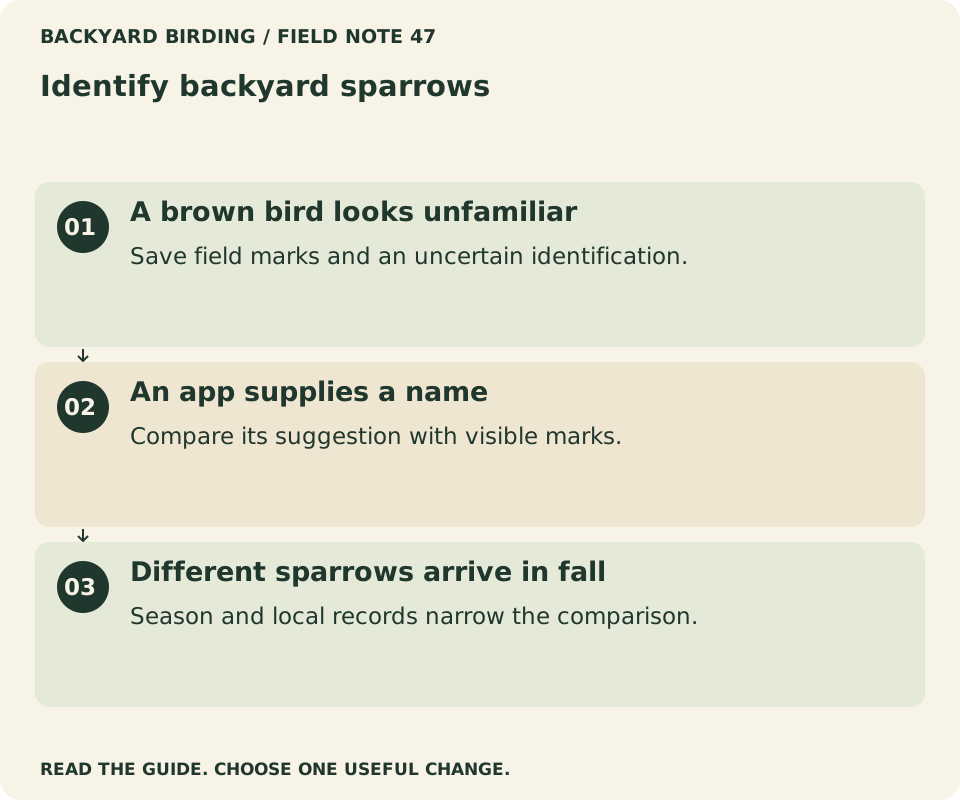
- A brown bird looks unfamiliar. Save field marks and an uncertain identification.
- An app supplies a name. Compare its suggestion with visible marks.
- Different sparrows arrive in fall. Season and local records narrow the comparison.
Let place and season narrow the field
Before comparing twenty species, check a regional list for the month. A bird common in winter in one state may be an unusual summer visitor there, while remaining ordinary elsewhere. Local habitat also matters: a brushy wet edge and a busy restaurant patio attract different combinations of birds.
Use recent sightings and seasonal summaries as context, not proof. Someone else's report in your county does not establish that your bird is the same species. Conversely, an unusual local record is possible, but it needs stronger documentation than a routine identification.
Keep the scale clear. “Seen in the state” is a broad statement, especially in a large state with mountains, desert, coast, and agricultural land. Nearby observations from similar habitat are often more relevant to your starting list. A county boundary itself has no meaning to the bird, so include adjacent suitable areas when comparing patterns.
Our fall migration guide explains how changing seasonal traffic can introduce unfamiliar sparrows. When a new bird arrives, preserve the date and photograph before trying to decide whether it is a resident, migrant, or winter visitor. One observation establishes presence at that moment; a series of observations is needed to describe the broader pattern.
Notice behavior without turning it into a shortcut
Some sparrows spend much of their time close to cover, while House Sparrows are conspicuous around buildings and people. These tendencies can help direct attention, but behavior overlaps. Native sparrows visit feeders, and House Sparrows can feed on natural seed away from a building.
Describe a behavior precisely. “Scratched backward through dry leaves” is more useful than “acted like a native bird.” “Entered a cavity in the eave” is more useful than “was nesting,” unless you saw enough to establish nesting activity. Specific language keeps an interpretation from becoming the evidence for itself.
Watch the bird after it leaves the feeder. A retreat into a shrub may offer a better side view, and a brief pause on a low branch can reveal a hidden breast pattern. The feeder is a convenient meeting point, not the only place worth looking.
Do not use aggression as an identification feature. A short chase says little about species identity, and competition at a concentrated food source can involve many birds. If crowding makes observation difficult, reduce the amount of food rather than adding more simply to keep every bird in view. Clean, manageable feeding conditions are more important than creating a photographic gathering.
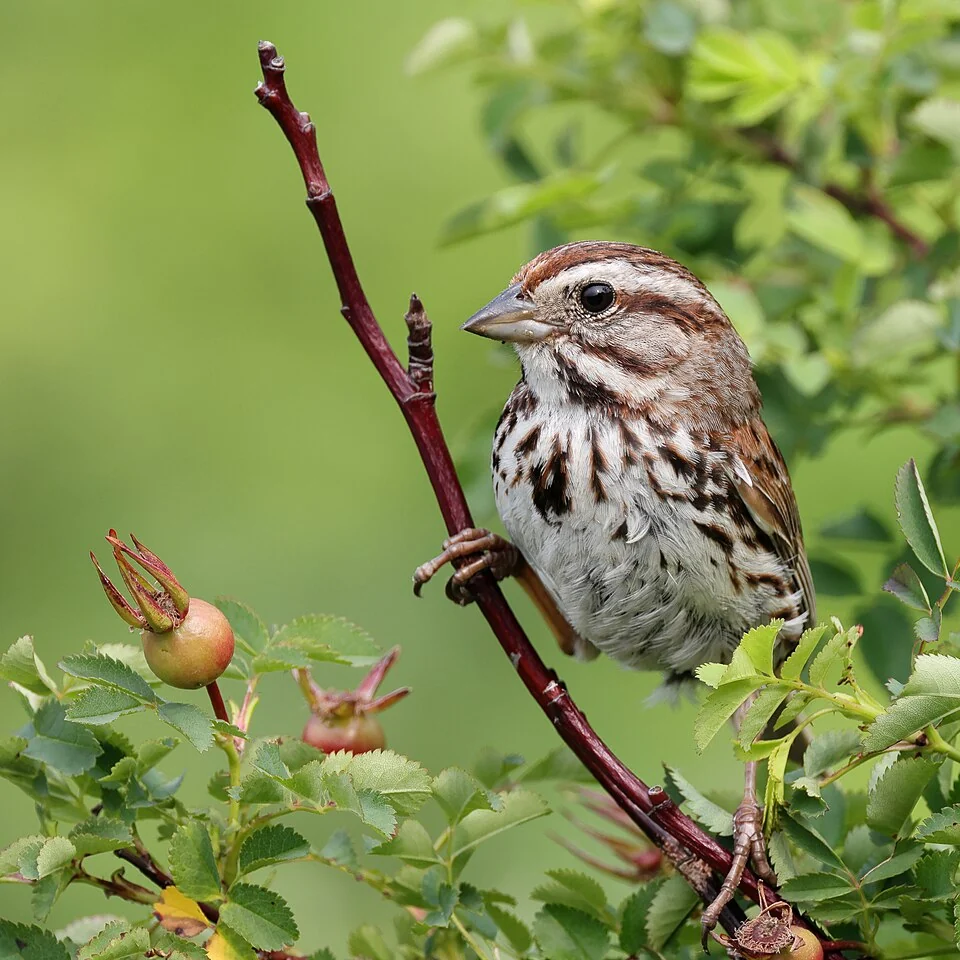
Photo: Cephas · Melospiza melodia JRVdH 03.jpg · CC BY-SA 4.0. Resized for this guide.
Take photographs that preserve the evidence
A useful identification photograph does not need to be beautiful. Aim for a sharp eye and bill, a readable face pattern, and at least one view of the underparts. A second photograph of the back or tail can answer a question the first image leaves open.
Avoid excessive digital enlargement. A larger blur can look persuasive while adding no information. Keep the original file and make any crop a separate copy. If you share the image for identification, include the location at an appropriate regional scale, date, and the behavior you observed.
Be cautious with strong automatic color enhancement. It can exaggerate warm tones or make a gray crown appear brown. Describe the lighting conditions and compare features that depend less on exact color, such as the position of an eye line or the distribution of breast streaks.
For feeder cameras, save a short sequence rather than only the app's chosen portrait. Adjacent frames may reveal the tail or face before a bird turns away. Our AI bird-identification guide explains why an automatic label should be checked against visible marks. A confident percentage is not a substitute for a view that actually contains the distinguishing features.
Use sound as a second line of evidence
Sparrow songs and calls can be distinctive, but learning them takes repeated listening in context. Begin by connecting a visible bird with its sound. Do not assume the loudest call in a flock comes from the bird closest to you.
Listen to authoritative recordings away from active birds, preferably through headphones. Compare the rhythm, pitch changes, and repeated phrases rather than trying to memorize a single written imitation. Calls can be harder than full songs, and background noise can obscure the details needed for a reliable identification.
If you record a sound, note where the bird was and whether you saw it vocalize. A recording from a mixed flock without visual confirmation may support several possibilities. Keep that limitation attached when asking for help or reviewing an app result.
Avoid playing calls to bring birds out of cover for a better view. Quiet waiting usually serves a backyard identification well, and repeated playback can disturb normal behavior. If a bird remains hidden, you can still make a valuable note about an unidentified call at a particular time and place. The next observation may connect it with a visible species without any need to provoke a response.
Understand the House Sparrow distinction without misusing it
House Sparrows were introduced to North America and can compete with native cavity-nesting birds. Cornell's House Sparrow overview provides the background. That ecological context is a reason to identify carefully, especially near nest boxes; it is not a reason to assume every brown bird is an unwanted intruder.
If a bird enters a nest box, observe its marks from a distance before drawing conclusions. Native species can look plain or unfamiliar, particularly in poor light. Do not disturb eggs, young, or nesting material based on a quick app label.
For nest-box conflicts, consult NestWatch's guidance on non-native birds and applicable local rules. Management choices depend on confirmed identity, occupancy, and the specific situation. This identification guide does not provide trapping or nest-removal instructions.
A good first step is often to review the setting and the box program rather than act immediately. Keep reliable records, learn the native cavity nesters in your area, and ask an experienced local nest-box monitor or wildlife professional when uncertain. Accuracy has practical consequences here. An unresolved identification should slow intervention, not encourage a more forceful guess.
Small mistakes. Better moves.

Read the visual as text
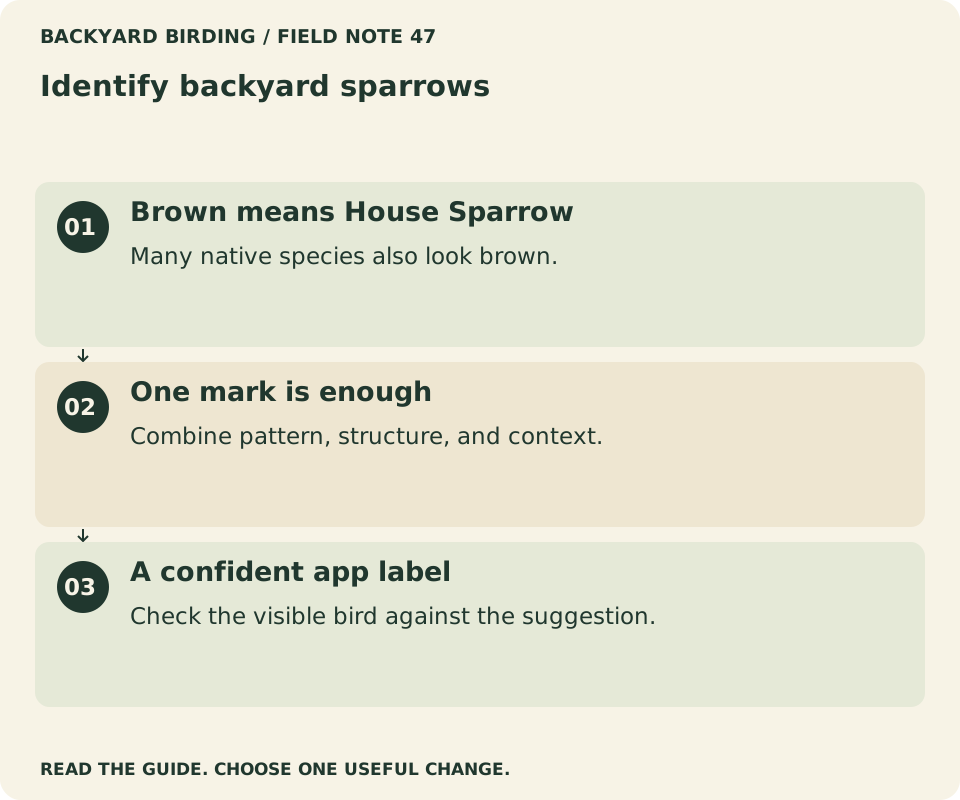
- Brown means House Sparrow. Many native species also look brown.
- One mark is enough. Combine pattern, structure, and context.
- A confident app label. Check the visible bird against the suggestion.
Make feeding areas useful for observation
A clean feeding area with a clear view is easier to study than a crowded tray surrounded by old food. Use modest servings, inspect the ground, and keep the supply dry. Different birds will still come and go, but you will be better able to see the marks that distinguish them.
Do not add large amounts of millet or mixed seed solely to concentrate sparrows for photographs. Food accumulation can attract other animals and make sanitation harder. A removable platform or catch tray should be emptied and cleaned, not treated as a permanent seed bed.
Vegetation is valuable even when it reduces the length of a clear view. A nearby shrub gives birds a place to move between visits, and natural seed-bearing plants contribute resources beyond supplied food. Our native-plant planning guide helps choose plants suited to the actual site.
Check glass along the flight route. A bird coming from cover to a feeder may encounter reflections that look like more habitat. Use the window-collision guide to address the full pane. Better identification should come from patient observation and safer conditions, not from bringing birds ever closer to untreated glass.
Work through two common uncertain sightings
A plain brown bird beside a male House Sparrow
Start with the individual, not its companion. You can see a pale eyebrow and a stout bill, but the feeder rim hides the breast. Female House Sparrow is a reasonable candidate. Wait for the bird to step onto the tray or turn. If the underside is plain and the rest of the pattern fits, confidence increases. If strong streaks appear, reopen the comparison.
Write the record according to the view you obtained. “Possible female House Sparrow; breast obscured” is an honest result if the bird leaves. The neighboring male does not fill in the missing feature.
A rusty-capped bird on a winter morning
A rusty cap brings Chipping and American Tree Sparrows to mind, but the season and your location affect their likelihood. Seek the eye line, central breast spot, and bill pattern. A rusty eye line with a dark upper bill and yellowish lower bill supports American Tree Sparrow. A crisp dark eye line and plain breast may support Chipping Sparrow, depending on the remaining marks.
These examples show how to use several pieces of evidence without demanding certainty from a poor view. The useful next action is a better observation of a specific feature, not a longer list of speculative names.
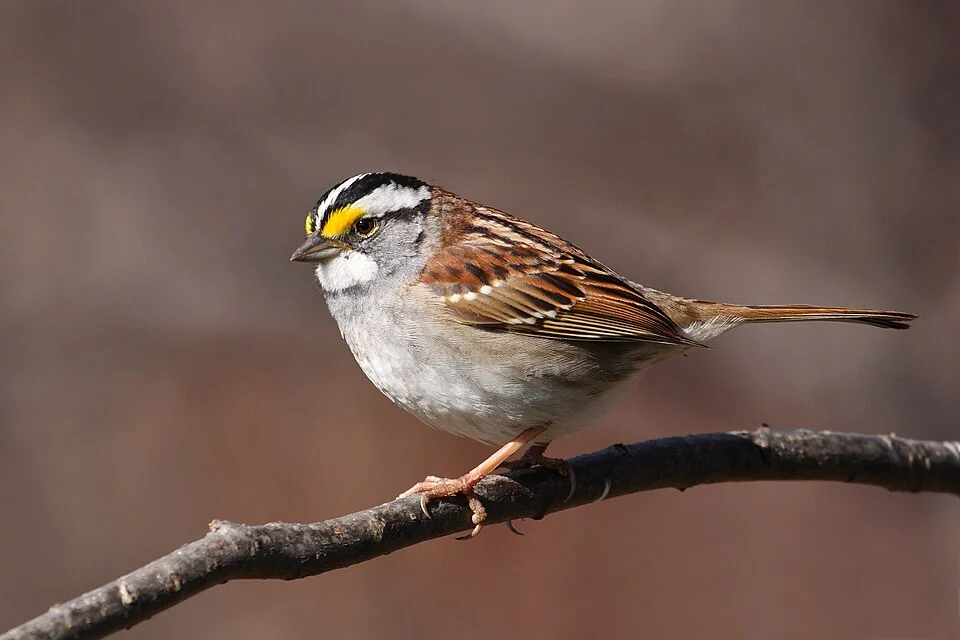
Photo: Cephas · Zonotrichia albicollis CT1.jpg · CC BY-SA 3.0. Resized for this guide.
Build a small local reference collection
Choose five sparrows that occur regularly in your region and season. For each, keep one adult reference, one less obvious plumage when relevant, and a short note about the feature you most often miss. Link to authoritative accounts rather than copying an uncredited gallery into a personal document you may later share.
Organize the collection around comparisons. Female House Sparrow beside Song Sparrow, Chipping beside American Tree Sparrow, and White-throated beside White-crowned are more useful pairs than a folder arranged only alphabetically. Add a finch comparison when that is a recurring source of confusion.
Include your own uncertain photographs with the uncertainty intact. After a later clear observation, revisit them. Sometimes the original frame supports a firmer identification; sometimes it remains unresolvable. Do not erase the limitation just because you now know the species occurs nearby.
The bird journal guide offers a simple recording system. A short local collection becomes especially helpful during migration, when a species familiar from last autumn returns in a plumage you have not considered for months. It keeps learning tied to birds you can actually encounter rather than an overwhelming continental list.
Use a description worksheet before choosing a name
For an unfamiliar bird, write a short description while the view is fresh. Use separate lines for shape, face, underside, wing, tail, behavior, and setting. Leave a line blank when you did not see the feature. A blank is more honest and more useful than filling the space from what the proposed species ought to show.
An example might read: “Compact bird; broad pale eyebrow; breast hidden; brown streaked back; tail medium length; feeding on tray beside building.” That description supports a shortlist but does not yet settle the species. The next viewing goal is the breast and a clearer look at the face, not another photograph of the back.
Now compare the description with references. Mark which features agree, which conflict, and which remain unseen. If the candidate requires you to ignore a clearly observed contradiction, consider another species. If it depends on a feature hidden in every frame, keep the result provisional.
This method is particularly useful with children or a birding partner. Ask each person what they saw before announcing a name. Once one confident identification is spoken, others may unconsciously reinterpret their memory to match it. Independent descriptions can preserve a detail that would otherwise disappear.
Keep the worksheet brief enough to use outdoors. A few specific words can be better than a polished paragraph written hours later. The record's value comes from its connection to the actual view, not from the completeness of its vocabulary.
Handle a possible unusual sparrow carefully
Sometimes a bird genuinely does not fit the expected local species. Start by documenting the ordinary possibilities thoroughly. Age, molt, lighting, and partial views explain many surprising appearances, but they should not be used to dismiss a clear unusual pattern without comparison.
Save original photographs and note the location, date, time, habitat, and duration of the sighting. Describe the marks that led you away from the common candidates. A statement such as “unusual sparrow” gives another observer less to work with than a description of the face, breast, bill, and tail.
Ask an experienced local birder or appropriate identification community for help, providing the context and your uncertainty. Do not attach a rare name as an established fact merely to attract attention. If the evidence improves later, update the record; if it remains insufficient, retain the broader identification.
Respect the bird and the location while seeking confirmation. Avoid repeated playback, trespassing, or crowding a small feeding area. A possible rarity does not change the need for normal care and quiet observation. The best evidence usually comes from patient views that let the bird continue its activity, with a clear record of what was actually visible.
Questions about backyard sparrow identification
Is every bird with a breast spot a Song Sparrow?
No. Other sparrows can show a central spot, and feathers or shadows can create an apparent mark. Combine the breast pattern with the face, bill, tail, range, and season. A single feature is best used as a prompt to look more closely.
Can a native sparrow feed beside House Sparrows?
Yes. Shared food does not imply shared species. Identify individuals in a mixed group, especially the less conspicuous birds around the edge. The obvious male House Sparrow may be the easiest bird to name and the least informative one to keep watching.
Should I trust the first identification from a camera app?
Use it as a suggestion. Check whether the original frame shows the proposed species' distinguishing marks and whether alternatives fit. Save the sequence and regional context. An unresolved label is preferable when the essential view is missing.
What should I learn first?
Learn the adult male and female House Sparrow, then compare them with the two or three native sparrows most common locally. Focus on breast pattern and face markings before subtle color differences. Add species gradually as real observations create a reason to learn them.
What if I never get a clear enough view?
Keep the observation at the level it supports. A small brown bird using the hedge is still part of the yard's activity. Record the date, behavior, and missing feature, then watch again. Careful identification includes knowing when the evidence ends.
Watch it. Then try it.
Review the steps and common mistakes in two short, silent animations. Each has a complete text transcript below.
Your four-step action map
Read the complete video transcript
Identify backyard sparrows.
- Describe before naming. Record head, breast, bill, and tail details.
- Compare age and sex. A female differs from a familiar adult male.
- Check place and season. Use local records to narrow the comparison.
- Keep uncertain records. Save useful photographs without forcing a name.
Try the steps, then note any problem that still needs attention.
Three mistakes to avoid
Read the complete video transcript
Identify backyard sparrows.
- Brown means House Sparrow. Many native species also look brown.
- One mark is enough. Combine pattern, structure, and context.
- A confident app label. Check the visible bird against the suggestion.
Try the steps, then note any problem that still needs attention.
Both animations use this real photograph by Rhododendrites. Photo source · CC BY-SA 4.0. The photo is adapted into original educational animations, not recordings of a field test.
At a glance
| First check | Useful response |
|---|---|
| Describe before naming | Record head, breast, bill, and tail details. |
| Compare age and sex | A female differs from a familiar adult male. |
| Check place and season | Use local records to narrow the comparison. |
| Keep uncertain records | Save useful photographs without forcing a name. |
Sources & evidence
- House Sparrow identification account
- Song Sparrow account
- Chipping Sparrow
- American Tree Sparrow
- White-throated Sparrow account
- White-crowned Sparrow account
- House Sparrow overview
- NestWatch's guidance on non-native birds
Our standard: real evidence before ratings. Corrections follow our editorial process.
Our verdict & your next actions
Choose the row that describes your setup, then follow the suggested check or adjustment.
| Your situation | Our verdict | Your next action |
|---|---|---|
| A brown bird looks unfamiliar | Save field marks and an uncertain identification. | Record useful observations |
| An app supplies a name | Compare its suggestion with visible marks. | Check automated identifications |
| Different sparrows arrive in fall | Season and local records narrow the comparison. | Follow backyard migration |
Your pocket field checklist
Tick off the steps as you go.
0 of 4 steps completed
Keep building your knowledge in birds, or search the full backyard library.