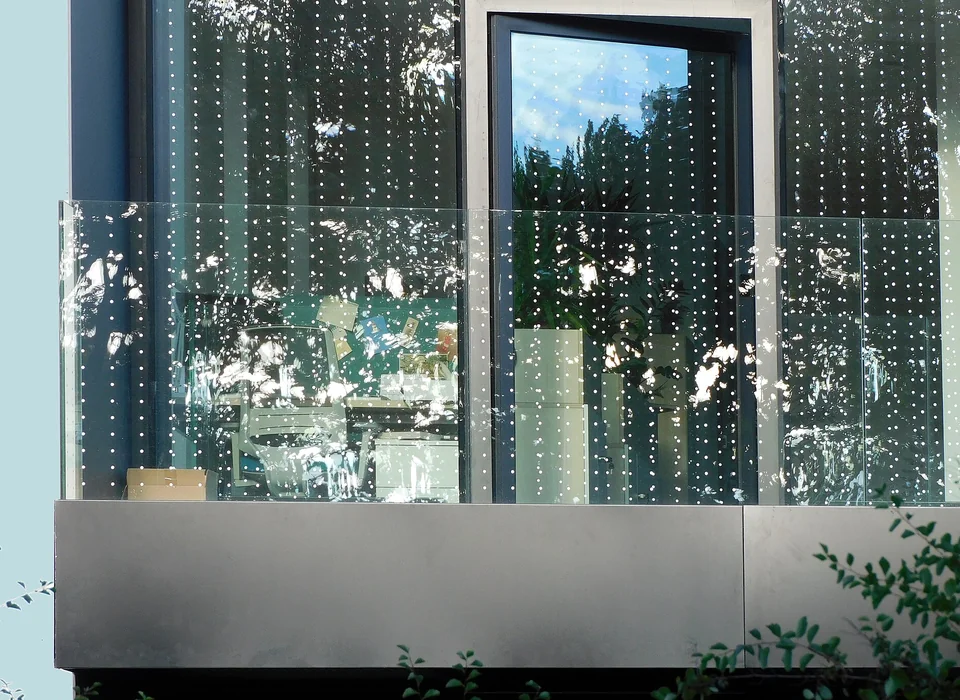
Photo: Panek · Dotted glass bird collision deterrent wwf poland.jpg · CC BY-SA 4.0. Cropped, gently adjusted, and resized for this guide.
The short answer
Treat the full outside surface of risky glass with a closely spaced visible pattern or suitable barrier. Inspect every approach, including baths and shrubs; feeder distance alone does not make reflective windows safe.
Start with the glass, not the feeder
A bird can see a reflected tree, a patch of sky, or a clear-looking route through two windows where a person sees a pane of glass. That mismatch is the central problem. Moving a feeder may change the path birds take, but it does not teach them that a transparent or reflective surface is solid. If your aim is to prevent the next collision, treat the hazardous glass itself. The advice applies to a quiet living-room window as much as to a large picture window: residential glass can be dangerous even when a feeder is not directly in front of it.
Stand outside at several times of day and look at each pane from the height and approach a bird might use. Morning light may turn one panel into a mirror; afternoon light may make the room behind it look like open habitat. Walk toward the house from trees, shrubs, a bath, and the feeder. Note panes that reflect cover, panes aligned with another window, and glass beside a favored flight route. Your short survey is more useful than treating only the pane where you happened to witness a strike.
The practical answer is a visible pattern or barrier across the outside of the risky surface. Cornell Lab and American Bird Conservancy both emphasize exterior treatments because an interior sticker can disappear behind an exterior reflection. The exact product matters less than complete, durable coverage at appropriate spacing. Begin with the glass; then review feeder placement, lighting, and the surrounding habitat as parts of the same plan.
What a collision record can and cannot tell you
The sound of one impact is a clear warning, but the absence of a sound is weak reassurance. A bird may strike when nobody is home, and a bird that flies away may still be injured. Check for feather marks, a dusty outline, or a bird beneath the pane, but do not wait for physical evidence before correcting an obvious reflection. A particularly misleading window can be hazardous on days when you never see a bird near it.
Make a simple window map: label each pane, note what it reflects at morning and afternoon, and record the date and location of any strike. Include likely approaches from the yard. A repeated mark at one corner can guide immediate attention, but the whole pane still needs an effective treatment; a bird does not understand a tiny safe island around one sticker. If two panes form a corner, inspect both directions. If windows on opposite walls show daylight through the house, reduce that apparent passage as well.
This record is for your decisions, not a claim that your house has a measured collision rate. One household's sightings cannot establish a product's effectiveness. It can reveal whether your treatment is still present after rain, cleaning, and seasonal changes. Keep the record brief enough to maintain: window, date, time, weather, observed bird if known, and action taken. A photograph of the pane from outside helps you compare the reflection before and after.
Why a single hawk silhouette fails
A lone decal does not turn a wide pane into a wall. Birds can still aim for the broad unmarked spaces. The familiar black hawk outline also is not a reliable predator warning simply because it resembles a bird of prey to us. What matters is whether a bird approaching the pane sees a continuous, tightly spaced visual obstacle rather than large apparent openings.
Cornell's current homeowner guidance describes markings uniformly spaced about 2 inches apart across the exterior surface when the goal is to deter even small birds. American Bird Conservancy's home guidance also focuses on dense visible patterning and exterior placement. This is a layout rule, not a demand that every mark be two inches wide. Dots, short strips, paint marks, cords, or a suitable screen can create a repeated visual pattern. Inspect a manufacturer's tested spacing and application directions for the chosen system; do not assume the word “bird-safe” on packaging establishes how it performs on your pane.
Treat the entire risky pane, including upper corners and the parts hidden from an indoor view by furniture. On a divided window, assess each piece of glass separately. If a treatment leaves a large clear band because you ran out of tape, finish the pattern before considering the job complete. A useful test is to stand where the bird approaches and ask whether any unmarked opening still looks like a clear flight path. The answer should drive the next row of marks.
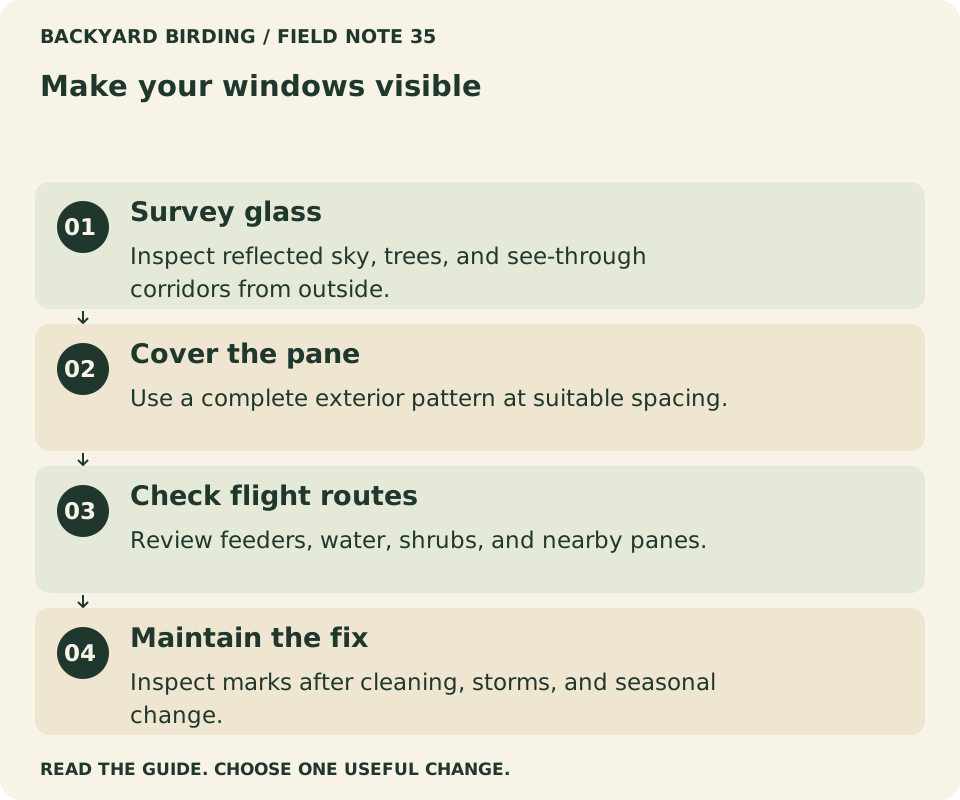
Your visual action map

Read the visual as text
- Survey glass. Inspect reflected sky, trees, and see-through corridors from outside.
- Cover the pane. Use a complete exterior pattern at suitable spacing.
- Check flight routes. Review feeders, water, shrubs, and nearby panes.
- Maintain the fix. Inspect marks after cleaning, storms, and seasonal change.
Choose an exterior treatment that will stay in place
There is no single right material for every home. Exterior dot or tape systems can be discreet from indoors and visible from outside; removable tempera paint offers a low-cost trial; tightly hung cords and properly installed screens create a physical or visual barrier. A film may alter the view or reflected image more broadly. Compare material claims, installation access, cleaning instructions, local weather, and how you will inspect wear. The best treatment is the one you can install correctly over the full problem surface and keep in working condition.
| Treatment | Main strength | What to verify before using it |
|---|---|---|
| Exterior dots or tape | Clear repeated pattern | Spacing, adhesion, visibility, replacement |
| Exterior tempera marks | Inexpensive trial | Complete coverage, rain resistance, reapplication |
| Cords or properly mounted screen | Strong visual interruption | Spacing, tension, safe mounting, maintenance |
| Exterior shade or awning | Reduces some reflections | Coverage when open, seasonal sun angle |
| Interior blinds alone | Convenient supplement | Whether exterior reflection remains visible |
Avoid loose mesh that could entangle wildlife. If you use a screen or net system, follow its documented mounting and tension instructions; do not improvise a sagging barrier in a flight path. For high or inaccessible windows, use a qualified installer rather than reaching from an unsafe ladder. A temporary, complete exterior paint pattern on a reachable pane can be a sensible way to make a dangerous window safer while you arrange a durable installation.
Install the pattern on the side birds see
Prepare the exterior glass as the product directs, then measure a repeatable grid across its full width and height. Start at an edge and work systematically. Corners, mullions, and overlapping panes can interrupt a row; restart the spacing on the next exposed piece of glass rather than treating the frame as though it were a mark in the middle of a pane. View the finished window from outside before putting tools away. Bright sun and deep shade can change contrast, so inspect under more than one light condition.
The location of a mark matters. An interior decal may seem prominent while you are inside looking out, yet the exterior reflection of a tree can dominate when a bird looks in. If an exterior installation is impossible, an interior blind, shade, or light change may reduce a see-through illusion, but check the actual outside view. Do not describe an interior treatment as equivalent to a full exterior pattern without evidence for that specific window and condition.
Think ahead to cleaning. Will the householder remove some rows to wash the glass and forget to replace them? Can a gardener's hose dislodge the lower strip? Put the installation date in your window map and note the product or paint used. After storms and routine cleaning, inspect for lifted edges, missing dots, dirty film, or a new reflection from seasonal foliage. Treating glass is a maintained household safety measure, not a one-time decoration.
Reassess the feeder route without relying on a magic distance
Older bird-feeding advice often gave a precise near-or-far distance from glass. That can be useful as part of a site assessment, but Cornell's newer collision guidance cautions against relying on feeder distance as the protective measure: if a feeder is near a window, make the window bird-friendly. Reflective glass can endanger birds coming from a bath, plant, branch, or open yard even if the feeder is moved.
Map the short route from the feeder to shelter and the longer route to the next tree. Watch the direction birds use when startled. A feeder directly on a window can change the speed of a departure, but it does not solve every impact risk at neighboring panes. Equally, putting a feeder far from a picture window may leave an attractive reflection on the flight path. Your goal is a safe combination of visible glass, sensible access, and a low-risk approach, not compliance with an old number alone.
For the broader placement decision, use the feeder-location guide. It covers access for cleaning, cover, predators, and weather as well as windows. If you move a feeder, change one variable at a time and keep watching the treated glass. Moving a food source is a reversible adjustment; a complete exterior window treatment is the direct response to misleading glass.
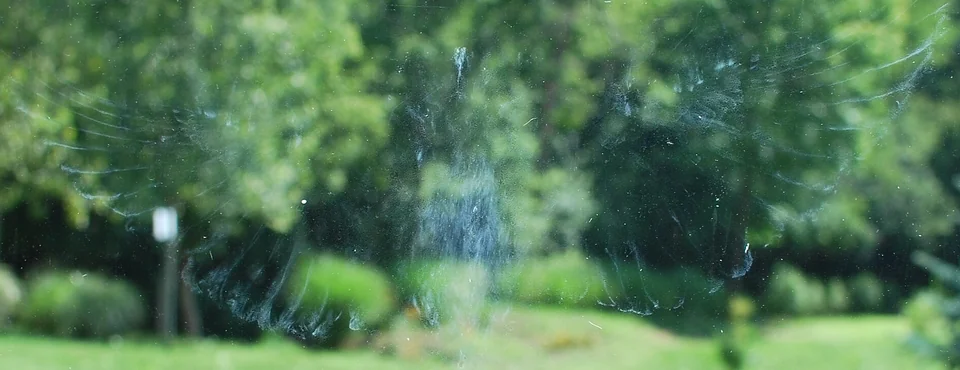
Photo: Ted · Bird Imprint on Window 0073.jpg · CC BY-SA 2.0. Cropped, gently adjusted, and resized for this guide.
“The direct fix is to make hazardous glass visible across the whole pane, then check the routes birds take through your yard.”
Backyard Birding — editorial takeaway
Don't forget baths, shrubs, and indoor sightlines
Food is not the only reason birds cross a yard. A bath may draw species that never use seed feeders. Native shrubs offer cover and natural food; a branch can become a launching point. The consequence is straightforward: examine the window from these approaches too. When an attractive habitat feature sits beside a reflection, improve the pane instead of removing useful habitat as the first move.
Paired windows present another problem. From outside, a bird may see foliage through a room and interpret two panes as a gap. Closing a blind or door can interrupt that view, but a bright reflected surface on the first pane may remain. Walk the sightline, photograph what you see from outside, and decide which glass faces need exterior markings. Glass railings, storm doors, patio doors, and garage windows deserve the same attention as the familiar living-room picture window.
If the bath is directly below a hazardous pane, temporarily move it while you complete the treatment. Then return it to a site where cats cannot ambush bathing birds and where you can keep water clean. Our shallow-bath guide explains water access. The two choices reinforce each other: a welcoming water source is more responsible when the approach and nearby glass are also addressed.
When a bird has just hit the window
First make the area quiet and keep pets and people back. Do not assume a bird that sits still is merely resting, or that a bird that later flies away has no injury. Cornell directs people who find a sick or injured bird to contact a licensed wildlife rehabilitator or a veterinarian able to advise on wild birds. Call before transport; facilities differ in what they can accept. Local wildlife agencies can help identify an appropriate contact.
Handling wild birds can stress them and expose people to pathogens. Follow the rehabilitator's specific instructions for containment, gloves, a ventilated box, warmth, and transport rather than a generic internet rescue recipe. Do not give food, water, or medicine to an injured bird unless a qualified professional directs it. If there is a risk from traffic, a cat, or severe weather, tell the professional that detail when you call so they can advise on the immediate decision.
The second task is to correct the pane. A rescue attempt without glass treatment leaves the same hazard for the next bird. Write down the exact pane and approach while they are fresh in mind. A temporary exterior grid on reachable glass can reduce further risk while a longer-lasting solution is arranged. If a bird is dead, follow your local wildlife or public-health authority's reporting and handling directions, especially during a current disease advisory.
Treat nighttime light as a separate hazard
Window patterning helps with reflections and apparent openings in daylight. Artificial light at night presents another problem, especially during migration: lighting can draw or disorient birds, and illuminated glass remains a collision risk. Use downward-directed outdoor light where needed, turn off decorative or nonessential lights, and close curtains or blinds so bright rooms do not shine outward unnecessarily. Keep the glass treatment in place; a dark room at midnight does not fix a mirror-like pane at noon.
Look at the household schedule. A motion sensor may provide access lighting without an all-night glow. A porch lamp may have a shielded alternative. If several homes or a building share the same nighttime exposure, a wider lights-out practice can matter more than a single lamp. BirdCast and local conservation groups publish migration information, but you need not wait for a forecast to remove needless light.
Be precise about what your household can control. A backyard owner cannot fix every distant tower, but can make the home less confusing. Check doors, windows, and fixtures together after dark. If blinds reduce a visual passage at night, note whether they are routinely left open. A habit that is easy to repeat is more durable than a complicated rule dependent on remembering a special date.
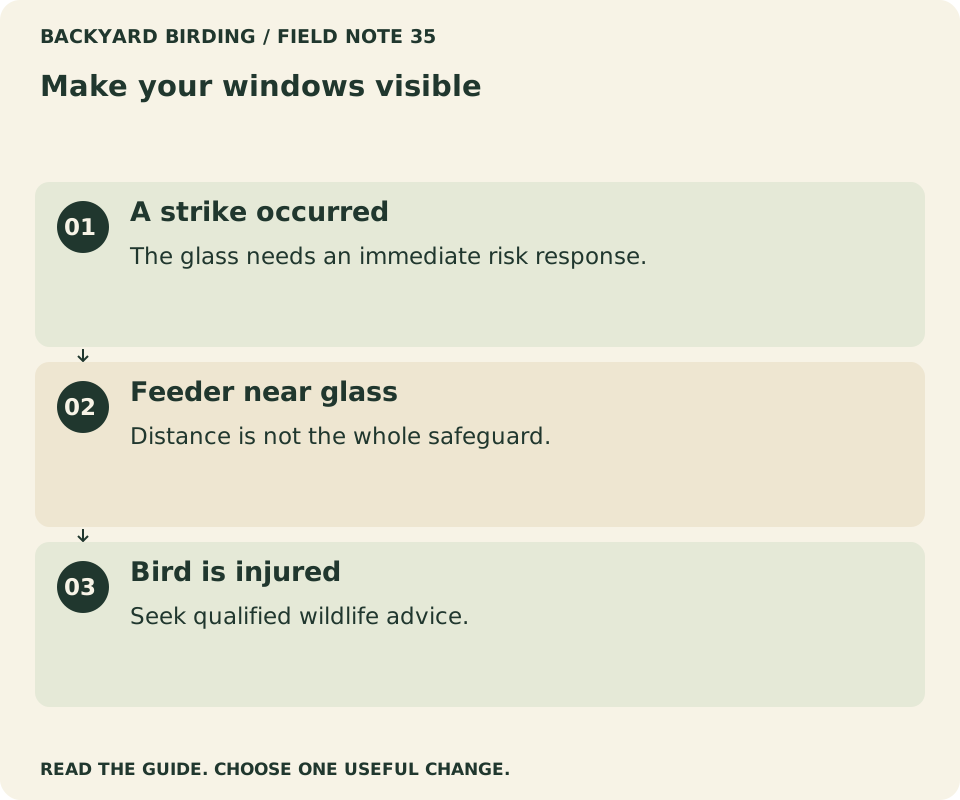
Find your situation

Read the visual as text
- A strike occurred. The glass needs an immediate risk response.
- Feeder near glass. Distance is not the whole safeguard.
- Bird is injured. Seek qualified wildlife advice.
Test your plan from the bird's viewpoint
After installation, revisit the same outside positions used in your initial survey. At the first position, is a reflected tree broken into a clearly marked surface? At the second, can you still see straight through the room to greenery beyond? At the third, are there untreated neighboring panes? Photograph each view. Do not treat a screenshot as a scientific efficacy test; use it to catch obvious gaps and to make maintenance visible.
Then observe the ordinary bird routes for a few weeks. Record strikes if they occur and inspect the mark pattern immediately. A continuing collision may indicate incomplete coverage, loss of adhesion, an adjacent pane, or a route you missed. It does not automatically mean all visible patterns fail. Correct the specific weakness and keep the broader glass survey open. In a rental, ask the property manager about approved exterior treatments; removable paint or other reversible choices may be possible, but obtain any needed building approval.
Avoid the trap of measuring success solely by how many collisions you witness. The aim is to remove a known visual hazard; most households do not have a controlled before-and-after count. A completely treated pane with durable spacing and an outside view that no longer reads as open sky is a more defensible standard than “we haven't heard a thud lately.”
Windows change through the year
The glass does not stay visually constant. New leaves can add a reflected canopy; bare winter branches can reveal sky through the house; lower seasonal sun can brighten a door that seemed dull in summer. Check priority windows in spring and fall and whenever a feeder or bath moves. Storms, window washing, and exterior renovations can also remove marks or change their visibility.
If a strike happens during migration, respond to the pane, but do not assume that only migrants are affected. Resident birds encounter residential glass all year. Conversely, a window that has been quiet during winter is not necessarily safe when leaf-out changes its reflected background. Put a short seasonal inspection in the same calendar as feeder and bath care.
Families may want to keep a view of the yard. Many dense dot or cord treatments preserve substantial visibility from inside because the eye looks past repeated small marks, but this varies with material and layout. Test a small area while planning the complete installation; do not leave that small test area as the final protection. A readable view and bird-friendly glass are compatible goals when material choice and spacing are considered together.
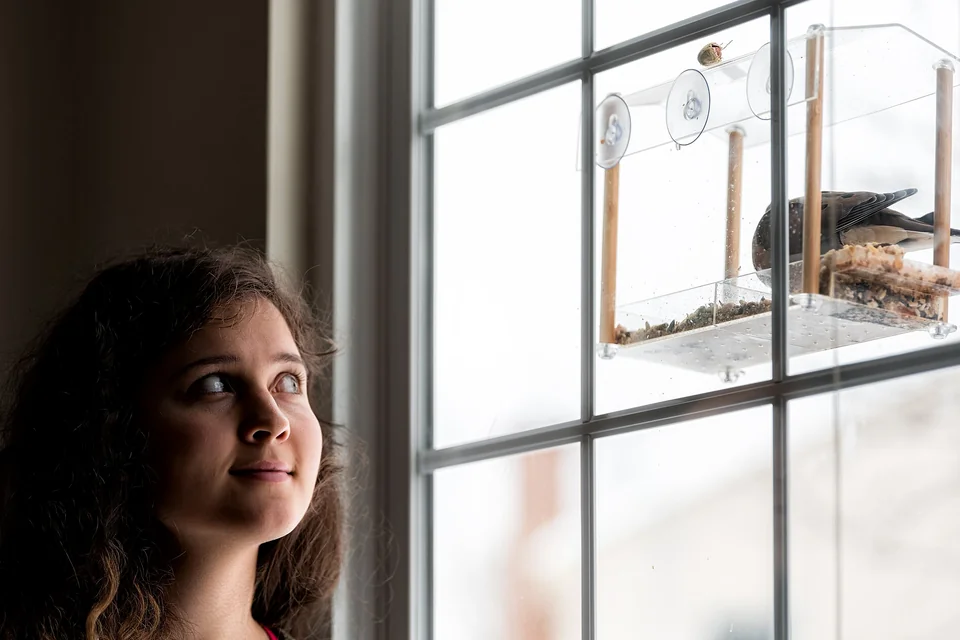
Photo: USFWS Headquarters · Mourning dove bird perched on a bird feeder on a window with young girl watching inside (54182122110).jpg · Public domain. Cropped, gently adjusted, and resized for this guide.
Common fixes that sound plausible but miss the hazard
A decorative owl or single hawk sticker does not cover a large pane. An interior decal may be hidden by a daytime reflection. A feeder move may alter one approach while leaving other birds exposed. Turning off lights helps at night but not a bright afternoon reflection. Ultraviolet-only products should be evaluated against independent performance information rather than assumed invisible-to-us means visible-to-birds in every condition. These distinctions explain why a household can feel busy making changes yet still hear impacts.
Another weak approach is to place marks only where a bird previously hit. That location is evidence of a problem, not the boundary of the problem. A second bird can strike the clear upper half or an adjacent glass door. The full risk surface needs treatment. Likewise, a bath or feeder removed temporarily during a collision episode should not be treated as the permanent solution while hazardous glass remains.
When choosing a product, ask what covers the glass, where it attaches, what spacing it creates, and how it survives cleaning and weather. That checklist is more useful than a vague promise of “protection.” For independent options and DIY examples, consult American Bird Conservancy's home guidance alongside Cornell's window-collision advice.
A practical plan for a typical backyard
Imagine a feeder six yards from a house. Its nearest picture window reflects a maple in the morning; a patio door reflects open sky in the afternoon. The first response is not to move the feeder at random. Mark the two panes on a sketch. Photograph each reflection. Install a complete exterior pattern on the picture window and door at the recommended spacing for the chosen system. Check both from the yard. Inspect other panes along the route to the next cover.
Then look at the feeder's ordinary function. Can you reach it to clean? Is spilled seed collecting beneath it? Are birds crossing a line of glass when startled by a cat? Move the feeder if its site creates another avoidable problem, but do not credit the move with solving untreated reflections. If a shallow bath is nearby, include the route from bath to cover in the same review.
Keep the plan measurable in everyday terms: all risky panes identified; exterior treatment complete; maintenance reminder set; collision response contact saved. The homeowner does not need to prove a decline in a national mortality figure. The next useful action is to fix the visible risk at this house and keep the fix intact.
If you cannot treat every window at once
Prioritize panes with a documented strike, strong reflected habitat, a see-through corridor, or heavy bird movement. Temporary exterior paint or tape on reachable glass can close the most obvious gap while you arrange durable material for a high window. If the work requires a professional, give them the full pane map and spacing requirement, not simply a request for a decorative sticker. Ask how the treatment will be maintained after washing.
Do not interpret prioritization as permission to ignore other glass indefinitely. The risk inventory is a work list. Inspect less obvious panes after the highest-risk ones are handled. A low-cost complete treatment on a small problem window can be more valuable than a polished but partial pattern on a large pane.
For apartments and shared buildings, document the outside reflection and request the landlord's approved method. If you cannot alter exterior glass, reduce obvious through-views with blinds, discuss safe permitted options, and keep a record of strikes. A building's rules change the installation path, not the underlying need to make the glass apparent to birds.
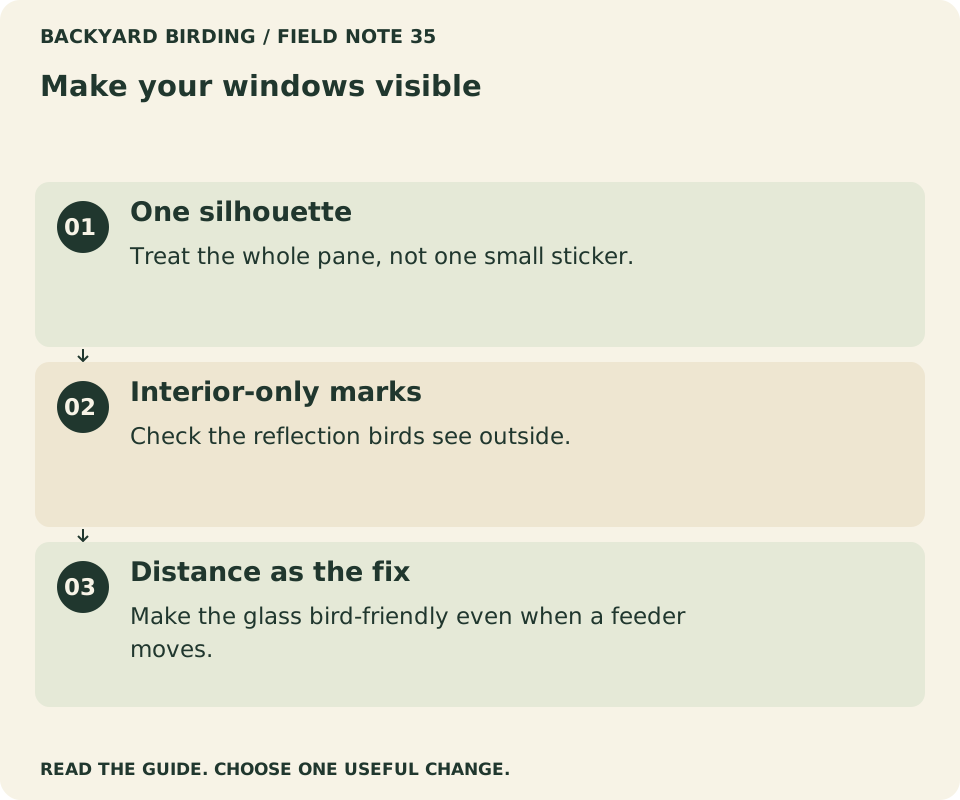
Small mistakes. Better moves.

Read the visual as text
- One silhouette. Treat the whole pane, not one small sticker.
- Interior-only marks. Check the reflection birds see outside.
- Distance as the fix. Make the glass bird-friendly even when a feeder moves.
Check a new window before the installer leaves
If you are replacing windows, ask how the exterior glass will appear from the yard rather than assuming a modern coating is bird-safe. Energy performance and collision prevention answer different questions. A pane that reduces heat transfer can still reflect trees. Ask for the exact bird-friendly glazing pattern or compatible exterior screen, its spacing, and whether it covers the full pane. Obtain installation and maintenance details that can be checked later.
Look at adjacent surfaces too. A new sliding door, balcony railing, or corner window can create a transparent corridor even when the original picture window is treated. Take outside photographs at the time of installation and again when the seasons change. If the work changes the feeder or bath position, repeat the yard approach survey. It is cheaper and easier to address the full design before landscaping and trim make access difficult.
Keep the wider backyard welcoming and safer
A bird-friendly yard is not measured by feeder count. Plants, water, cover, and clean food can make a place useful, but every addition changes the routes birds take. When you add native shrubs, a bath, or a new perch, look back toward the house. If vegetation begins to appear in a reflection, extend or adjust the glass treatment. When you replace windows or doors, consider bird-friendly glazing and exterior screens at the design stage rather than retrofitting after a strike.
Continue ordinary hygiene and observation. The cleaning guide covers food-contact surfaces; the yard journal can help record which paths birds use. Neither replaces visible glass. Combining a simple window map with the rest of your backyard routine helps you notice a new hazard before it becomes a repeated one.
One final check is worth doing today: choose the window that most convincingly reflects sky or leaves, stand outside and look at it from a bird's approach, then plan a complete exterior pattern. That specific action is more effective than collecting more stickers without deciding where and how they will cover the pane.
Watch it. Then try it.
Review the steps and common mistakes in two short, silent animations. Each has a complete text transcript below.
Your four-step action map
Read the complete video transcript
Make your windows visible.
- Survey glass. Inspect reflected sky, trees, and see-through corridors from outside.
- Cover the pane. Use a complete exterior pattern at suitable spacing.
- Check flight routes. Review feeders, water, shrubs, and nearby panes.
- Maintain the fix. Inspect marks after cleaning, storms, and seasonal change.
Try the steps, then note any problem that still needs attention.
Three mistakes to avoid
Read the complete video transcript
Make your windows visible.
- One silhouette. Treat the whole pane, not one small sticker.
- Interior-only marks. Check the reflection birds see outside.
- Distance as the fix. Make the glass bird-friendly even when a feeder moves.
Try the steps, then note any problem that still needs attention.
Both animations use this real photograph by Panek. Photo source · CC BY-SA 4.0. The photo is adapted into original educational animations, not recordings of a field test.
At a glance
| Your situation | Our conclusion | Your next action |
|---|---|---|
| A strike occurred | The glass needs an immediate risk response. | Inspect and treat the pane. |
| Feeder near glass | Distance is not the whole safeguard. | Review the feeder route. |
| Bird is injured | Seek qualified wildlife advice. | Follow the collision response. |
Sources & evidence
- Cornell Lab: Why birds hit windows and how to prevent it
- American Bird Conservancy: Solutions for homes
- Cornell Lab: What to do with a sick or injured bird
Our standard: real evidence before ratings. Corrections follow our editorial process.
Our verdict & your next actions
Choose the row that describes your setup, then follow the suggested check or adjustment.
| Your situation | Our verdict | Your next action |
|---|---|---|
| A strike occurred | The glass needs an immediate risk response. | Inspect and treat the pane. |
| Feeder near glass | Distance is not the whole safeguard. | Review the feeder route. |
| Bird is injured | Seek qualified wildlife advice. | Follow the collision response. |
Your pocket field checklist
Tick off the steps as you go.
0 of 4 steps completed
Keep building your knowledge in problems, or search the full backyard library.