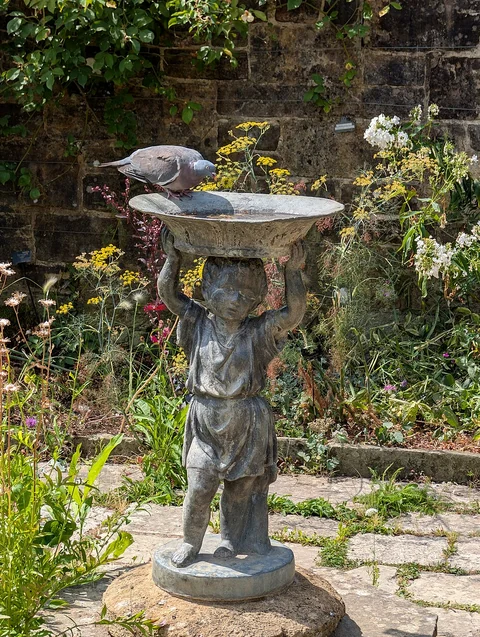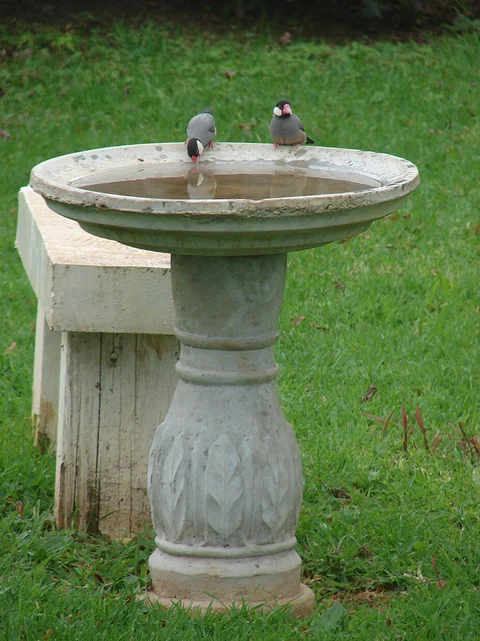
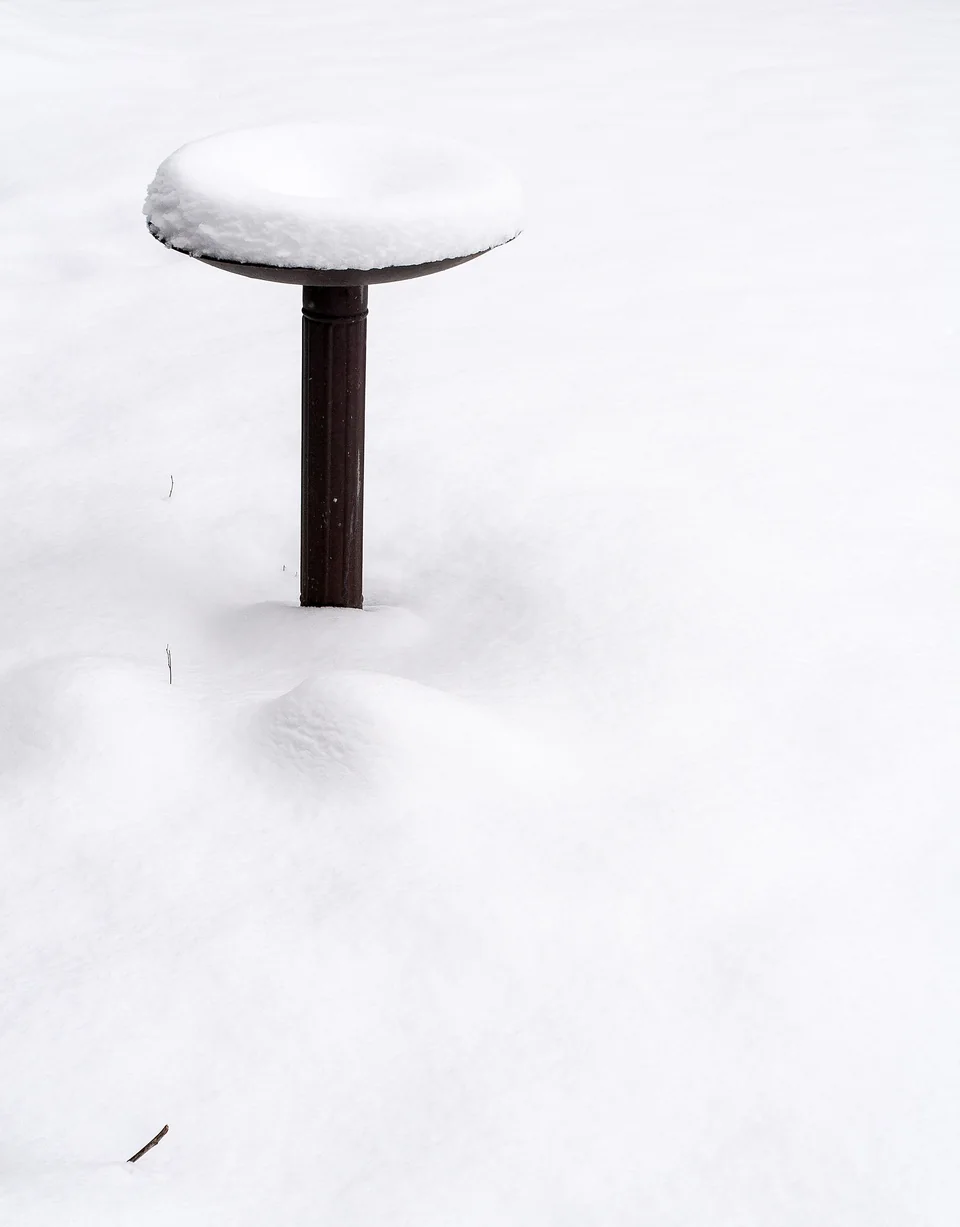
Photo: David Ratledge · Bird Bath in Snow - Knoxville, Tennessee - February 13, 2014.jpg · CC BY 4.0. Cropped, gently adjusted, and resized for this guide.
The short answer
Offer clean, shallow water in a stable, accessible basin. A daily removable bowl works for many households; use outdoor-rated heat only with safe power and a cleaning routine you can sustain.
Choose a winter water routine you can maintain
A frozen birdbath is not a failure to rescue every bird in the neighborhood. Birds can often obtain water from snow or natural drips, and they have ways to conserve it. Yet a dependable shallow pool can bring birds into view, including species that ignore seed. The decision for a householder is practical: can you supply clean, accessible water through the weather you actually have? A small bowl you refresh consistently may do more good than a large heated bath that you rarely clean.
Start with your climate and your daily routine. In a place with occasional frost, a removable bowl may be enough. In a region with long hard freezes, an outdoor-rated heater may make a regular water source easier to maintain. Neither setup removes the need to inspect the basin, replace dirty water, and keep birds safe from cats and slick edges. Snow, ice, and the power cord all change how you reach the bath.
Cornell Lab's birdbath guidance gives the simplest winter option: put out a plastic bowl at about the same time daily and bring it in when ice forms. It also describes thermostatically controlled heated baths for those who want water available during subfreezing periods. Use that range of options to choose a routine you can sustain, rather than treating a heater as the default requirement.
Decide between a daily bowl and a heated basin
The daily bowl has few parts and little electrical complexity. Place a shallow, stable container of fresh water out while you can monitor it; remove it before solid ice becomes difficult to release. You can keep a second clean bowl indoors so the exchange is quick. This method is especially workable during short cold spells or where you cannot safely run power to the yard. Its limitation is availability: water may freeze between changes, and the source is absent after you bring it indoors.
A heated basin or correctly matched immersion heater keeps water open for longer, but adds product selection, power, weather protection, and cleaning questions. Check the manufacturer's minimum water level, suitable basin materials, automatic shutoff claims, mounting, and cord routing. The equipment must be listed for outdoor use in the intended conditions. A warmed surface can still become contaminated, and a shallow heated pool is not a substitute for fresh water.
| Situation | Useful starting option | What demands attention |
|---|---|---|
| Mild frost on some mornings | Removable plastic bowl | Refresh timing and safe removal |
| Repeated deep freezes | Outdoor-rated heated bath | Power protection, water level, cleaning |
| No safe outdoor outlet | Daily bowl or no artificial bath | Do not improvise an extension-cord route |
| Little time for upkeep | Smaller, simpler setup | Avoid an unattended dirty reservoir |
If your only electrical route crosses a walkway or requires indoor equipment exposed to snow, do not force a heated solution. Consult a qualified electrician or choose the bowl routine. A pause in backyard water provision is preferable to an unsafe installation.
Give birds shallow water and sure footing
The winter bath still needs the same physical access as a summer bath. Cornell recommends about one inch of water at the edge, sloping to no more than two inches at the center, with a gently sloped surface. A steep decorative bowl may be difficult for a small bird to enter and leave. A glazed surface can be slippery. Add stable stones or branches that rise above the water so a bird can drink without getting thoroughly wet, particularly when the air is cold.
Keep the basin level and secure. A light pan can tip when a larger bird lands or when wind catches it. A heater insert can change the remaining depth and create a surface you need to clean around, so reassess access after installation. If a stone shifts each time the basin is washed, choose a different arrangement. There should be more than one comfortable place to perch or stand.
Our bath-depth guide explains how to test a basin with ordinary water before winter equipment is added. The winter version has one extra question: can birds approach, drink, and leave without stepping across a smooth rim or deep water in a freezing wind? Answer that by looking at the actual setup, not at the product photo.
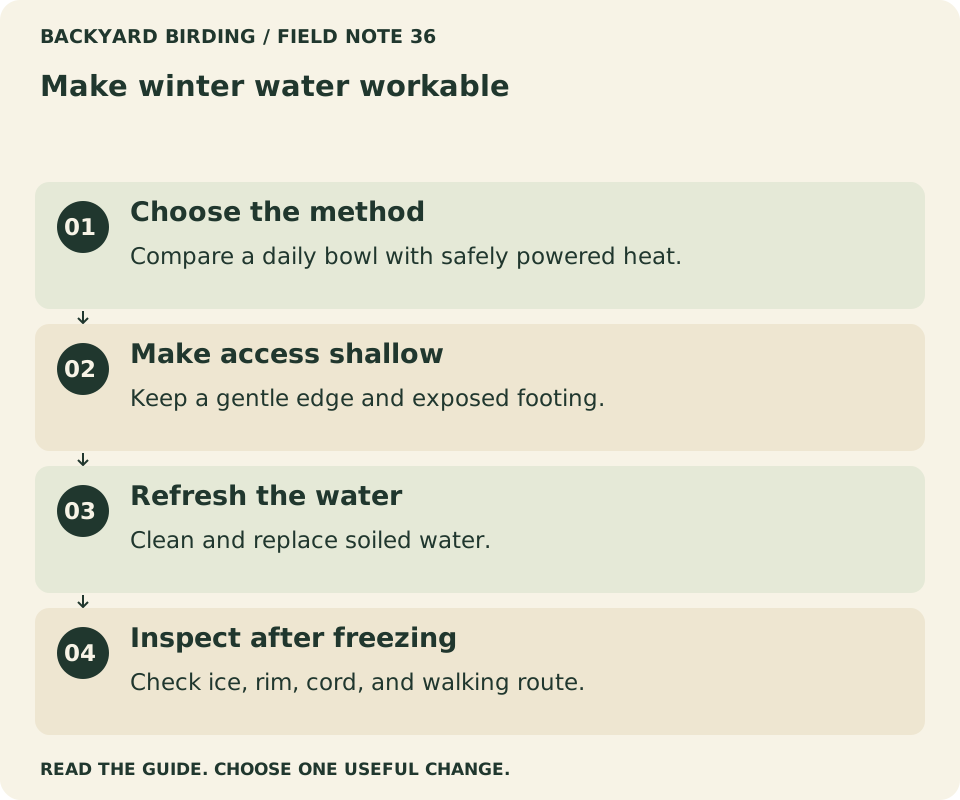
Your visual action map

Read the visual as text
- Choose the method. Compare a daily bowl with safely powered heat.
- Make access shallow. Keep a gentle edge and exposed footing.
- Refresh the water. Clean and replace soiled water.
- Inspect after freezing. Check ice, rim, cord, and walking route.
Place water where birds can see danger
A bath should be accessible to birds and manageable for you. Ground-level water can resemble a natural puddle, but birds drinking or bathing are vulnerable to a stalking cat. Cornell recommends open space between a bath and dense shrubbery so birds can see an approaching predator. Nearby branches can provide a place to preen after a visit; dense cover pressed right against the rim can conceal an ambush. Keep pet cats indoors and do not create a narrow corridor that funnels birds toward a hiding place.
Position the bath where you can carry water without slipping. In winter, a path that was easy in summer may be icy or buried in snow. If you must lean across a frozen flowerbed or step onto a slick retaining wall, move the bath. Convenience is part of bird welfare because an awkward bath is less likely to receive fresh water. Keep it away from locations where road salt or de-icing chemicals can splash into the basin.
Also look back toward the house. A bath can draw birds across a reflective window even if no feeder is nearby. Survey the approach and treat hazardous glass. The window-collision guide gives the complete exterior-glass check. Water, shelter, and safe flight paths belong in the same yard plan.
Keep the electrical part boring and safe
If you choose heat, use a heater or heated birdbath designed for outdoor conditions and follow its exact instructions. Cornell's guidance calls for a ground-fault circuit interrupter, or GFCI, for a bath heater. Check the outlet and cord route with an electrician if you are uncertain. Do not adapt an indoor appliance, immersion kitchen device, or unprotected household extension cord for a snowy garden. Keep connections out of standing water and away from places where shovels, pets, or foot traffic can damage them.
Read what the product actually does. Some thermostats switch on only below a temperature threshold; some units have low-water protection. A marketing line about automatic shutoff does not mean you may leave the basin dry. Follow the specified minimum level and inspection interval. A device that still feels warm after emptying, has damaged insulation, trips the GFCI, or behaves unexpectedly should be disconnected according to its instructions and checked by the manufacturer or a qualified professional.
Budget for the electrical installation as well as the heated bowl. Include suitable outlet access, protected cord routing, replacement parts, and a way to remove the unit for cleaning. Confirm those details before ordering the heater. If the site cannot accommodate them, use a removable bowl while you reconsider the location.
Never put antifreeze, salt, or glycerin in the bath
The water offered to birds should be plain, clean water. Cornell explicitly warns against antifreeze because it is poisonous to animals. It also discourages glycerin: it can coat and mat feathers, undermining insulation when a bird most needs it. Salt and other de-icers are not a substitute for a safe heater or a routine of replacing the bowl. A product intended for a car, sidewalk, or ornamental fountain is not thereby appropriate for drinking wildlife.
The same principle applies to homemade recipes passed around online. A solution that remains liquid at a lower temperature has changed the water birds drink and bathe in. Its effect on feathers, surfaces, and other animals matters. When an improvised additive seems necessary to keep a basin open, that is a signal to change the method, not the recipe.
Use physical methods: a fresh removable bowl during accessible hours, or appropriately rated heat. If the water freezes anyway, bring in the bowl and replace it when you can. Do not pour boiling water onto a frozen concrete or ceramic bath; rapid temperature change may crack it, and the water can refreeze on the surrounding surface. Choose a basin material suitable for the weather and the method you plan to use.
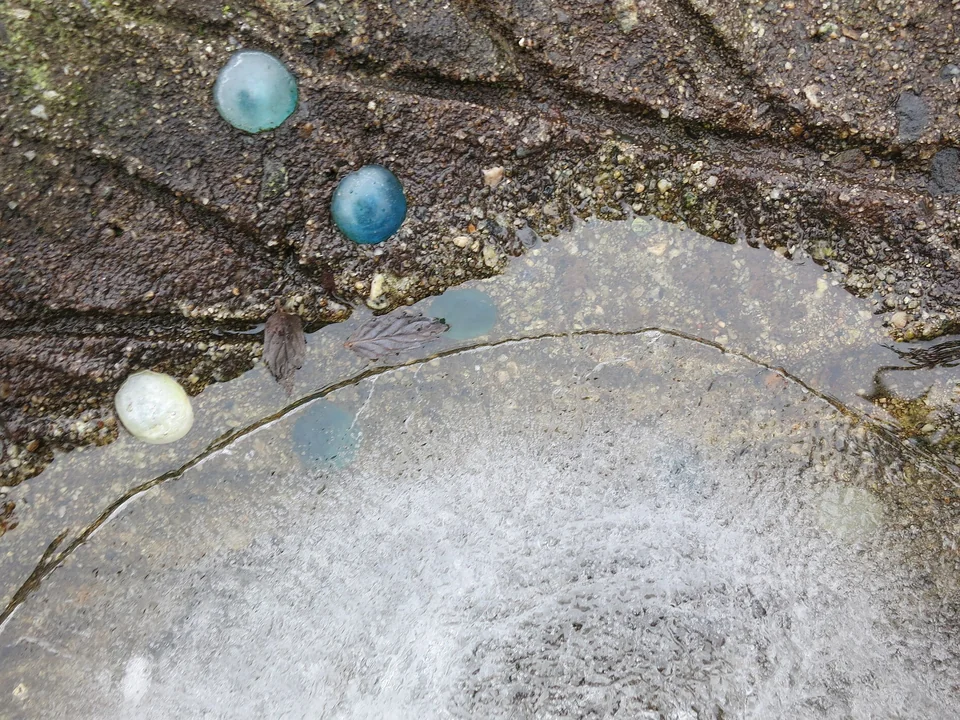
Photo: Ruth Hartnup from Vancouver, Canada · Ice in a bird bath (8398245183).jpg · CC BY 2.0. Cropped, gently adjusted, and resized for this guide.
“A simple clean bowl on a dependable schedule can be more useful than a heated bath nobody maintains.”
Backyard Birding — editorial takeaway
Build a repeatable water-change schedule
Open water is not automatically clean water. Birds may leave droppings, feathers, food fragments, or mud. Winter can slow some processes, but it does not remove contamination. Inspect at each refill and replace water when soiled. A heated bath needs this attention as much as an unheated one. Cornell recommends changing birdbath water every day or two in ordinary conditions; treat visible soiling as a reason to act sooner.
Empty the basin, scrub it using a method compatible with the material and heater instructions, rinse thoroughly, and let it drain before fresh water is added. Disconnect any electrical element as instructed before handling or cleaning. Keep a dedicated brush for the birdbath rather than using a food-preparation sponge. Wash your hands afterward. Our bath-cleaning guide covers the basic routine; use the heater manual for the electrical portion.
The most useful schedule is tied to an action you already perform. If you check seed each morning, check the water then. If you are away for several days, ask whether anyone can maintain the bath; a heated basin should not be treated as a set-and-forget wildlife service. Reduce the setup or remove it temporarily when regular care is impossible.
Prevent ice from making maintenance harder
An unheated basin may freeze into a solid disk. Forcing the ice free with a metal tool can damage the bowl and create sharp fragments. A removable flexible container makes the exchange easier: bring it indoors to thaw, put out a clean spare, and wash the original before its next use. Avoid striking a frozen heater or bending its cord to free the ice. Follow the manufacturer's thawing procedure if equipment has frozen unexpectedly.
Snowfall can cover the rim, and blowing leaves may collect in open water. Clear the access path and look for partial ice that narrows the shallow area. A heater may open only a small central hole in a deep basin; birds still need an accessible edge or stone. Inspect from the same angle a bird approaches. The visible patch from your kitchen window may hide a slick ring around it.
Plan for power interruptions. If the heater stops during a storm, it is reasonable to bring the unit in and switch to a daytime bowl rather than repeatedly filling an unsafe or frozen assembly. Check the outlet, cord, and device only when you can do so safely. Do not step onto ice to troubleshoot a backyard bath.
Understand what birds may do at a winter bath
Some visitors will drink from a perch and leave; others may bathe even in cold weather. Watching both behaviors helps you assess whether the basin is usable. A bird standing on a stone and taking brief sips has found a dry-footed route. A bird that repeatedly approaches but does not land might be responding to a slippery rim, nearby disturbance, an exposed location, or simply an alternative water source. One observation is not a diagnosis.
Do not force birds to use the bath by moving food closer or removing natural water. The purpose is to offer a suitable option. Birds may prefer a thawed patch elsewhere, a drip, or snow. The Cornell article explicitly notes that keeping an artificial bath ice-free is not critical for survival in many situations. That reassurance matters: it lets you prioritize a safe, clean installation over the anxiety of maintaining water every minute.
If a bird appears weak, disoriented, or injured, the bath is not a treatment. Contact an appropriate wildlife rehabilitator or wildlife agency for advice and follow current local guidance. Keep pets away. Do not attempt to infer a disease from a photograph taken through a window.
Find your situation

Read the visual as text
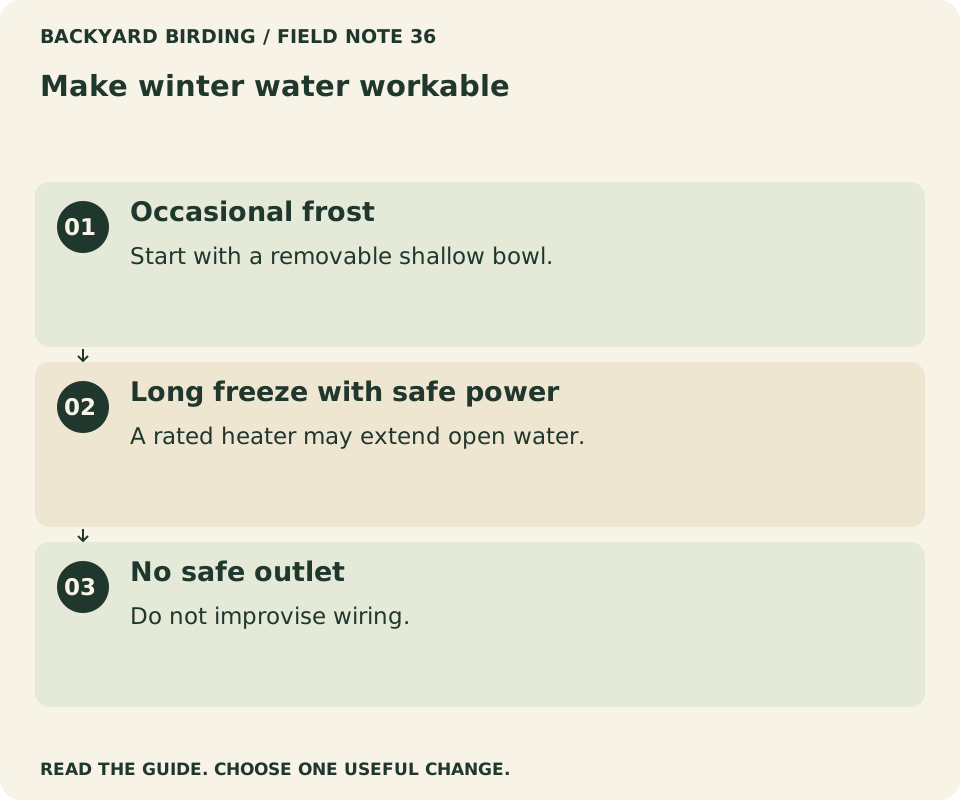
- Occasional frost. Start with a removable shallow bowl.
- Long freeze with safe power. A rated heater may extend open water.
- No safe outlet. Do not improvise wiring.
Compare the true work behind common setups
An elevated heated pedestal may look tidy but require you to carry water and cleaning tools across an icy yard. A low bowl is easier to lift yet may need more thought about cats, snow cover, and a level base. A heater insert can preserve an existing basin but may create hard-to-clean seams and a new cord route. These are ownership differences, not merely product features.
Before buying, rehearse a full winter service cycle. Where do you place the heater while washing the basin? How do you drain water without creating a sheet of ice on a path? Can you see the minimum level from the house? Can you remove the bath when the forecast changes? What happens if the device fails? A solution that passes this rehearsal is more likely to remain useful in February than one chosen for appearance alone.
The winter feeding guide covers food choices and station care, but water should have its own maintenance card. Record the basin, power method, cleaning interval, and the safest route to it. That card helps another household member step in without guessing how the setup works.
Keep water separate from poultry and other higher-risk contexts
A backyard birdbath is a different setting from a domestic poultry flock. If you keep chickens, ducks, or other captive birds, follow current USDA and state animal-health guidance on separating wild birds from feed and water. USDA APHIS advises poultry owners to keep wildlife away from poultry resources as part of biosecurity. Do not place a wild-bird bath where poultry can drink from it or where runoff enters their enclosure.
Likewise, follow a current local wildlife advisory if officials recommend changing feeding or water practices during an outbreak. Guidance can differ by state, species, and disease. A general winter-bath article cannot substitute for an active instruction from your wildlife agency. Keep your source check tied to the date and location rather than treating a past outbreak notice as permanent nationwide advice.
Keep the ordinary bath routine clear before a problem arises: fresh water, cleaned equipment, separation from poultry, and attention to current official notices. An apparently healthy visitor does not call for a disease diagnosis. If several birds seem ill around the station, pause the shared water source and ask the relevant wildlife agency or rehabilitator what to do next.
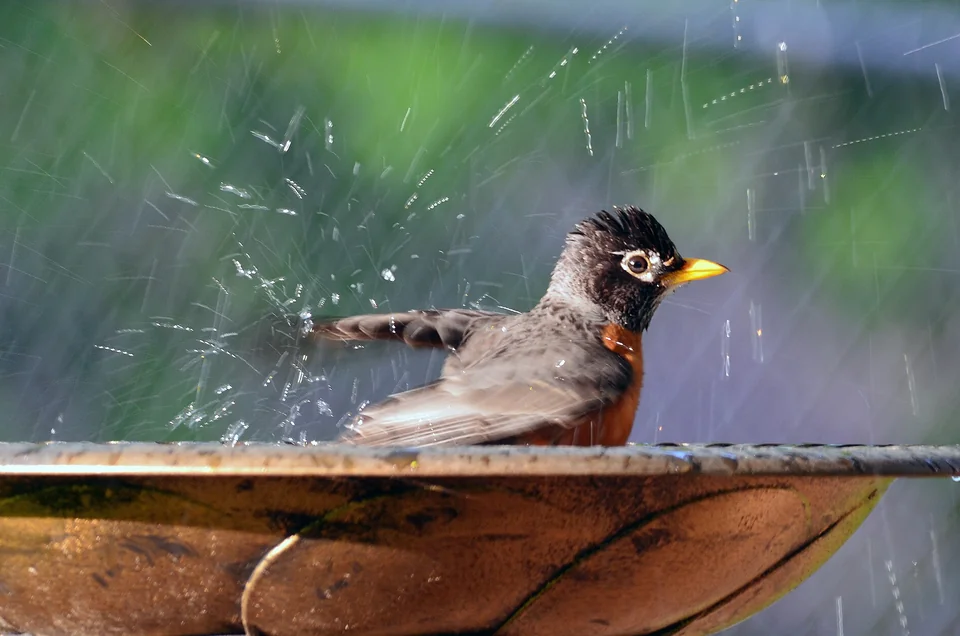
Photo: U.S. Fish and Wildlife Service - Midwest Region · American Robin (42253318841).jpg · Public domain. Cropped, gently adjusted, and resized for this guide.
A seven-day trial before you expand the setup
Start with one shallow bowl in a safe position. For a week, note when you put water out, when ice forms, whether birds use it, and how long emptying and cleaning take. Include weather and any contamination. This short trial reveals whether a daily bowl fits your schedule and whether the location works. It also shows if the basin is too deep or awkward to carry.
If the water freezes quickly and you want a longer open period, compare an outdoor-rated heated bath against the actual trial. Choose a size you can clean, not merely one with the largest volume. Verify safe power access before purchase. Keep the stone or branch footing that made the first basin usable. After installation, repeat the observation: available water is only an improvement if birds can reach it and you can maintain it safely.
Use the week's notes to choose the next step. If carrying the bowl was awkward, try a smaller container or a shorter route. If cleaning was easy but freezing left little open water, check whether safe power is available. Bird visits will vary with weather and natural water, so assess the workload and access as well as the number of visitors.
Questions people ask during a freeze
Do birds need a heated bath to survive? Cornell says keeping a bath ice-free is generally not critical; birds can often obtain water elsewhere. A heated bath is an optional reliable source, not a rescue guarantee. Can I use warm water in an ordinary bowl? You can offer fresh water in a suitable removable bowl, but expect it to cool and freeze. Do not rely on a one-time warm fill to stay open. Should I keep water out overnight? Only if the setup is designed, powered, and maintained for those conditions; otherwise bring the bowl in when ice forms.
Can I use a ceramic or concrete birdbath I already own? Check the material's freeze suitability. Cornell notes that concrete may crack in freezing conditions. A removable insert can protect the larger basin and simplify washing, but it still needs a stable, shallow arrangement. Will a heater mean less cleaning? No. Heat keeps water liquid; it does not remove droppings or other debris.
The answers point to the same decision: select a physically safe vessel, offer plain clean water, and plan how you will service it. A birdbath that remains usable for one dependable part of the day can be better than a permanently available basin whose condition nobody checks.
What to do after the first storm
Inspect the whole setup, not just the visible water. Is the rim accessible above snow? Are footing stones still stable? Is the cord intact and routed away from shovel work? Has the basin tipped, cracked, or collected dirty runoff? If any part is unsafe, stop using it until corrected. Replace water and clean the bath before resuming ordinary use.
If birds are visiting, note what they do rather than counting only the species. A bird that drinks from an exposed stone without entering deep water suggests the footing helps. A group waiting around a single narrow gap may need more accessible edge. Do not respond by filling the basin deeper; adjust shape, stones, or site. Keep a little open approach space so birds can watch for predators.
At the end of the cold period, remove and clean any winter-only heater or insert as directed, dry it, and inspect it before storage. Continue the regular water-change routine in warm weather, when contamination can increase quickly. The seasonal hardware changes; the obligation to provide shallow, clean, accessible water does not.
Small mistakes. Better moves.

Read the visual as text
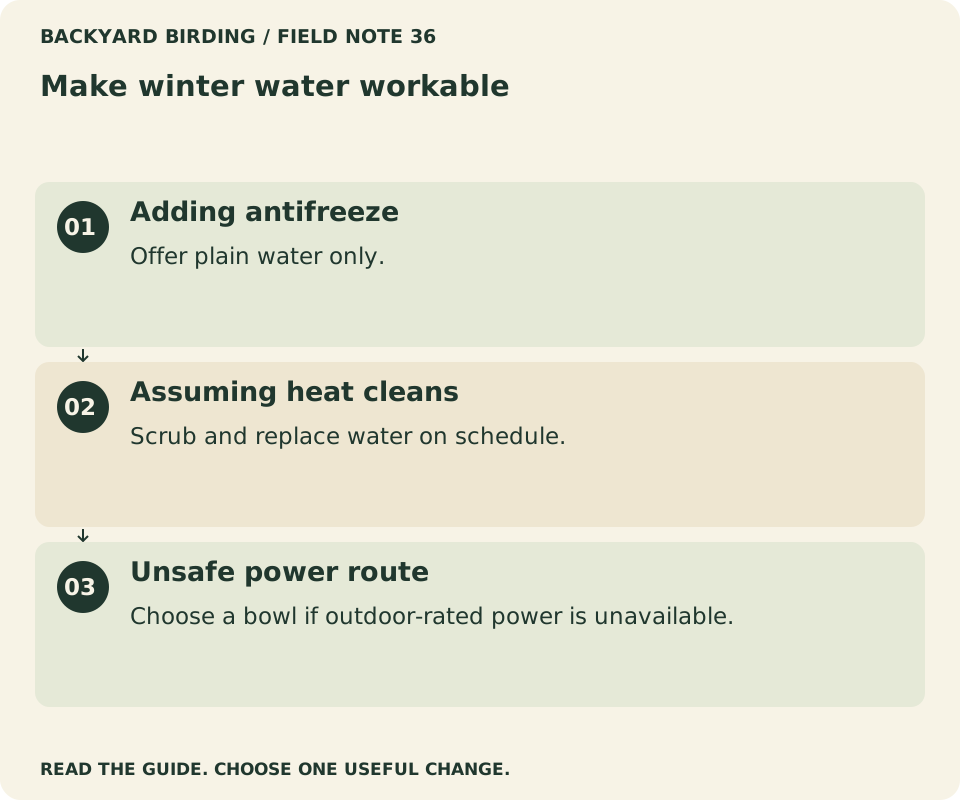
- Adding antifreeze. Offer plain water only.
- Assuming heat cleans. Scrub and replace water on schedule.
- Unsafe power route. Choose a bowl if outdoor-rated power is unavailable.
Match the plan to your actual freeze pattern
A thermometer reading at the airport is not the whole story for an exposed yard. A sheltered courtyard, windy deck, and shaded garden basin may freeze at different speeds. During the first cold week, record when the water becomes inaccessible rather than assuming the product's advertised temperature range describes your exact site. Check after a windy night and after a sunny day; both can change ice formation and water loss.
Use those observations to simplify the routine. A bowl that stays open for two useful daytime hours may be enough for your schedule. If ice closes it almost immediately and you still want regular water, investigate an appropriately installed heated setup. If a heated bath repeatedly runs dry or becomes hard to clean, reduce its size or reconsider the location. The goal is a safe, clean source that works in your microclimate, not a claim that one device suits every winter.
The simplest good decision
Choose the setup you will actually maintain. If an outdoor-rated heated bath has safe power, the right basin, and a realistic cleaning routine, it can offer open water through prolonged freezing weather. If those conditions are missing, use a small removable bowl when you can refresh it. Place either where cats cannot hide at the rim, where glass on the approach is made bird-friendly, and where you can reach the water without risking a fall.
Before the first freeze, set aside a clean spare bowl and check your route to the bath. If you plan to use heat, read the manual and confirm the outlet requirements before installation. Keep a note of ice formation and cleaning during the first week so you can adjust the routine to your yard.
Watch it. Then try it.
Review the steps and common mistakes in two short, silent animations. Each has a complete text transcript below.
Your four-step action map
Read the complete video transcript
Make winter water workable.
- Choose the method. Compare a daily bowl with safely powered heat.
- Make access shallow. Keep a gentle edge and exposed footing.
- Refresh the water. Clean and replace soiled water.
- Inspect after freezing. Check ice, rim, cord, and walking route.
Try the steps, then note any problem that still needs attention.
Three mistakes to avoid
Read the complete video transcript
Make winter water workable.
- Adding antifreeze. Offer plain water only.
- Assuming heat cleans. Scrub and replace water on schedule.
- Unsafe power route. Choose a bowl if outdoor-rated power is unavailable.
Try the steps, then note any problem that still needs attention.
Both animations use this real photograph by David Ratledge. Photo source · CC BY 4.0. The photo is adapted into original educational animations, not recordings of a field test.
At a glance
| Your situation | Our conclusion | Your next action |
|---|---|---|
| Occasional frost | Start with a removable shallow bowl. | Check basin depth. |
| Long freeze with safe power | A rated heater may extend open water. | Keep a cleaning routine. |
| No safe outlet | Do not improvise wiring. | Use the daily bowl plan. |
Sources & evidence
- Cornell Lab: Attract birds with birdbaths
- Cornell Lab: Providing water for birds
- USDA APHIS: Protect poultry from wildlife
Our standard: real evidence before ratings. Corrections follow our editorial process.
Our verdict & your next actions
Choose the row that describes your setup, then follow the suggested check or adjustment.
| Your situation | Our verdict | Your next action |
|---|---|---|
| Occasional frost | Start with a removable shallow bowl. | Check basin depth. |
| Long freeze with safe power | A rated heater may extend open water. | Keep a cleaning routine. |
| No safe outlet | Do not improvise wiring. | Use the daily bowl plan. |
Your pocket field checklist
Tick off the steps as you go.
0 of 4 steps completed
Keep building your knowledge in bird baths, or search the full backyard library.