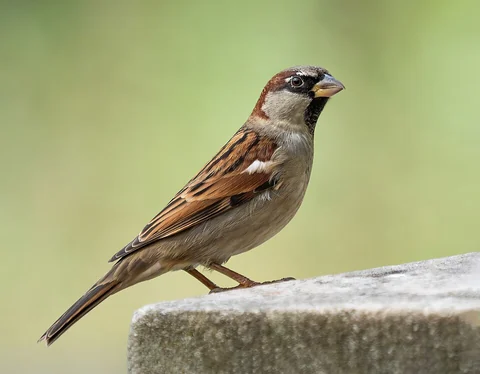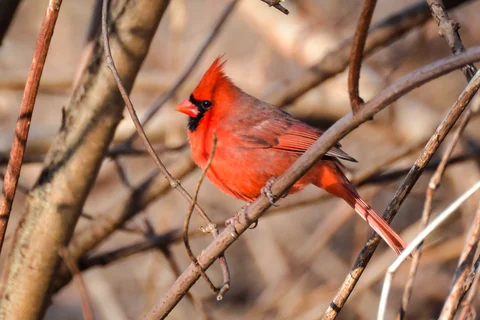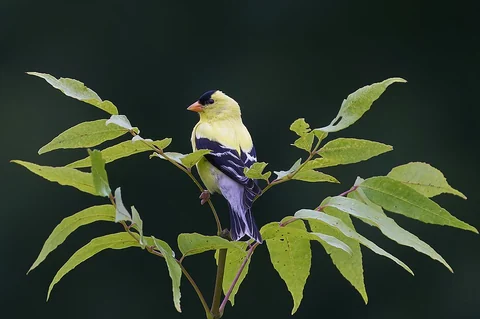
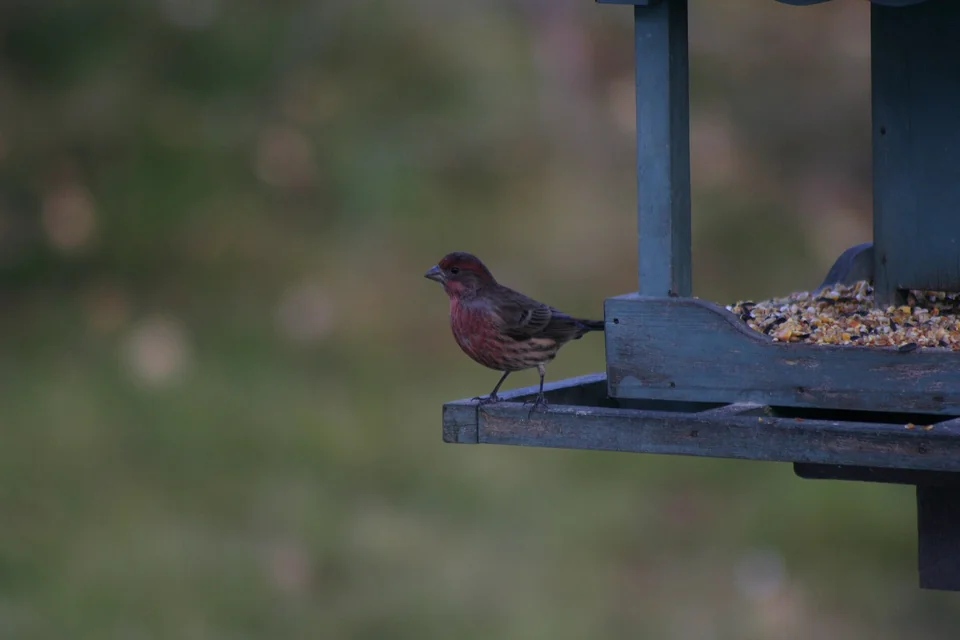
Photo: Robert Taylor from Stirling, ON, Canada · Male Purple Finch 3812 (5126903664).jpg · CC BY 2.0. Cropped, gently adjusted, and resized for this guide.
The short answer
Use several visible marks together: male color distribution and flank streaks, female face pattern and breast contrast, plus head shape and local range. Leave the species unresolved when the decisive view is missing.
Name the bird only after you describe it
Two streaky finches at a feeder can look almost interchangeable for a few seconds. A red head may suggest House Finch; a richer raspberry bird may invite the name Purple Finch. Color alone is a poor verdict. Male House Finches vary from yellow-orange to red, light changes hue, and Western Purple Finches need not look like a bright eastern field-guide plate. Females and young birds make the puzzle more interesting because neither presents the easy-sounding “purple” clue.
Begin with what the bird actually shows: head shape, face pattern, streaking, back color, bill, wing length, and where and when you saw it. One feature may be hidden. Another may be distorted by posture. The goal is not to force every visiting finch into a species box; it is to build an identification you can explain from visible evidence. Project FeederWatch calls House, Purple, and Cassin's Finches a difficult group, including in regions where their ranges overlap.
This guide gives a repeatable comparison for backyard observers. It separates male and female characters, shows where geography helps, and explains when “finch species uncertain” is the accurate record. For an unknown visitor, take a few unobstructed photographs or notes before searching for the nearest color match. A clear side view and a frontal view often answer more than a dozen guesses based on a single red pixel.
Establish the likely candidates in your location
House Finch occupies much of the United States and often uses towns, farms, and feeders. Purple Finch is less uniformly present; its occurrence changes with region, season, and food conditions. In parts of the West, Cassin's Finch adds a third similar species. Range is a filter, not a proof. A common local species deserves consideration first, but an unusual bird can still appear, and a familiar shape can be misread.
Check the current species maps and recent local records for the date of your sighting. Cornell's House Finch and Purple Finch maps provide broad context; a local bird checklist can show whether your county regularly records both. Do not turn a continental range map into a claim that one species must be present at your address on a particular day. Winter movement and regional variation matter.
If you are in an area where Purple Finch is scarce, raise the evidence threshold before assigning that name. Look for more than a reddish bird. Conversely, if a small flock appears during a season when Purple Finches commonly move through your area, do not label every bird House Finch by habit. The useful question is: Which visible features would still support this identification if I had not looked at the map first?
Compare male pattern before comparing shades of red
An adult male House Finch often has its strongest red on the forehead, face, throat, and upper breast; brown back and prominent brown flank streaks remain. A male Purple Finch commonly shows a more extensive raspberry wash over head, breast, and much of the back, with less obvious flank streaking. These are patterns, not paint swatches. Angle and lighting can shift perceived color dramatically, while a camera's processing can make a House Finch look unusually rich.
Follow the boundary of color. Does reddish color stop at a brown back? Are the sides boldly streaked against the red chest? Or does the color seem to wash through the back and sides? Cornell's species comparison and Project FeederWatch's tricky finch guide illustrate these differences with photographed birds. Compare the whole pattern, not one isolated feather.
| Male feature | House Finch tendency | Purple Finch tendency |
|---|---|---|
| Red distribution | Concentrated on head and chest | Broader wash over head, breast, back |
| Back | Mostly brown | Often rosy, especially eastern birds |
| Flanks | Conspicuous dark streaks | Usually weaker, more diffuse streaks |
| Head | Smoothly rounded | Larger-looking, sometimes puffy crown |
| Best caution | Variable yellow-to-red color | Western birds can be less extensively red |
No single row is an absolute test. Use several features that agree, and say which ones were actually visible.
Your visual action map

Read the visual as text
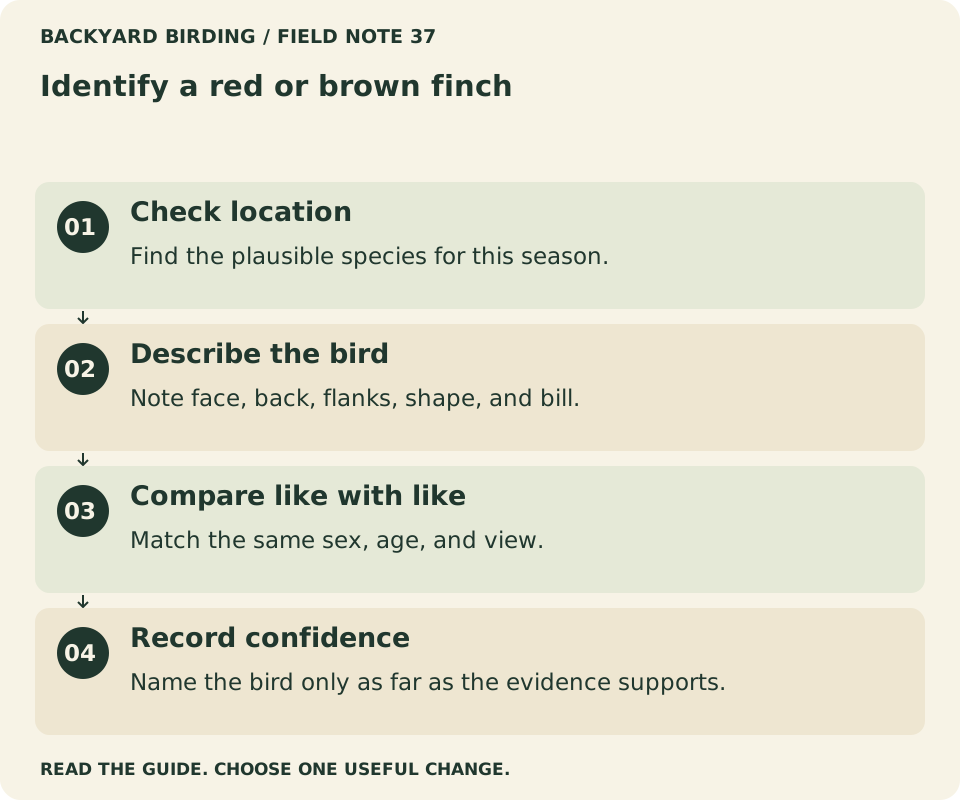
- Check location. Find the plausible species for this season.
- Describe the bird. Note face, back, flanks, shape, and bill.
- Compare like with like. Match the same sex, age, and view.
- Record confidence. Name the bird only as far as the evidence supports.
Female faces often tell the clearer story
Female and immature House Finches tend to have a plain brown face without a strong white eyebrow. Their breast streaking is often long, fine, and somewhat blurred on a dull background. Female or immature Purple Finches generally show a stronger face pattern: a pale eyebrow above a darker cheek area and a pale stripe below it. Their brown streaks on a whiter underside often look shorter and more substantial. This contrast can be easier to judge than the precise shade of a male's red.
Look at the face from the side, not just the breast from below. Is there a crisp pale line over the eye? A dark patch through the cheek? Is the lower face bordered by another pale line? If the head is turned away, wait or keep the identification tentative. A feeder camera aimed only at a tray may record feet and chest beautifully while hiding the most useful facial characters.
Female Purple Finches can vary geographically, and feathers wear. Project FeederWatch's comparison describes these marks as tendencies across the group; an individual picture can be less clear. The temptation is to choose the species that matches one image online. A stronger method is to compare the same view and age/sex class in multiple authoritative references, then return to your original photograph. If the decisive face pattern is unresolved, “House/Purple Finch” can be a better notebook entry than a confident wrong label.
Head and bill: useful when the bird holds still
House Finch usually looks relatively slim and long-tailed, with a smoothly rounded head. Purple Finch often appears stockier, with a proportionally larger head and a crown that can look slightly peaked or puffy. Its bill may appear heavier. The differences are subtle; posture can change a bird's apparent shape in an instant. A Purple Finch fluffed against cold and a House Finch leaning forward at a feeder are not fair silhouettes to compare.
Watch the bird before it reaches the food. A perch on a branch gives a more natural side profile than a contorted feeding position. Compare head-to-body proportion, crown contour, bill depth, and tail shape in the same moment. If both species are side by side, that can help, but size alone is weak because individual birds vary and distance distorts scale. Avoid estimating from a single photograph with no stable reference.
These structural clues become more valuable when color is compromised. In a backlit scene, a rounded versus fuller head and relative wing and tail proportions may remain visible. Still, if the profile is not sharp, do not invent detail by enlarging a blurry image. A field mark has value only if it is actually resolved in the source view.
Watch for Cassin's Finch in the West
In western mountains and nearby regions, a third lookalike can turn a two-way comparison into a three-way one. Male Cassin's Finches often show a bright raspberry crown that can look peaked, with less red spread over the back than an eastern Purple Finch. Females may have a faint pale eyebrow, but the face contrast differs from a classic female Purple Finch. Project FeederWatch explicitly treats all three together because the ranges overlap in some places.
Do not identify Cassin's solely because a head looks pointy in one frame. Feathers can rise temporarily. Add bill shape, body proportions, breast streaks, and local likelihood. If you are in a lowland city where Cassin's Finch is rarely recorded, the name demands stronger documentation than it would in suitable mountain habitat. The same logic works in the other direction: an upland bird should not automatically be called House Finch because it used a feeder.
For most backyard readers the useful outcome is a broader habit: identify the local comparison set before comparing plumage. A field guide limited to two species may cause you to miss a third. After checking the maps, compare the actual photograph against the appropriate sex and regional form. A carefully recorded uncertainty is part of good birding, not a failure to finish the quiz.
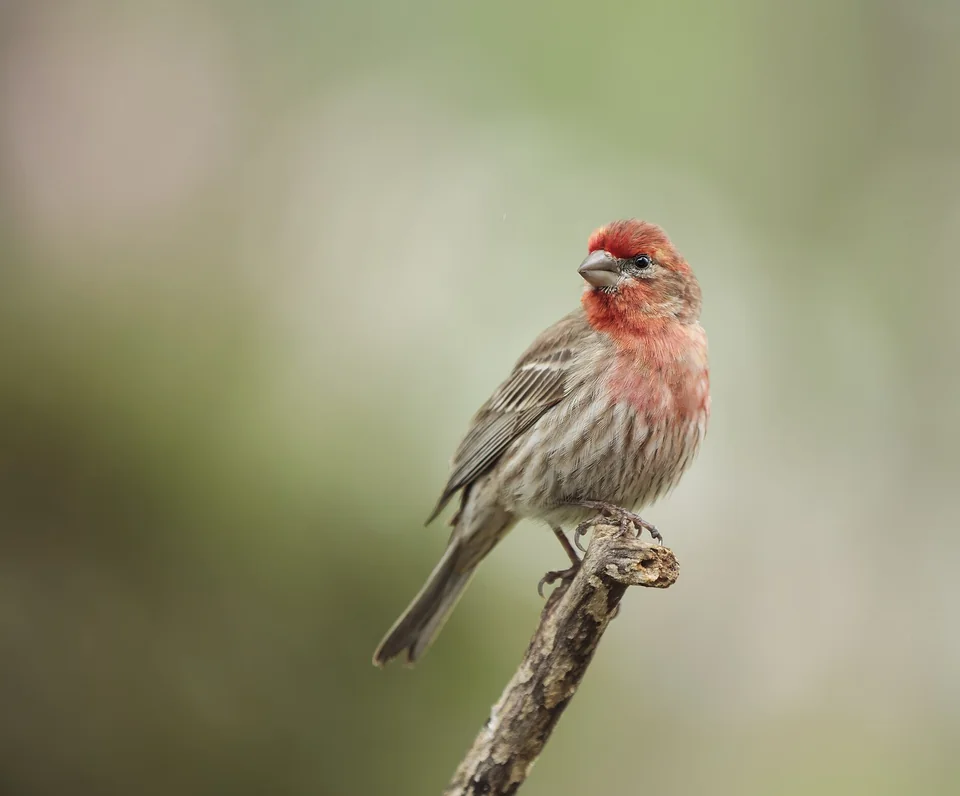
Photo: Shenandoah National Park from Virginia · House Finch (male) (33709417694).jpg · Public domain. Cropped, gently adjusted, and resized for this guide.
“Describe the whole finch before naming it; a missing field mark is a reason to keep the identification open.”
Backyard Birding — editorial takeaway
Take photographs that preserve the field marks
A useful identification image does not have to be beautiful. It must show diagnostic features. Try for one side view of the face and body, one frontal or three-quarter view of the underside, and a back view if the bird allows it. Keep the unedited original, the date, the location, and a rough note on light. Cropping can help a reviewer find the bird; heavy sharpening or color shifts can make streaking and red distribution unreliable.
If several finches arrive together, photograph them as a group before isolating one bird. Relative size and a consistent light source can help. Record which frame belongs to which individual. An app that labels each clip may present several events as several species, but the original sequence could be one bird turning around. Use a short observation log: “rounded brown head; fine side streaks; red forehead and breast; mostly brown back,” rather than “probably House Finch because red.”
Our yard journal shows how to keep a useful record without making it elaborate. If you use a smart feeder, the AI identification guide explains why a proposed label should remain a hypothesis until the image supports it. No amount of software confidence creates a white eyebrow that the camera failed to capture.
Learn the limits of color and season
House Finch males derive their red, orange, or yellow coloration from pigments in their food during feather growth. As a result, an orange or yellow male is not a different species solely because it lacks scarlet red. Purple Finch plumage can vary between eastern and western populations; Cornell's comparison explicitly notes that western males may be more olive and less extensively red. Seasonal wear and molt can alter the crispness of feather edges in both birds.
Camera settings introduce another layer. Automatic white balance can turn a berry-toned bird orange under warm porch light or deepen a brown back. A phone photographed through window glass may add tint. When color and structural evidence disagree, revisit the actual view in natural light rather than making the image more saturated. A field identification should survive a modest change in screen brightness.
This does not mean color is useless. The distribution of color across head, breast, sides, and back is often informative. It means a label such as “red finch” is a starting description, not a diagnosis. Combine pattern with face, streaks, shape, and range. If only the red head appears in one partial frame, stop at a broader identification and look for another observation.
Use behavior and habitat as context, not a shortcut
House Finches are familiar birds around buildings and feeders. Purple Finches often associate with coniferous or mixed woodland and may visit feeders, especially outside breeding season. Those tendencies provide context; they do not replace field marks. A bird at a suburban feeder can be Purple Finch, and a House Finch can perch in a tree. Food choice is also not a reliable separator because both eat seeds and may use similar feeding stations.
Listen if you know the vocalizations, but use recordings carefully. Background birds can call while a different finch sits in frame. A sound from the correct direction and moment can add evidence; an unidentified chirp in a yard full of birds can confuse the case. If you are learning calls, compare verified recordings and keep a note of what you actually heard rather than retrofitting a sound to the bird you wanted.
For feeder design and food suitability, the finch-food guide covers seed and port compatibility. It should support responsible feeding, not become an identification key. An apparently different preference may reflect feeder access or dominance rather than species identity.
Find your situation

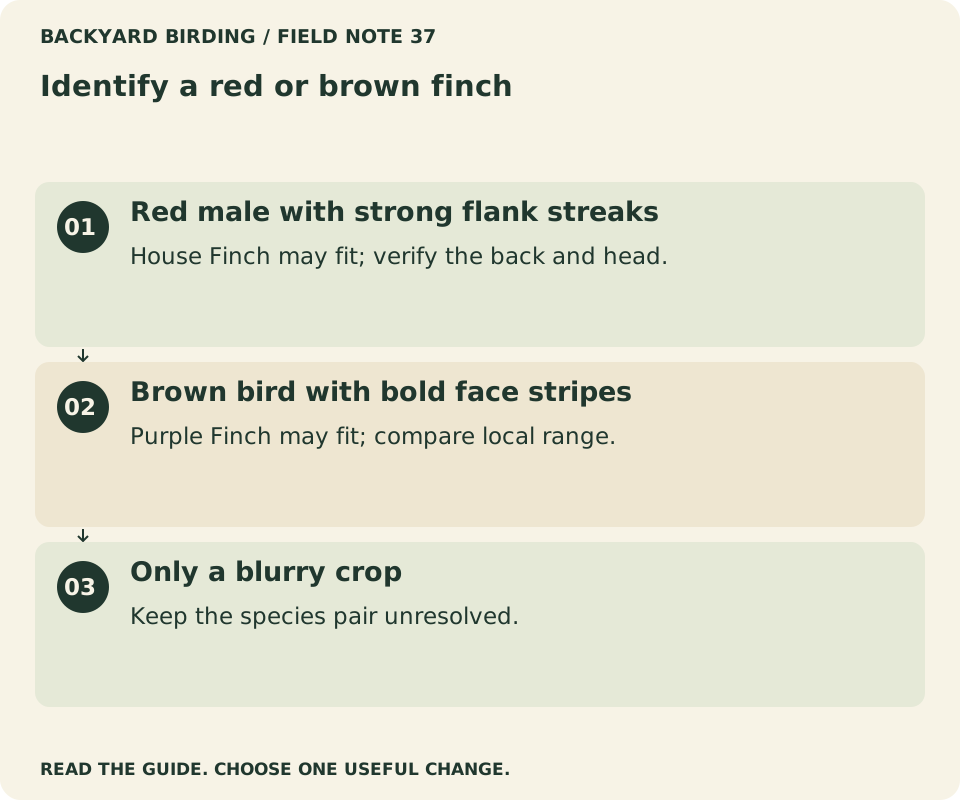
Read the visual as text
- Red male with strong flank streaks. House Finch may fit; verify the back and head.
- Brown bird with bold face stripes. Purple Finch may fit; compare local range.
- Only a blurry crop. Keep the species pair unresolved.
A step-by-step identification workflow
First establish date and place. Check which of House, Purple, and Cassin's Finches are plausible locally. Second, note sex/age class as far as the image allows; compare a brown female with brown-female references, not an adult male plate. Third, describe the face, back, flanks, head shape, and bill before you read an app suggestion. Fourth, compare at least two independent field marks. Fifth, identify what the photograph does not show.
Suppose you see a male with a round head, red centered on the forehead and breast, a brown back, and strong dark streaks down the sides. Those features agree with House Finch. Suppose instead the face and back look washed raspberry, the head looks larger, and the flanks are pale without strong streaks. That combination favors Purple Finch. If you see only a reddish bird from behind at dusk, neither conclusion is secure.
Keep a confidence description such as “House Finch, supported by face, back, and flank pattern,” or “House/Purple Finch, face obscured.” A plain-language confidence note can be more informative than a false percentage. It shows another observer exactly what to review and helps you learn when a future clear view becomes available.
What to do with a confusing female finch
Brown birds deserve as much attention as red ones. Take a side view, then ask whether the eyebrow is clearly pale and strong, whether a dark cheek patch is framed by pale lines, and whether underside streaks are thick against white or fine against dull brown. Do not let one pale feather above the eye stand in for a complete face pattern. Sun glare can create a false bright stripe.
Next compare the head contour and bill in the same frame. A fuller-headed bird with strong face contrast can favor Purple Finch, while a plain-faced, smoothly rounded bird with fine streaking can favor House Finch. In the West, check Cassin's as an additional possibility. When an individual has intermediate-looking features, seek another angle or leave the label unresolved. Real birds do not always pose as clean comparison plates.
If the bird is part of a mixed flock, label individuals separately. A red male of one species beside a brown female does not establish that they are a pair or even the same species. Social proximity at a feeder is weak identification evidence. Use the visible marks on each bird.
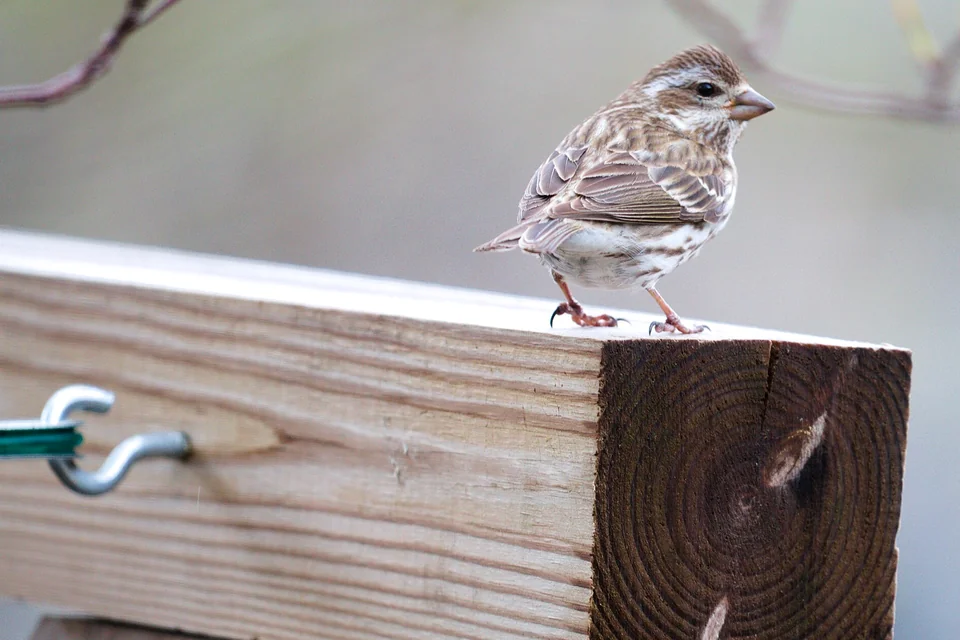
Photo: Mathieu Landretti · Female Purple Finch.jpg · CC BY-SA 4.0. Cropped, gently adjusted, and resized for this guide.
Avoid common mistakes in online photo comparison
Image search results often mix adult males, females, juveniles, different regions, and inconsistent lighting. A close crop may omit the back or flanks that would settle the question. Some photos are mislabeled, and a caption may describe a bird in the background rather than the focal individual. Start with Cornell Lab and Project FeederWatch's curated comparisons, then use other photographs to practice rather than treating a single search image as authority.
Compare your bird with a photograph taken from a similar angle and, where possible, in similar light. Match adult males with adult males rather than treating every reddish finch as the same comparison. Look at how the eyebrow sits above the cheek, where red extends across the back, and how streaks run down the flanks. A photograph's species label helps you find a reference; the visible marks still have to match your own bird.
If you share an uncertain record with a birding group, include the original crop, date, county, and your description of visible marks. Say which candidates you considered. That gives reviewers useful evidence and makes their explanation educational. Posting a heavily processed close-up with no location may attract confident guesses that cannot be checked.
Identification and a healthy feeding station are separate jobs
An identification guide should not distract from feeder care. Finches gather at shared ports and surfaces; if seed is wet, hulls have accumulated, or birds appear ill, clean the station and follow current wildlife guidance. A swollen or crusty eye in a finch is a reason to seek advice about disease response, not a feature that distinguishes House from Purple Finch. Appearance cannot confirm a pathogen.
Keep a modest fill and inspect the food-contact path. The feeder-cleaning guide covers routine care. If you notice a bird acting abnormally, use our sick-bird response guide for the first steps and local-authority route. Do not capture or treat a wild bird on the basis of an online image match.
After reviewing a finch photograph, check the station itself. Look below the ports for damp seed and inspect the tray and ground for accumulated hulls. An interesting visitor can hold your attention while those ordinary jobs wait. Keep a cleaning reminder beside your observation notes so recording the bird and maintaining its feeding surface both get done.
Practice with observations you can verify
For a week, choose two or three finch visits and describe the bird before opening a field guide. Record “plain brown face, fine streaks, rounded head” or “bold pale eyebrow, dark cheek, coarse streaks,” then compare with Cornell's species accounts. If your first answer changes, write down which field mark changed it. That reflection builds skill faster than remembering a name alone.
Try a paired exercise: look at one adult male and one brown female from curated reference photos. Notice that the decisive pattern is not the same for both. For the male, distribution of reddish color and flank streaking may lead; for the female, face pattern and underside contrast often carry more weight. Revisit your own photographs without looking at labels first. If a key feature is missing, note the next angle you want at the feeder.
Keep the description with the photograph, whether you confirm House Finch, favor Purple Finch, or leave the species unresolved. A later view may show the eyebrow, back, or flank pattern that was hidden. Add that new observation alongside the first note so you can see which detail changed the identification.
Small mistakes. Better moves.

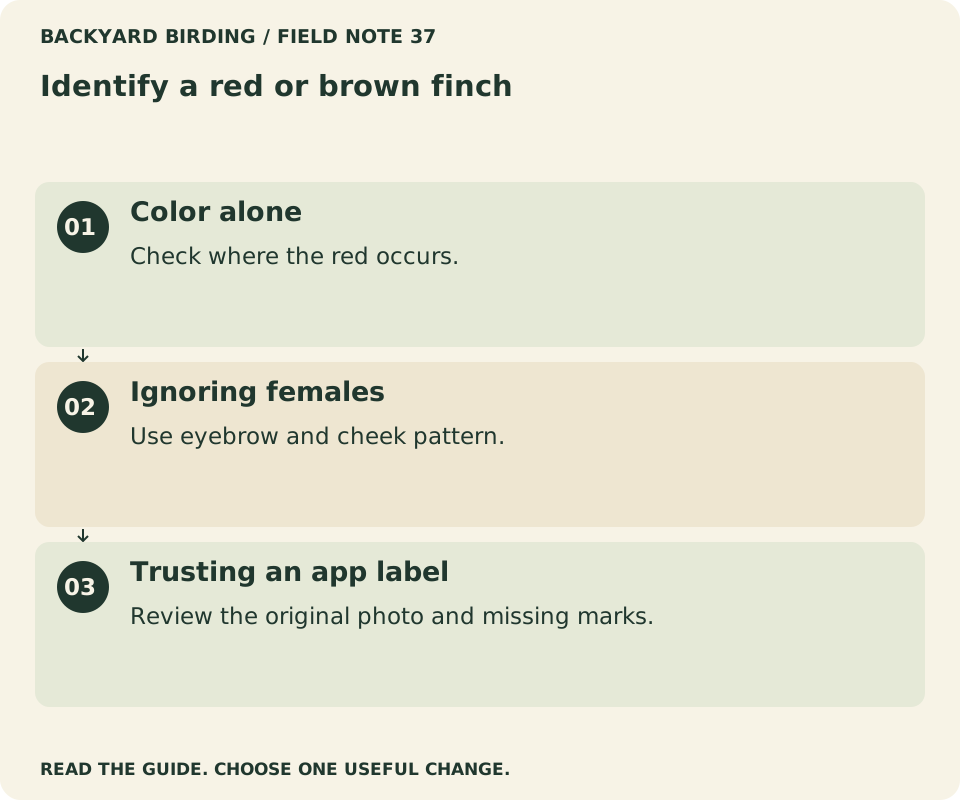
Read the visual as text
- Color alone. Check where the red occurs.
- Ignoring females. Use eyebrow and cheek pattern.
- Trusting an app label. Review the original photo and missing marks.
A two-bird comparison can sharpen the evidence
When two finches share the frame, use them as a controlled comparison only if both are in similar light and distance. A bright male beside a dull female is not a fair red-color test; sex and age differ. Two brown birds at the same feeder may make face contrast and streak pattern easier to notice, but they can still be different ages or species. Describe each individual first, then compare corresponding features.
Look for the same structures in both: eyebrow, cheek, bill, breast background, flank marks, and tail. Avoid letting one confident identification determine the other by contrast alone. If one bird is clearly a House Finch, the bird beside it is not automatically Purple Finch merely because it looks different. It could be another House Finch in different plumage. Record which feature actually separates them and retain the original uncropped frame so another observer can assess the comparison.
Answer the question your feeder visitor actually raises
When a reddish finch arrives, do not ask only, “Is it purple enough?” Ask where the red sits, whether the back is reddish or brown, how strongly the sides are streaked, and what the head and bill look like. When a brown finch arrives, ask whether the face carries a bold pale eyebrow and cheek pattern. Add date and local likelihood, then stop where the visible evidence stops.
If you have a clear photograph, the Cornell and Project FeederWatch comparisons can make the next identification satisfying and defensible. If you do not, keep a brief uncertainty note and watch again. The point of learning these two finches is not a perfect score at every feeder visit; it is to see more of the bird each time it appears.
Watch it. Then try it.
Review the steps and common mistakes in two short, silent animations. Each has a complete text transcript below.
Your four-step action map
Read the complete video transcript
Identify a red or brown finch.
- Check location. Find the plausible species for this season.
- Describe the bird. Note face, back, flanks, shape, and bill.
- Compare like with like. Match the same sex, age, and view.
- Record confidence. Name the bird only as far as the evidence supports.
Try the steps, then note any problem that still needs attention.
Three mistakes to avoid
Read the complete video transcript
Identify a red or brown finch.
- Color alone. Check where the red occurs.
- Ignoring females. Use eyebrow and cheek pattern.
- Trusting an app label. Review the original photo and missing marks.
Try the steps, then note any problem that still needs attention.
Both animations use this real photograph by Robert Taylor from Stirling, ON, Canada. Photo source · CC BY 2.0. The photo is adapted into original educational animations, not recordings of a field test.
At a glance
| Your situation | Our conclusion | Your next action |
|---|---|---|
| Red male with strong flank streaks | House Finch may fit; verify the back and head. | Use the field-mark checklist. |
| Brown bird with bold face stripes | Purple Finch may fit; compare local range. | Record the full observation. |
| Only a blurry crop | Keep the species pair unresolved. | Check AI label limits. |
Sources & evidence
- Project FeederWatch: Tricky finch identification
- Cornell Lab: Purple Finch comparison
- Cornell Lab: Bird ID skills: color pattern
Our standard: real evidence before ratings. Corrections follow our editorial process.
Our verdict & your next actions
Choose the row that describes your setup, then follow the suggested check or adjustment.
| Your situation | Our verdict | Your next action |
|---|---|---|
| Red male with strong flank streaks | House Finch may fit; verify the back and head. | Use the field-mark checklist. |
| Brown bird with bold face stripes | Purple Finch may fit; compare local range. | Record the full observation. |
| Only a blurry crop | Keep the species pair unresolved. | Check AI label limits. |
Your pocket field checklist
Tick off the steps as you go.
0 of 4 steps completed
Keep building your knowledge in birds, or search the full backyard library.