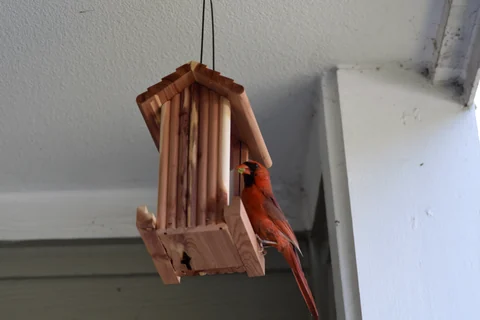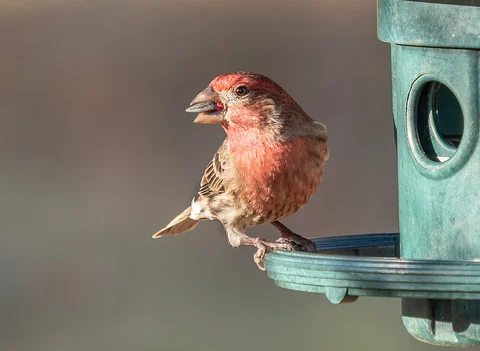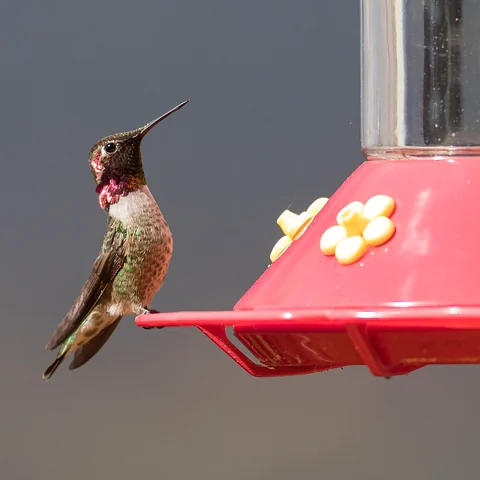
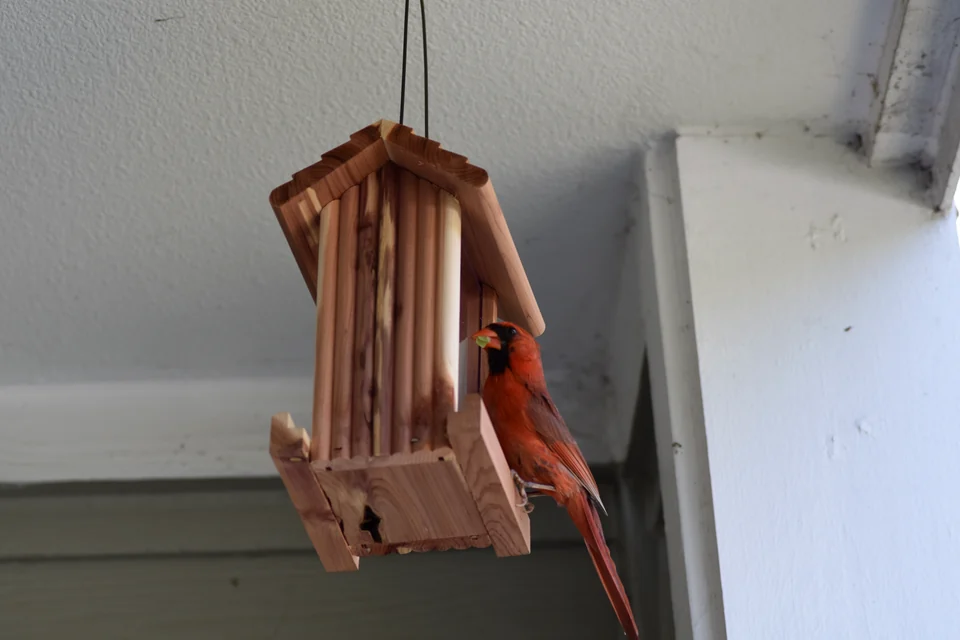
Photo: Slakshmin · A real feeding visit is useful context for choosing equipment; this photograph is not a product test by our publication. · CC BY-SA 4.0. Cropped, gently adjusted, and resized for this guide.
The short answer
For seed, compare a feeder with reachable ports and a removable base. For nectar, choose an accessible reservoir you can empty and wash frequently. The two examples below serve those different jobs.
What makes a bird feeder a good buy?
The best feeder for a backyard is not necessarily the one with the largest reservoir, the most ports, or the longest feature list. It is the feeder that presents suitable food, fits the available location, and remains practical to clean. A purchase that fails any one of those tests can become an expensive source of frustration.
The comparisons below draw on bird-feeding guidance and manufacturer information; they are not hands-on product tests. Use them to build a shortlist, then check the exact model's manual. Pay particular attention to how it opens, the food it accepts, the mounting clearance it needs, and what comes in the box.
Choose a category before comparing brands
Start by deciding what you want to offer. A general seed station, a nyjer feeder for small finches, a suet cage, and a nectar feeder meet different needs. Trying to rank them on one scale obscures the useful question: what job does your yard need a feeder to do?
For a first seed feeder, compare a cleanable tube with a cleanable hopper. If you already have a reliable seed setup, identify what an additional feeder would change. A separate food type may create a meaningful option. A second large reservoir filled with the same mix may simply double the washing without solving a specific problem.
Treat cleaning access as a buying requirement
Request the manual and look for removable floors, accessible ports, and parts that drain. Decorative seams can hide residue; permanently fixed bases can make it difficult to remove the oldest seed. Consider the brushes and washing space you have, rather than imagining equipment you might buy later.
Check the care instructions for the material. Do not assume that every feeder is dishwasher-safe or that every coating tolerates the same cleaner. A product should make its maintenance requirements clear before purchase. If the seller cannot explain how the food chamber opens, that uncertainty deserves more weight than an attractive lifestyle photograph.
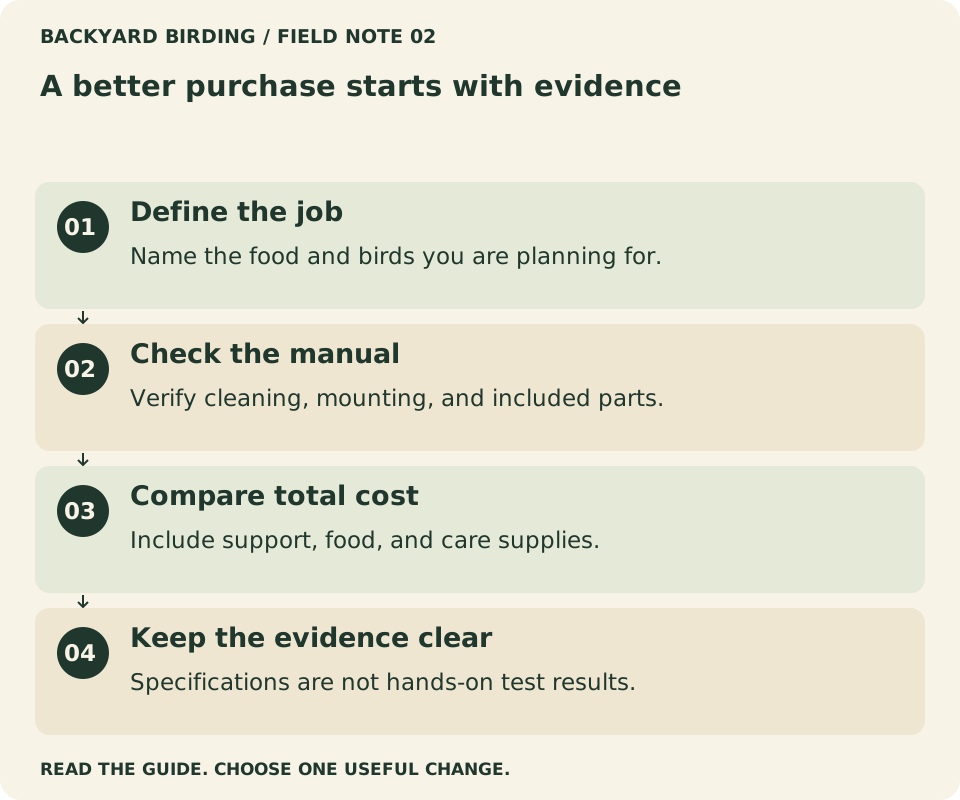
Your visual action map

Read the visual as text
- Define the job. Name the food and birds you are planning for.
- Check the manual. Verify cleaning, mounting, and included parts.
- Compare total cost. Include support, food, and care supplies.
- Keep the evidence clear. Specifications are not hands-on test results.
Look beyond the advertised capacity
Capacity describes how much food fits, not how long you should leave it there. Useful capacity depends on visits, weather, and your inspection routine. A smaller fill makes it easier to see whether food is moving through the feeder and reduces the amount you may need to discard after rain.
Consider handling as well. Imagine lifting the filled feeder down with one hand while opening a gate or carrying a cleaning container. A heavy reservoir may be inconvenient even when the birds eat quickly. Compare the working weight and mounting process, not simply the number printed beside the product name.
| Buying priority | Evidence to ask for | Weak substitute |
|---|---|---|
| Cleanability | Manual showing separated parts | A claim that it is hygienic |
| Food compatibility | Specific recommended seed types | A photograph of mixed seed |
| Weather handling | Drainage and accessible wet areas | A roof alone |
| Repairability | Listed replacement parts | An unsupported durability slogan |
| Squirrel resistance | Installation and mechanism instructions | The word squirrel-proof |
| Value | Complete setup and maintenance costs | Reservoir size per dollar |
Research example: a weight-activated seed feeder
The Brome Squirrel Buster Standard is a useful example of a product whose appeal depends on installation. Its manufacturer describes a weight-sensitive feeding mechanism. That description is a specification, not evidence that we have measured squirrel exclusion, bird acceptance, or long-term reliability.
Before considering it, read the current instructions for mounting, clearance, adjustment, and cleaning. Ask how the mechanism works when the feeder is correctly suspended, and whether a nearby branch or rail would allow an animal to reach food without loading the intended part. Check the exact model name: a feature on another Squirrel Buster model should not be assumed to apply to the Standard.
Build a complete cost comparison
Include the feeder, mounting equipment, any compatible baffle, an initial food supply, and basic cleaning tools. Then consider recurring costs. A design that spills your chosen seed may be less economical than one with a higher purchase price. A model with replaceable parts may be easier to keep in service after an accidental break.
Do not assign imaginary dollar savings to those possibilities. Instead, write down what is included, what is extra, and what remains unknown. If a seller's listing is ambiguous about the pole or hanging bracket, resolve that before checkout. Comparing complete setups is more informative than comparing two headline prices.
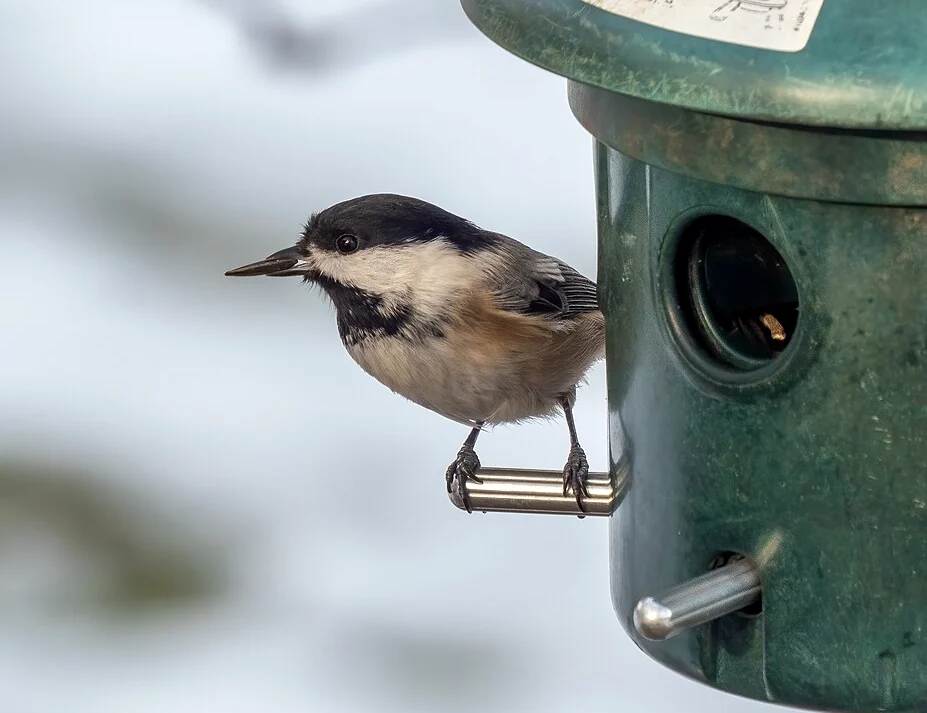
Photo: Rhododendrites · Black-capped chickadee (31171).jpg · CC BY-SA 4.0. Cropped, gently adjusted, and resized for this guide.
Inspect the feeder before filling it
Open the packaging while you still have the instructions and return information. Check for sharp damage, incomplete parts, stiff latches, and an insecure closure. Assemble it as directed, then take it apart again. This is the right time to discover a missing part or an awkward cleaning step.
Once installed, begin with a modest fill and watch how food reaches the ports. Keep notes on actual problems: a stuck channel, a loose mount, water in the base. Separate those observations from normal variations in bird activity. A quiet afternoon does not prove the equipment is defective.
Read marketing claims as questions to investigate
Weatherproof should prompt you to examine joints, drainage, and the exposed food area. Easy-clean should prompt you to request the disassembly instructions. Squirrel-proof should prompt you to look for required clearances and mounting conditions. The useful response to a broad claim is a specific question about how the design works.
Do not assume that a claim is false simply because it is marketing, but do not treat it as a completed test either. Look for the evidence relevant to your use. A manufacturer can establish dimensions or explain a mechanism; a statement about long-term field performance requires a different kind of support. Keeping that distinction clear makes comparisons more informative.
Separate must-have features from preferences
Write two lists. The first contains requirements: compatible food, reachable cleaning surfaces, suitable mounting, and manageable handling. The second contains preferences: a particular finish, decorative shape, extra capacity, or a matching set of accessories. A product should satisfy the first list before the second decides the purchase.
This prevents a common shopping compromise in which an appealing design gradually turns an inaccessible base into a minor concern. It is reasonable to care about appearance; the feeder will be part of your yard. Appearance should help choose among workable products rather than persuade you to accept one whose everyday care you already know will be difficult.
Find your situation

Read the visual as text
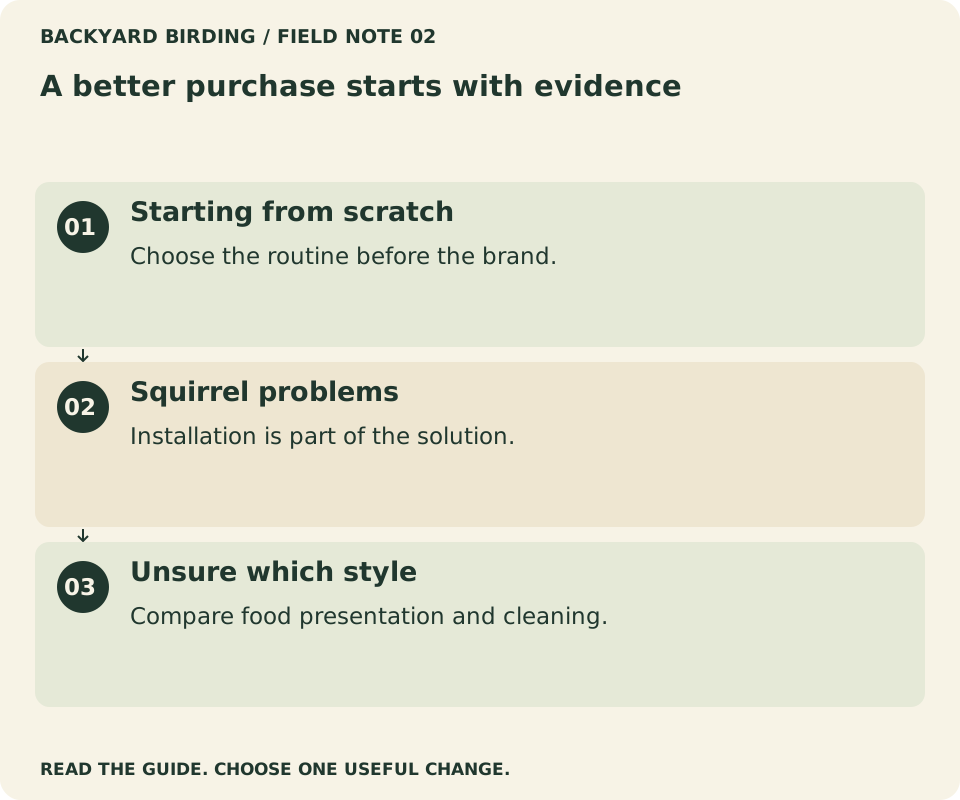
- Starting from scratch. Choose the routine before the brand.
- Squirrel problems. Installation is part of the solution.
- Unsure which style. Compare food presentation and cleaning.
Ask whether parts can be replaced
A broken lid, perch, or hanging component does not always require a new feeder. Check whether the manufacturer lists spare parts for the exact model and whether those parts are realistically available where you live. Save the model number because visually similar generations may use different fittings.
Repairability is not a guarantee that a feeder will last indefinitely. It is a practical option when a specific component fails. Compare the part cost and handling effort with replacement, and do not continue using damaged equipment while waiting if the damage affects safe operation. A clear parts diagram can be more valuable than an unqualified durability slogan.
Consider the support as carefully as the feeder body
Check whether a pole, bracket, hook, or clamp is included and whether it fits the intended location. Review load and installation instructions. A feeder photographed on an attractive pole may be sold without that pole, and a clamp designed for one surface may not be appropriate for another.
Plan how the support affects access routes and cleaning. A sturdy pole in an unsuitable location can still allow a squirrel bypass. A beautiful hanging bracket above a difficult reach can discourage maintenance. The purchase is a functioning setup, so the shortlist should include the support needed to make each candidate usable.
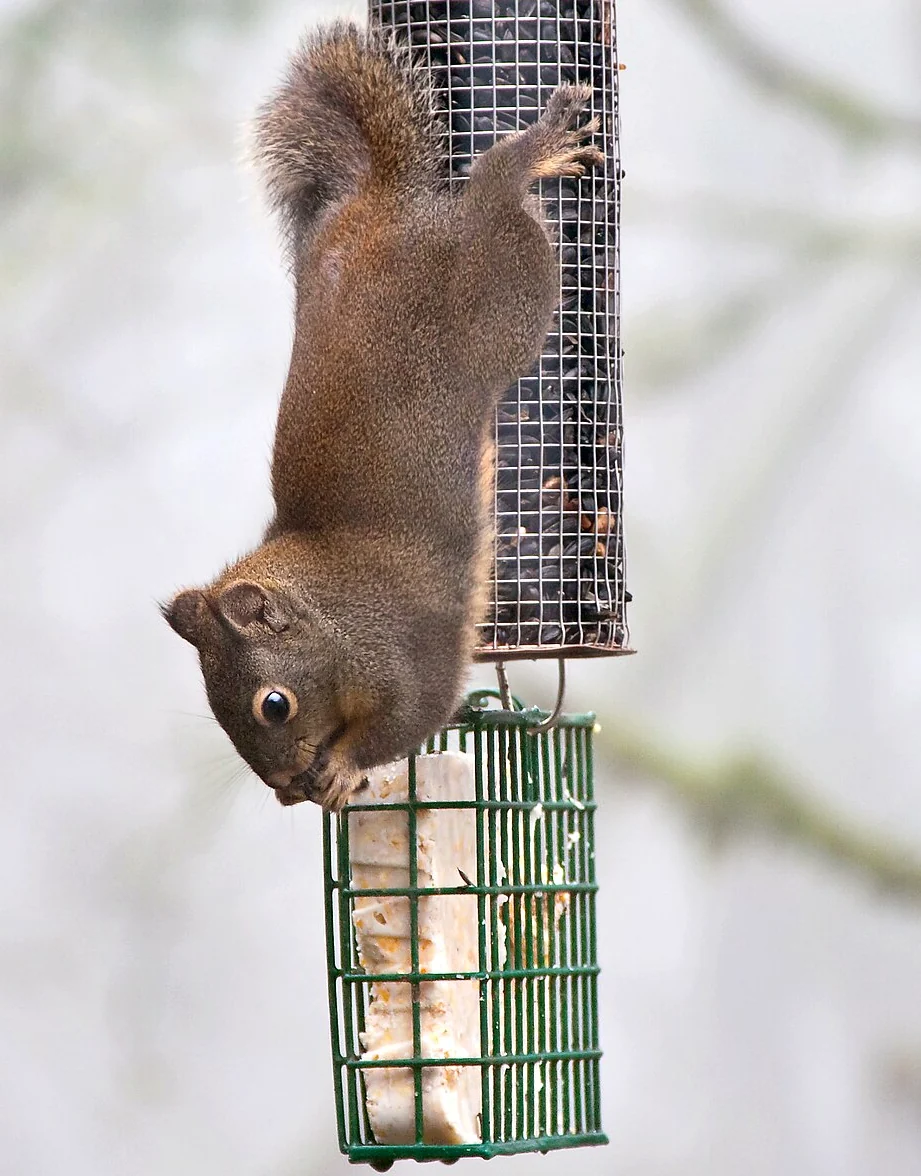
Photo: Sheila Sund from Salem, United States · Squirrel at bird feeder (8412202406).jpg · CC BY 2.0. Cropped, gently adjusted, and resized for this guide.
Compare three ownership scenarios
For a person who enjoys a daily yard round, a feeder with a broad surface that is easy to inspect may fit comfortably. The extra attention is part of an established routine. Compare whether its removal and cleaning remain simple when the weather is unpleasant, not only on a sunny afternoon.
For someone with limited storage space, a compact feeder and small food purchases may make more sense than maximum capacity. Check where the cleaned parts will dry and where the supply will stay protected. The footprint inside the home matters alongside the footprint in the garden.
For a household sharing care, choose a model whose steps are easy to explain. Label the food, keep small parts together, and make the fill amount clear. A mechanism that only one person understands can become unreliable in practice when that person is away.
Look for meaningful evidence in reviews
Useful reviews explain what was used, for how long, where it was installed, and what the reviewer actually observed. Photographs of the base after disassembly or a clear account of a recurring leak help you assess a specific issue. A statement that birds love it without context is less informative.
Be cautious about transferring a review from one model to another or from a different environment to your own. A feeder used beneath a covered porch is not exposed like one on an open pole. A review can still be useful, but the conditions should remain attached to the conclusion. This publication keeps manufacturer research separate from hands-on testing for that reason.
Inspect the first month as an ownership check
Keep notes on the things you can assess directly: assembly, refilling, drainage, cleaning access, mounting stability, and visible food condition. Photograph a defect clearly and retain the purchase information if you need support. Contact the seller or manufacturer while return and warranty options are easy to establish.
Avoid delaying a practical complaint because you hope more bird visits will make the problem irrelevant. An insecure closure or unreachable dirty section remains a design or condition issue even when the feeder is popular. Enjoy the birds while evaluating the equipment on its own working requirements.
Small mistakes. Better moves.

Read the visual as text
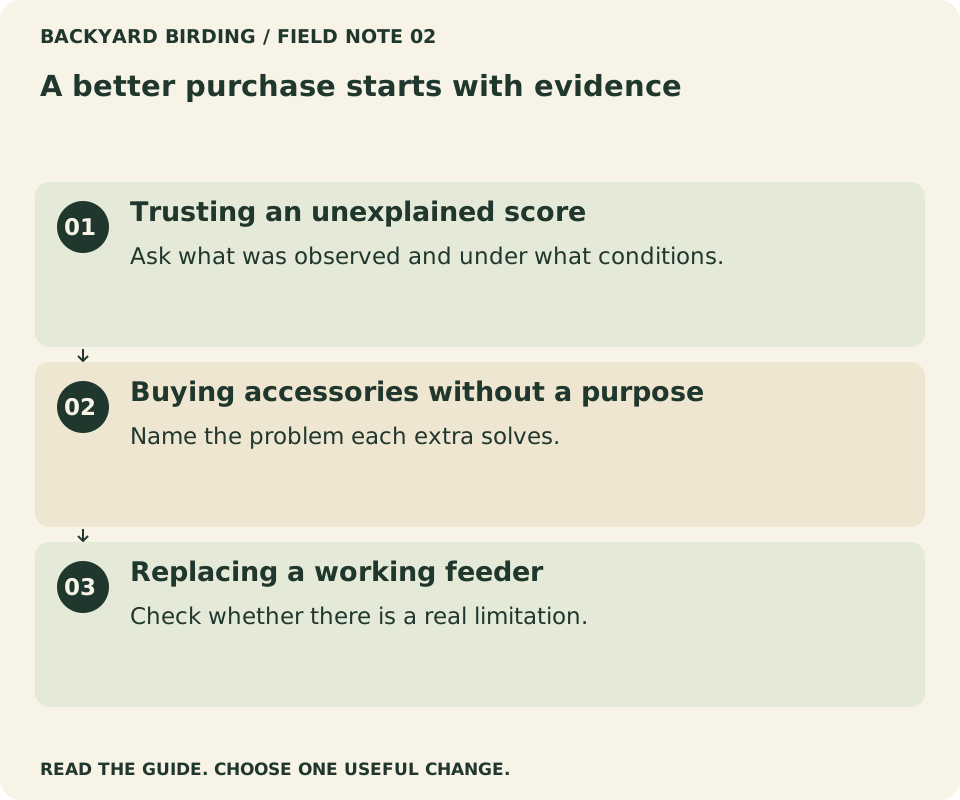
- Trusting an unexplained score. Ask what was observed and under what conditions.
- Buying accessories without a purpose. Name the problem each extra solves.
- Replacing a working feeder. Check whether there is a real limitation.
Know when keeping the current feeder is the best value
If your existing feeder dispenses appropriate food, cleans thoroughly, mounts securely, and has manageable waste, replacement may offer little. Identify the proposed improvement before spending. A different color or an extra port can be enjoyable, but it should be understood as a preference rather than a necessary upgrade.
Maintenance supplies, a better storage arrangement, or suitable window treatment may address a more meaningful need. Consider the feeding station as a whole when deciding where the next dollar should go. The best purchasing advice sometimes results in maintaining a workable setup rather than replacing it.
A final comparison sheet you can reuse
For each candidate, record model, food, mounting, cleaning steps, filled handling, spare parts, total initial cost, and any unresolved question. Mark an unknown as unknown. Then identify which requirement each optional feature serves and remove extras that do not solve a real problem.
Keep the sheet with the manual after purchase. Add the seller, purchase date, and details of any separately bought pole, bracket, or tray. When a part needs replacing, you will have the exact model and compatible accessories together instead of having to identify them again from photographs.
Keep product version information with the purchase
Save the exact name, model number, and manual version when available. Retail listings sometimes combine several sizes or generations, and a review may describe a different item from the one selected in your cart. Check the dimensions, food recommendations, and included hardware again before completing the order.
After delivery, compare the contents with that record. A missing bracket or different base is easier to resolve before installation. If you later order a replacement part, use the saved model information rather than matching only the color or overall shape. Precise identification is a small task that supports cleaner comparisons, better support requests, and more reliable maintenance throughout ownership.
Common purchasing questions
Are expensive feeders better?
Price can reflect materials, mechanisms, electronics, or branding. It does not establish suitability. Pay for features you can connect to a real need, and compare the support and replacement parts behind the purchase.
Should I prioritize squirrel resistance?
If squirrels are already a problem, it belongs in the comparison. Start with access routes and mounting. A mechanism cannot compensate for every installation, and some yards need a location change before another product.
What if no model meets every preference?
Separate essential requirements from optional ones. Safe mounting, accessible cleaning, and suitable food dispensing should remain essential. Color, decorative details, and excess capacity can be negotiable. That distinction usually makes the shortlist much clearer.
Before ordering, check the last unresolved item on your shortlist: the mount, removable base, food compatibility, or replacement part. Once the feeder arrives, unpack and assemble it while you can still compare the contents with the order and ask the seller about anything missing.
For the next part of your setup, read Binoculars for Backyard Birding: Choose by Fit, Focus, and View.
Watch it. Then try it.
Review the steps and common mistakes in two short, silent animations. Each has a complete text transcript below.
Your four-step action map
Read the complete video transcript
A better purchase starts with evidence.
- Define the job. Name the food and birds you are planning for.
- Check the manual. Verify cleaning, mounting, and included parts.
- Compare total cost. Include support, food, and care supplies.
- Keep the evidence clear. Specifications are not hands-on test results.
Try the steps, then note any problem that still needs attention.
Three mistakes to avoid
Read the complete video transcript
A better purchase starts with evidence.
- Trusting an unexplained score. Ask what was observed and under what conditions.
- Buying accessories without a purpose. Name the problem each extra solves.
- Replacing a working feeder. Check whether there is a real limitation.
Try the steps, then note any problem that still needs attention.
Both animations use this real photograph by Slakshmin. Photo source · CC BY-SA 4.0. The photo is adapted into original educational animations, not recordings of a field test.
At a glance
| Need | Look for | Do not assume |
|---|---|---|
| Seed feeder with squirrel pressure | A suitable weight mechanism and placement | That a mechanism works from every mounting position |
| Hummingbird station | A small, accessible nectar reservoir | That bigger capacity is better |
| Low maintenance | Parts you can reach and dry | That “easy-clean” has been independently tested |
Products to compare
Compare the features and current manufacturer instructions for your intended setup. These are research-based comparisons, not hands-on tests.
Squirrel Buster Standard
Readers researching a seed feeder for squirrel pressure
- Brand
- Brome
- Type
- Weight-activated seed feeder
- Capacity
- 1.3 lb seed; 4 ports (manufacturer specification)
- Price
- Check the current offer with the seller
Why consider it
- Published capacity and port count
- Designed around a weight-activated feeding mechanism
What remains uncertain
- Placement remains important
- No independent performance or durability test published here
Who should skip: A nectar feeder buyer or anyone needing proven performance data from this publication
See manufacturer specifications ↗HummZinger HighView 12 oz.
Readers comparing a conventional nectar feeder
- Brand
- Aspects
- Type
- Nectar feeder
- Capacity
- 12 oz. (manufacturer specification)
- Price
- Check the current offer with the seller
Why consider it
- Clearly identified model: Aspects #429
- Modest, published nectar capacity
What remains uncertain
- No hands-on leak or cleaning test published here
- Capacity does not determine a safe refill schedule
Who should skip: A seed-feeder buyer or anyone seeking camera features
See manufacturer specifications ↗Sources & evidence
- Project FeederWatch: Feeder types
- Cornell Lab: How to clean your bird feeder
- Brome: Squirrel Buster Standard
Our standard: real evidence before ratings. Corrections follow our editorial process.
Our verdict & your next actions
Choose the row that describes your setup, then follow the suggested check or adjustment.
| Your situation | Our verdict | Your next action |
|---|---|---|
| Starting from scratch | Choose the routine before the brand. | Build the beginner setup. |
| Squirrel problems | Installation is part of the solution. | Map the access route. |
| Unsure which style | Compare food presentation and cleaning. | Explore feeder types. |
Your pocket field checklist
Tick off the steps as you go.
0 of 4 steps completed
Keep building your knowledge in bird feeders, or search the full backyard library.