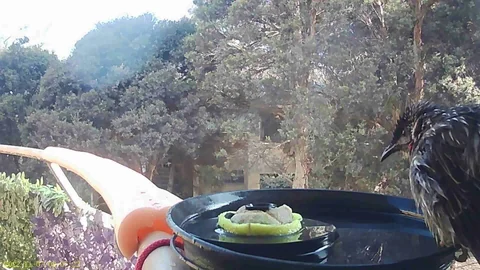
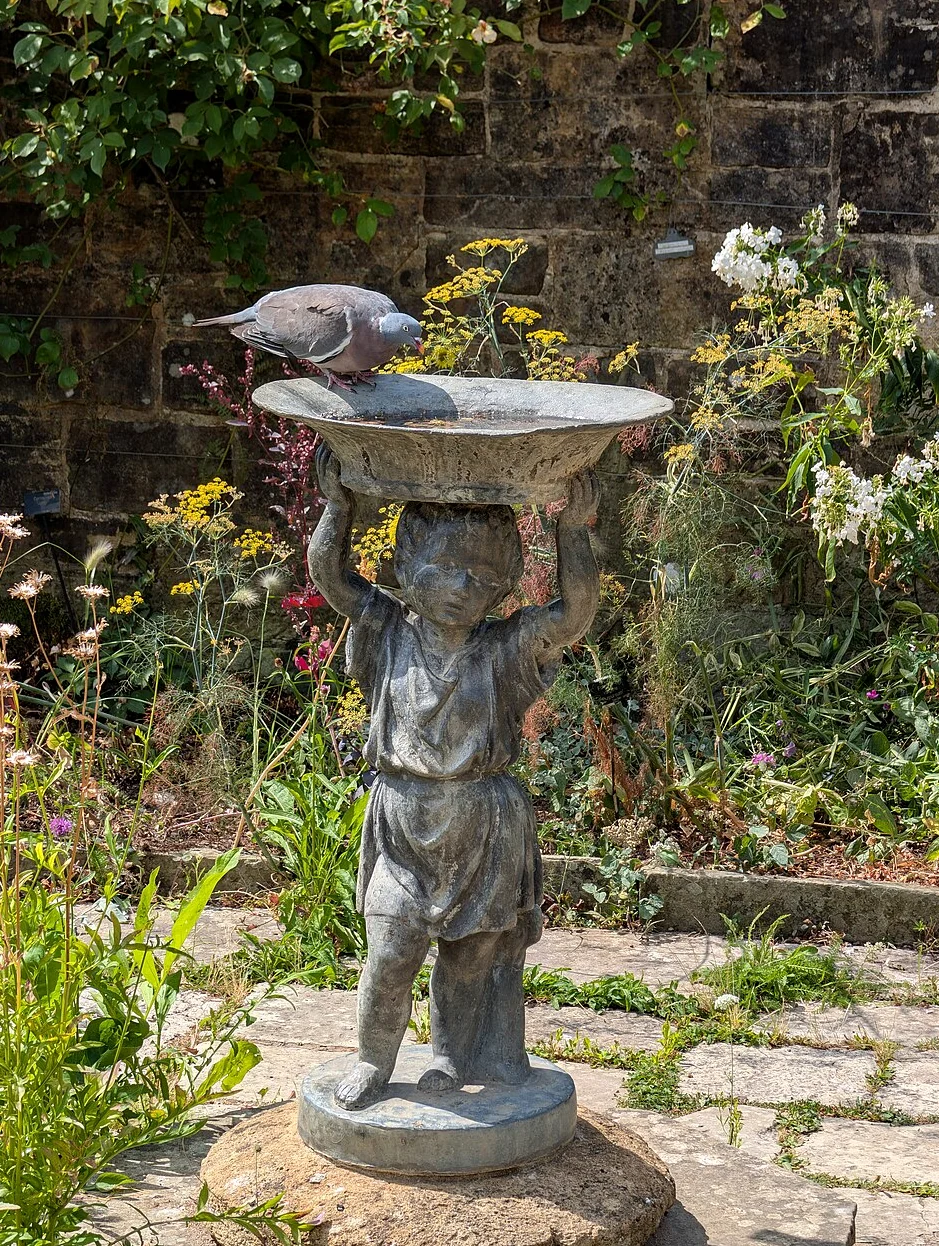
Photo: Andy Li · Wood pigeon drinking from a bird bath - Nymans 2026-07-31.jpg · CC0. Cropped, gently adjusted, and resized for this guide.
The short answer
Choose a shallow basin with a gentle approach and secure footing. Cornell recommends roughly one inch at the edge, increasing to no more than about two inches in the middle.
Measure the water birds can actually stand in
A birdbath's advertised depth often describes the bowl rather than the water you should offer. The useful measurement is the distance from the filled water surface to the footing at the edge and toward the center. A dramatic deep basin may be attractive as garden furniture while offering poor access for small visitors.
Cornell's birdbath guidance recommends a shallow profile: roughly one inch at the edge, increasing to no more than about two inches in the middle. Think of that as a practical starting shape, not a requirement to fill every basin to its rim. An accessible approach and stable footing matter alongside the number on a ruler.
A gentle approach is more useful than a deep reservoir
Imagine a cross-section through the bowl. A gradual slope provides several standing depths. A steep-sided container can have the same center depth while giving a small bird little room to enter cautiously. The shape of the usable area therefore matters as much as its deepest point.
Inspect the rim as well. Is there somewhere stable to land? Does the surface become slippery when wet? A basin that looks manageable when dry may behave differently once filled. Test the setup on level ground and watch how the water distributes before deciding that the design is ready.
How to check a basin at home
Place the bath on its intended stable support and fill it to the level you plan to maintain. Use a ruler at several positions: the approach, a point partway in, and the center. If the bowl is irregular, check more than one side. A tilted support can create a deep pocket on one edge and a nearly dry surface on the other.
Record or mark a sensible fill level where you can see it during refilling without adding unsafe material to the bathing surface. The goal is repeatability. If several people care for the bath, they should not have to guess whether full means the rim, a decorative line, or the shallow level you intended.
| Part of the setup | What to check | Why it matters |
|---|---|---|
| Entry area | A shallow, gradual approach | Birds can assess and enter the water |
| Center | Avoid excessive depth | A large reservoir is not the main objective |
| Footing | Stable, nonslippery contact surfaces | Depth alone does not ensure usable access |
| Support | Level and secure under a full basin | Tilt changes both depth and stability |
| Fill routine | A repeatable water level | Different caretakers can maintain the same setup |
| Cleaning access | Every surface remains reachable | Added objects must not hide contamination |
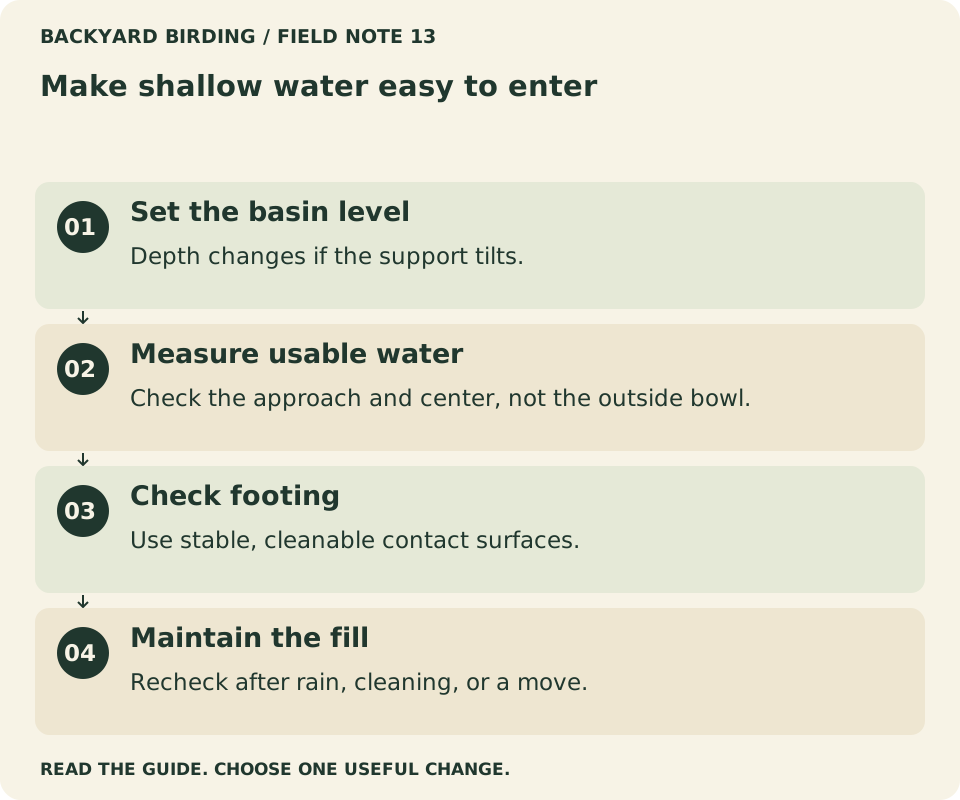
Your visual action map

Read the visual as text
- Set the basin level. Depth changes if the support tilts.
- Measure usable water. Check the approach and center, not the outside bowl.
- Check footing. Use stable, cleanable contact surfaces.
- Maintain the fill. Recheck after rain, cleaning, or a move.
Can stones improve a bowl that is too deep?
Stable, clean stones can create shallower standing areas in some suitable basins, and birdbath guidance commonly includes them as an access aid. They must sit securely rather than rock or roll under contact. Leave usable water and make sure the arrangement does not become an unstable pile.
Consider the cleaning consequences before adding many objects. Every stone and the surface beneath it need inspection and cleaning. If the only way to make a bowl usable is to fill it with a complicated mass of pieces, a naturally shallow basin may be the better choice. An improvised adjustment should make the whole routine simpler, not merely improve its appearance in a photograph.
Match the material to both footing and maintenance
Concrete, stone, ceramic, metal, and plastic differ in weight, surface finish, and care requirements. None can be judged by material name alone. A textured basin can provide a useful surface but may require more attention in its irregularities; a smooth decorative finish may be easy to wipe but slippery when wet.
Read the manufacturer's instructions for cleaning and weather exposure. Consider whether you can empty the bowl without risky lifting. A heavy basin that cannot be moved easily needs a practical way to remove the water and reach the bottom. The right material is one you can use and maintain safely in the chosen location.
Depth changes as you use the bath
Evaporation, splashing, rain, and refilling change the water level. A shallow bath may need more frequent attention precisely because it does not hold a large volume. That is a maintenance consideration, not a reason to make it much deeper for convenience.
Check after rain as well as during dry weather. A basin filled to the intended level yesterday may overflow or exceed that level after a storm. Look at the actual water, not just the calendar. If you cannot inspect it regularly, choose a simpler arrangement or temporarily remove it until care is available.
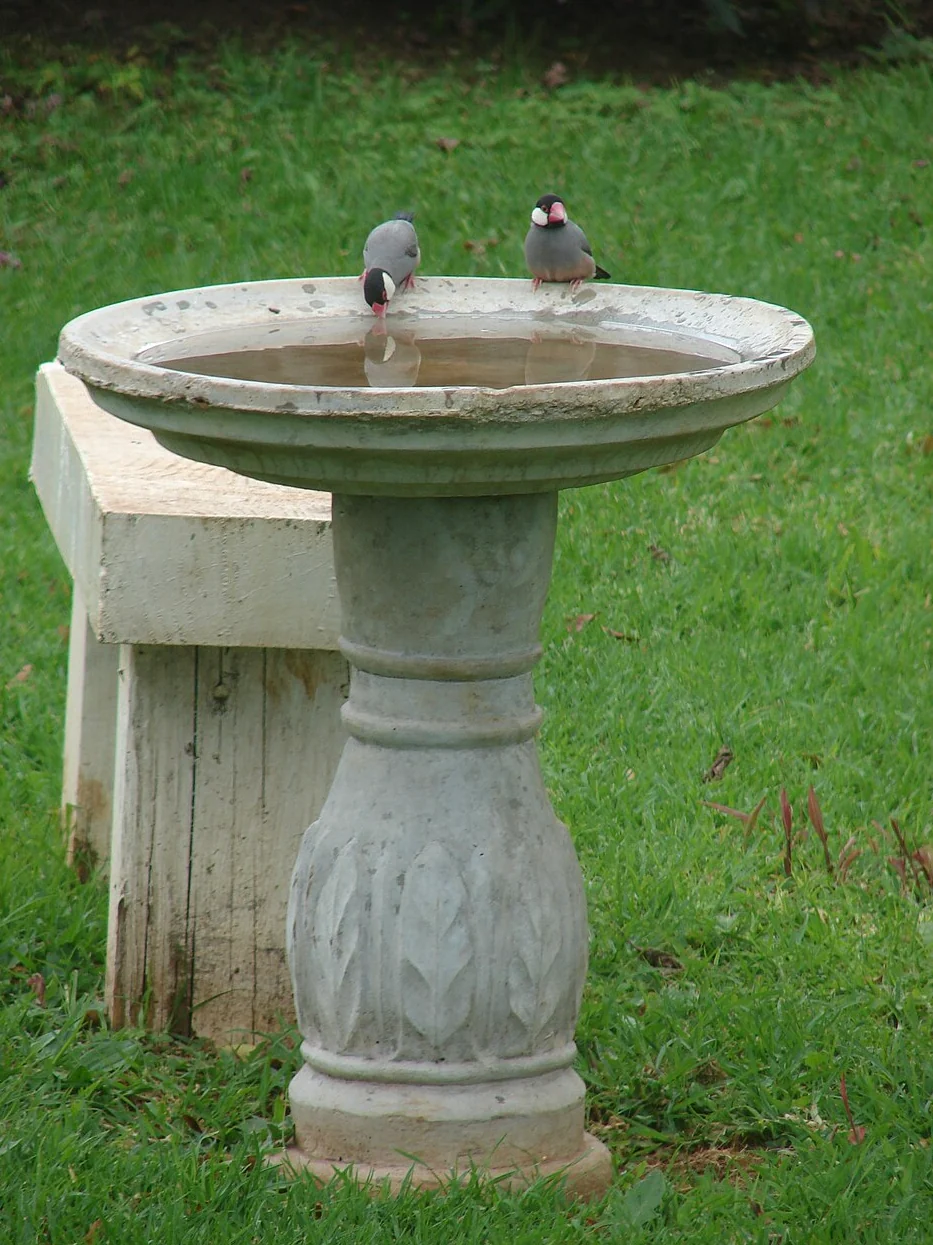
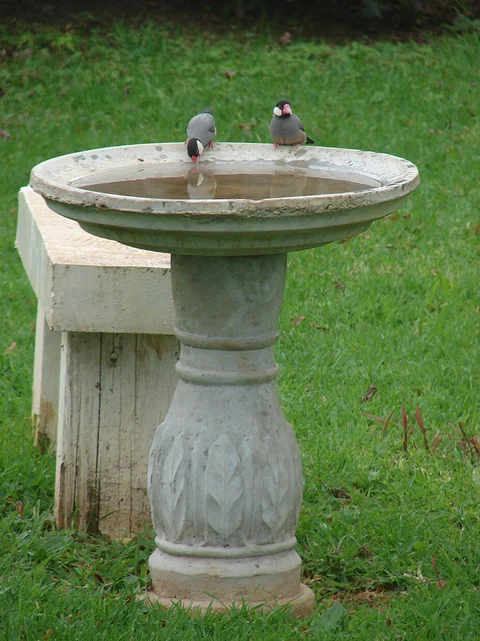
Photo: Forest & Kim Starr · Starr 080215-2865 Lonchura oryzivora.jpg · CC BY 3.0. Cropped, gently adjusted, and resized for this guide.
Position it for birds and for the person cleaning it
Look for a location where the basin stays stable, you can approach comfortably, and you can observe from a distance. Consider nearby cover, pets, glass, and the material that can fall into the water. Directly beneath a feeder may lead to unnecessary seed and debris in the bowl.
Do not select the site solely because a hose reaches it. Water supply is useful, but you also need a safe way to empty and scrub the bath. If the support is narrow or awkward to reach, solve that before filling. A well-placed modest basin can be more successful as a care routine than a spectacular feature you avoid maintaining.
Ground-level and pedestal baths
A ground-level basin may be easy to refill but deserves a careful look at pets and the surrounding approach. A pedestal raises the water and can improve your view, but the base and bowl must remain stable. Neither height automatically resolves every concern.
Inspect the full support, including the surface underneath. Soil can settle, a deck can slope, and an uneven paver can make the bowl rock. Check stability with the basin filled, because water adds weight. Follow the product's mounting instructions rather than balancing a heavy bowl on an improvised narrow object.
Moving water does not replace shallow access
A dripper or suitable fountain can add movement, but the pump and fittings should not consume the usable standing area or create awkward obstacles. Review the minimum water level required by the equipment and compare it with the shallow level suitable for the basin. If those requirements conflict, choose compatible equipment rather than filling the bath too deeply.
Powered parts introduce care instructions of their own. Disconnect and handle them as directed before cleaning. Keep cords and connections appropriately installed and do not improvise electrical work around water. This guide concerns basin access; follow the product's instructions for the powered system and obtain qualified help when installation requires it.
Find your situation

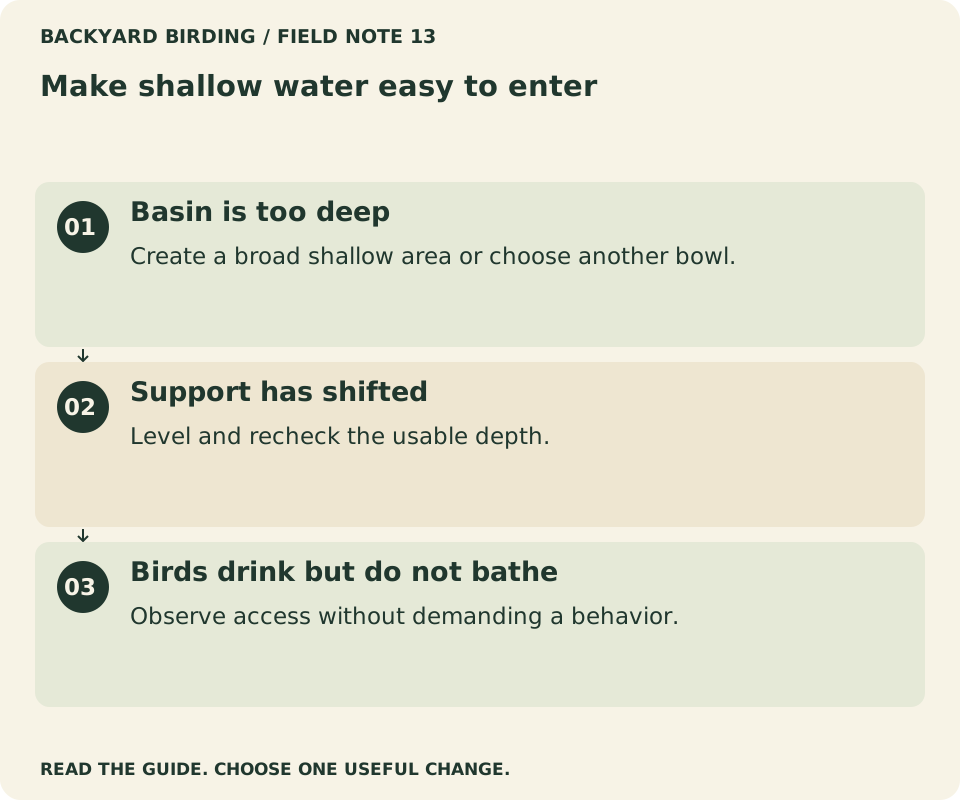
Read the visual as text
- Basin is too deep. Create a broad shallow area or choose another bowl.
- Support has shifted. Level and recheck the usable depth.
- Birds drink but do not bathe. Observe access without demanding a behavior.
Observe the first visits without constantly changing the setup
Once the bath is clean, stable, and shallow, watch from indoors or another quiet position. Note whether birds land on the rim, enter the water, or leave without bathing. One visit cannot prove a design is wrong. Birds may approach cautiously, and activity varies with the surroundings.
If several observations suggest a difficulty, identify the specific feature: slipping, unstable footing, a steep entry, or disturbance nearby. Adjust that feature and observe again. Repeatedly moving the entire bath after every quiet day makes it difficult to learn whether the design or your activity is affecting use.
An example: adapting a decorative basin
Suppose a bowl measures four inches deep when filled to the rim. Do not assume that its capacity is the recommended fill. First see whether a lower water level creates a usable edge; in a steep bowl it may not. Then evaluate whether a small number of secure stones can create an accessible shallow area that remains easy to clean.
If the result is a tiny island surrounded by a steep drop, the adaptation may still be unsatisfactory. A separate shallow insert or a different basin may make more sense, provided it sits securely and can be maintained. The goal is a broad, usable bathing area, not merely one point where the ruler reads two inches.
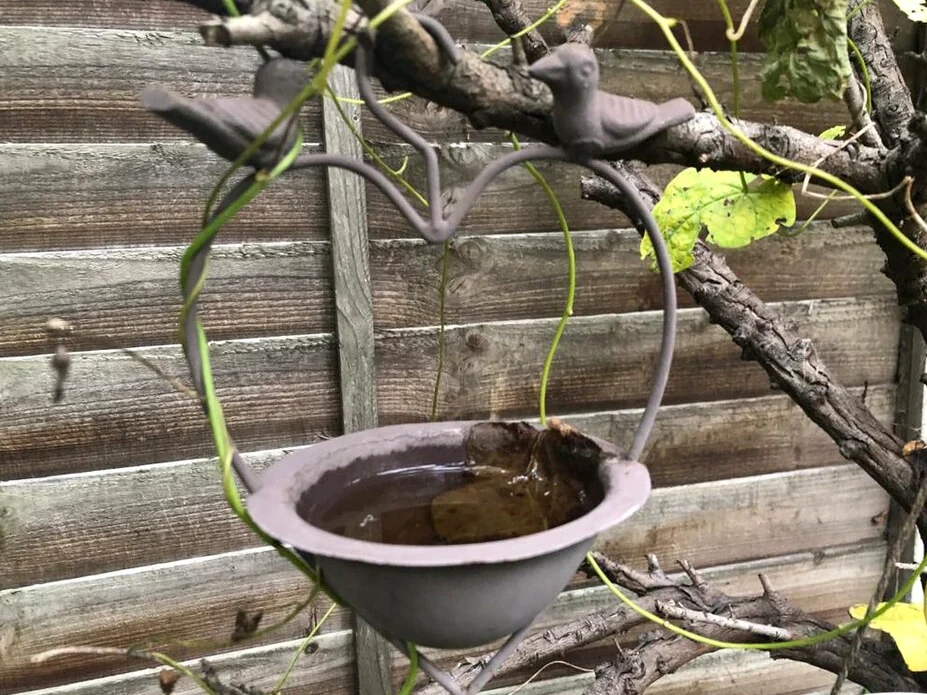
Photo: Roger Bellver · Bird hanging feeder 001.jpg · CC BY-SA 4.0. Cropped, gently adjusted, and resized for this guide.
A short inspection before each refill
- Look at the water and remove dirty water rather than indefinitely topping it up.
- Check that the bowl and support remain level and stable.
- Inspect the entry area and any stones for movement or residue.
- Refill to the intended shallow level instead of automatically reaching the rim.
- Confirm that no new debris, cord, or object obstructs the bathing area.
- Make sure cleaning remains manageable for the person responsible for the next check.
Check the fill mark again if the bowl tilts, a stone moves, or someone else has topped it up. Keep the ruler with the cleaning kit so measuring is easy. When several people share care, show them the shallow entry area as well as the fill mark; both need to be restored after cleaning.
Check the basin after a support change
Moving a pedestal, adding a paver, or shifting a ground-level bowl can alter the effective depth even when you pour in the same amount of water. Recheck level and measure the entry and center again. Do not rely on the previous fill mark until you confirm that the basin sits as intended.
Look for rocking under light contact and for soil that may settle after watering. A support that seems secure when empty may behave differently with a full bowl. Follow the product's installation requirements and avoid stacking narrow objects to gain height. Stability is part of usable access, not a separate decorative concern.
Choose an access aid with cleaning in mind
If you use stones, arrange a small number of stable pieces that you can lift and scrub easily. Avoid filling every space with decorative material. The surface below must remain reachable, and the objects should not obscure the actual water depth.
Take a photograph of the arrangement if it helps another caretaker restore it after cleaning. Then check the result rather than copying the photograph blindly: stones can shift, a replacement may be a different size, and the support may have moved. The intention is a stable shallow area, not an exact decorative pattern preserved at the expense of function.
Small mistakes. Better moves.

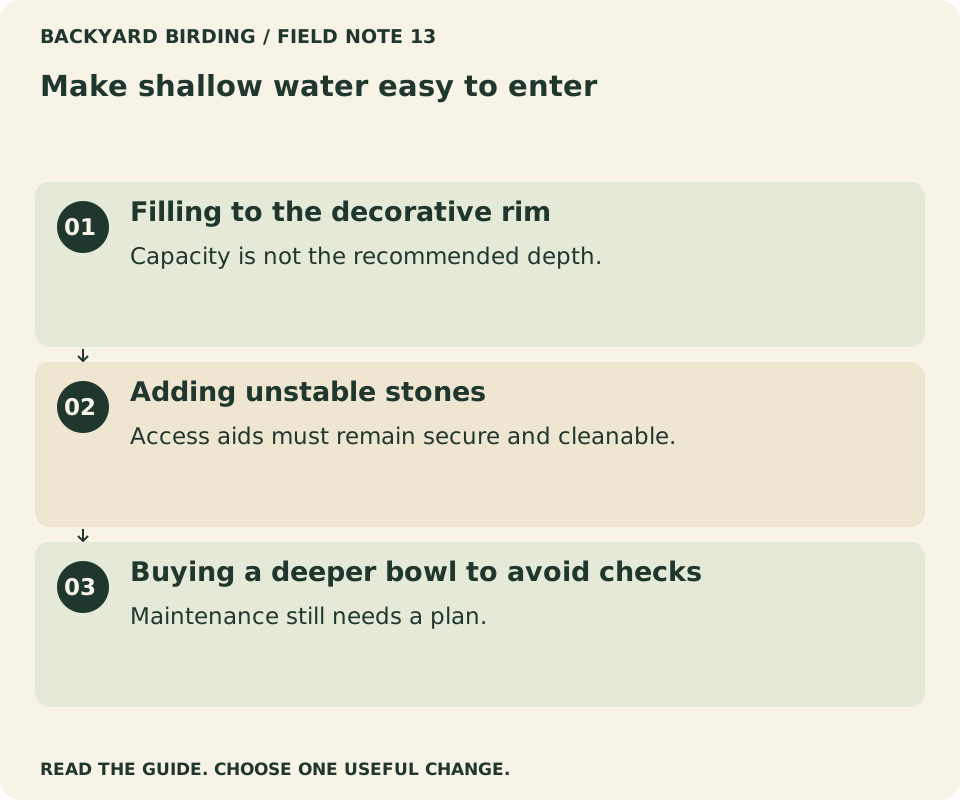
Read the visual as text
- Filling to the decorative rim. Capacity is not the recommended depth.
- Adding unstable stones. Access aids must remain secure and cleanable.
- Buying a deeper bowl to avoid checks. Maintenance still needs a plan.
Distinguish water volume from maintenance convenience
A deeper bowl may need topping up less often, but that convenience does not establish that its profile is suitable for bathing birds. Choose a usable shallow design first, then make the refill routine practical. A reachable water source or a smaller removable basin can reduce effort without increasing depth.
If daily inspection is unrealistic, consider whether the setup should remain in use unattended. You can pause a bath or arrange care rather than turning it into a larger reservoir. Equipment should fit the maintenance you can provide, and the water level should serve bird access rather than compensate for a missing caretaker.
Compare two bowls in the shop
Look inside from the side and trace the slope with your eyes. Ask about the intended water level, surface finish, weight, and cleaning method. If a display includes decorative stones, consider whether they are required to make the basin usable or are merely styling.
Check how the bowl attaches to its support and whether you can remove it safely. Ask to see the care instructions before buying, especially for a heavy or glazed model. Picture yourself emptying the bowl, lifting any stones, scrubbing the bottom, and putting it back. If one of those steps seems awkward in the shop, compare a simpler basin.
Keep observations focused on access
When evaluating the bath, describe where a bird lands and what happens next. Slipping, an unstable stone, or difficulty finding a shallow standing area are specific observations. A bird drinking and leaving is not automatically evidence of a defect.
Use repeated observations to guide a small adjustment, then check cleanliness and stability again. The purpose is to improve a usable water feature, not to force every visitor to bathe or to turn one brief encounter into a universal recommendation about basin shape.
Frequently asked questions
Is two inches a target for the whole bowl?
No. The useful profile includes shallower access toward the edge. A flat two-inch depth with steep sides is different from a gradual basin that reaches that depth only near the center.
Will a deeper bath attract larger birds?
Do not make a general backyard basin unnecessarily deep in pursuit of a particular visitor. Select equipment and depth for safe, manageable use and consult species-specific resources where needed. Greater volume does not automatically mean better access.
Can I use marbles or loose decorations?
Avoid unstable small objects that create awkward footing or complicate cleaning. If you add access features, choose stable, cleanable pieces and inspect how they sit. A naturally suitable basin is often simpler than extensive decoration.
Why are birds drinking but not bathing?
Drinking is still use of the resource. Observe without forcing a particular behavior. Check access and cleanliness, but do not assume the design has failed because each visitor uses it differently.
How do I know when to replace the basin?
Consider replacement if it is unstable, damaged, difficult to clean, or cannot provide a broad shallow area without awkward modifications. A smaller, simpler bowl can be an improvement when it makes both bird access and regular care more reliable.
For the next part of your setup, read Where to Place a Bird Feeder: A Practical Yard Layout Guide.
For a related next step, read Winter Birdbaths: Clean Water, Safe Heat, and an Easy Cold-Weather Routine.
Watch it. Then try it.
Review the steps and common mistakes in two short, silent animations. Each has a complete text transcript below.
Your four-step action map
Read the complete video transcript
Make shallow water easy to enter.
- Set the basin level. Depth changes if the support tilts.
- Measure usable water. Check the approach and center, not the outside bowl.
- Check footing. Use stable, cleanable contact surfaces.
- Maintain the fill. Recheck after rain, cleaning, or a move.
Try the steps, then note any problem that still needs attention.
Three mistakes to avoid
Read the complete video transcript
Make shallow water easy to enter.
- Filling to the decorative rim. Capacity is not the recommended depth.
- Adding unstable stones. Access aids must remain secure and cleanable.
- Buying a deeper bowl to avoid checks. Maintenance still needs a plan.
Try the steps, then note any problem that still needs attention.
Both animations use this real photograph by Andy Li. Photo source · CC0. The photo is adapted into original educational animations, not recordings of a field test.
At a glance
| Basin detail | Check |
|---|---|
| Edge | Shallow approach |
| Center | Avoid excessive depth |
| Surface | Secure footing |
| Maintenance | Easy to empty and clean |
Sources & evidence
Our standard: real evidence before ratings. Corrections follow our editorial process.
Our verdict & your next actions
Choose the row that describes your setup, then follow the suggested check or adjustment.
| Your situation | Our verdict | Your next action |
|---|---|---|
| Basin is too deep | Create a broad shallow area or choose another bowl. | Plan the cleaning requirements. |
| Support has shifted | Level and recheck the usable depth. | Review the beginner setup. |
| Birds drink but do not bathe | Observe access without demanding a behavior. | Use the observation checklist. |
Your pocket field checklist
Tick off the steps as you go.
0 of 4 steps completed
Keep building your knowledge in bird baths, or search the full backyard library.