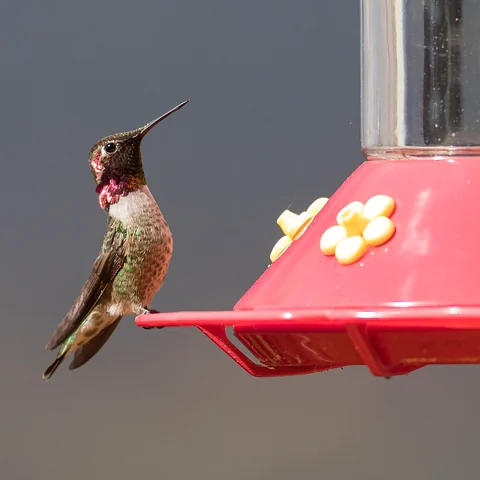
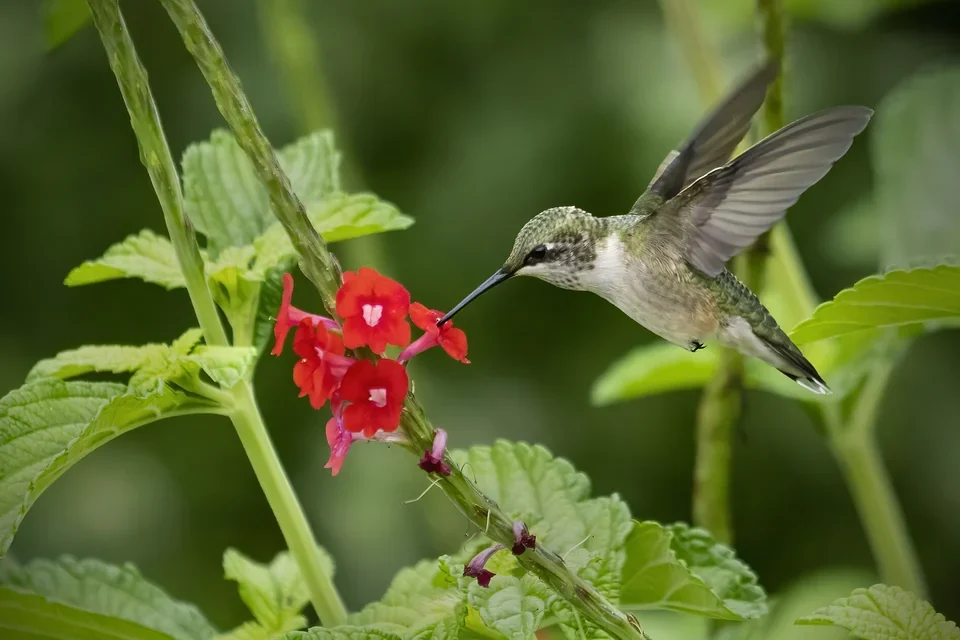
Photo: Jack Nevitt · Ruby-Throated hummingbird on red flower.jpg · CC BY-SA 4.0. Resized from the credited adaptation.
The short answer
Choose locally suitable flowering plants for your actual light, moisture, and space, then plan overlapping bloom periods. Regional natives can support both nectar and insect resources. Keep flowers, shelter, clean water where appropriate, and careful feeder care part of one habitat plan.
Build a flowering season, not a shopping list
A hummingbird garden works best when suitable flowers open across the period hummingbirds use your area. One spectacular plant can provide a brief display and then leave a long gap. A smaller group of well-chosen plants may offer a more useful sequence while fitting the soil, light, and care you can provide.
Begin with the hummingbirds expected locally and the conditions in your yard. The plants that suit a moist eastern garden differ from those suited to a dry southwestern bed or a California woodland edge. “Native to North America” is too broad a description to settle a planting decision.
This guide explains how to choose flowers, compare several useful examples, plan bloom succession, and observe whether the garden is working. It treats feeders as an optional supplement rather than the center of the design. Flowers, insects, perches, and safe movement through the yard belong in the same plan.
Audubon's hummingbird-friendly yard guidance provides the broad habitat framework. Use the plant examples here as candidates to investigate locally, not a universal prescription. The best first purchase is a plant that fits your actual site and fills a real seasonal gap, even if it is less dramatic than the flower in a catalog cover.
Identify the hummingbirds and their local season
Check which species occur in your region before planning around a single familiar hummingbird. Ruby-throated Hummingbirds dominate many eastern summer observations, while western regions can support a different mix and more varied seasonal patterns. A national arrival date will not describe every location.
Use regional records, local bird organizations, and authoritative range maps to establish a likely season. Then look at the plants already blooming during that period. A late-flowering plant can be useful in one region and miss most hummingbird activity in another.
Our hummingbird timing guide explains how to use local observations without treating one early record as the normal arrival date. Apply the same approach to planting: plan around a seasonal window, then refine it with what happens in your own garden.
Keep a simple first-sighting and last-sighting record, but distinguish those observations from the true limits of local presence. You may miss birds that visit while you are away. The goal is a practical overlap between flowers and likely visitors, not a claim that your yard record captures every hummingbird moving through the neighborhood.
Measure sun, moisture, and available space
Before choosing species, inspect the planting area at several times of day. Record direct sun, afternoon shade, reflected heat from walls, and exposure to wind. A bed described casually as “sunny” may receive only a short bright period after nearby trees leaf out.
Check how water behaves after rain. Does the soil remain moist, drain quickly, or stay saturated? Do not choose a moisture-loving plant for a dry site on the assumption that occasional extra watering will always solve the mismatch. Likewise, a plant adapted to well-drained conditions may struggle in a low wet pocket.
Allow for mature size. A small nursery pot does not reveal how a clump, shrub, or vine will occupy the bed several years later. Leave room for paths, windows, maintenance access, and neighboring plants. A vigorous vine needs an appropriate support and a realistic place to grow.
Write the site conditions at the top of your plant list. This keeps a beautiful flower from overriding the practical constraints during a nursery visit. Our native-plant planning guide offers a broader site assessment. A good match reduces repeated replacement and makes it easier to keep the garden healthy without constant intervention.
Your visual action map

Read the visual as text
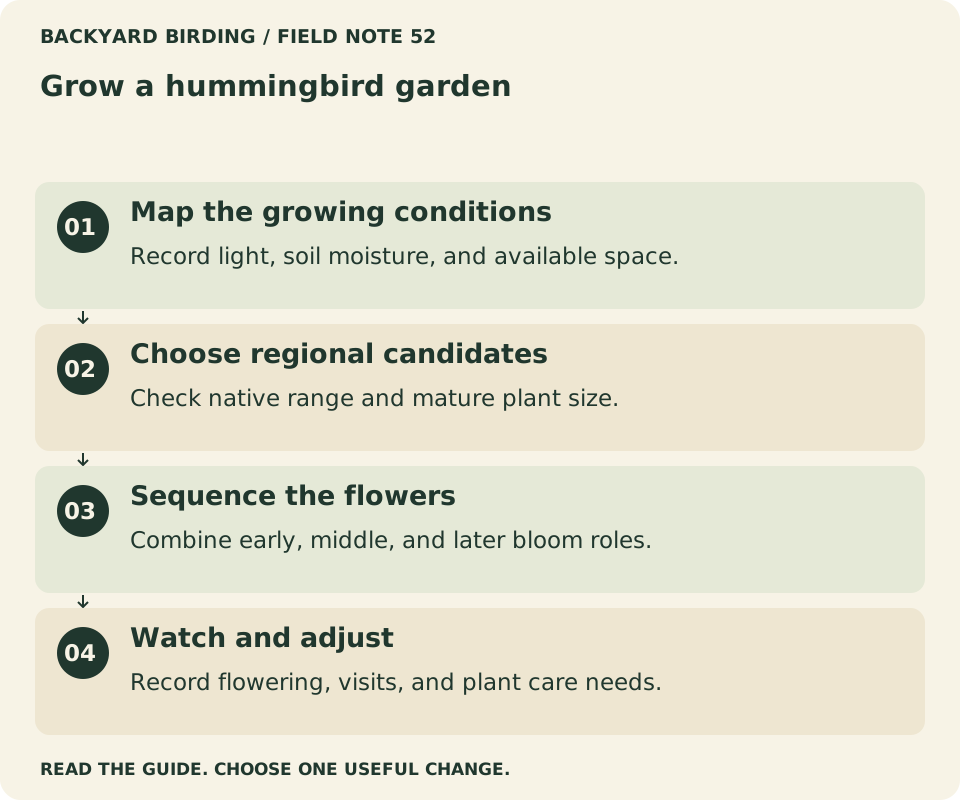
- Map the growing conditions. Record light, soil moisture, and available space.
- Choose regional candidates. Check native range and mature plant size.
- Sequence the flowers. Combine early, middle, and later bloom roles.
- Watch and adjust. Record flowering, visits, and plant care needs.
Understand flower shape without relying only on red
Tubular flowers are familiar hummingbird plants, and many useful species have red or orange blooms. Hummingbirds also visit flowers of other colors. Color is a visible clue for people choosing plants, but it does not establish nectar value, local suitability, or the ease with which a bird can use a particular flower.
Look at the actual bloom structure and the documented wildlife use of the species. Highly modified ornamental forms may differ from the familiar wild form. Avoid assuming that every cultivar with a hummingbird on its label performs identically.
A nursery plant in flower offers a useful opportunity to observe visitors, but a short visit there is only one piece of evidence. Ask about the scientific name, mature size, bloom period locally, and the plant's growing needs. Those answers matter more than a broad claim that it is irresistible to hummingbirds.
Keep the garden varied enough to support more than nectar. Insects are part of hummingbird feeding, and vegetation provides places to perch and move between flowers. Avoid trying to create an insect-free hummingbird garden. The aim is a functioning patch of habitat, not a display of red objects around a feeder.
Use eastern red columbine for an early-season role
Eastern red columbine, Aquilegia canadensis, is one candidate for gardens within its appropriate range and conditions. Its nodding red-and-yellow flowers provide a distinctive early-season shape. The North Carolina Extension plant account describes its habitat, growing conditions, and wildlife value.
Check local bloom timing rather than copying a month from another state. Elevation, exposure, and seasonal weather can shift the display. In your plan, label it as a potential earlier resource and confirm the actual weeks after planting.
Place it where you can see the flowers without crowding the approach. A view from a window or a chair several feet away may be more useful than planting directly against a busy walkway. Review nearby glass before adding an attraction close to the house.
Do not expect one clump to carry the whole season. Pair its role with later suitable plants and allow enough room for each to develop. Keep the botanical name on the label, since ornamental columbines vary and a generic packet labeled “columbine mix” may not contain the species you intended to plant.
Match cardinal flower to a genuinely moist site
Cardinal flower, Lobelia cardinalis, is known for bright red flower spikes and hummingbird use. Its moisture requirements are central to the choice. The North Carolina Extension account describes moist to wet conditions and a later-season bloom period.
Do not place it in a dry exposed bed simply because the flowers are appealing. If the site repeatedly dries out, choose a locally appropriate alternative rather than building the whole garden around compensatory watering. A rain-garden position also needs assessment; occasional flooding and prolonged unsuitable saturation are not interchangeable conditions for every planting.
Use its height and form in the layout. Keep taller stems from blocking a path or hiding a window treatment, and leave space to inspect the soil and maintain neighboring plants. A flowering spike should be part of a stable planting, not something squeezed into the last gap in a crowded pot.
Check household suitability as well as wildlife value. The extension account notes toxicity concerns, so keep plant selection compatible with children, pets, and the way the space is used. A plant attractive to hummingbirds is not automatically edible or harmless to every other animal. Choose with the whole household in mind.
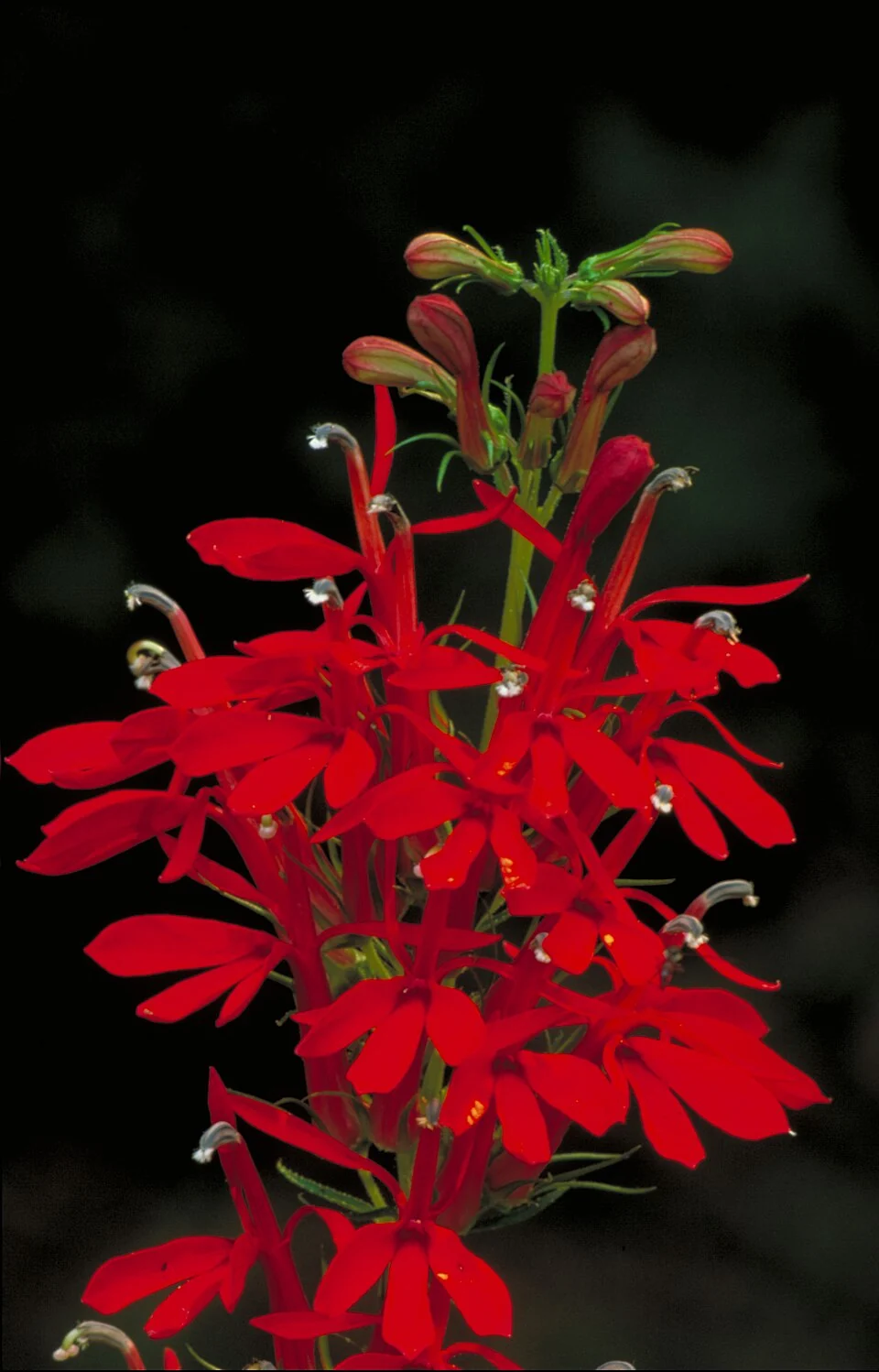
Photo: Barnes, Dr. Thomas G. · Lobelia cardinalis - Cardinal Flower.jpg · Public domain. Resized for this guide.
Give coral honeysuckle the right support
Coral or trumpet honeysuckle, Lonicera sempervirens, is a climbing plant with tubular flowers. It is distinct from other honeysuckles that may be invasive in particular regions. Use the scientific name when researching or purchasing rather than asking only for “honeysuckle.”
The North Carolina Extension account and Audubon's species page describe its growing habit and wildlife use. Confirm that it is appropriate locally, then plan the support before planting.
A fence or trellis must suit the mature growth and allow maintenance. Avoid sending a vine into gutters, utility equipment, or places where future pruning would conflict with nesting birds. A small plant can make an inadequate support look sufficient for a season before the mismatch becomes apparent.
Think about viewing as the vine grows. Flowers placed above eye level may still be used, but a section visible from a comfortable indoor position can make observation easier. Keep the route to nearby glass safe. The design should let you enjoy the visits without repeatedly standing beside the flowers or pruning away most of the useful growth to recover access.
Plan for the spread of scarlet bee balm
Scarlet bee balm, Monarda didyma, can contribute a summer flowering display where its moisture, light, and regional requirements fit. It is a spreading perennial, so give it room rather than treating the small nursery container as its permanent footprint.
The North Carolina Extension account describes moist, well-drained soil, sun to some shade, hummingbird use, and susceptibility to powdery mildew. Choose placement and spacing with those characteristics in mind, and seek local advice when disease or growing conditions become a problem.
A plant that develops imperfect leaves may still be part of a useful garden, but identify the issue before applying a treatment. Avoid routine spraying simply to preserve a catalog appearance. Insect and disease management should be specific to an actual problem and compatible with the wildlife purpose of the planting.
When comparing cultivars, record the exact name and ask what differs: height, spread, flower form, or disease tolerance. Do not assume a compact form has every characteristic of the species. A practical garden plan can include cultivated selections, but the decision should rest on the actual plant and site rather than a broad “pollinator” label.
Consider autumn sage within its regional context
Autumn sage, Salvia greggii, is associated with a different set of growing conditions from a moisture-loving cardinal flower. The North Carolina Extension account describes its southwestern origins, well-drained soil needs, and hummingbird-attracting flowers.
Use that distinction when planning. Do not put every hummingbird plant in one watering zone simply because the flowers serve a similar visitor. A dry well-drained bed and a moist border can each be useful, but they call for different plant combinations and care.
Check local winter suitability and the exact cultivar's mature size. The word “autumn” in the common name is not a universal promise of one fixed bloom season. Local climate and plant condition affect when flowers appear.
For readers outside the plant's appropriate range, treat it as an example of the selection process rather than a required purchase. A regional native-plant specialist may suggest a different sage or another local flower that fills the same role more reliably. The garden benefits from a sound match more than from reproducing a national list item by item.
Find your situation

Read the visual as text
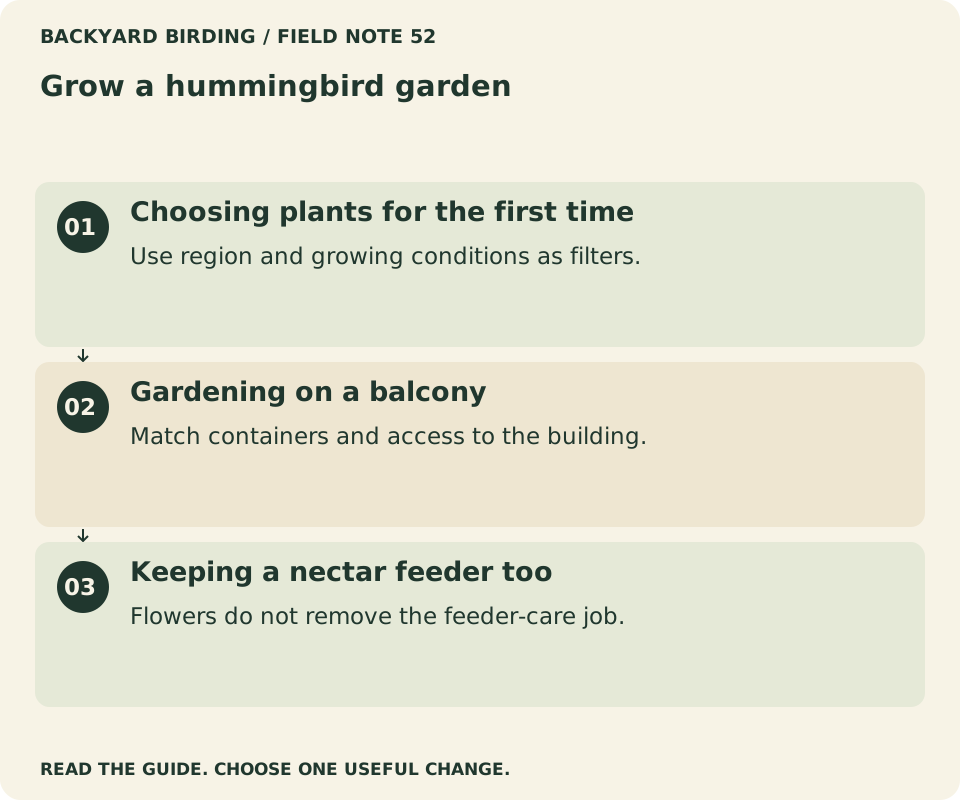
- Choosing plants for the first time. Use region and growing conditions as filters.
- Gardening on a balcony. Match containers and access to the building.
- Keeping a nectar feeder too. Flowers do not remove the feeder-care job.
Find western alternatives through local plant resources
Western gardens need their own regional shortlist. California, the Pacific Northwest, the desert Southwest, and mountain gardens differ greatly in rainfall, soils, winter conditions, and hummingbird seasons. A plant suitable in one should not be promoted as a universal western choice.
Audubon's hummingbird yard guide includes examples such as hummingbird sage and regional sages. Use those names to begin a local conversation, then consult a native-plant society, botanical garden, or extension service for species appropriate to your county and site.
Ask about the summer-water requirements of plants adapted to your region. Do not assume a native plant needs either no water at all or the same frequent irrigation as a new lawn. Establishment care and mature care can differ, and the nursery should help you plan both.
A useful local shortlist contains the scientific name, mature dimensions, exposure, drainage, expected bloom period, and any important maintenance concern. Three well-understood candidates are more valuable than twenty names without those details. This approach also keeps your planting plan adaptable when a species is unavailable or a nursery offers a different cultivar.
Compare plant roles before combining them
Use the table as a planning prompt, not a substitute for local suitability checks. The same broad role may be filled by another species in your region.
| Candidate | Possible role | Site question to resolve |
|---|---|---|
| Aquilegia canadensis | Earlier flowering resource | Does local timing overlap hummingbird presence? |
| Lobelia cardinalis | Later flower spikes | Can the site maintain suitable moisture? |
| Lonicera sempervirens | Flowering vine and vertical structure | Is there room and an appropriate support? |
| Monarda didyma | Summer perennial display | Can its spread and moisture needs be accommodated? |
| Salvia greggii | Flowers in a well-drained regional planting | Are climate, drainage, and winter conditions suitable? |
| A locally recommended western species | Regional replacement for an unsuitable list plant | Is the recommendation specific to your area? |
Group plants by compatible conditions before grouping them by color. That reduces the risk of keeping one plant too wet while another repeatedly dries out. Within a suitable group, vary flowering times and structure where space allows.
Do not buy the entire list at once. Choose the most obvious gap in your existing garden, establish a small planting, and use its first season to refine the next step. A phased approach makes it easier to correct a mistaken light or moisture assessment before it affects a large bed.
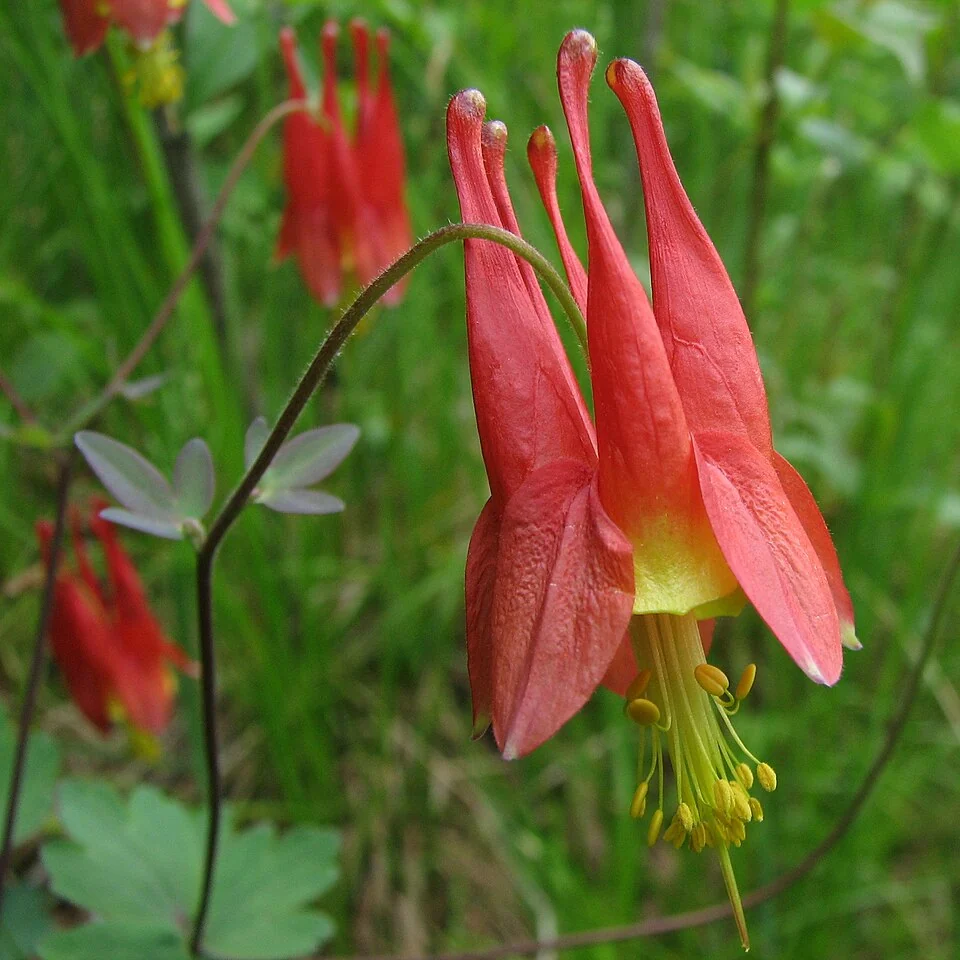
Photo: Ragesoss · Wild Columbine.jpg · CC BY-SA 3.0. Resized for this guide.
Draw a local bloom calendar
Make a row for each plant already in the garden and a column for each month of likely hummingbird presence. Mark observed flowering, not only the dates on a label. Add a separate row for proposed plants so expectations remain distinct from results.
Look for gaps and excessive concentration. If nearly everything flowers at the same time, the next purchase may be a plant that opens earlier or later rather than another peak-season favorite. Keep the calendar simple enough to update during an ordinary walk through the garden.
Record the start and end of meaningful bloom rather than one isolated flower. A single late blossom does not necessarily provide the same resource as a sustained display. Note heat, drought, pruning, or unusual weather that may explain a short season.
Do not expect perfect continuity in the first year. New plants need to establish, and local conditions can shift timing. The calendar is a tool for learning which resources are available, not a performance contract for the garden. Over several seasons, your own records can guide plant selection more precisely than a generalized national flowering chart.
Arrange flowers for access and observation
Plant in a way that leaves birds room to approach flowers and move away. Avoid crowding every bloom against a window or within a narrow enclosed corner. A visible patch can be enjoyable from indoors without placing it directly against untreated glass.
Use existing structure thoughtfully. Nearby branches or suitable vegetation can provide perches, while different planting heights can create a more varied setting. Do not add an artificial perch merely because a garden photograph includes one; observe whether a real need exists.
If several hummingbirds are present and one repeatedly guards a resource, distributed flowering patches may offer more options than one concentrated display. The available space and species behavior still matter, so avoid promising that a particular layout eliminates territorial interactions.
Keep maintenance access in the plan. You should be able to water, inspect, and tend plants without repeatedly pushing through the main flowering area. A narrow service path or a reachable container can make care easier and reduce disturbance. The best arrangement supports both ordinary plant maintenance and quiet observation over the whole season.
Use containers where the site supports them
Containers can work in a patio or balcony, but they change the root environment. Pots can dry quickly, heat strongly, and expose roots to winter conditions differently from the ground. Choose plants specifically suited to the available container and local climate.
Check drainage and the practical watering route. A plant that needs frequent attention may be a poor fit if you travel often or cannot carry water comfortably. Larger pots and wet growing medium also add weight, so follow building requirements on balconies and elevated decks.
Audubon's small-space planting article offers useful context. Our balcony birding guide addresses glass, mounting, neighbors, and maintenance in shared buildings.
Start with a manageable number of containers. A pair of healthy plants with complementary flowering periods can be more useful than a crowded collection that repeatedly wilts. Keep labels and note actual bloom dates. If a plant struggles, reassess the pot, exposure, and watering before replacing it with another species that has the same unmet needs.
Small mistakes. Better moves.

Read the visual as text
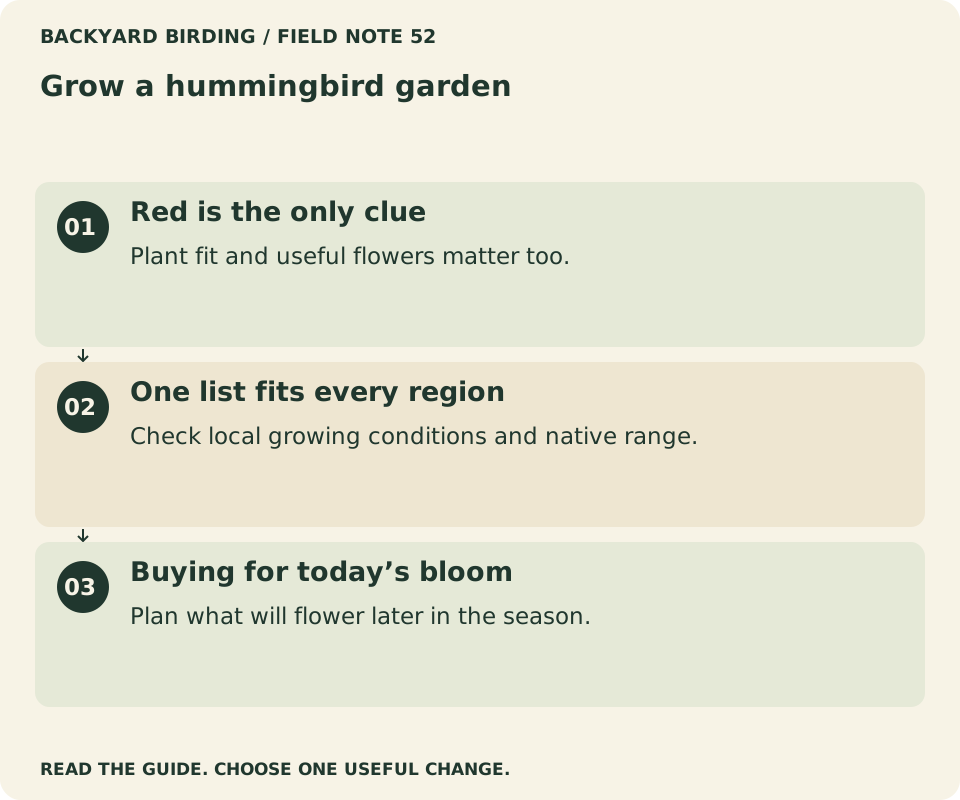
- Red is the only clue. Plant fit and useful flowers matter too.
- One list fits every region. Check local growing conditions and native range.
- Buying for today’s bloom. Plan what will flower later in the season.
Ask nurseries specific questions
Bring the site description and your bloom gap to the nursery. Ask for the scientific name, local native status, mature size, and growing requirements of the exact plant offered. A common name or a broad wildlife logo is not enough to confirm a match.
Ask about pesticide treatments and what information is available for the plant's production and care. Do not assume every nursery product has the same treatment history. If your wildlife goals depend on a particular practice, seek a clear answer before purchasing rather than trying to infer it from appearance.
Check the plant itself. Look for a sound root system, appropriate growth, and signs of stress or damage. A plant forced into a large floral display may still need careful establishment after purchase. Ask how to transition it to your site and when local planting conditions are favorable.
Keep the receipt and label with your garden notes. These details help identify a cultivar later and make a follow-up question more precise. “The red salvia” may describe several different plants; the exact name lets you find the correct care guidance instead of applying advice for a relative with different requirements.
Support insects and avoid unnecessary treatments
A hummingbird garden includes more than nectar. Small invertebrates are part of hummingbird feeding, and plants support many other visitors. Broadly trying to eliminate insects can conflict with the purpose of the garden.
Inspect a plant problem before treating it. Identify the organism or condition, assess the actual damage, and use local extension guidance to decide whether intervention is needed. Cosmetic leaf damage does not always justify a spray, and the wrong treatment can waste effort or harm unintended organisms.
Follow any product label and local guidance if treatment is necessary. Avoid casual mixtures of household substances promoted as harmless because they are familiar. “Natural” does not establish suitability for a flowering plant used by wildlife.
Keep routine garden decisions connected to observation. Are leaves damaged but the plant growing well? Is a watering mismatch causing stress that looks like an insect problem? Is the plant simply in the wrong exposure? Solving the underlying site issue may be more effective than repeatedly treating symptoms while leaving the conditions unchanged.
Use a feeder as a separate maintained resource
A nectar feeder can supplement flowers, but it should not be used to hide gaps in plant care or left unmaintained because the garden looks healthy. Choose a small feeder you can disassemble and wash fully.
Use the standard mixture in our homemade nectar guide. Keep replacement frequent enough for conditions, including daily attention during very hot weather and immediate action when contamination appears. Flowers and feeders have different care requirements.
Place the feeder with the same attention to glass and access as the planting. Do not hang it deep within vegetation where leaks, insects, or dirty ports are hard to see. Keep the cleaning route convenient so maintenance remains a normal task rather than a project.
Observe flowers and feeder separately. Heavy feeder use does not prove that the garden flowers are unsuitable, and a quiet feeder does not prove hummingbirds are absent. They may be feeding elsewhere. A short watch of both resources can help you understand the local pattern without turning one visible count into a verdict on the whole garden.
Observe the garden without forcing a visit
Choose a comfortable viewing point and watch at several times over the season. Record which flower the bird actually uses, not merely the nearest plant when it appears. A hovering hummingbird may inspect, perch, chase another bird, or feed; those are different observations.
Keep photographs and notes tied to dates. A plant that attracts visits during one week may bloom at a different time the next year. Note the weather and flowering stage when it helps explain the result.
Avoid moving pots or feeders repeatedly in response to one quiet day. Give plants time to establish and birds time to encounter them. At the same time, act promptly on real problems such as untreated glass, a failing support, or a plant repeatedly drying out.
At season's end, choose one improvement based on the record. Fill an actual bloom gap, replace an unsuitable plant, or make watering easier. The bird journal guide can keep those observations simple. A useful garden evolves from local evidence rather than an expanding collection of plants bought because each was advertised as a hummingbird favorite.
Turn an eastern mixed bed into a seasonal plan
Imagine an eastern garden with a partly shaded bed, a sunny fence, and one consistently moist corner. Do not put the same flower in all three positions. Begin by matching candidate plants to each micro-site, then consider how their flowering periods might overlap locally.
Eastern red columbine may be worth investigating for an earlier role in a suitable part of the bed. Coral honeysuckle may fit the fence if there is room for its mature growth and the support is appropriate. Cardinal flower may be a candidate for the moist area, while scarlet bee balm needs enough suitable space for its spreading habit. These are possibilities to verify, not a finished planting prescription.
Write down the local bloom expectations and the conditions each plant needs. If two candidates require the same limited moist space, choose one rather than crowding both. If the fence is shaded much of the day, reconsider the flowering expectations before buying a vine.
Plant a manageable first phase and keep the remaining areas available for later decisions. During the first season, record plant health, actual flowering, watering needs, and bird use. You may discover that the “moist corner” dries sharply in midsummer or that a neighboring tree shades the bed more than expected.
Use those findings to revise the next phase. A garden plan should become more accurate as you learn the site. Replacing an unsuitable idea on paper is cheaper and less disruptive than repeatedly replacing struggling plants. The purpose of the example is to connect plant roles with real conditions, not to make every eastern yard contain the same four species.
Build a nursery worksheet for a dry small garden
For a small dry garden, begin with the constraints: hours of sun, drainage, available width, winter conditions, and the amount of establishment watering you can provide. Take that description to a regional native-plant nursery rather than requesting a national top-ten hummingbird list.
Ask for a few candidates that flower at different times within the local hummingbird season. For each, record the scientific name, mature height and width, expected local bloom, and whether the plant's summer-water needs fit the existing irrigation. A locally appropriate sage may be useful, but its exact identity and requirements still matter.
Add a column for the question that could rule the plant out. Perhaps the mature spread exceeds the bed, the winter conditions are unsuitable, or the only available position drains poorly. This makes the decision more honest than a list containing only attractive features.
Before purchase, choose where the plant will go and how you will reach it for care. Leave space for growth and avoid placing the flowers against hazardous glass. If the plan requires moving several established plants or rebuilding irrigation, decide whether a simpler candidate can meet the same seasonal need.
After planting, replace the expected bloom dates with observed ones. Keep the nursery recommendation as a starting hypothesis and let the garden provide the detail. A small dry planting can be useful without being packed tightly, continuously watered, or forced to flower every week. Suitability and continuity improve through thoughtful selection, not through sheer plant count.
Questions about hummingbird flowers
Do all flowers need to be red?
No. Hummingbirds visit suitable flowers of several colors. Choose documented local plants with useful bloom structure and timing, then fit them to the site. Color alone is an incomplete selection method.
Can one plant attract hummingbirds?
One appropriate flowering plant can be a useful beginning, but visits depend on local birds and the surrounding landscape. Do not expect a guarantee. A small healthy planting is easier to learn from than a large mismatched one.
Should I remove every non-native ornamental immediately?
Begin by identifying what you have and checking local invasive-plant guidance. Prioritize harmful invasive species and add suitable native resources thoughtfully. A phased plan can protect useful existing structure while you improve the garden, without creating a bare space unnecessarily.
Why are the plants flowering but no hummingbirds appear?
Check regional presence, timing, observation hours, and the wider habitat. Also confirm the exact plant and its condition. A flower display does not guarantee that birds are nearby or that you see every visit.
What is the best first planting decision?
Choose one locally appropriate plant that fits your light and moisture conditions and fills a gap in the flowering season. Keep its label, establish it properly, and record what happens. That is a stronger foundation than buying a long national list without a site plan.
Watch it. Then try it.
Review the steps and common mistakes in two short, silent animations. Each has a complete text transcript below.
Your four-step action map
Read the complete video transcript
Grow a hummingbird garden.
- Map the growing conditions. Record light, soil moisture, and available space.
- Choose regional candidates. Check native range and mature plant size.
- Sequence the flowers. Combine early, middle, and later bloom roles.
- Watch and adjust. Record flowering, visits, and plant care needs.
Try the steps, then note any problem that still needs attention.
Three mistakes to avoid
Read the complete video transcript
Grow a hummingbird garden.
- Red is the only clue. Plant fit and useful flowers matter too.
- One list fits every region. Check local growing conditions and native range.
- Buying for today’s bloom. Plan what will flower later in the season.
Try the steps, then note any problem that still needs attention.
Both animations use this real photograph by Jack Nevitt. Photo source · CC BY-SA 4.0. The photo is adapted into original educational animations, not recordings of a field test.
At a glance
| First check | Useful response |
|---|---|
| Map the growing conditions | Record light, soil moisture, and available space. |
| Choose regional candidates | Check native range and mature plant size. |
| Sequence the flowers | Combine early, middle, and later bloom roles. |
| Watch and adjust | Record flowering, visits, and plant care needs. |
Sources & evidence
- hummingbird-friendly yard guidance
- North Carolina Extension plant account
- North Carolina Extension account
- North Carolina Extension account
- Audubon's species page
- North Carolina Extension account
- North Carolina Extension account
- small-space planting article
Our standard: real evidence before ratings. Corrections follow our editorial process.
Our verdict & your next actions
Choose the row that describes your setup, then follow the suggested check or adjustment.
| Your situation | Our verdict | Your next action |
|---|---|---|
| Choosing plants for the first time | Use region and growing conditions as filters. | Build a local plant list |
| Gardening on a balcony | Match containers and access to the building. | Plan a small-space setup |
| Keeping a nectar feeder too | Flowers do not remove the feeder-care job. | Make and manage nectar |
Your pocket field checklist
Tick off the steps as you go.
0 of 4 steps completed
Keep building your knowledge in hummingbirds, or search the full backyard library.