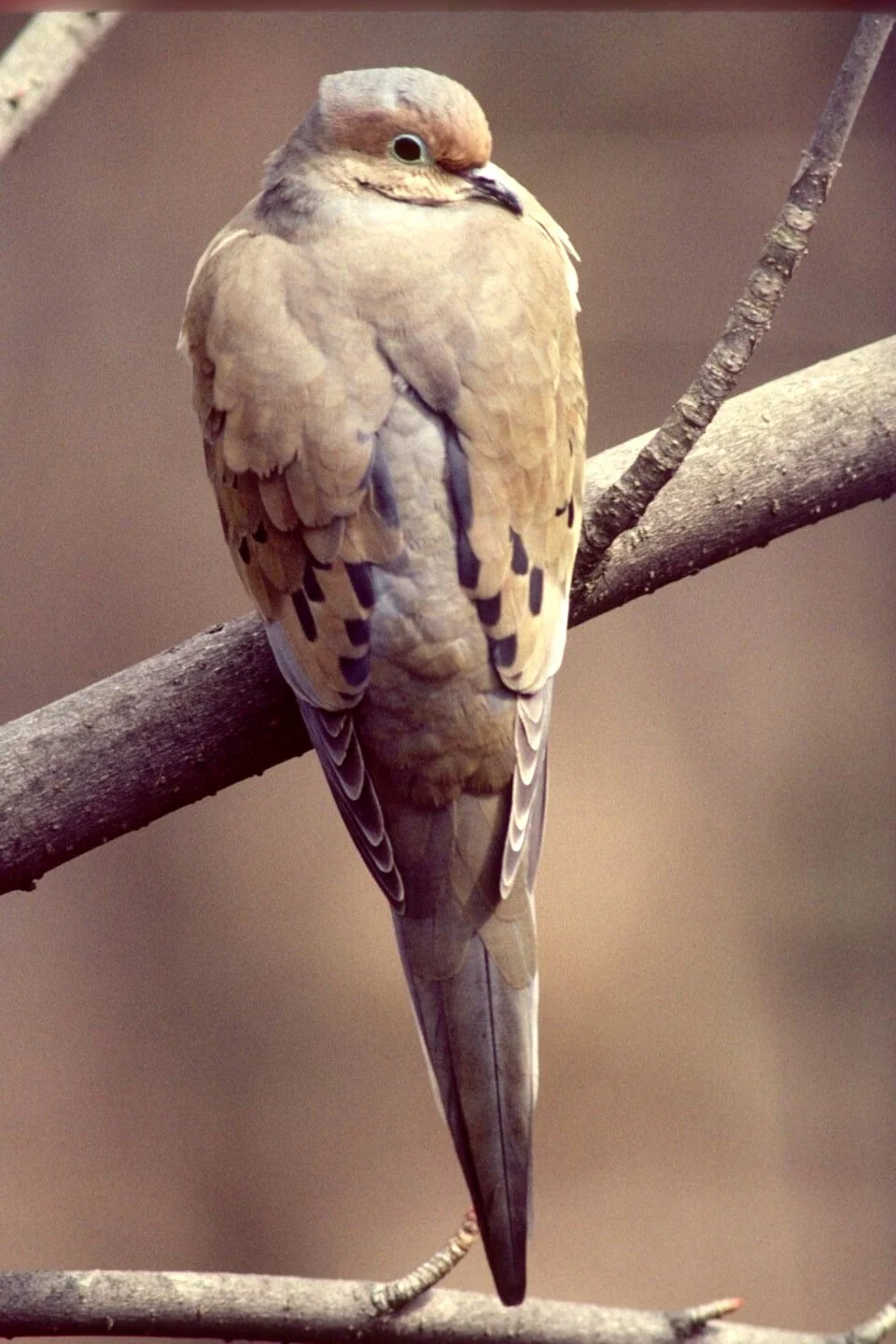
Photo: Dominic Sherony · Mourning Dove (Zenaida macroura) (3483334485).jpg · CC BY-SA 2.0. Resized for this guide.
The short answer
Look for a small head, warm gray-brown body, black wing spots, and a long pointed tail. Mourning Doves often forage on the ground. Keep feeding areas dry and clean, protect nearby glass, and leave healthy fledglings with their parents.
Begin with the whole dove
A Mourning Dove can seem plain until you watch it closely. Soft brown plumage conceals a pattern of dark wing spots, the tail narrows to a long point, and a sudden departure reveals white along the outer tail. On the ground, the bird walks with a small head above a rounded body. On a wire, the same bird looks much slimmer.
Mourning Doves are widespread North American birds, but not every dove in a yard is this species. Eurasian Collared-Doves, White-winged Doves, Rock Pigeons, and smaller regional doves can occur in the same general setting. Start with identification before deciding that an unfamiliar bird needs a different food or that a newcomer is displacing the usual visitors.
This guide joins identification with practical yard care. You will learn what to look for, how ground feeding changes the cleanup problem, why a nest can look surprisingly slight, and when a young dove should be left with its parents or referred to a wildlife rehabilitator.
The aim is a workable relationship with the birds already nearby. You do not need to attract the largest possible gathering. A small number of doves using clean feeding areas and safe water is easier to accommodate than a crowded station with persistent waste. Begin by watching the routes they take, the surfaces they use, and what remains after they leave.
Identify a Mourning Dove in a brief view
Look first for a relatively small head, slender dark bill, rounded body, and long tapered tail. The upperparts are muted brown or gray-brown, and dark spots mark the folded wings. When the tail opens, the pale outer feathers become more visible. These structural clues remain useful when shade makes the colors difficult to judge.
Cornell's Mourning Dove identification page offers several views. Compare a perched bird with perched examples and a feeding bird with feeding examples. A fluffed resting dove can look much bulkier than one stretching forward to pick up seed.
Avoid deciding sex from a single distant photograph. Subtle differences can be obscured by light, age, posture, and feather condition. For most backyard purposes, a correct species identification and a description of behavior are more valuable than an unsupported male or female label.
Make a short checklist before reaching for the camera: tail shape, wing spots, head proportions, and any neck marking. If you only see a bird flying away, record the features you actually caught. “Long pointed tail with pale edges” is useful evidence. “Probably the usual dove” is a reasonable provisional impression, but it should not become a detailed record without another look.
Compare the doves likely in your region
Eurasian Collared-Doves generally look larger and paler, with a dark half-collar at the back of the neck and a squarer tail. White-winged Doves show a conspicuous white wing area, especially in flight, and a different overall pattern. Rock Pigeons are typically stockier and more variable in plumage. Local range and habitat narrow the comparison but do not replace visible marks.
| Bird | A helpful distinction | View to seek |
|---|---|---|
| Mourning Dove | Long pointed tail and dark folded-wing spots | Side view and tail during departure |
| Eurasian Collared-Dove | Dark nape collar and less pointed tail | Back of neck and tail shape |
| White-winged Dove | Broad white wing marking | Folded wing and flight view |
| Rock Pigeon | Stockier form and variable color patterns | Whole body rather than color alone |
Use the comparison accounts for Eurasian Collared-Dove and White-winged Dove when those birds are plausible locally. In some regions, smaller doves require additional comparisons; a national four-bird table is not a complete local field guide.
Size is easiest to assess when birds share the same surface at the same distance. A dove close to a camera can look larger than a pigeon farther away. Keep the original photograph rather than cropping out every reference point. Tail, collar, and wing pattern usually offer a better starting point than an estimate made from a lone silhouette.
Your visual action map

Read the visual as text
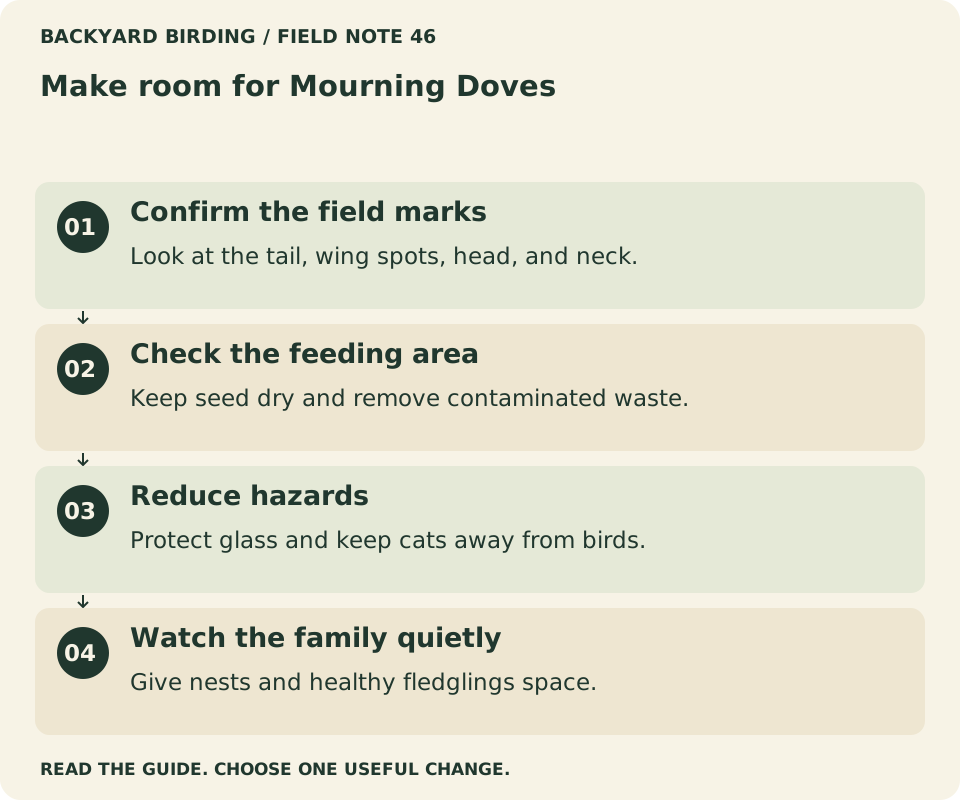
- Confirm the field marks. Look at the tail, wing spots, head, and neck.
- Check the feeding area. Keep seed dry and remove contaminated waste.
- Reduce hazards. Protect glass and keep cats away from birds.
- Watch the family quietly. Give nests and healthy fledglings space.
Understand the sound you are hearing
The familiar low cooing is often mistaken for an owl by people who have not connected it with a visible dove. Listen for the complete phrase and locate the bird before naming the sound. A dove can call from a roof or wire that lies outside the part of the yard you usually watch.
Mourning Doves also produce a noticeable wing whistle during flight. That sound may accompany a sudden departure, but the noise itself does not identify the reason for leaving. A person, a pet, another bird, or an ordinary movement can trigger flight. Avoid turning every quick takeoff into evidence of a predator nearby.
Study Cornell's Mourning Dove recordings with headphones. Then spend a few quiet minutes listening outside without playback. Try to distinguish a repeated vocal phrase from the brief mechanical sound of wings. Connecting sound with a visible action builds a more dependable memory than repeatedly playing a clip at the birds.
For a household learning together, let each person describe the rhythm in their own words before checking the identification. The exercise is about noticing, not agreeing on a perfect phonetic spelling. If the sound remains uncertain, keep it as an unidentified call and wait for a visual confirmation. A patient second observation is better than forcing the nearest familiar label.
Match feeding to a seed-eating ground forager
Seeds dominate the Mourning Dove's diet. The birds commonly feed on the ground, taking food from open surfaces rather than hanging from small perches in the way a chickadee might. Cornell's life-history account describes this seed-focused feeding pattern.
That does not mean a yard should be covered in loose seed. Food spread over soil becomes difficult to separate from droppings, damp leaves, and old hulls. A small, removable platform can make the feeding area easier to inspect, provided its design drains well and gives the birds enough room.
Watch how the doves use your current station. They may be collecting spill beneath a tube feeder rather than choosing a food you intentionally supplied for them. Before adding another feeder, reduce avoidable spillage and assess whether the remaining food can be kept clean. A bird eating waste does not make the waste harmless.
Offer only an amount that moves through the setup promptly. There is no universal scoop size for every yard. The number of birds, competing species, weather, and your observation schedule all matter. Start small and increase only when the food is being used without creating a persistent layer on the surface or ground below.
Choose a platform you can actually maintain
A useful dove feeder needs stable access, drainage, and cleaning access. Check the whole design before buying: can the feeding surface be removed, can corners be scrubbed, and will water collect around fasteners or a raised rim? A roof can reduce direct rain while leaving wind-driven rain and humidity unresolved.
Mesh or perforated floors need inspection too. Fine food particles can lodge in openings, and damaged edges should not be left where feet contact them. A solid tray may be easier to wipe but needs effective drainage and frequent emptying. No material eliminates the maintenance decision.
Think about how you will lift the feeder when it is wet or partly full. A broad platform can become awkward if it hangs beyond comfortable reach. Choose a mount that you can service from stable ground. Avoid arrangements that require leaning out of a window or climbing around an active feeding area with a bowl of waste.
Project FeederWatch's feeder-type guidance is a useful overview. Our tube-versus-hopper comparison explains why food access and cleaning often matter more than capacity. For doves, evaluate the actual landing and feeding surface rather than assuming a product named “songbird feeder” will suit every visitor equally well.
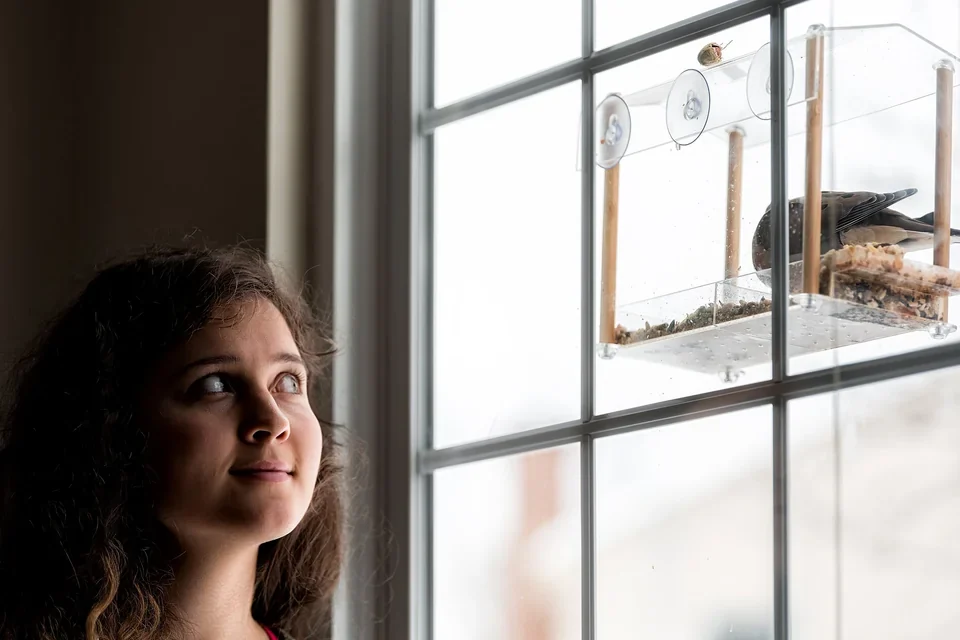
Photo: USFWS Headquarters · Mourning dove bird perched on a bird feeder on a window with young girl watching inside (54182122110).jpg · Public domain. Resized from the credited adaptation.
Choose food by ingredients and condition
Read the ingredient list on a seed mix. A photograph of a dove on the bag does not tell you how much of the mixture local birds will use or how much debris it will leave. Begin with a modest quantity of a suitable seed or mix, then inspect both the feeder and the ground to see what is eaten and what accumulates.
Project FeederWatch's food-type guide describes common offerings, including sunflower and millet. Use that information alongside observation. Preferences can vary among the birds visiting a particular yard, and a broad mix may attract more species than you intended to feed.
Keep new food separate from old residue. Pouring fresh seed over a damp layer hides the very material that needs removal. If food smells musty, clumps, becomes visibly moldy, or is contaminated, discard it and clean the equipment. Do not try to salvage a spoiled batch by drying it in the sun or mixing it into a larger clean batch.
Store the supply in a dry, secure container appropriate for the setting. Label a new batch so you know which food is oldest, and buy quantities you can use while they remain in good condition. The bird-seed storage guide covers the container, moisture, and pest checks that make feeding more predictable throughout the year.
Keep ground cleanup part of the feeding decision
Doves draw attention to the ground beneath a station. Look there every time you refill. Empty hulls, intact seed, droppings, and wet plant matter have different implications, but all can accumulate if nobody checks the surface. A feeder that looks clean from above may sit over a neglected patch.
Use a manageable area where waste can be collected without damaging roots or washing contaminated material into a drain. A removable catch tray can help contain spill, but it becomes another feeding surface and needs cleaning itself. Do not let the word “catcher” turn it into permanent outdoor storage.
After rain, inspect the lowest layer. The top may look dry while food underneath remains damp. Empty the tray rather than stirring the wet layer into the dry material. If you repeatedly find more waste than you can reasonably remove, reduce the amount offered or pause feeding while you redesign the station.
Keep food away from places where it encourages rodents into buildings. Secure the stored supply and remove spilled food promptly. A larger nightly pile is not a responsible way to compensate for a quiet daytime feeder. The practical test is whether you can leave the area clean at the end of the day. If the answer is consistently no, the setup needs less food or a different location.
Provide water with room for a larger visitor
Mourning Doves can use a shallow birdbath, but the basin should offer stable footing and an unobstructed approach. A narrow decorative bowl crowded with ornaments may hold water while providing little usable space. Think about the bird's body and the path it needs to enter and leave.
Start with a gentle slope and shallow water. Check depth with a ruler rather than estimating from a photograph or the outside height of the bowl. Our birdbath-depth guide explains why the edge, center, and surface texture should be assessed together.
Place the bath where you can clean it without dragging equipment through dense cover. Nearby vegetation can offer a retreat, but avoid putting the rim beside a concealed cat approach. Look at surrounding windows from outside as well; a bath can draw birds toward reflected foliage.
Fresh water does not stay clean simply because it moves. If you add a fountain, inspect the basin and pump, maintain a quiet shallow area for access, and replace contaminated water. The solar-fountain guide compares circulation, splash loss, and maintenance. A plain bowl maintained reliably may be more useful than a complicated feature that runs low or develops a film between inspections.
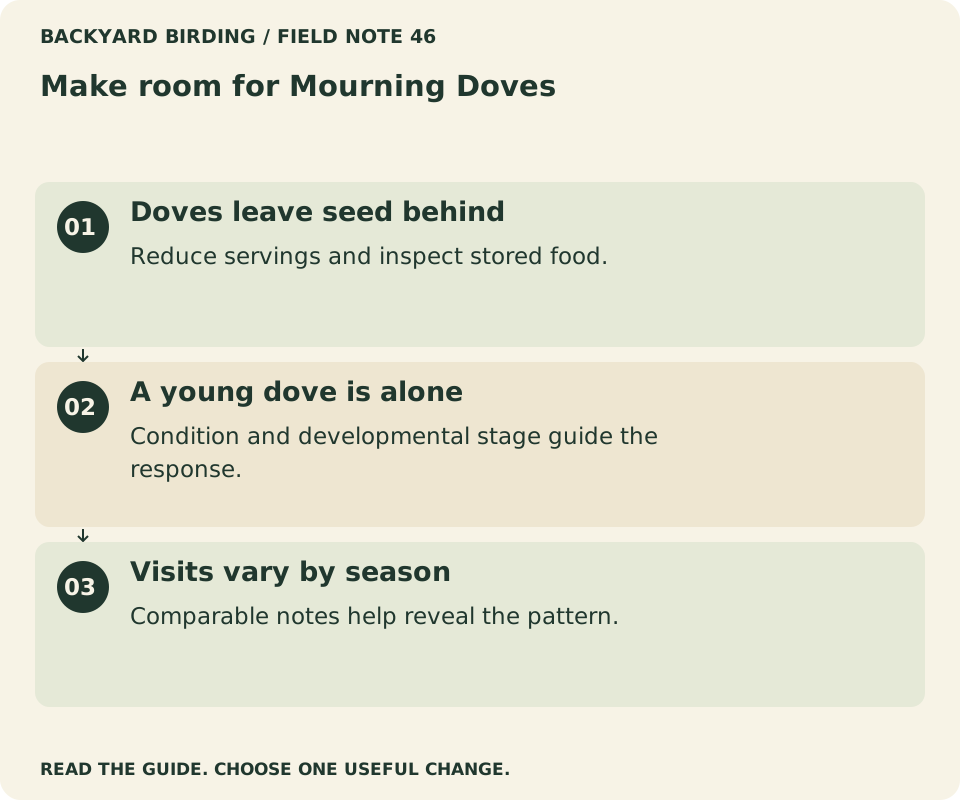
Find your situation

Read the visual as text
- Doves leave seed behind. Reduce servings and inspect stored food.
- A young dove is alone. Condition and developmental stage guide the response.
- Visits vary by season. Comparable notes help reveal the pattern.
Recognize ordinary social behavior
Doves may feed together, wait on wires, preen, pursue one another, or leave suddenly. Watch a full sequence before deciding that a brief interaction is a serious problem. One bird displacing another from a small tray can reflect competition at that moment without proving that the species is unusually aggressive.
Crowding is something you can address. If birds repeatedly jostle on a narrow surface, first consider whether too much food is concentrating activity in one place. Reducing the serving or simplifying the station may be more useful than adding food to every corner of the yard.
Do not assign pair relationships from proximity alone. Two birds sitting together may be a pair, but a short observation rarely tells the whole story. Descriptions such as “two doves preening side by side” preserve the interesting behavior without making claims about lifelong bonds or individual identity.
Audubon's Mourning Dove field guide provides a broader account of breeding and feeding behavior. Use it to interpret patterns while keeping your own observations specific. A simple note about who arrived, where they fed, and how the interaction ended is often enough to answer a practical question about feeder space or disturbance.
Understand the surprisingly simple nest
A Mourning Dove nest may look like a loose platform of twigs rather than a deep, carefully enclosed cup. That appearance alone is not evidence that the birds need your help rebuilding it. Their normal nesting arrangement differs from the substantial mud-lined nest of an American Robin.
Nests may occur in trees, sheltered structures, and other sites around homes. Once birds are using a location, avoid moving the nest or adding supports directly into it without professional advice. An intervention that looks helpful can disturb the adults or create a new hazard.
The U.S. Fish and Wildlife Service nest guidance explains why occupied nests require care and why removal questions cannot be answered solely from whether a nest looks inconvenient. If maintenance work conflicts with nesting, contact the relevant wildlife authority or a qualified local professional before proceeding.
Plan ahead where possible. Before the nesting season, inspect equipment, gutters, and areas scheduled for repairs. Make necessary lawful maintenance decisions while sites are unoccupied, rather than waiting until eggs or young are present. Once a nest is active, shift routine activity when you can and observe from a distance. You can enjoy the event without making the nest a daily close-up photo subject.
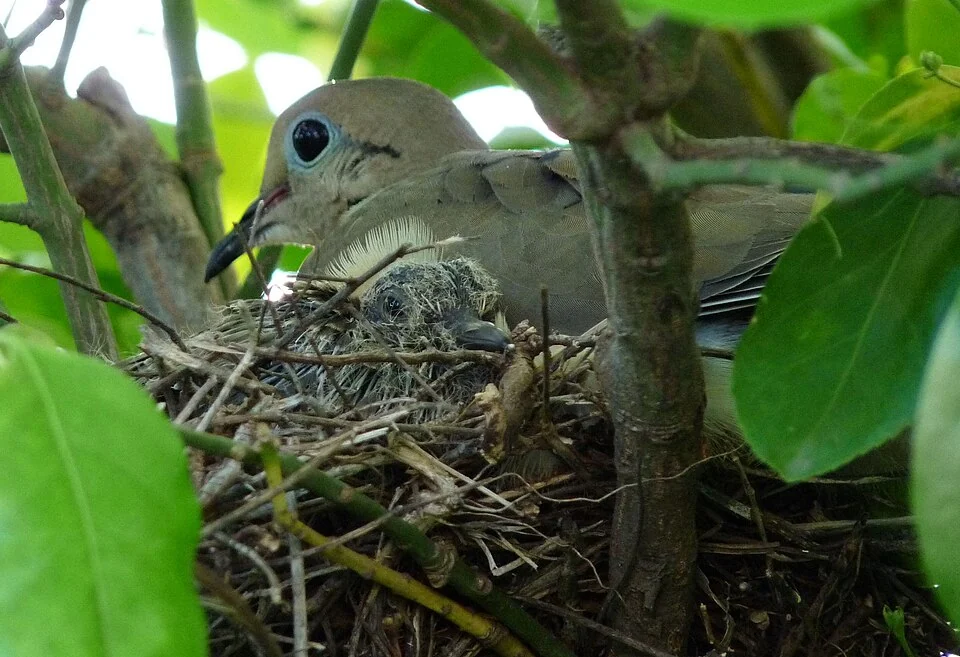
Photo: Kilarin · Zenaida macroura -chick and adult in nest-8c.jpg · CC BY 2.0. Resized for this guide.
Give parents and young space
Adult doves feed their young differently from the seed-pecking behavior you see at a tray. The young receive crop milk and, as they develop, other food from their parents. A packet of seed is therefore not a suitable substitute for parental care, and a person should not try to reproduce the process from a short online description.
A young dove can remain quiet and still, which makes age and condition hard to assess casually. Use the bird's visible feathering, posture, movement, and circumstances as information for a rehabilitator when help is needed. Do not repeatedly pick it up to test whether it can fly.
If a feathered youngster is in a safe place and no injury is apparent, keep pets back and observe from a distance. If it is injured, was caught by a cat, or faces a situation you cannot assess safely, seek prompt advice. The Wildlife Center of Virginia's baby-bird guidance distinguishes normal development from circumstances needing intervention.
Our baby-bird response guide includes a practical information checklist for the call. Avoid bread, milk, water forced into the bill, or an improvised hand-feeding mixture. While you obtain advice, reducing disturbance is usually a more useful action than experimenting with care.
Separate seasonal movement from feeder loyalty
The doves you see in summer may not represent the same individuals you see in winter. Seasonal movements vary across the species' range, and local feeding groups can change with weather and available food. A familiar perch can be used by many birds over time.
Use Cornell's Mourning Dove range map and local observations to frame expectations. A broad range map shows where the species occurs seasonally; it does not predict the number that should visit your exact property on a particular morning.
Record arrivals and departures as observations, not promises. If doves disappear for several days, inspect food condition and hazards, then consider what changed nearby. Harvest, construction, natural seed availability, weather, and your own viewing hours can all affect what you notice. There is no need to assume the feeder failed immediately.
During cold weather, maintain a routine you can sustain safely. Keep food dry, clean the feeding surface, and avoid hazardous trips across ice merely to preserve an exact refill time. Our winter-feeding guide helps plan supplies and access. A manageable winter station is one you can inspect properly, not simply one with the largest reservoir.
Respond to concerning signs without diagnosing
A bird sitting still is not automatically sick. Resting posture, weather, and the context matter. More concerning observations include obvious injury, difficulty moving, persistent abnormal behavior, or several birds at a feeding area appearing unwell. Describe what you see rather than naming a disease from a photograph.
Keep people and pets away from a concerning bird, and contact a wildlife rehabilitator or local wildlife agency for current advice. If multiple birds appear ill, shared food and water surfaces need attention and feeding may need to pause. Follow local guidance about reporting, cleaning, and restarting.
Take a photograph from a distance if it helps the consultation, but do not chase the bird for a clearer image. Note the time, number of affected birds, species if known, and whether you observed a collision, pet contact, or other incident. These details are more useful than a confident but unsupported diagnosis.
The sick-bird guide covers the broader response. Cornell's feeder-cleaning instructions explain routine sanitation. Keep cleaning equipment separate from food-preparation tools, follow the relevant product and wildlife instructions, and rinse and dry appropriately before reuse. A clean-looking top surface is not enough if food remains trapped beneath a removable floor.
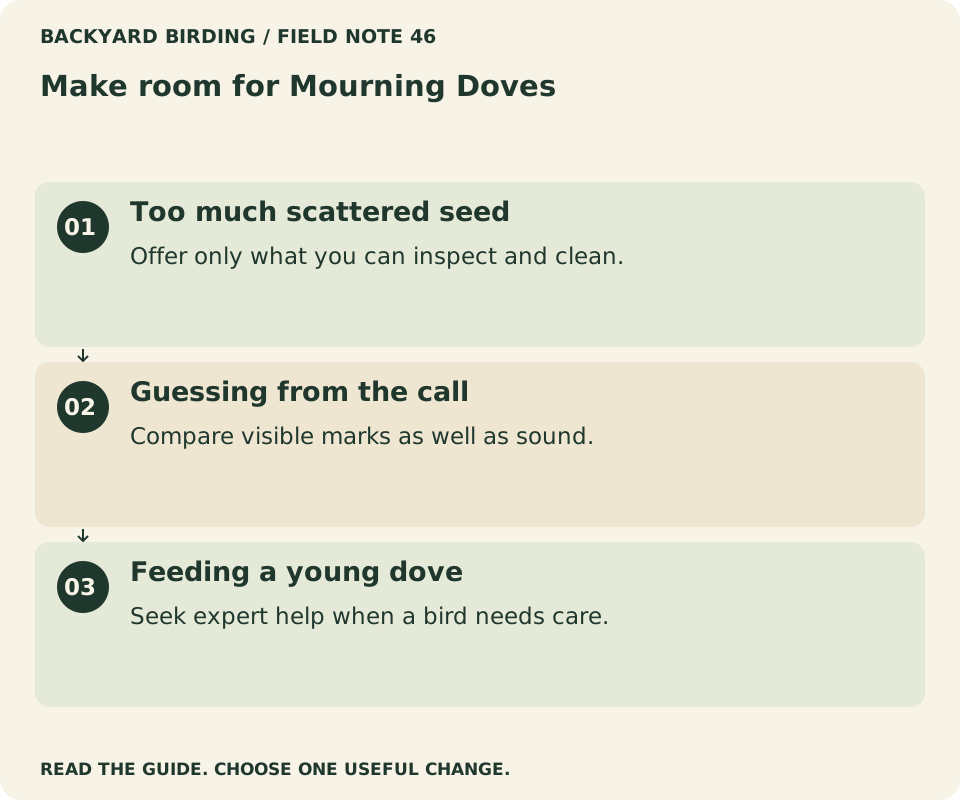
Small mistakes. Better moves.

Read the visual as text
- Too much scattered seed. Offer only what you can inspect and clean.
- Guessing from the call. Compare visible marks as well as sound.
- Feeding a young dove. Seek expert help when a bird needs care.
Make the yard safer for birds that feed low
Ground-feeding birds spend time where pets and concealed predators can approach. Keep cats indoors or in a secure enclosure, and avoid placing food beside a dense hiding place that reaches the feeding surface. A view of nearby cover can be useful without pushing the birds into an ambush corner.
Review windows along the route between feeding and resting places. A sudden departure may send doves toward a reflection of open sky or trees. Treat hazardous glass across its full exterior surface using a suitable pattern or barrier, following the American Bird Conservancy's home guidance.
Avoid sticky substances, loose tangling lines, or improvised deterrents around the station. If you need to reduce visits in a particular location, remove the food attraction and use appropriate noninjurious building management while respecting active nests. Do not create a trap in an attempt to protect a patio from droppings.
Walk the area at the level of the practical task: where will seed fall, where will water drain, and where can a startled bird go? That review often reveals a simpler improvement than another accessory. Moving a catch tray into reach, treating one risky pane, or shortening the route for daily cleanup can make the arrangement safer and easier to keep.
Keep a useful dove record
Choose one observation point and a short repeatable watching period. Record the largest number of doves visible at once, the surface used, and the food or behavior you could confirm. If birds come and go continuously, say so rather than adding every arrival into a total of supposedly different individuals.
Add notes about the station itself. Was the tray wet? Was whole seed left overnight? Did one corner collect debris? Linking bird observations with equipment condition helps you make practical changes without blaming the birds for a design problem.
For example, several doves feeding beneath a tube feeder while ignoring a new platform may suggest that familiar spill is drawing them. Clean the ground, reduce spill, and watch again before adding more food. If a broad tray becomes crowded and dirty quickly, smaller servings may be the first adjustment to try.
At the end of a week, choose one finding worth acting on. Keep the record in the simple format described in our bird journal guide. There is no need for a complicated spreadsheet or a perfect photograph. Consistent notes can reveal whether the problem is excess food, poor drainage, a difficult cleaning location, or simply an expectation that every bird should use the feeder in the same way.
Compare two feeding layouts before committing
Imagine a feeder hanging over a planted bed and a second possible location above a small cleanable area. The bed hides fallen seed neatly, but that visual advantage can conceal damp food and droppings. The open surface makes waste more obvious and may be easier to maintain, provided it does not create a slip hazard or conflict with other uses.
Do not choose solely by which arrangement looks tidier from the window. Visit both positions and rehearse the work: remove the feeder, collect waste, inspect the support, and clean any tray. Think about rain as well as dry weather. A location that is easy to sweep when dry may become a muddy collection point after storms.
Now consider the birds' route. Where can a dove land, and where will it go if startled? Is there hazardous glass, a narrow enclosed corner, or a concealed cat approach? A cleanable surface is useful only within a safe overall arrangement.
You can test a modest serving at the better location without filling every available space. Watch whether doves feed comfortably and whether waste stays manageable. If the setup attracts more activity than you can maintain, reduce the food. There is no obligation to increase capacity every time more birds appear.
Keep the final choice reversible. Seasonal wind, nearby work, or changes in the household may alter the best location. A removable platform with a clear cleaning route gives you options without turning feeding into a permanent landscape commitment.
Distinguish a useful count from a story about individuals
Suppose two doves arrive, one leaves, and another appears several minutes later. You have observed three arrivals, but you have not necessarily seen three different birds. The first bird may have returned outside your view. Record the maximum number present together and add a note about turnover.
The same caution applies to pairs. Two birds visiting together repeatedly may be associated, but a camera angle or similar plumage rarely lets you recognize them as the same individuals across weeks. Describe the repeated pattern without assigning identities you cannot verify.
A simple count can still answer practical questions. If the maximum group at the tray increases and cleanup becomes harder, the station may need smaller portions or a pause. If the same number of birds visits but much more seed remains, check the food mix and weather exposure rather than assuming every bird has changed its preference.
Use photographs to preserve the scene, not to manufacture precision. A wide frame showing all visible birds supports a count better than separate close-ups taken at different times. If a bird is partly hidden, mark the count as a minimum. These small habits make ordinary observations more trustworthy and reduce the temptation to turn a busy feeder into an unsupported population estimate.
The point is not to remove personality from birdwatching. You can enjoy a familiar routine while keeping the written record clear about what you know. That balance is especially helpful when you compare seasons or share observations with someone learning the species.
Common Mourning Dove questions
Are the doves nesting in my planter doing something wrong?
Not necessarily. Human structures can provide nesting sites. Keep your distance, avoid moving an occupied nest, and seek local wildlife advice if the location creates a genuine conflict. A nest that looks flimsy may still reflect normal dove construction.
Why do doves ignore the tiny perches on my tube feeder?
The design may not offer the broad stable access they use comfortably. Evaluate a cleanable platform or accept that different birds use different parts of the habitat. Do not scatter large amounts of seed on the ground simply to make the tube feeder appear suitable for every species.
Do I need to buy grit for them?
Do not assume a backyard visitor requires every supplement sold for captive birds. Provide appropriate food if you feed, maintain natural habitat, and avoid adding unneeded materials to the station. Questions about an injured or captive bird belong with a qualified rehabilitator or veterinarian.
Is a larger flock proof that my yard is healthier?
No. A large gathering may reflect concentrated food, seasonal movement, or conditions elsewhere. Assess cleanliness, bird access, habitat, and hazards alongside numbers. More birds at one tray can mean more maintenance rather than a better setup.
What should I change first?
Inspect the ground and the feeding surface. If food is staying wet or accumulating, reduce the serving and improve cleanup before adding equipment. If the station is clean and manageable, spend the next watch learning one field mark or behavior. Familiar doves offer plenty to notice without constantly changing their surroundings.
Watch it. Then try it.
Review the steps and common mistakes in two short, silent animations. Each has a complete text transcript below.
Your four-step action map
Read the complete video transcript
Make room for Mourning Doves.
- Confirm the field marks. Look at the tail, wing spots, head, and neck.
- Check the feeding area. Keep seed dry and remove contaminated waste.
- Reduce hazards. Protect glass and keep cats away from birds.
- Watch the family quietly. Give nests and healthy fledglings space.
Try the steps, then note any problem that still needs attention.
Three mistakes to avoid
Read the complete video transcript
Make room for Mourning Doves.
- Too much scattered seed. Offer only what you can inspect and clean.
- Guessing from the call. Compare visible marks as well as sound.
- Feeding a young dove. Seek expert help when a bird needs care.
Try the steps, then note any problem that still needs attention.
Both animations use this real photograph by Dominic Sherony. Photo source · CC BY-SA 2.0. The photo is adapted into original educational animations, not recordings of a field test.
At a glance
| First check | Useful response |
|---|---|
| Confirm the field marks | Look at the tail, wing spots, head, and neck. |
| Check the feeding area | Keep seed dry and remove contaminated waste. |
| Reduce hazards | Protect glass and keep cats away from birds. |
| Watch the family quietly | Give nests and healthy fledglings space. |
Sources & evidence
- Mourning Dove identification page
- Eurasian Collared-Dove
- White-winged Dove
- Mourning Dove recordings
- life-history account
- feeder-type guidance
- food-type guide
- Mourning Dove field guide
- U.S. Fish and Wildlife Service nest guidance
- Wildlife Center of Virginia's baby-bird guidance
- Mourning Dove range map
- feeder-cleaning instructions
- American Bird Conservancy's home guidance
Our standard: real evidence before ratings. Corrections follow our editorial process.
Our verdict & your next actions
Choose the row that describes your setup, then follow the suggested check or adjustment.
| Your situation | Our verdict | Your next action |
|---|---|---|
| Doves leave seed behind | Reduce servings and inspect stored food. | Review seed storage |
| A young dove is alone | Condition and developmental stage guide the response. | Assess a found youngster |
| Visits vary by season | Comparable notes help reveal the pattern. | Keep a bird journal |
Your pocket field checklist
Tick off the steps as you go.
0 of 4 steps completed
Keep building your knowledge in birds, or search the full backyard library.