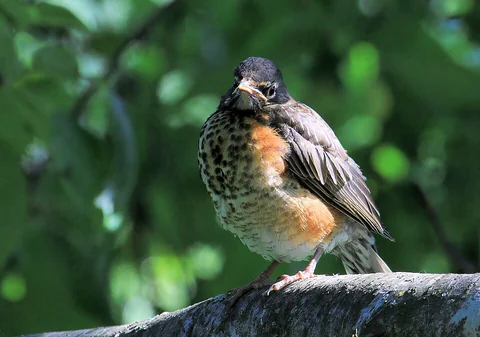
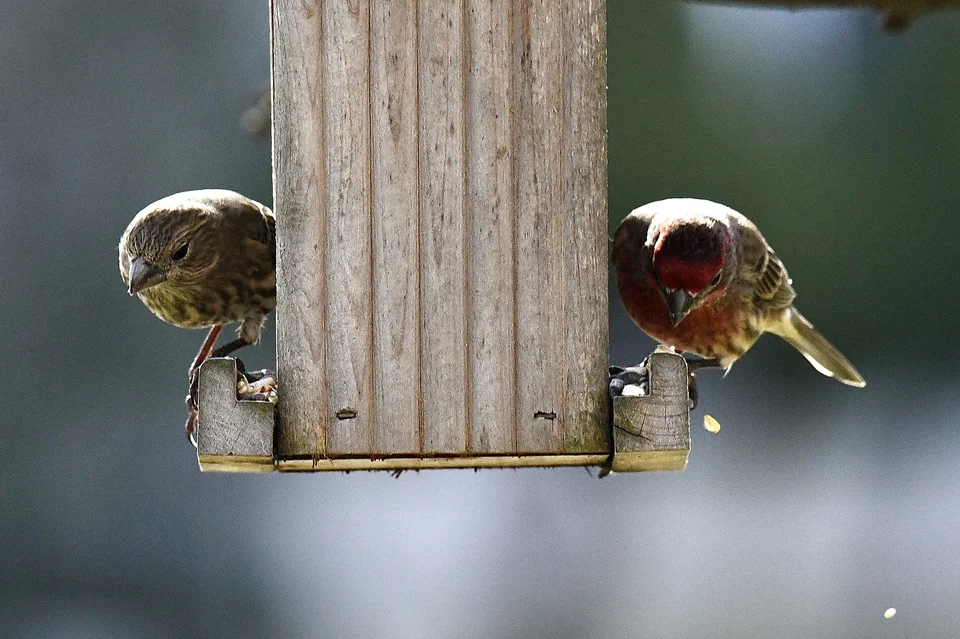
Photo: Michele Dorsey Walfred · House finches at bird feeder.jpg · CC BY 2.0. Cropped, gently adjusted, and resized for this guide.
The short answer
Do not diagnose a bird from a photograph. Keep people and pets back, document visible signs, clean shared feeding surfaces, pause feeders when several birds appear ill, and seek current local wildlife advice.
A sick-looking visitor changes the plan
A finch sitting motionless on a feeder, eyes partly closed, or a bird with obvious eye swelling deserves attention. The first useful action is not to name a disease from the kitchen window. Several conditions can produce similar signs, and a photograph cannot confirm a pathogen. Your job is to reduce avoidable contact at the feeding station, protect people and pets, document what you saw, and ask the right local authority for guidance when the situation warrants it.
Start by keeping your distance. Keep children and pets away from the bird and any dead wildlife. If it is injured or unable to move normally, contact a licensed wildlife rehabilitator or local wildlife agency before attempting capture. Cornell Lab advises calling ahead because not every clinic can accept potentially infectious wild birds. Do not medicate, feed, or bring an apparently sick bird inside without professional direction.
The response at the feeder depends on the observation and local context. One ambiguous posture is not the same as several visibly ill birds. A current state advisory may call for a stronger pause than a general article does. This guide gives a conservative decision framework, not a veterinary diagnosis or a standing replacement for public wildlife instructions. Check the date on any advisory you find; past outbreaks may have ended or changed.
Record the observation before guessing at a cause
Write down the date, time, location, species if reasonably known, number of birds affected, and what you actually saw. “House Finch with swollen-looking left eye, remained on tray for ten minutes” is more useful than “finch has conjunctivitis.” Note whether there were other birds sharing the port, whether food was wet or visibly moldy, and whether a bird was found beneath a window. A collision can leave a bird still or disoriented without implying an infectious disease.
If you can photograph the bird without approaching it, preserve the original image and note the distance and lighting. Do not use an app's disease suggestion as a diagnosis. A wildlife professional may ask for a description or picture and can advise on what to do. Avoid posting a close-up with a confident disease name before anyone has assessed it; that can spread inaccurate local alarms.
Keep the observation separate from your action log. You might write: “Two birds appeared weak; feeders removed at 10 a.m.; seed discarded; state agency contacted.” This distinction matters later. It shows what prompted the response and which parts of the station were actually cleaned. A short log also helps if another household member maintains the feeders while you are away.
Decide whether to pause feeding
Cornell Lab advises cleaning the feeding area if a sick bird appears. If several birds appear diseased, its guidance says to take down all feeders for at least a week so birds disperse. Project FeederWatch offers similar advice for visibly sick birds. Treat these as general starting points and follow any more specific current instruction from your state wildlife agency. A temporary pause is usually a manageable option; wild birds are not dependent on a single household's feeder as their only food source.
| What you observe | Immediate household response | Next check |
|---|---|---|
| Uncertain single brief behavior | Observe from a distance; inspect food and surfaces | Recheck for repeated abnormal signs |
| Clearly sick bird at a feeder | Remove shared food access, clean site, seek local guidance | Document bird and affected equipment |
| Several visibly ill birds | Take down all feeders for at least a week per Cornell guidance | Ask state wildlife agency about reporting and restart |
| Dead bird or current local advisory | Avoid handling; contact relevant authority | Follow its handling and feeding instructions |
| Domestic poultry on property | Separate wild-bird access from flock resources | Follow USDA and state biosecurity advice |
The table is a decision aid, not a disease classifier. If you are unsure whether an animal is injured, ill, or simply resting, a wildlife rehabilitator can advise. If you see a dead bird or multiple sick birds, local reporting advice takes priority over waiting for a predictable pattern.
Your visual action map

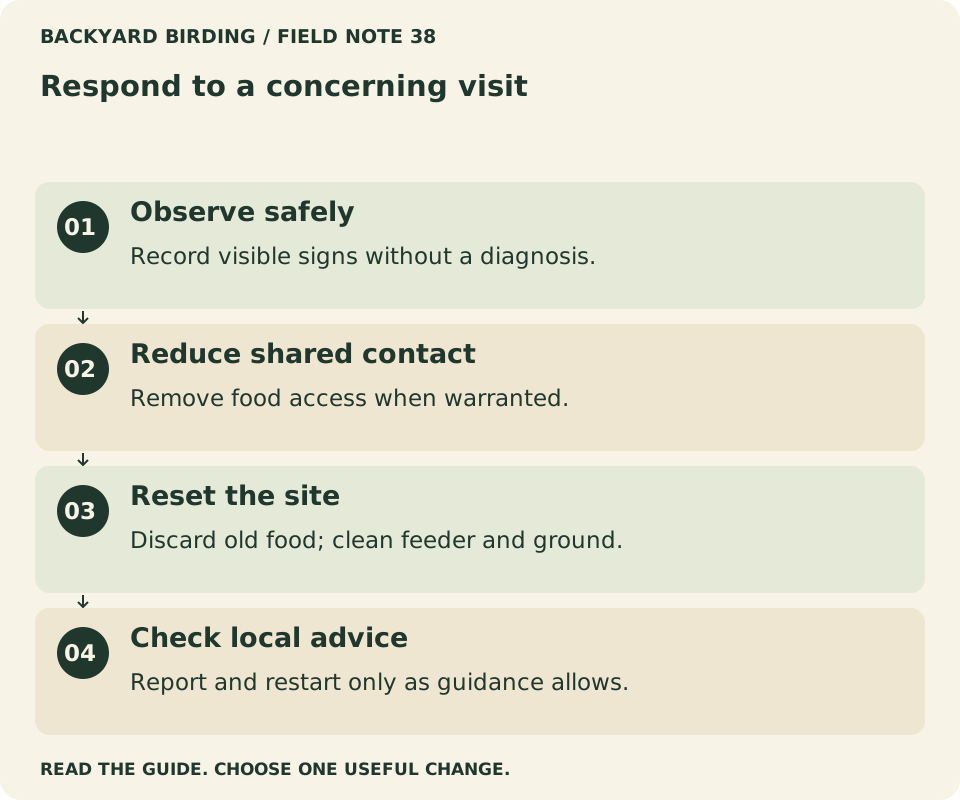
Read the visual as text
- Observe safely. Record visible signs without a diagnosis.
- Reduce shared contact. Remove food access when warranted.
- Reset the site. Discard old food; clean feeder and ground.
- Check local advice. Report and restart only as guidance allows.
Clean the whole contact path, not only the visible perch
Removing a feeder is the start of a reset. Discard old or contaminated food; do not top it off and rehang the unit. Take apart the approved washable pieces and clean food ports, perches, tray, reservoir, seams, and the area beneath. Droppings and damp hulls can accumulate where a quick wipe does not reach. Rinse thoroughly and dry completely before any future refill. Wear appropriate protection and wash hands after handling equipment.
Cornell's feeder-cleaning guidance and the exact manufacturer's instructions should be read together. A cleaning solution safe for a simple metal feeder may not be appropriate for a camera, battery, coated surface, or wooden assembly. Do not mix cleaning chemicals. Follow label directions for dilution, contact time, ventilation, and rinsing. If the device cannot be properly disassembled or sanitized, consider whether it is suitable for continued feeding.
Our cleaning guide explains the routine method; this article addresses the decision when an ill bird may have used the station. Give the ground equal attention. Rake up old seed and droppings rather than washing everything into a small muddy patch where birds will continue to forage.
Understand why crowding and old food matter
Feeders bring multiple birds to shared surfaces. That concentration can increase opportunities for organisms to move between birds, particularly where feces contaminate food or surfaces. Damp seed can spoil, and a deep reservoir may hide old food beneath a fresh-looking top. Routine hygiene is therefore not cosmetic. It changes the conditions at the common contact point, even though it cannot eliminate every wildlife disease.
Reduce the amount of seed offered to what birds will use before it deteriorates. Check drainage after rain and remove wet clumps promptly. Space multiple feeders so birds are not forced into one crowded port, and move or clean a station if waste accumulates beneath it. Cornell's discussion of summer feeder safety specifically highlights moving feeders and preventing seed hulls and droppings from building up at one site.
None of this proves a particular bird caught an illness at your feeder. A sick bird may seek easy food, and disease can spread elsewhere. The practical claim is narrower and important: a clean, uncrowded, well-managed station reduces avoidable shared contamination. That is a reason to maintain it before an obvious sick bird appears, not just after.
Eye disease, salmonellosis, and avian flu are different questions
House Finch eye disease is associated with *Mycoplasma gallisepticum*, and visibly affected finches can have swollen or crusty eyes. Salmonellosis can also appear around shared feeding areas. Neither can be confirmed by a homeowner from posture or a single phone image. Distinguishing the causes matters for wildlife surveillance and care, but the first household steps remain observation, safe separation, site cleaning, and professional advice where needed.
Highly pathogenic avian influenza raises a different set of questions. Cornell's January 2026 guidance, developed with USDA APHIS input, says documented infection has been relatively uncommon among typical songbird feeder visitors and does not give a blanket national recommendation to remove feeders unless a household keeps domestic poultry. It explicitly says to follow state guidance if that differs. This is a dated summary, not a permanent promise about future virus behavior. Check current USDA and local agency information when making a decision.
Avoid collapsing all bird illness into “bird flu.” The words can create unnecessary alarm and, worse, can obscure a real local reporting need. A householder does not need to identify the pathogen to make a prudent first response. Explain the observed signs accurately and let qualified agencies interpret them.
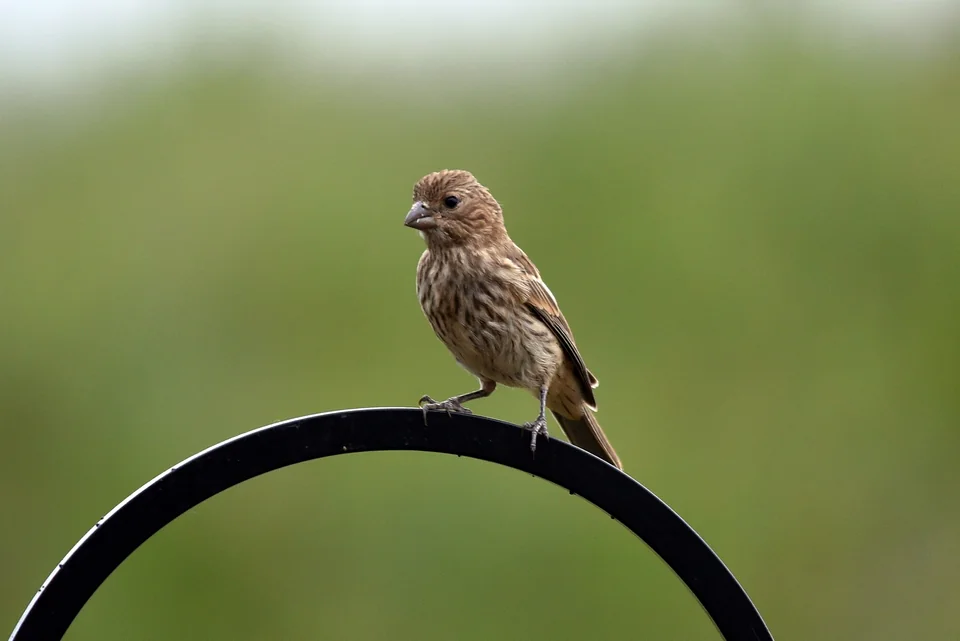
Photo: U.S. Fish and Wildlife Service - Midwest Region · House finch (50057806123).jpg · Public domain. Cropped, gently adjusted, and resized for this guide.
“Describe what you saw, reduce shared contact, and let qualified local guidance direct the next step.”
Backyard Birding — editorial takeaway
If you keep chickens, ducks, or pet birds
Poultry changes the risk calculation. USDA APHIS advises reducing opportunities for wild birds to access poultry feed and water and keeping wildlife away from flock facilities. Keep wild-bird feeders and baths well away from domestic birds, and do not allow them to share water. Use separate footwear and equipment as your flock biosecurity plan requires. A backyard songbird feeder routine does not substitute for poultry-specific instructions.
Cornell's avian-influenza guidance says poultry keepers should take down wild-bird feeders or keep them well away from the captive flock as a secondary protective measure. USDA's Protect Your Birds From Wildlife page details the broader work: secure buildings, remove attractants, protect food and water, and report illness in the flock. Follow current state veterinarian and USDA advice for poultry signs and reporting.
Pet birds also need separation from wild birds and contaminated materials. Do not carry a dirty wild-bird feeder through the room where a pet bird lives. If the household has captive birds and a wild bird appears ill, describe that context when contacting an agency or veterinarian. It can affect the advice you receive.
What to do with an injured or dead bird
Do not handle a sick or dead wild bird casually. Keep pets away and contact a wildlife rehabilitator, state wildlife agency, or local public-health authority as appropriate. Cornell's sick-bird guidance says to call before bringing an injured bird to a facility because some cannot isolate infectious birds. An agency can also say whether a dead bird should be reported or tested during a current event.
If a professional instructs you to move a bird, follow its handling directions for gloves, containment, and transport. Do not improvise a treatment with household medicine, a dish of sugar water, or a warm closet. Wild birds are easily stressed and may require a specialized, permitted rehabilitator. If you have had unprotected contact with an apparently sick or dead bird and develop symptoms, contact a healthcare professional and describe the exposure; public-health guidance can change.
Record the location before any authorized removal. A bird found immediately beneath a window may have suffered a collision rather than an infectious disease. Use the window-collision guide to address that separate hazard. Keeping hypotheses distinct helps the next person give you useful advice.
Follow the current local advisory, not last year's screenshot
State wildlife agencies may issue temporary feeder recommendations during a particular illness event. Those directions can differ across states and may later be lifted. Cornell's archived 2021 statement illustrates why date matters: the affected states eventually lifted do-not-feed recommendations. An old social-media graphic can continue circulating after the underlying instruction has changed.
When checking an advisory, note the issuing agency, publication or update date, affected area, species or context, exact requested action, and any later update. If the agency says remove feeders, follow that direction even if a general article describes a less restrictive baseline. If an advisory is unclear, contact the agency instead of guessing from a headline. A local veterinarian may be the right contact for captive birds; a wildlife agency or rehabilitator may be right for wild birds.
This habit also protects your readers if you share the information. Link to the current official page, not a cropped image. Say “as of [date]” for time-sensitive guidance. Avoid claiming there is no risk everywhere because one national source found low risk for a specific group at one point in time.
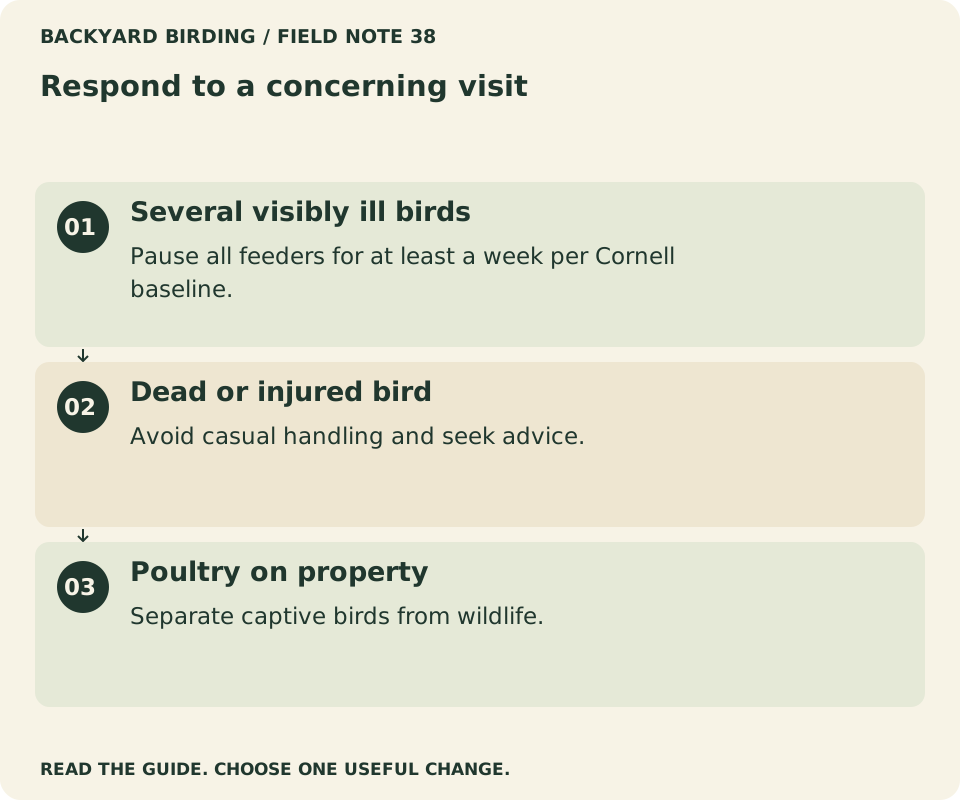
Find your situation

Read the visual as text
- Several visibly ill birds. Pause all feeders for at least a week per Cornell baseline.
- Dead or injured bird. Avoid casual handling and seek advice.
- Poultry on property. Separate captive birds from wildlife.
Reopen a station deliberately after a pause
Before rehanging, clean and dry equipment, remove old seed from the ground, and inspect stored food. Choose a modest fresh fill so you can see how the station behaves. Do not treat the end of one week as automatic clearance if a local advisory remains in force or sick birds are still present. Recheck official guidance and your observations. If the site has recurring dampness or crowding, change the setup before restarting.
A restart log can be simple: date, feeder type, amount offered, cleaning completed, and observations over the next several days. If birds return without obvious issues, continue ordinary hygiene. If several sick birds reappear, pause again and consult your wildlife authority. Your notes may reveal that the same ground patch accumulates hulls, or that one feeder design is too difficult to clean well.
The purpose is not to guarantee a disease-free yard. No household can do that. A deliberate restart prevents the avoidable mistake of putting a sanitized feeder back over a dirty pile of seed or filling it with a questionable supply. It also keeps the response proportionate: you can resume responsible feeding when the context allows, without pretending the initial observation never happened.
Adjust equipment if cleaning is consistently difficult
A complex feeder that cannot be opened easily invites shortcuts. Consider a smaller reservoir, removable tray, accessible ports, and a finish compatible with the cleaning method you plan to use. For a camera feeder, separate washable food-contact parts from electronics as the model instructions require. A desirable video clip is not worth a food surface you cannot inspect.
The feeder-type guide helps compare access and food presentation. If the problem is seed on the ground, the waste guide separates normal hulls from food being dropped. The aim is a station with fewer hidden reservoirs of old material and a cleaning routine that fits ordinary life.
Do not buy a new device before checking the basic conditions. An expensive feeder placed over a wet seed pile can reproduce the same concern. Conversely, a simple, well-maintained tube can be a better choice than a feature-rich unit whose base is hard to wash. Evaluate the entire route from storage container to port to ground beneath it.
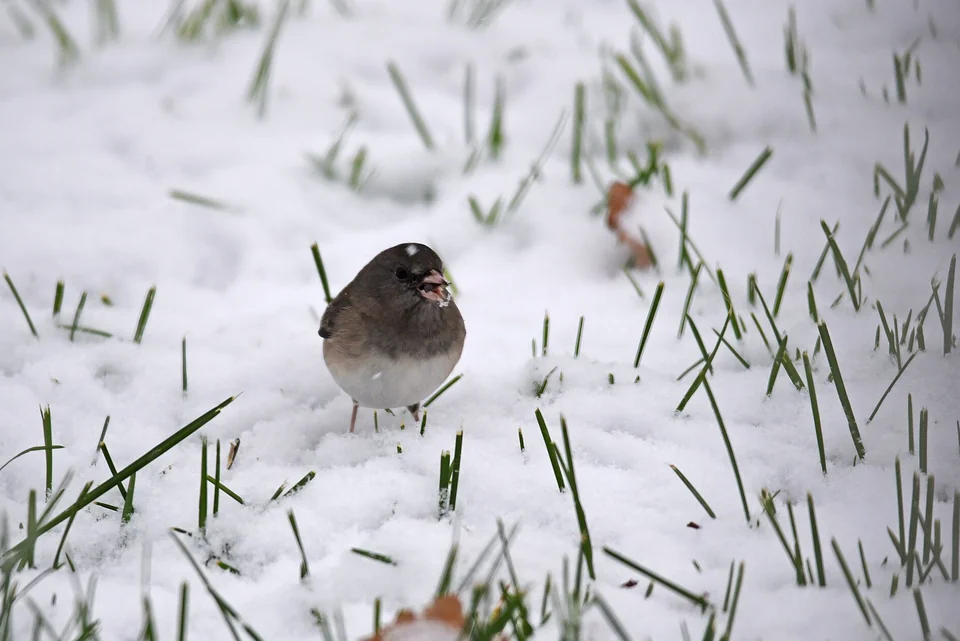
Photo: U.S. Fish and Wildlife Service - Midwest Region · Dark-eyed junco (50510431537).jpg · Public domain. Cropped, gently adjusted, and resized for this guide.
Questions that come up after a sick-bird sighting
Should I leave one feeder up for healthy birds? If several birds appear diseased, Cornell recommends taking down all feeders for at least a week to disperse the congregation. Follow any current local instruction that differs. Will the birds starve if I pause? Wild birds forage from multiple sources; a temporary household pause is generally a reasonable response. Continue to support natural habitat, but do not use it as a reason to leave contaminated equipment in service.
Can I tell from a photo whether this is bird flu? No. Different causes can produce overlapping signs, and laboratory testing may be needed. Is a single sleepy-looking bird enough to identify disease? No. Record the behavior, watch safely, inspect the station, and seek advice if concerning signs persist or other birds are affected. Do I need to bleach every surface? Use a compatible documented cleaning method, the manufacturer's material guidance, and any agency advice. Mixing or overconcentrating chemicals can create another hazard.
Keep the wildlife agency's contact and the feeder's cleaning instructions with your notes. When you call, describe the number of birds, the signs you observed, and whether poultry or pet birds are present. Ask what to do with the equipment and when to reassess feeding, then record the advice and its date.
Separate unusual behavior from an illness claim
A bird puffed up briefly in cold weather may be conserving heat; a bird holding still near a window may have struck glass; a fledgling can look awkward without being abandoned. The same visible sign can have more than one explanation. That uncertainty should slow the diagnosis, not the low-risk parts of your response. Keep people and pets back, inspect the shared feeding surfaces, and record whether the behavior persists or appears in several birds.
Seek professional advice when a bird cannot move normally, is repeatedly falling, has obvious injury, or remains in a vulnerable location. Explain exactly what happened before you noticed it. Did you hear a window strike? Was the bird already on the ground? Is another bird behaving similarly? These details help a rehabilitator triage the case. They are more valuable than a species or disease label supplied by a camera app.
If the bird recovers enough to leave, still correct any identifiable hazard. A collision-prone pane does not become safe because the first bird flew away. Likewise, visibly wet seed deserves removal even if a still bird later appears healthy. The household can fix conditions without claiming a medical cause.
Keep cleaning supplies and waste under control
Before starting, choose a work area where discarded seed and wash water cannot run into a poultry enclosure, vegetable-preparation space, or a spot birds will immediately forage. Wear gloves when handling contaminated material; wash hands and the work area afterward. Keep the feeder brush separate from dishes used by people. If equipment uses electronics, keep those parts dry and follow the model manual before any wet cleaning.
Dispose of old seed and collected ground waste rather than scattering it elsewhere in the yard. The exact waste rules may vary locally, especially during a disease advisory. Ask the issuing authority if it has specific disposal instructions. Never combine bleach with ammonia or another cleaner; follow a single product's label and rinse and dry as directed. More chemical is not automatically more protective.
Keep the cleaning sequence where helpers can see it: remove the feeder, discard old food, wash approved parts, rinse, dry, clear the ground, and refill only when the pause or local guidance allows. Put dirty tools aside for cleaning before carrying equipment indoors. That order helps keep the newly cleaned feeder separate from the waste you have just removed.
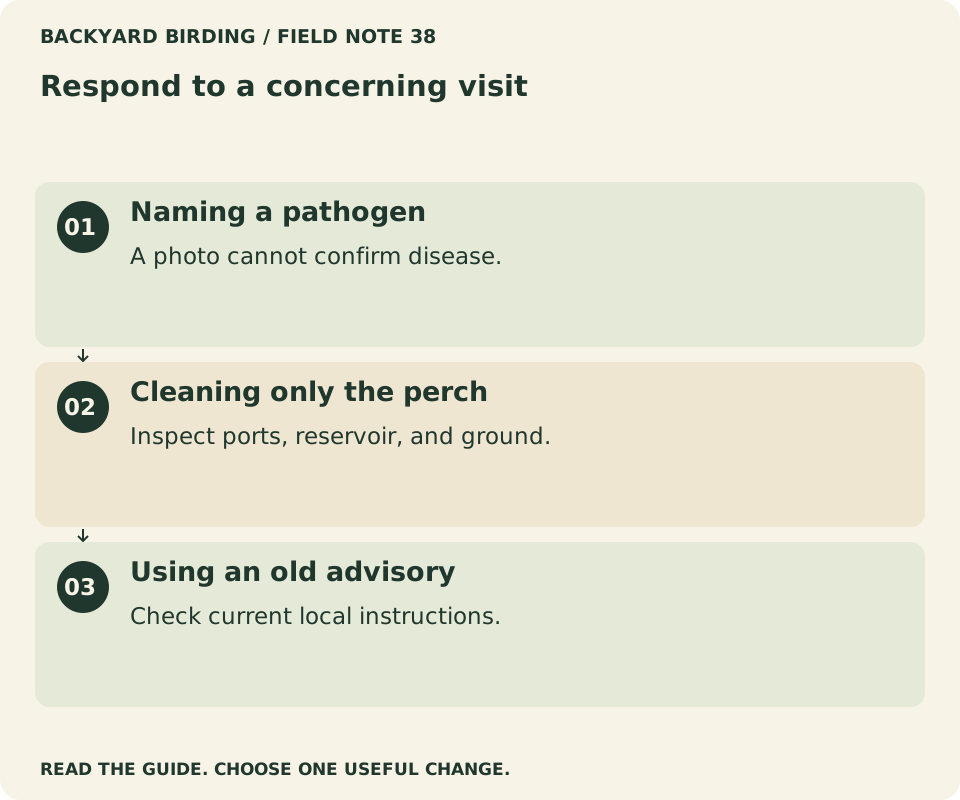
Small mistakes. Better moves.

Read the visual as text
- Naming a pathogen. A photo cannot confirm disease.
- Cleaning only the perch. Inspect ports, reservoir, and ground.
- Using an old advisory. Check current local instructions.
Share observations without spreading a rumor
Wildlife agencies and citizen-science projects can use well-described reports, but they need observations rather than a social-media diagnosis. Keep the date, place, number of affected birds, species if known, visible signs, and any image. Before submitting, check the project's current instructions: some collect routine feeder counts, others ask for specific disease reports, and a state agency may have a separate reporting channel during an outbreak.
If you tell neighbors, use measured wording. “I saw two finches with swollen-looking eyes, removed my feeders, and asked the wildlife office what to do” is accurate. “Bird flu is spreading through every feeder on the street” is not supported by that observation. Include a link to the current official advisory when one exists and note its date. This helps a neighborhood respond consistently without amplifying a false or expired instruction.
Follow up your own report when advice arrives. Add the agency's actual recommendation to the household log and update your restart plan. That small record makes future decisions faster and shows exactly what was known at the time.
Prevent the next avoidable problem
Set a routine that checks food and ground together. Keep seed dry in storage, offer amounts that turn over, clean feeder parts on schedule, and remove accumulations beneath the station. Space stations when possible. Keep a small card with the local wildlife agency and rehabilitator contact, the date of the last cleaning, and the cleaning limits for each device. If a bird appears ill, you can act promptly without searching for a bottle of improvised disinfectant.
Watch the wider yard too. A dirty bath is another shared surface; the bath-cleaning guide covers that routine. If a window is causing injuries, solve the glass problem. If you keep poultry, preserve a strong physical and operational separation from wild birds. These are distinct interventions for distinct risks.
If you need to act today, write down what you saw and remove any visibly spoiled food from service. Keep people and pets away from an affected bird, then contact the appropriate local wildlife service for the situation. Record the advice before restarting so another household member can follow the same plan while you are away.
Watch it. Then try it.
Review the steps and common mistakes in two short, silent animations. Each has a complete text transcript below.
Your four-step action map
Read the complete video transcript
Respond to a concerning visit.
- Observe safely. Record visible signs without a diagnosis.
- Reduce shared contact. Remove food access when warranted.
- Reset the site. Discard old food; clean feeder and ground.
- Check local advice. Report and restart only as guidance allows.
Try the steps, then note any problem that still needs attention.
Three mistakes to avoid
Read the complete video transcript
Respond to a concerning visit.
- Naming a pathogen. A photo cannot confirm disease.
- Cleaning only the perch. Inspect ports, reservoir, and ground.
- Using an old advisory. Check current local instructions.
Try the steps, then note any problem that still needs attention.
Both animations use this real photograph by Michele Dorsey Walfred. Photo source · CC BY 2.0. The photo is adapted into original educational animations, not recordings of a field test.
At a glance
| Your situation | Our conclusion | Your next action |
|---|---|---|
| Several visibly ill birds | Pause all feeders for at least a week per Cornell baseline. | Clean the station and check local advice. |
| Dead or injured bird | Avoid casual handling and seek advice. | Follow the safety steps. |
| Poultry on property | Separate captive birds from wildlife. | Review current USDA guidance. |
Sources & evidence
- Cornell Lab: Sick, injured, or dead birds
- Cornell Lab: Avian influenza and feeders, updated January 2026
- Cornell Lab: How to clean your bird feeder
- USDA APHIS: Protect poultry from wildlife
Our standard: real evidence before ratings. Corrections follow our editorial process.
Our verdict & your next actions
Choose the row that describes your setup, then follow the suggested check or adjustment.
| Your situation | Our verdict | Your next action |
|---|---|---|
| Several visibly ill birds | Pause all feeders for at least a week per Cornell baseline. | Clean the station and check local advice. |
| Dead or injured bird | Avoid casual handling and seek advice. | Follow the safety steps. |
| Poultry on property | Separate captive birds from wildlife. | Review current USDA guidance. |
Your pocket field checklist
Tick off the steps as you go.
0 of 4 steps completed
Keep building your knowledge in problems, or search the full backyard library.