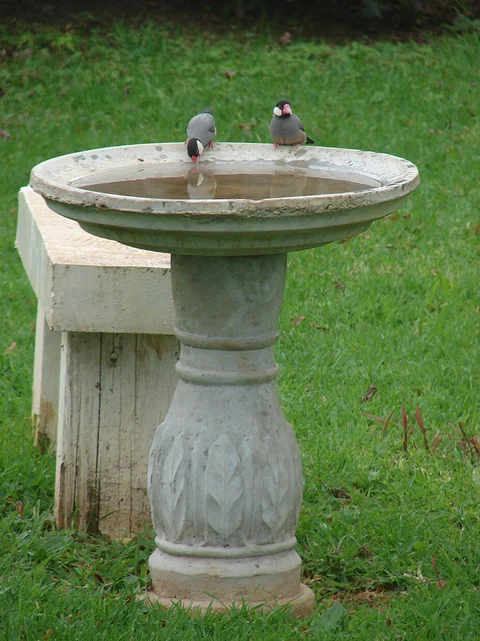
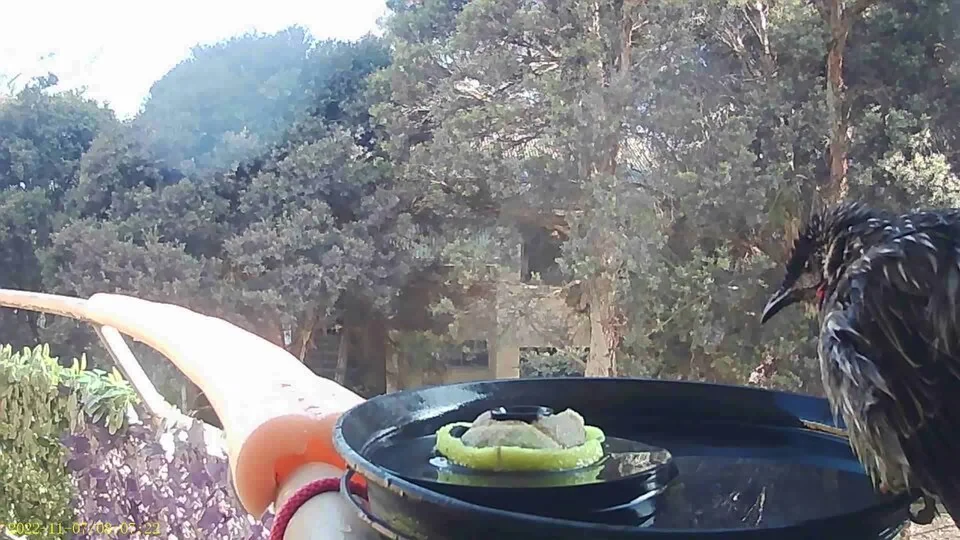
Video still: Mardeg · Solar-powered bird bath fountain.webm · CC BY-SA 4.0. Resized for this guide.
The short answer
Choose a fountain that fits the basin, sunlight, and care you can provide. Direct-sun pumps may stop under cloud cover; battery models depend on their charge and controls. Keep the intake submerged as instructed, limit splash, and clean the bath and pump regularly.
Start with the birdbath, then consider the fountain
A solar fountain can add movement and sound to a birdbath without requiring a mains-powered pump. It can also empty a small basin through splash, stop when a cloud passes, or become another device that needs cleaning. The useful question is whether it improves a bath that already offers safe, shallow access.
Begin with the basin. Is it stable, easy to empty, and shallow enough for gradual entry? Can birds stand securely and leave easily? If those basics are missing, a pump will not correct them. Our birdbath-depth guide is the right starting point for a steep or slippery bowl.
Then decide what you want from the fountain. A gentle ripple may be enough to make water noticeable. A tall spray may look attractive to people while sending water beyond the rim in ordinary wind. There is no requirement for a dramatic jet in a useful birdbath.
This guide explains the main designs, the relationship between sun and operation, pump care, water loss, and troubleshooting. It does not rank products from invented tests. The aim is to help you read specifications, observe your own setup, and choose a system whose daily care you can manage.
Understand the three common solar arrangements
A direct-solar pump uses power from the panel as it is available. It may slow or stop when sunlight weakens. A system with a battery can store some energy, but its runtime depends on the specific design, charge, settings, and conditions. A separate panel lets you place the collector away from the water, within the supplied cable's limits.
| Arrangement | Main advantage | Question to check |
|---|---|---|
| Floating direct-solar unit | Compact assembly with little external cabling | Will it drift and spray beyond the rim? |
| Pump with separate solar panel | Panel and basin can occupy different positions | Can the cable be routed safely at the supplied length? |
| Battery-equipped solar system | May run beyond immediate bright sun | What does the exact manual say about charging and runtime? |
These categories can overlap. A unit may float and include a battery, or use a remote panel without one. Read the actual model description instead of inferring features from the word “solar.”
Manufacturer instructions demonstrate why model details matter. Smart Living's standard-solar troubleshooting guidance concerns specified direct-sun systems; its battery-equipped products have different instructions. Use such documents to understand the questions, then follow the manual for the exact equipment you own.
Check the sunlight at the panel location
Observe the proposed panel position through the part of the day when you want the fountain to operate. A sunny-looking garden can have moving shade from a fence, roof, or tree. The collector needs appropriate exposure, not merely a bright view of the sky.
For a floating panel, the bath and collector share a location. This can create a tradeoff if you prefer some shade over the water. A separate panel offers more placement flexibility, but only if the supplied cable can reach safely without becoming a trip or maintenance hazard.
Do not use one noon observation to predict all-day performance. Check morning and afternoon, and remember that the sun's angle and foliage change through the season. Record when shade reaches the panel rather than concluding the pump is faulty each time the flow changes.
Avoid improvised cable extensions, splices, or power adapters. Compatibility includes more than a connector that happens to fit. If the supplied arrangement cannot reach the chosen location, select another position or a system designed for the distance. Follow the manufacturer's electrical and weather-exposure instructions for all components, including parts that are meant to remain dry.
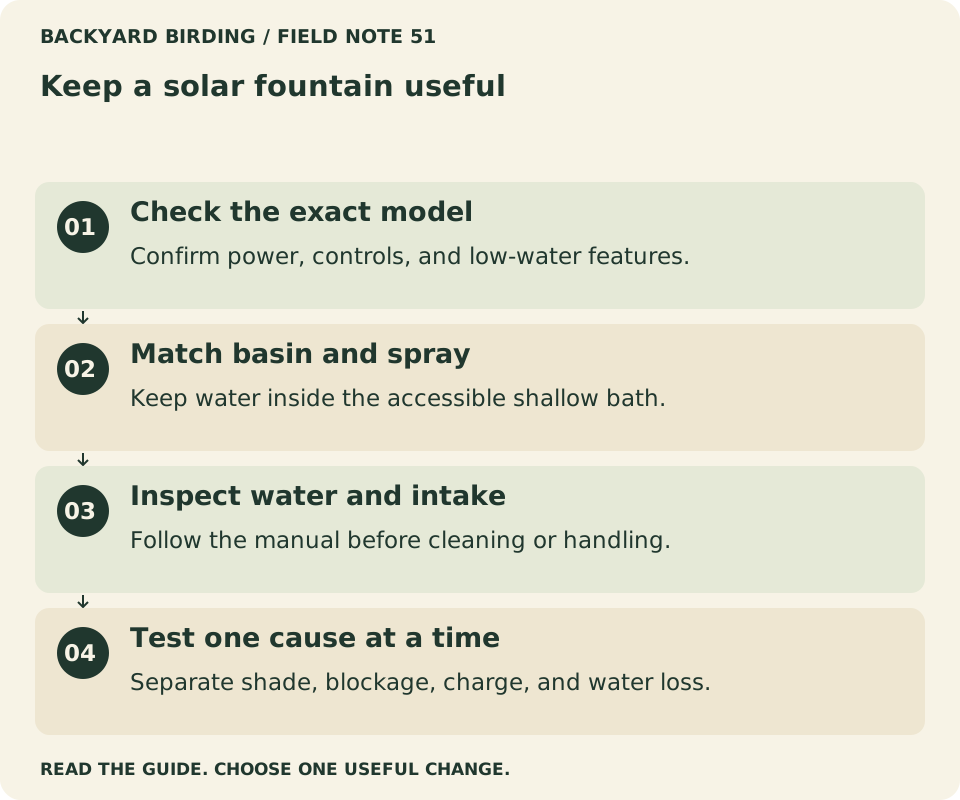
Your visual action map

Read the visual as text
- Check the exact model. Confirm power, controls, and low-water features.
- Match basin and spray. Keep water inside the accessible shallow bath.
- Inspect water and intake. Follow the manual before cleaning or handling.
- Test one cause at a time. Separate shade, blockage, charge, and water loss.
Read the pump's water requirements before choosing depth
The pump needs the water level specified by its manufacturer. The birds need a shallow accessible bathing area. Those requirements must work together. Do not deepen the entire basin simply to submerge a pump that does not fit the intended bath.
Some designs use a lower reservoir or a separate pump recess, while others sit directly in the visible basin. Examine the actual layout and the minimum operating depth. Also check how much space the unit occupies; a broad floating disk can leave a narrow ring of usable water.
If you use stable stones to improve footing, keep them from blocking the pump intake or creating a trap. They should not shift under a bird or hide a dirty pocket you cannot clean. Empty and inspect the whole arrangement periodically rather than assuming the stones make a deep bowl automatically suitable.
Measure the depth after installing the pump and any supports. The water line shown in a product photograph may not represent your basin. Keep a quiet shallow area available, and use the birdbath setup guide to assess the edge and exit as well as the center.
Choose a gentle flow that stays inside the basin
Start with the lowest suitable flow or simplest outlet allowed by the product. Watch where the water lands in a light breeze. A spray that reaches the rim in calm conditions may empty the bowl quickly when wind changes direction.
Different nozzle heads can change the spray pattern. More holes or a taller jet are not necessarily better for birds. Compare the pattern with the basin's diameter and the amount of open water left for drinking and bathing.
Observe the ground around the bath. A wet ring outside the bowl, water on nearby paving, or rapid level loss can reveal splash that is hard to see from a distance. Do not assume all disappearing water is evaporation.
If splash persists, lower the flow, use an appropriate alternate outlet, or remove the fountain. A plain maintained bath remains useful. The fountain should fit the basin and conditions; the basin should not be turned into a deep reservoir merely to compensate for an unsuitable spray. This is a practical design decision you can make from observation without needing a numerical performance score.
Keep floating units from drifting into trouble
A floating fountain may move toward the edge or collect against an ornament, especially in wind. That can direct the spray outside the basin or leave the pump in a poor position. Check the manufacturer's intended way of controlling movement, if any.
Do not add loose loops of fishing line, string, or wire where birds can become entangled. A homemade tether can create a hazard larger than the drifting problem. Use only an appropriate supplied or manufacturer-approved positioning arrangement.
Check that any spacers or attachments remain secure and do not leave sharp edges. The fountain should be removable for cleaning without dismantling an elaborate structure around it. If it cannot remain positioned safely in your basin, a separate fixed pump or a plain bath may be a better fit.
Watch more than the first few minutes after installation. A unit centered by hand may drift later when the sun moves, wind rises, or a bird bathes vigorously. Your goal is an arrangement that remains workable during ordinary use, not a temporary position that looks right only while you stand beside it.
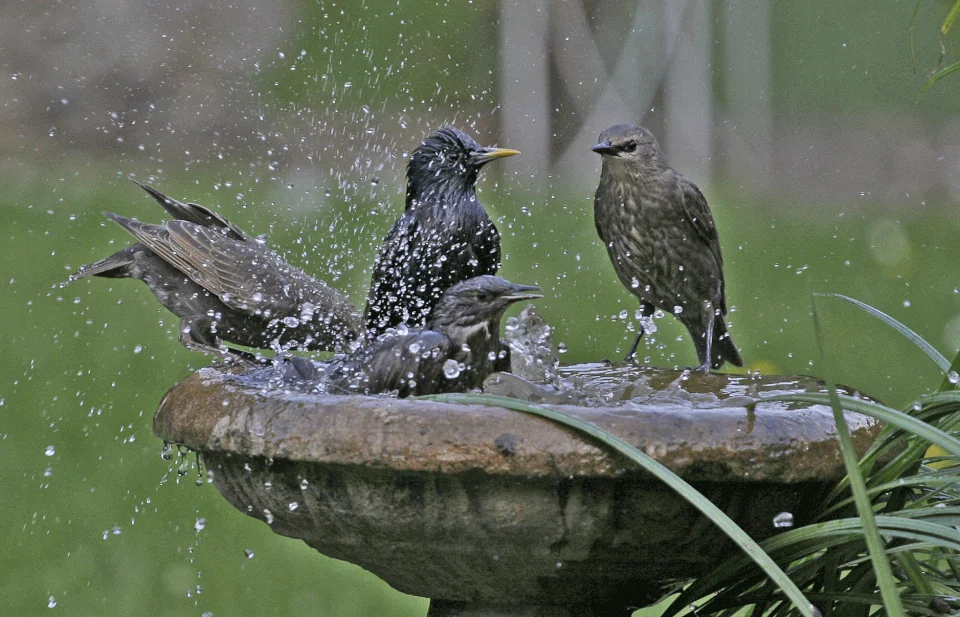
Photo: NatJLN · Sturnus vulgaris -four bathing in birdbath -London-8.gif · CC BY 2.0. Resized for this guide.
Understand what a battery does and does not promise
A battery-equipped solar fountain may continue running when direct sunlight is interrupted, but the word “battery” does not establish all-night operation. Capacity, charging conditions, pump setting, control mode, age, and temperature can affect performance. Check the exact manual and avoid transferring a runtime claim from another model.
Read how the system should be charged initially and how it behaves after several cloudy days. Some products have timers or selectable modes. A stopped pump may reflect its setting or a depleted battery rather than a broken component.
Use only compatible replacement batteries and follow the manufacturer's access and disposal instructions. Do not open sealed components or improvise charging equipment. If a battery compartment is damaged, wet where it should be dry, swollen, or otherwise abnormal, stop using the device and seek the manufacturer's advice.
Smart Living's IntelliSolar support page illustrates model-specific checks for a particular battery system. It is not a universal repair procedure. Locate your own model number before following any troubleshooting page, especially when photographs of several generations look similar.
Treat low-water shutoff as a feature to verify
Some pumps include a water-level sensor that stops operation when water becomes too low. Others do not. Verify the feature in the exact product documentation rather than assuming it comes with every solar fountain.
Even a system with shutoff needs inspection. Sensors can require cleaning, and a partly wet or dirty sensor may not behave as you expect. The feature is a safeguard within a maintained system, not permission to leave a small basin unattended indefinitely.
Keep the water at the required level during operation, but do not solve low water by topping up a contaminated basin. Empty, clean, and refill when needed. If you will be away and cannot arrange care, turn off and remove the pump according to its instructions.
A useful pre-purchase question is whether you can find clear instructions for dry running, sensor care, and restarting. If those details are absent or ambiguous, ask the manufacturer before relying on the feature. A simple system with understandable maintenance can be preferable to one with a long list of poorly explained claims.
Separate circulation from cleaning
Moving water is not disinfected water. A fountain circulates what is in the basin, including fine debris and contamination. A small intake filter may catch particles, but it does not establish that the water is safe or eliminate the need to scrub surfaces.
Empty the bath when it is dirty, clean it appropriately, rinse, and refill with fresh water. Inspect the rim, underside of accessories, and any reservoir or recess. These are easy places to overlook when the moving surface looks attractive.
Our birdbath-cleaning guide explains the general routine. Follow the fountain manufacturer's instructions for the pump and electrical parts, which may not tolerate the same cleaning method as the basin. Do not immerse components meant to remain dry.
Avoid adding household chemicals, essential oils, algae treatments, or other products simply because the water develops a film. Use only a treatment explicitly appropriate for the intended wildlife use and equipment, and seek qualified guidance when unsure. In many ordinary birdbaths, emptying, scrubbing, and renewing the water is the practical response rather than adding another substance.
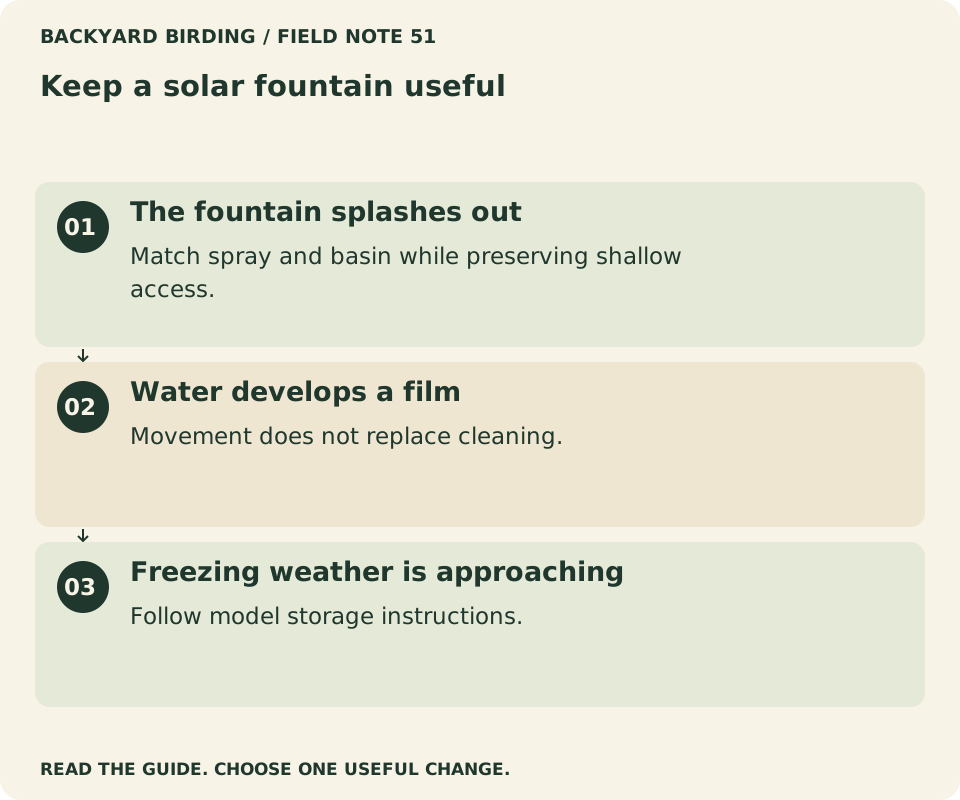
Find your situation

Read the visual as text
- The fountain splashes out. Match spray and basin while preserving shallow access.
- Water develops a film. Movement does not replace cleaning.
- Freezing weather is approaching. Follow model storage instructions.
Clean the intake and impeller as instructed
The intake can collect leaves, seed fragments, feathers, and other debris. Reduced flow may begin there even when the panel receives good sun. Turn off or disconnect the equipment as directed before removing it from the water or opening any serviceable part.
Read the manual before taking the pump apart. Some small pumps have a removable intake cover and impeller assembly; others are not intended for the same user access. Keep small parts in a tray so they do not fall into the garden or a drain.
Clean only in the way specified for the model, then reassemble carefully. A cover or tube not seated properly can change the flow or allow parts to loosen. Do not force a stuck component or substitute a tool that can damage a seal.
Audubon's solar birdbath project instructions describe why pump access and routine maintenance belong in the design. The broader lesson remains useful even if your equipment differs: buy and install a fountain with a clear path to the parts you must inspect. A pump hidden beneath an immovable decorative structure is difficult to maintain well.
Keep panel care simple and safe
A layer of dirt or debris can reduce the light reaching a solar panel. Inspect the surface and clean it as the manufacturer directs, using materials that will not scratch or damage it. Avoid abrasive pads or a chemical chosen only because it works on household glass.
Check the position after wind, gardening, or cleaning. A separate panel may have tilted, moved into shade, or become covered by new plant growth. The fountain's behavior can change even when no component has failed.
Inspect cables and connectors without pulling on the wires. Route them away from mower paths, foot traffic, and places where doors or furniture can pinch them. Keep connections in the locations and orientation required by the product instructions.
Do not modify the panel mount to place it somewhere unsafe to reach. A roof or high wall may offer more sun but make inspection disproportionate to a small birdbath. Choose a location you can service from stable ground, or select a simpler water arrangement. Access is part of performance because equipment that cannot be checked is more likely to remain dirty or damaged.
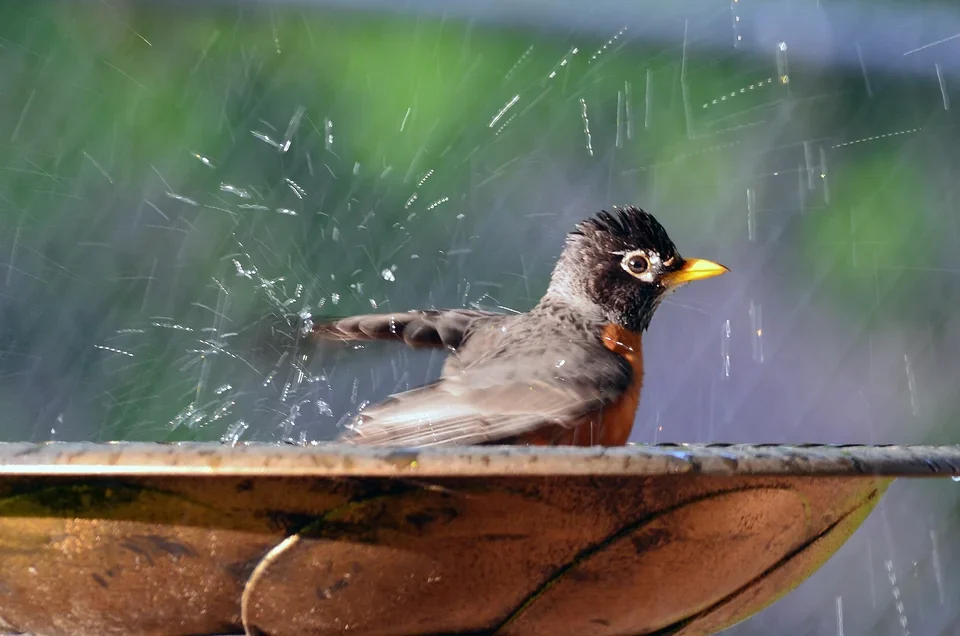
Photo: U.S. Fish and Wildlife Service - Midwest Region · American Robin (42253318841).jpg · Public domain. Resized from the credited adaptation.
Troubleshoot weak or intermittent flow in order
Start with the conditions the system needs, then inspect the parts. For a direct-solar unit, a cloud or moving shade can explain an interruption. For a battery system, check the operating mode and charge instructions. Do not replace the pump before understanding the power arrangement.
Next check water level and intake access. A low basin, blocked inlet, displaced tube, or unsuitable nozzle can affect the flow. Turn the unit off as directed before handling it, and use the exact manual to identify serviceable components.
| Symptom | First checks | Avoid assuming |
|---|---|---|
| Stops when clouds pass | Direct-solar design and panel exposure | Every interruption means a fault |
| Weak flow in bright sun | Water level, intake, tubing, nozzle | A larger panel is automatically the answer |
| Runs briefly then stops | Water sensor, mode, and battery guidance | Repeated restarting fixes the cause |
| Pump sound but little water | Submersion and correct assembly | Noise proves normal operation |
| Rapidly emptying basin | Splash, wind, leaks, and bird use | All loss is evaporation |
Change one factor at a time and keep the result. A short note about sun, water level, and flow helps the manufacturer more than “it never works.” Stop if you find damaged electrical parts or a condition the instructions do not cover.
Diagnose water loss before adding a bigger reservoir
Observe the fountain in ordinary weather. Is the spray falling outside the bowl? Does the floating unit move toward the edge? Are birds splashing water out, or is the basin itself leaking? These causes require different responses.
You can compare the basin with the pump off for a short period while continuing normal care. If water loss changes markedly, the fountain may be contributing through spray. This is a practical observation, not a controlled test; weather and bird use can change between periods.
Inspect the base and surroundings for wet patches. A hairline crack or overflow route may be easier to notice after the surface is dry. Do not seal a basin with an unverified material that will contact bird water. Follow the basin manufacturer's repair guidance or replace it if a suitable repair is unavailable.
Avoid making the bathing area deeper merely to delay refilling. A larger hidden reservoir can be part of a purpose-designed system, but it introduces additional cleaning and access requirements. For a small household bath, lowering the spray or removing the fountain may solve the problem more simply while preserving safe access.
Do not rely on a fountain to solve mosquitoes
Water movement may make part of a basin less suitable for mosquitoes, but small solar fountains can stop at night or during cloud, and still pockets may remain. Do not treat a moving jet as proof that the whole arrangement is free of mosquito breeding opportunities.
The CDC's home mosquito guidance recommends emptying and scrubbing water-holding containers regularly, including birdbaths. Inspect the entire area: plant saucers, buckets, hidden reservoirs, and unused dishes may hold water even when the visible bath is maintained.
Birdbath care may need to be more frequent than a general weekly mosquito-prevention interval. Droppings, debris, heavy use, or visible film call for action when they occur. Do not leave dirty water because the next scheduled mosquito check is several days away.
If you find larvae or a persistent problem, empty and scrub the appropriate containers and consult local mosquito-control guidance. Avoid adding an insecticide casually to water used by birds. The fountain remains a water feature with maintenance needs, not a substitute for inspecting and removing unnecessary standing water around the property.
Small mistakes. Better moves.

Read the visual as text
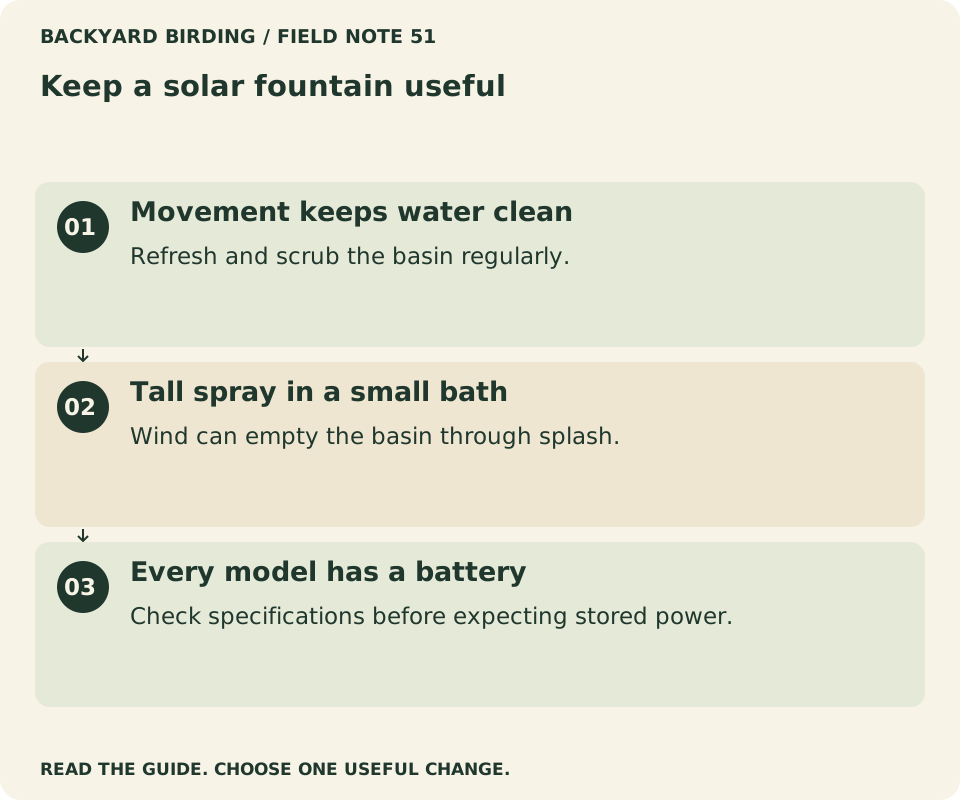
- Movement keeps water clean. Refresh and scrub the basin regularly.
- Tall spray in a small bath. Wind can empty the basin through splash.
- Every model has a battery. Check specifications before expecting stored power.
Keep birds' approach and retreat clear
Watch how birds use the bath after adding the fountain. Some may approach the quiet edge, wait until the spray changes, or avoid a busy center. Give them a shallow calm area rather than expecting every visitor to stand beside the nozzle.
Review nearby cover and predator access. A shrub can offer a retreat, but dense vegetation directly against the basin may conceal a cat. Keep cats indoors or securely enclosed, and choose a position that allows you to inspect the approach.
Look at glass along the route. Movement and sound may draw attention to the water without making surrounding windows safe. Our window-collision guide explains how to treat the hazardous exterior surface.
Do not judge the fountain after one hesitant visit. Observe at a distance over several appropriate periods, keeping water fresh throughout. If the device consistently reduces usable space or causes birds to struggle for footing, simplify the arrangement. The goal is a workable water source. Human enjoyment of the sound is a legitimate benefit, but it should not override the physical needs of the birds using the basin.
Prepare for freezing weather and seasonal storage
Many small solar fountains and decorative basins are not intended to remain in freezing water. Read the temperature and winter-storage instructions for every component. Solar power does not make a pump, battery, tube, or ceramic bowl freeze-resistant.
Before freezing conditions, stop the unit as directed, empty water from components that require draining, clean them, and let them dry appropriately. Store parts together with the model information so spring reassembly does not depend on memory.
Inspect cables, seals, and small fittings before storage. Note anything that needs a compatible replacement, and avoid leaving a damaged part to be rediscovered during the next season's first fill. Batteries may have specific storage requirements; follow the product instructions rather than applying a generic charging rule.
If you want winter water, make that a separate decision. Our winter-birdbath guide compares a removable bowl with appropriately rated heating where safe power is available. A summer solar fountain should not be adapted into a winter heater with improvised equipment.
Compare ownership costs beyond the purchase price
Consider replacement pumps, compatible batteries, filters if used, and whether small parts remain available. A low initial price can become less attractive if the entire system must be replaced when one ordinary component fails.
Look for clear model numbers and accessible instructions. A product listing that combines several versions can obscure which battery, connector, or pump is included. Save the exact manual and purchase details before packaging is discarded.
Include maintenance time in the decision. A fountain that takes a few minutes to remove and clean may fit easily into the bath routine. A design that requires dismantling several decorative layers can make every cleaning feel like a repair project.
Ask what the fountain adds that you value: gentle sound, a visible ripple, or a particular arrangement of moving water. Then compare that benefit with a plain bath you already own. There is no need to upgrade simply because moving water appears in an attractive garden photograph. A good purchase solves a clear problem or adds a benefit you will maintain responsibly.
Run a first-week setup check
On the first day, confirm assembly, water depth, flow direction, and panel exposure. Watch the unit long enough to see whether it drifts or splashes beyond the basin. Keep the manual nearby while you learn the controls.
Over the following days, check at different times rather than only at noon. Note shade, cloud, wind, water loss, and bird use. This reveals whether a change in operation follows the environment or persists under suitable conditions.
After the first cleaning, inspect the parts again when reassembled. Confirm that covers, tubes, and positioning pieces sit correctly. A system that works before cleaning but not afterward may have an assembly issue rather than a new electrical fault.
At the end of the week, decide whether the arrangement is worth keeping. A useful result might be a lower spray, a different approved nozzle, a panel moved into better exposure, or removal of the fountain altogether. Keep the bath's shallow access and cleaning routine as the fixed requirements. Everything else can be adjusted around them.
Work through a shaded-bath example
Suppose your current bath sits beside a tree and stays partly shaded during the afternoon. You like that position because it is easy to clean and has a clear view, but a floating direct-solar fountain runs only briefly. Before replacing the pump, observe when sunlight actually reaches the panel.
If the operating periods match the direct sun, the device may be behaving as designed. You then have a choice: accept intermittent movement, move the whole bath only if the new site remains suitable, or consider a compatible separate-panel system. None of those choices requires calling the existing pump defective.
A remote panel creates a second site to assess. Check exposure through the day, the supplied cable length, and whether the route crosses a path or gardening area. Do not choose it solely because the panel can be placed in sun somewhere on the property. It must also be reachable and connected safely within the product's design.
If the cable route is unsuitable, a plain bath in the original good location may be the best result. Birds can use still water, and the cleaning routine remains the main responsibility. You have learned that continuous solar movement conflicts with the site's constraints, which is useful information before another purchase.
The same reasoning applies to a battery model. Stored energy can change operating behavior, but it does not make the panel independent of charging conditions. Read the actual instructions and compare the added care with the benefit you want. Choose the simplest arrangement that meets your purpose without sacrificing the bath's access or maintenance.
Keep a model record for future repairs
Photograph or write down the model numbers on the pump, panel, controller, and battery unit where applicable. Save the exact manual with the purchase information. A fountain's decorative name may remain the same while internal parts change between versions.
When contacting support, describe the configuration and the symptom precisely. Include whether the system has a battery, when it last worked, the sunlight conditions, water level, and any cleaning or reassembly performed. A short video of the flow may help if the manufacturer requests it, but keep electrical parts handled only as instructed.
Separate observed facts from guesses. “The pump runs in direct noon sun but stops when the fence shades the panel” is useful. “The battery is broken” is not established if the system has no battery or has not been charged according to its instructions.
Check replacement compatibility before ordering. Connector shape, voltage, pump characteristics, and model generation may matter. Do not splice parts from unrelated kits or use an adapter simply because it powers the pump briefly. The correct replacement should be identified through the manufacturer or a reliable authorized parts source.
If support cannot establish a safe compatible repair, stop using the damaged system. Retain the basin if it remains suitable as a plain bath, and dispose of electronic and battery components through appropriate local channels. A repair decision should preserve a safe water source, not keep an uncertain electrical assembly operating at any cost.
Solar birdbath fountain questions
Will it work in shade?
A direct-solar panel generally needs the exposure specified by its manufacturer. A separate panel can sometimes sit in sun while the basin occupies another position. Battery systems differ, so check the exact model rather than assuming stored power solves permanent shade.
Does it keep the water clean?
No. Circulation and a small debris filter do not replace emptying, scrubbing, rinsing, and fresh water. The pump and any hidden reservoir need inspection as well as the visible basin.
Is a taller spray better for birds?
Not necessarily. A gentle flow that stays within the basin and leaves a calm shallow area may be more practical. Match the outlet to the bowl and wind conditions rather than maximizing height.
Can I leave it running while away?
Only within the product's instructions and with a reliable care arrangement. Water loss and contamination still occur, and a low-water feature does not eliminate inspection. If nobody can maintain it, turn off and store the unit appropriately.
What should I check before buying?
Confirm minimum water depth, panel placement, battery behavior if present, low-water protection, cleaning access, and replacement parts. If those details are unclear, resolve them before purchase. A plain clean birdbath remains a complete and useful option.
Watch it. Then try it.
Review the steps and common mistakes in two short, silent animations. Each has a complete text transcript below.
Your four-step action map
Read the complete video transcript
Keep a solar fountain useful.
- Check the exact model. Confirm power, controls, and low-water features.
- Match basin and spray. Keep water inside the accessible shallow bath.
- Inspect water and intake. Follow the manual before cleaning or handling.
- Test one cause at a time. Separate shade, blockage, charge, and water loss.
Try the steps, then note any problem that still needs attention.
Three mistakes to avoid
Read the complete video transcript
Keep a solar fountain useful.
- Movement keeps water clean. Refresh and scrub the basin regularly.
- Tall spray in a small bath. Wind can empty the basin through splash.
- Every model has a battery. Check specifications before expecting stored power.
Try the steps, then note any problem that still needs attention.
Both animations use this video still by Mardeg. Original source · CC BY-SA 4.0. The photo is adapted into original educational animations, not recordings of a field test.
At a glance
| First check | Useful response |
|---|---|
| Check the exact model | Confirm power, controls, and low-water features. |
| Match basin and spray | Keep water inside the accessible shallow bath. |
| Inspect water and intake | Follow the manual before cleaning or handling. |
| Test one cause at a time | Separate shade, blockage, charge, and water loss. |
Sources & evidence
- standard-solar troubleshooting guidance
- IntelliSolar support page
- solar birdbath project instructions
- CDC's home mosquito guidance
Our standard: real evidence before ratings. Corrections follow our editorial process.
Our verdict & your next actions
Choose the row that describes your setup, then follow the suggested check or adjustment.
| Your situation | Our verdict | Your next action |
|---|---|---|
| The fountain splashes out | Match spray and basin while preserving shallow access. | Review basin depth |
| Water develops a film | Movement does not replace cleaning. | Clean the bath properly |
| Freezing weather is approaching | Follow model storage instructions. | Plan winter water care |
Your pocket field checklist
Tick off the steps as you go.
0 of 4 steps completed
Keep building your knowledge in bird baths, or search the full backyard library.