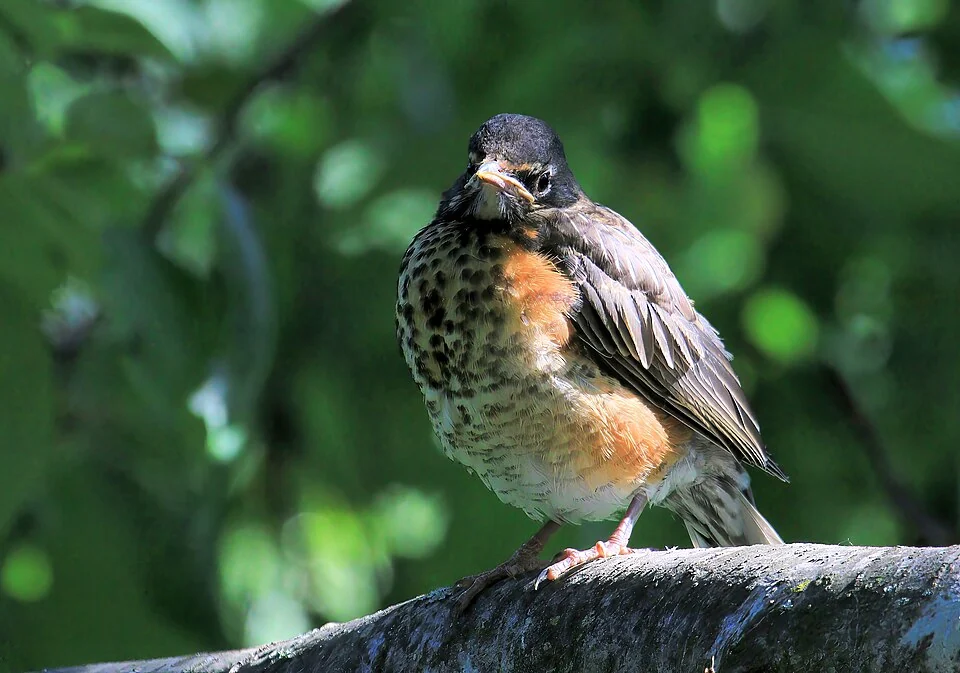
Photo: ImagePerson · American Robin Turdus migratorius fledgling 8485.jpg · CC BY 4.0. Resized for this guide.
The short answer
Keep pets and people back. A healthy feathered fledgling often belongs near its parents, even on the ground. A vulnerable nestling, injured bird, or bird caught by a cat needs a different response and prompt professional advice. Do not offer food or force water into its bill.
Start with safety, condition, and distance
If you have just found a young bird, keep pets and people back and look for obvious injury before doing anything else. A feathered fledgling on the ground may be in a normal stage of development and still receiving care from its parents. A sparsely feathered nestling, an injured bird, or a bird known to have been caught by a cat needs a different response.
Do not offer food or force water into the bill. Contact a licensed wildlife rehabilitator promptly when injury, cat contact, serious weakness, or uncertainty about a vulnerable nestling is involved. Do not wait for a feeding experiment to show whether the bird improves.
| What you can observe | First action |
|---|---|
| Feathered, alert youngster hopping in a reasonably safe place | Keep pets back, move away, and observe from a distance |
| Few feathers and unable to move like a fledgling | Look for the original nest from a safe position and seek advice if return is uncertain |
| Bleeding, obvious injury, entanglement, or known cat contact | Contact a licensed rehabilitator promptly |
| Unfamiliar young waterbird, raptor, or other species you cannot assess | Get species-specific professional guidance |
This guide is for the first decisions around a wild bird in the United States. It does not replace instructions from the professional assessing your particular situation. If the bird is in a road or another immediate hazard, protect your own safety and seek help rather than entering danger to reach it.
Understand the nestling and fledgling distinction
A nestling is still at the stage when it belongs in the nest. It may have little feathering and limited ability to support itself or move around. A fledgling has developed feathers and has left the nest, although its flying skills may still be poor. Parents often continue feeding fledglings outside the nest.
Cornell's baby-bird guidance explains why many apparently abandoned birds are healthy fledglings. The distinction prevents a common mistake: removing a young bird from a normal learning stage simply because it is not flying like an adult.
Assess visually where possible. Do not pick the bird up to test its grip, toss it into the air, or repeatedly chase it to see whether it can fly. Those actions add stress and can cause injury without producing a reliable assessment.
Development varies among species. A general songbird description does not fit every young bird, and feathering alone cannot rule out illness or injury. If the appearance, posture, or circumstances do not fit a clear normal fledgling situation, describe them to a licensed rehabilitator. “Small bird with short tail, fully feathered, hopping under a shrub” is more useful than an unsupported claim that it is a two-week-old orphan.
Check for circumstances that need prompt help
Look for visible bleeding, a drooping or obviously abnormal wing, inability to stand normally, entanglement, or a known accident. A bird that has been in a cat's mouth needs professional assessment even if you cannot see a wound. Do not release it merely because it becomes more active.
The Wildlife Center of Virginia's guidance treats injury and cat contact as reasons to seek a wildlife veterinarian or permitted rehabilitator. It also cautions against giving food or water during this response.
Keep the description factual. Say whether you saw the cat catch the bird, found the bird beside a window, or noticed blood without seeing an incident. These situations provide different information. Do not name a fracture, infection, or disease from appearance alone.
Avoid delaying a call while trying to obtain a perfect species identification. A clear photograph from a safe distance can help, but the professional can often begin with the bird's size, location, condition, and circumstances. The first priority is the right response to the condition, not a complete field-guide entry.
Your visual action map

Read the visual as text
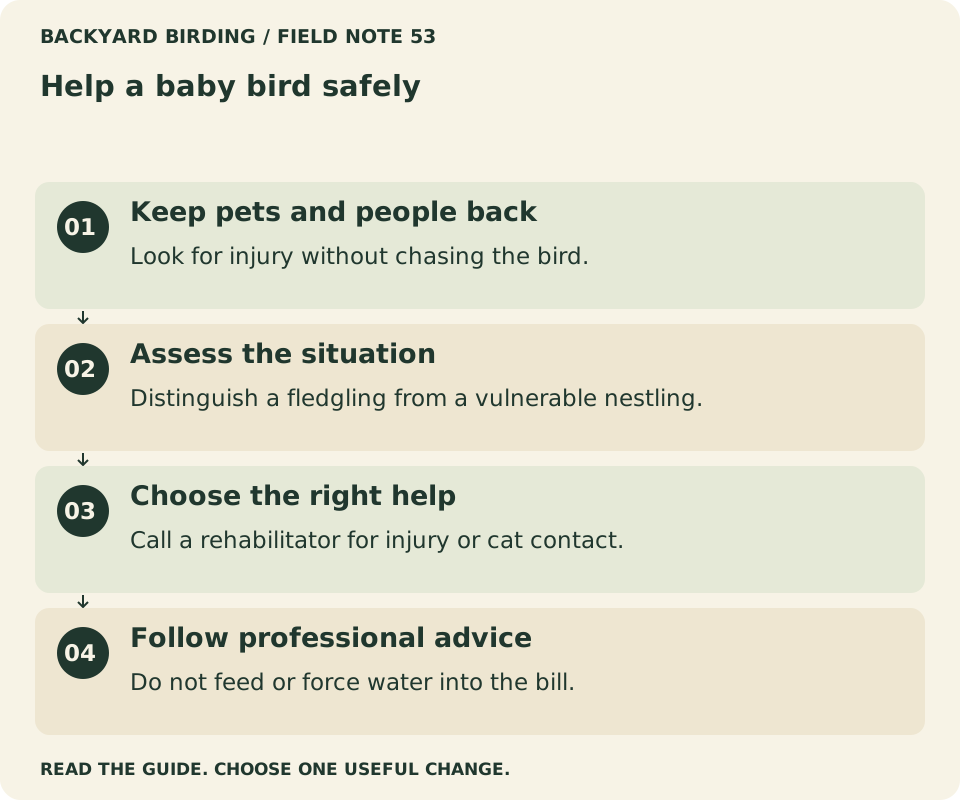
- Keep pets and people back. Look for injury without chasing the bird.
- Assess the situation. Distinguish a fledgling from a vulnerable nestling.
- Choose the right help. Call a rehabilitator for injury or cat contact.
- Follow professional advice. Do not feed or force water into the bill.
Give a healthy fledgling room for parental care
If the bird appears to be a healthy fledgling in a reasonably safe place, move away and keep pets and children back. Parents may remain nearby without approaching while people stand close. A bird that seems alone during your inspection may be attended once the area becomes quiet.
Watch from indoors or another distant location if possible. Use binoculars rather than moving closer whenever the bird shifts position. A short view of an adult bringing food is useful; you do not need to see every feeding to understand that parental care is occurring.
Do not repeatedly return a fledgling to a nest simply because you can see one. It may have left as part of normal development and leave again. The U.S. Fish and Wildlife Service's young-wildlife guidance explains why leaving healthy young wildlife in place is often the appropriate action.
Keep the household response quiet and coordinated. One person can watch while others use a different door or keep a dog inside. A crowd gathered around the bird changes the situation you are trying to assess. Giving the family space is an active helpful choice, even though it feels less dramatic than carrying the youngster indoors.
Handle an immediate hazard without moving the bird far away
A fledgling may be in a driveway, busy footpath, or another place where leaving it exactly where it sits creates an immediate risk. If it can be moved safely and no injury is apparent, a nearby sheltered spot in the same area may be appropriate. Keep any movement minimal so the parents can still find it.
Do not transport a healthy fledgling to a park, distant garden, or another neighborhood because that location looks more natural. The important connection is to its parents and original area, not to a place that appears greener to people.
If reaching the bird requires entering traffic, climbing, handling dangerous equipment, or approaching an aggressive animal, stop and seek appropriate help. Human safety comes first. Do not turn a small wildlife problem into a second emergency.
When in doubt, call a rehabilitator before moving the bird. Describe the exact hazard and nearby shelter. The advice may differ for a songbird, a waterbird, or another species. Keep the original location recorded in case professional care becomes necessary later. A photograph of the surroundings can be more useful than an extremely close photograph of the bird.
Consider returning an uninjured nestling to its original nest
An uninjured nestling may be returned to its original nest when the nest can be identified and reached safely. Look nearby from the ground first. Do not put the bird into the first visible nest without evidence that it is the correct one.
If the bird feels cold, appears weak, has been injured, or you are unsure of its condition, contact a rehabilitator for instructions before proceeding. Do not improvise warming with a hot lamp, direct heating pad contact, or hot water bottle against the bird.
Avoid climbing an unsafe ladder or reaching into a cavity you cannot inspect. A nest high in a tree is not safely accessible simply because you can see it. Explain the height, location, and condition of the nest when asking for help.
Brief necessary contact does not automatically make parents reject a baby because of human scent. That common belief can prevent an appropriate reunion. At the same time, it is not a reason to handle birds casually. Keep any necessary intervention brief, follow professional guidance when uncertain, and withdraw so the adults can resume normal activity.
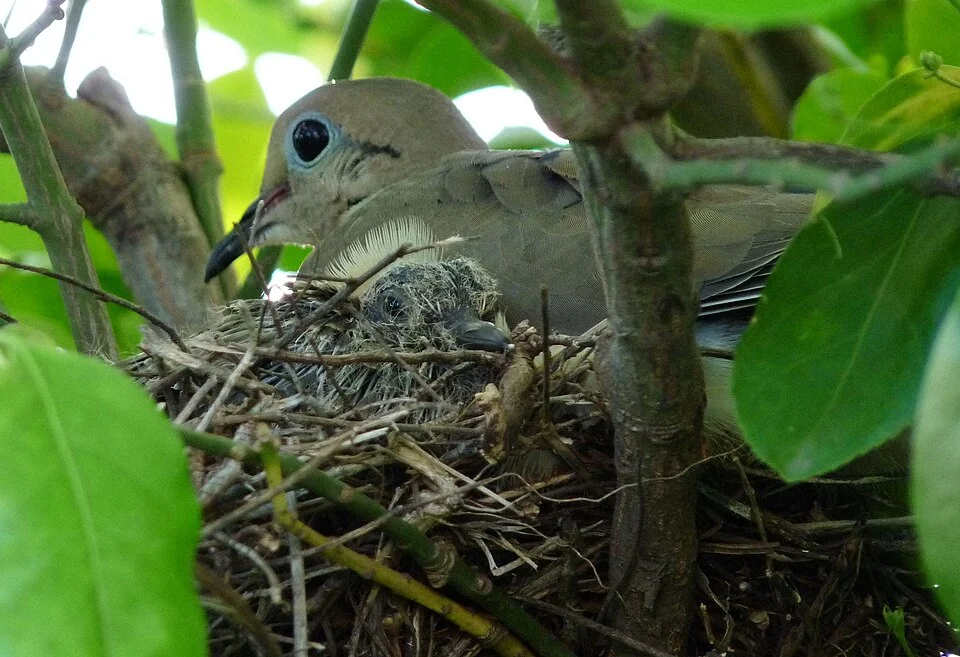
Photo: Kilarin · Zenaida macroura -chick and adult in nest-8c.jpg · CC BY 2.0. Resized for this guide.
Ask before making a substitute nest
A destroyed or inaccessible nest can lead people to build a replacement immediately. A substitute nest can sometimes be part of a reunification plan, but its suitability depends on the bird's age, species, condition, the remaining nest situation, and whether parents can care for it there.
Contact a licensed rehabilitator before constructing one. A lone very young nestling may need parental warmth that cannot be divided between an original nest and a separate container. A generic basket placed in a tree does not solve every situation.
If a professional recommends a substitute, follow their instructions for container, lining, drainage, secure attachment, placement, and observation. Avoid household fibers that can tangle around feet or become unsuitable when wet. Do not fasten anything where you cannot safely inspect it or where it may fall.
Record the original nest location and what happened to it. Was a branch cut, did a storm dislodge the nest, or was a single chick found without any visible nest? These details affect the plan. The goal is to support appropriate parental care where possible, not to create a new nest based on appearance alone.
Know why food and water can make things worse
A young bird's needs depend on species, developmental stage, and condition. The wrong food or feeding technique can cause serious harm. Water forced into the bill can enter the airway. A bird opening its mouth is not a reliable invitation to use a dropper or offer whatever food is nearby.
Do not give bread, milk, cereal, pet food mixtures, seed, or feeder mealworms while waiting for advice. A food that an adult bird eats in the wild may be inappropriate for a youngster in distress, and a temporary delay in amateur feeding is not a reason to invent a diet.
If you have already given something, tell the rehabilitator exactly what it was, approximately how much, when, and how it was offered. Do not hide the detail because you are worried about being criticized. It can affect the assessment and next instructions.
Keep the response focused on contacting qualified help, minimizing disturbance, and following the professional's direction. Do not use online growth charts or feeding schedules to start raising the bird at home. A successful outcome involves more than keeping it alive overnight; development, behavior, health, and eventual release all require appropriate expertise.
Find a licensed rehabilitator in your area
Use your state wildlife agency's directory or a reputable wildlife-help locator. Animal Help Now provides a U.S. directory for locating appropriate wildlife assistance. Check the provider's service area, accepted species, and current contact instructions.
Call before transporting the bird. Facilities may have limited hours, intake capacity, or species restrictions. A long drive to a closed center can delay care. Ask whether the facility can accept the bird and what to do while arranging transport.
If the first number does not answer, follow its stated voicemail instructions and try another appropriate provider or the state agency. Do not assume silence means the bird should be kept permanently. Keep notes so you know whom you contacted and what advice was given.
An ordinary veterinary clinic may not be able to accept wildlife, but it may direct you to a permitted service. Ask specifically about a wild bird and describe the condition. For large raptors, herons, or other birds that can injure a handler, seek trained assistance rather than attempting capture based on advice for a small songbird.
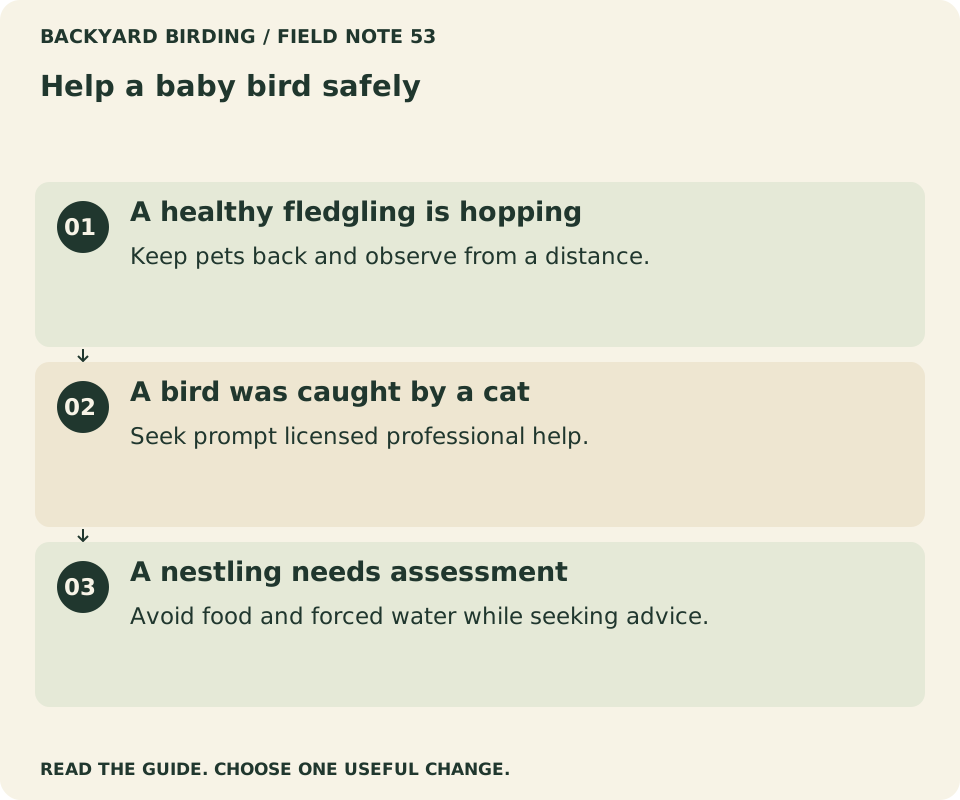
Find your situation

Read the visual as text
- A healthy fledgling is hopping. Keep pets back and observe from a distance.
- A bird was caught by a cat. Seek prompt licensed professional help.
- A nestling needs assessment. Avoid food and forced water while seeking advice.
Prepare the information that makes the call useful
Have the location, discovery time, approximate size, feathering, and visible condition ready. Explain whether the bird is still where you found it or has been moved. If you know of cat contact, a window strike, mowing, or another incident, mention it early.
| Information | Useful description |
|---|---|
| Location | Address or precise find site, plus the nearby habitat |
| Time | When found and how long it has been observed |
| Development | Feathered, partly feathered, or mostly bare; movement seen |
| Condition | Visible wounds, posture, breathing concern, or abnormal movement |
| Known event | Cat contact, collision, fallen nest, or no incident witnessed |
| Actions already taken | Movement, containment, food, water, or other handling |
Use ordinary language. “One wing hangs lower” is better than diagnosing a broken wing. “A cat carried it onto the porch” is more informative than “possibly stressed.” If you do not know something, say so.
Ask how to send a photograph if it would help. One clear image and a view of the find site are usually more useful than a long stream of close-ups. Follow the provider's preferred contact method and keep the bird's disturbance to a minimum while you communicate.
Follow temporary containment instructions carefully
A rehabilitator may advise temporary containment while transport is arranged. For a small bird, that often involves a secure ventilated box in a quiet place, but the exact instruction depends on species and condition. Follow the professional's directions rather than treating one box method as suitable for every bird.
Keep the container away from pets, children, loud sound, and direct sun. Do not repeatedly open it to check whether the bird looks better. A quiet bird is not necessarily recovered, and repeated handling can add stress.
Do not place a bowl of water or food inside unless specifically instructed. Spillage can chill or contaminate the bird and container, and the presence of food may encourage an inappropriate feeding attempt.
If you are told to provide warmth, ask for the exact safe method and monitoring needed. Avoid direct heat contact and uncontrolled heat sources. Report changes in condition to the provider. Temporary containment is a short bridge to appropriate care, not a home rehabilitation program or a reason to postpone the agreed transfer.
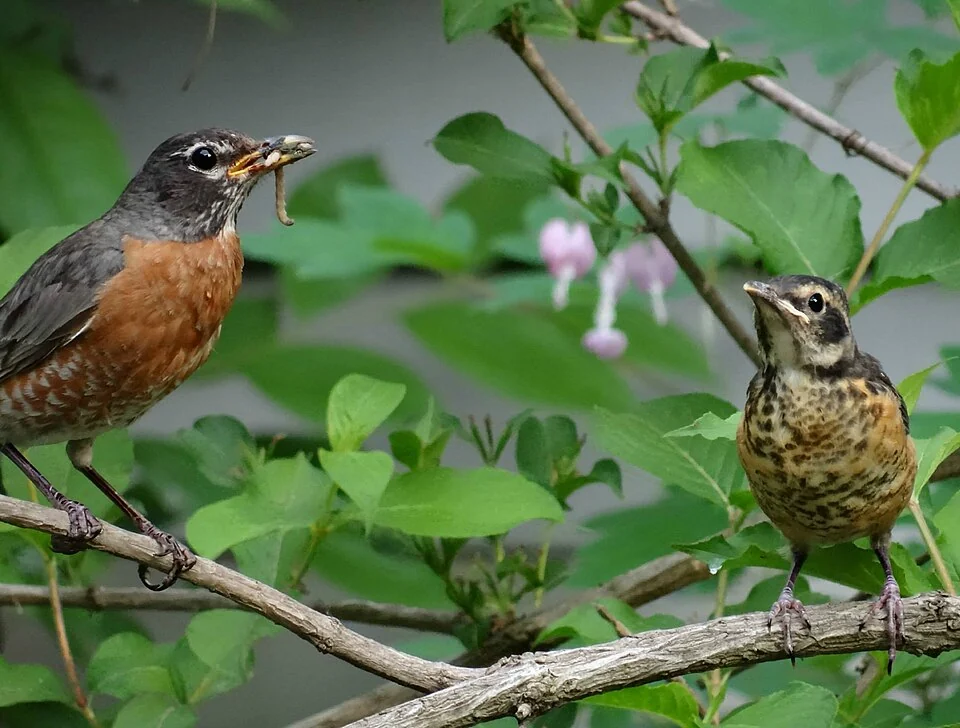
Photo: Jinn Bug · Male American Robin feeding fledgling robin.jpg · CC BY-SA 4.0. Resized for this guide.
Arrange transport before starting the journey
Confirm the receiving location, opening or intake instructions, and the name or service expecting the bird. Ask whether there are any changes to the containment plan for travel. Do not arrive at a different facility because it is closer without checking that it can help.
Keep the container secure in the vehicle, out of direct sun, and away from pets. Do not let a child hold an open box or allow the bird to ride loose. Avoid unnecessary stops and keep the journey calm.
Bring the written find location and the history of any handling, food, water, or known injury. If another person is driving, make sure they can relay the information accurately. The person delivering the bird may not have witnessed the original event.
Do not release the bird during transport because it becomes active inside the box. Activity is not a professional assessment of recovery, especially after cat contact or a collision. Contact the receiving rehabilitator if circumstances change and follow their instructions. The planned handoff should resolve the temporary-care stage rather than leave you guessing on the roadside.
Treat ducklings and other mobile young differently
Some young birds are mobile soon after hatching and normally move with a parent. A duckling's development and needs differ from those of a partly feathered songbird nestling. Do not apply the same “put it back in a nest” rule to every small bird on the ground.
Observe from a distance for adults and siblings, and describe the situation to a wildlife professional if the youngster appears separated, injured, trapped, or in an unsafe location. Avoid chasing a family toward traffic or water in an attempt to help.
Do not place an unfamiliar young bird in a pond or bathtub to test whether it belongs in water. Do not release it beside an unrelated group simply because the birds look similar. Reunification needs the correct species and circumstances, and professional advice can prevent an intuitive but harmful action.
Large birds and defensive adults can also create handling risks. Give them space and seek trained help when needed. The most useful first contribution may be keeping people and pets away while a qualified responder advises on the location, rather than attempting capture or relocation yourself.
Be cautious with swifts, hummingbirds, and unfamiliar species
Not every feathered young bird that remains on the ground is following the same pattern as a robin fledgling. Species differ in movement, nesting, and normal development. If the bird does not fit a clear familiar situation, seek identification and care advice promptly.
Hummingbirds are particularly small and delicate. Do not assume that a found youngster should receive sugar water by dropper because adults use nectar feeders. A feeder recipe is not a rehabilitation diet or a safe feeding method for a distressed bird.
Likewise, do not throw a swift or any other bird into the air to see whether it can fly. An inability to leave the ground can reflect a condition that needs assessment. Record the shape and circumstances and contact a rehabilitator who handles the species.
Use a photograph to support the consultation when safe, but do not postpone help while searching for a perfect match. A professional may recognize the bird from a modest image and the location. The appropriate level of certainty for a rescue decision is different from casually adding a name to a backyard bird list.
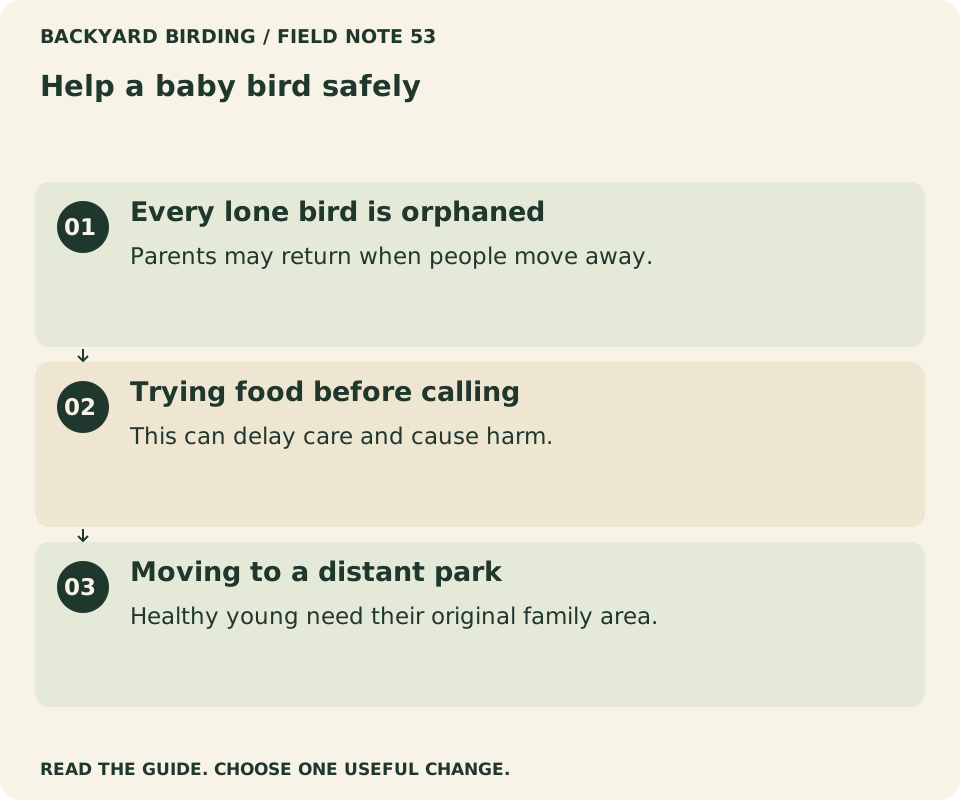
Small mistakes. Better moves.

Read the visual as text
- Every lone bird is orphaned. Parents may return when people move away.
- Trying food before calling. This can delay care and cause harm.
- Moving to a distant park. Healthy young need their original family area.
Respond thoughtfully after a storm or yard work
After a storm, inspect from a safe position before clearing fallen branches. If you find young birds or an occupied nest, pause work around them and seek guidance. Do not assume a nest on the ground is empty because the adults are temporarily out of sight.
Following tree work or pruning, record exactly where the nest or bird was found and what was moved. That information can help a rehabilitator assess whether reunion is possible. Avoid relocating the bird farther away while searching for a place that looks tidier or more sheltered.
If a mower or other equipment is involved, treat any possible injury seriously even when feathers hide the affected area. Contact a professional and describe the event. Do not use the bird's ability to hop as proof that no injury occurred.
For future work, inspect the area beforehand and plan maintenance around active nesting where possible and lawful. The U.S. Fish and Wildlife Service's nest guidance explains why occupied nests need special care. Prevention is easier than trying to reconstruct an unknown nest arrangement after a branch has already been removed.
Avoid turning observation into disturbance
Once a healthy fledgling is identified and immediate hazards are controlled, the household's next challenge is often restraint. Repeated visits, photographs, and checks can keep the area busy and interfere with the very parental behavior you want to observe.
Choose one distant viewing point and one person to coordinate. Keep a short record of meaningful events, such as an adult delivering food or the youngster moving into cover. There is no need to document every minute.
If you cannot see the bird after it moves under vegetation, do not automatically search through the plants. A hidden fledgling may be in a more suitable place than it was on open paving. Continue to keep pets away and seek advice if there is a specific reason for concern.
Avoid sharing the exact location publicly in a way that attracts visitors. A picture can be enjoyed later without inviting a crowd to an active nest or vulnerable youngster. The most valuable observation may be the one made quietly enough that the birds continue normal behavior throughout it.
Understand why keeping the bird is not the solution
Wild-bird rehabilitation requires appropriate permits, knowledge, facilities, and release planning. Legal protections vary by species and jurisdiction, but a found bird should not be kept as a pet or raised casually at home. Ask the state wildlife agency or a licensed rehabilitator about the correct route for the specific case.
The U.S. Fish and Wildlife Service directs people toward qualified wildlife help when intervention is needed. The goal is to preserve the bird's chance of returning to normal wild behavior, not merely to make it comfortable in a household.
Do not interpret a quiet bird, acceptance of food, or apparent attachment as proof that home care is succeeding. Those observations do not establish health or readiness for release. Social development, species-specific feeding, injury assessment, and appropriate flight conditioning may all matter.
If you want to help wildlife regularly, ask a licensed organization about volunteering, transport, or training. That channels the desire to help into a supported role. For the bird in front of you now, the practical next step remains the appropriate professional contact and the instructions for this individual situation.
Help children understand the helpful role of distance
A young bird is an immediate and emotional discovery for a child. Give them a clear job that does not involve handling: keep the dog indoors, note the discovery time, or help an adult find the local wildlife contact. Explain that parents may be caring for the bird even when they are not visible.
Avoid promises about the outcome. You can say that the household is taking the most useful steps available without guaranteeing that every bird will survive or return. If the bird needs professional care, explain the handoff simply and honestly.
For a healthy fledgling, watch from a window and look for an adult visit. That turns waiting into observation. A drawing or a short note can preserve the experience without moving closer for repeated photographs.
Afterward, choose one prevention task together: keep cats indoors, inspect windows, or learn the difference between a nestling and a fledgling before the next encounter. The lesson is not that people should never act. It is that the right action depends on the bird's condition, and sometimes giving a family space is the most effective help.
Make the next encounter less likely to become an emergency
Save a current state wildlife directory or reputable locator before you need it. Knowing where to seek advice reduces the temptation to follow the first unverified feeding recipe during a stressful moment.
Keep pets away from active nesting areas and fledglings. Review glass around feeders, baths, and vegetation using our window-collision guide. Inspect yard-work areas before mowing or pruning, and avoid unnecessary disturbance around known nests.
If you maintain nest boxes, learn the appropriate monitoring procedure for the species and follow NestWatch's guidance rather than opening a box whenever you want a photograph. Our nest-box guide covers placement and design questions that should be resolved before nesting begins.
Keep the response kit modest: a contact list, a way to record the find location, and access to an appropriate container if a professional instructs containment. Do not assemble a collection of feeding syringes and homemade formulas. Preparedness should make qualified help easier to obtain, not make amateur treatment feel like the default.
Work through an uncertain porch encounter
Suppose you find a feathered young robin beside the porch. It hops under a shrub when you approach, and you have not seen an injury or a cat interaction. Keep the dog indoors, step back, and watch from a window. Do not place the bird in a box merely because it cannot yet fly across the yard.
Record the discovery time and the exact spot. If an adult arrives with food after the area becomes quiet, that supports the interpretation of normal fledgling care. Continue keeping pets away and let the birds use the cover. You do not need to move the youngster into a nest or put a food dish beside it.
Now change one fact: you saw a cat carrying the same bird before dropping it. The response changes even if the bird can hop. Call a licensed rehabilitator promptly and describe the cat contact. Do not use the apparently active behavior to return to the wait-and-watch plan.
This comparison shows why condition and history come before a general rule about feathering. A photograph may look similar in both cases, but the known event makes the second situation different. Tell the professional what happened, including details that are not visible in the image.
Keep the handoff record with the bird
If professional intake is arranged, write a brief record that can travel with the container: find location, discovery time, known incident, and actions already taken. Include your contact information if the provider requests it. Keep the note outside the container where it can be read without opening the box.
If someone else transports the bird, review the record together. Make clear which facts were witnessed and which are uncertain. “Found near a window” and “saw it strike the window” should not become interchangeable during retelling.
Ask the receiving provider how updates are handled, then respect that process. Staff time and patient needs may limit individual follow-up. The useful outcome of the handoff is that the bird reaches appropriate care with an accurate history, not that the household continues directing treatment from a distance.
Once the immediate situation is resolved, inspect the location for a preventable cause. A glass treatment, a pet-management change, or a pause in yard work may protect the next bird. Keep that practical improvement separate from assumptions about what caused the current case when the evidence is incomplete.
Questions people ask after finding a baby bird
Will the parents reject it because I touched it?
Brief necessary contact does not automatically cause rejection because of human scent. That myth should not prevent an appropriate return to the original nest. Keep handling minimal and seek advice when the bird's condition or nest identity is uncertain.
How long should I wait for the parents?
There is no single waiting period that fits every species, condition, time of day, and event. Move away for normal fledgling observation, but seek prompt advice for injury, cat contact, a vulnerable nestling, or an uncertain situation. Do not apply a long generic waiting rule to an injured bird.
Can I give it just a little water?
Do not force water into the bill or add food while awaiting professional instructions. The method and the bird's condition matter. Tell the rehabilitator if anything has already been given.
What if I cannot reach anyone immediately?
Use another appropriate licensed provider or the state wildlife agency's guidance, follow recorded instructions, and keep pets and people away. If containment has been advised, maintain the quiet secure arrangement. Continue seeking qualified help rather than beginning a home feeding program.
What is the most important detail to remember?
Condition and context determine the response. A healthy feathered fledgling may need space; an injured bird or one caught by a cat needs prompt professional assessment. Keep the find location, describe what happened, and let the correct wildlife professional guide the next step.
Watch it. Then try it.
Review the steps and common mistakes in two short, silent animations. Each has a complete text transcript below.
Your four-step action map
Read the complete video transcript
Help a baby bird safely.
- Keep pets and people back. Look for injury without chasing the bird.
- Assess the situation. Distinguish a fledgling from a vulnerable nestling.
- Choose the right help. Call a rehabilitator for injury or cat contact.
- Follow professional advice. Do not feed or force water into the bill.
Try the steps, then note any problem that still needs attention.
Three mistakes to avoid
Read the complete video transcript
Help a baby bird safely.
- Every lone bird is orphaned. Parents may return when people move away.
- Trying food before calling. This can delay care and cause harm.
- Moving to a distant park. Healthy young need their original family area.
Try the steps, then note any problem that still needs attention.
Both animations use this real photograph by ImagePerson. Photo source · CC BY 4.0. The photo is adapted into original educational animations, not recordings of a field test.
At a glance
| First check | Useful response |
|---|---|
| Keep pets and people back | Look for injury without chasing the bird. |
| Assess the situation | Distinguish a fledgling from a vulnerable nestling. |
| Choose the right help | Call a rehabilitator for injury or cat contact. |
| Follow professional advice | Do not feed or force water into the bill. |
Sources & evidence
- baby-bird guidance
- Wildlife Center of Virginia's guidance
- U.S. Fish and Wildlife Service's young-wildlife guidance
- Animal Help Now
- U.S. Fish and Wildlife Service's nest guidance
Our standard: real evidence before ratings. Corrections follow our editorial process.
Our verdict & your next actions
Choose the row that describes your setup, then follow the suggested check or adjustment.
| Your situation | Our verdict | Your next action |
|---|---|---|
| A healthy fledgling is hopping | Keep pets back and observe from a distance. | Review fledgling care |
| A bird was caught by a cat | Seek prompt licensed professional help. | Check urgent circumstances |
| A nestling needs assessment | Avoid food and forced water while seeking advice. | Start with the first decisions |
Your pocket field checklist
Tick off the steps as you go.
0 of 4 steps completed
Keep building your knowledge in problems, or search the full backyard library.