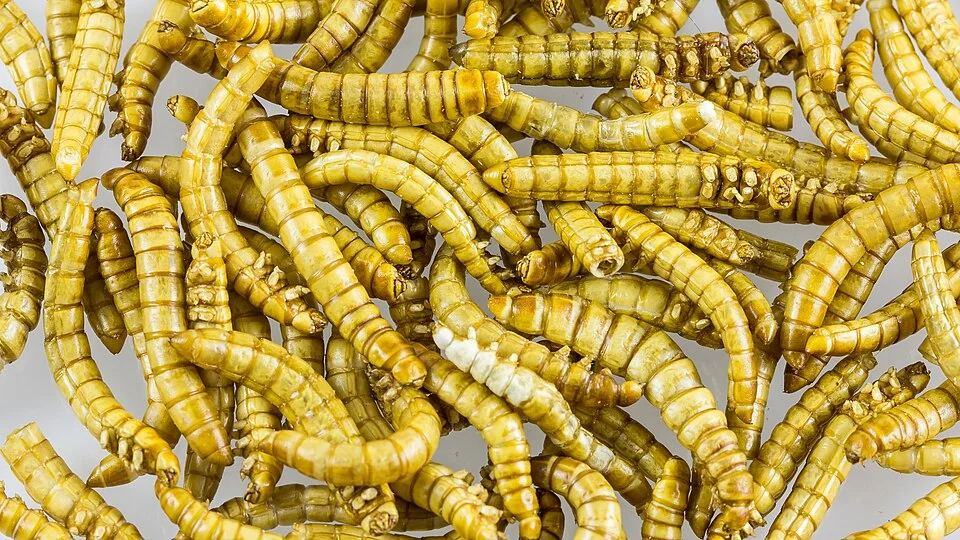
Photo: Raimond Spekking · Mealworms as food-2389.jpg · CC BY-SA 4.0. Resized for this guide.
The short answer
Offer mealworms as a modest supplement in a clean, suitable dish. Live and dried products differ in storage and acceptance. Follow the supplier’s directions, remove wet or contaminated leftovers, and never use mealworms as a complete diet or a home treatment for a rescued bird.
Decide what mealworms will add to your yard
Mealworms can bring a different kind of visitor to a feeding station. A bluebird may pause at a shallow dish while finches continue using sunflower seed nearby. A wren may inspect the offering and leave. The useful question is not whether mealworms are the best bird food in general, but whether a small, well-maintained serving fits the birds and routine in your particular yard.
Mealworms are the larval stage of a darkling beetle, commonly Tenebrio molitor. They are sold live and dried, and the two forms create different storage and serving tasks. Neither should be treated as a complete diet for wild birds or as an instruction for caring for an orphaned youngster.
Start with a small trial rather than a bulk order. Confirm that plausible insect-eating birds occur locally, choose a dish you can clean, and decide when you will remove unused food. If no bird takes it, you have learned something without creating a large maintenance problem.
This guide covers food selection, live-versus-dried decisions, serving arrangements, weather, cleanup, and realistic expectations. It also explains when to stop offering mealworms. A useful feeding practice should leave more time for observing birds, not a collection of damp food containers and increasingly complicated attempts to force a visit.
Understand the role of a supplement
Wild birds select food from a landscape, not a menu designed by one household. Insects, spiders, fruit, seeds, and other resources vary by species and season. A dish of mealworms adds one food to that setting. It does not replace native vegetation, natural foraging, clean water, or safe nesting habitat.
Cornell's guide to suet, mealworms, and other foods describes mealworms as an offering for several insect-eating birds. Keep the practical implication modest: some birds may accept them. Do not turn that into a claim that every species needs them or that larger quantities automatically improve breeding success.
Avoid homemade supplement recipes based on scraps of advice from different sources. Adding powders, oils, or vitamins changes the food and can create a new problem. A bird requiring a formulated diet or medical support belongs under qualified care. Backyard feeding should remain a small optional contribution to free-living birds.
You can set a useful boundary before starting: only offer food when you can inspect the dish, remove leftovers, and clean it afterward. If that boundary makes daily feeding impractical, use mealworms occasionally or choose habitat improvements instead. There is no requirement to offer every type of food available in a bird shop.
Know which birds might use the offering
Bluebirds are a familiar example, but mealworms can interest other birds that take invertebrate food. Which species actually visit depends on regional range, nearby habitat, season, and whether the birds discover the dish. A photograph of a particular bird on the package does not establish that it lives near you.
Cornell's summer-feeding guidance discusses bluebirds and several seasonal food options. Use it as background, then check the birds you observe. A seed feeder with only finches visiting may not be the right place to expect immediate mealworm use.
Before buying, spend a few short watches identifying birds in the lawn, shrubs, and lower branches. Note how they forage. An Eastern Bluebird dropping from a perch toward open ground presents a different setting from a dense urban balcony visited mainly by pigeons.
Our bluebird guide explains why open foraging areas, perches, and regional species matter. For robins, the American Robin guide puts supplemental feeding alongside natural ground food and fruit. Choose the habitat connection first. Mealworms should support a plausible plan, not become a substitute for learning which birds already use the area.
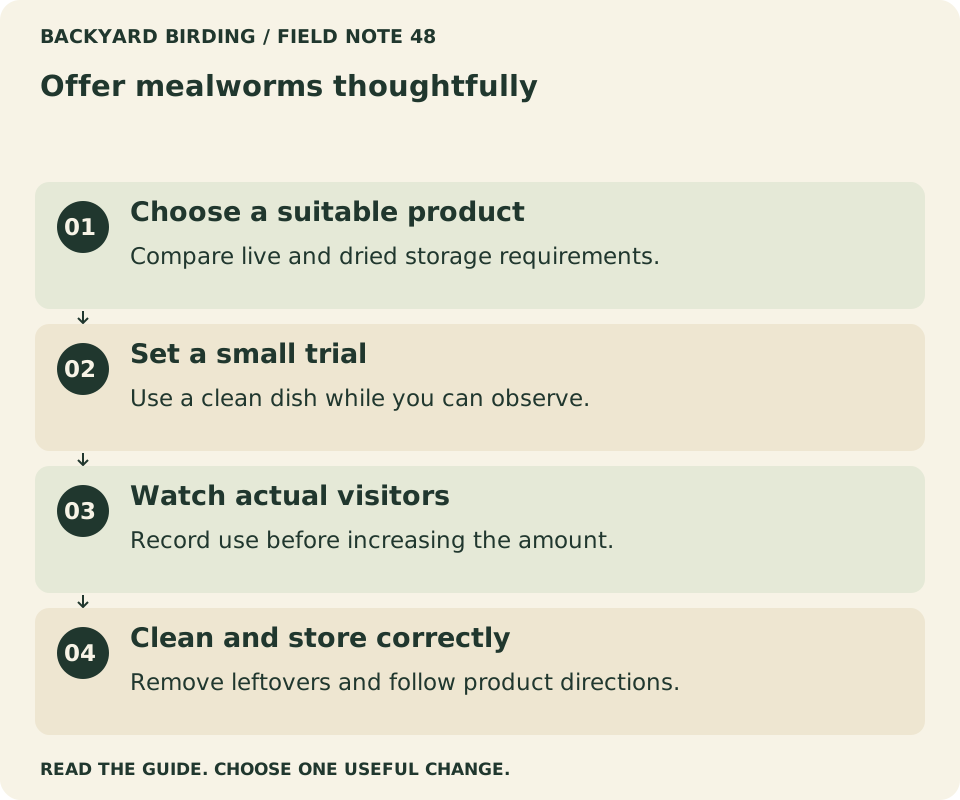
Your visual action map

Read the visual as text
- Choose a suitable product. Compare live and dried storage requirements.
- Set a small trial. Use a clean dish while you can observe.
- Watch actual visitors. Record use before increasing the amount.
- Clean and store correctly. Remove leftovers and follow product directions.
Compare live and dried mealworms honestly
Live mealworms move, which can help birds notice them, but they require appropriate storage and secure handling. Dried mealworms are easier to store and measure, yet may be ignored by birds that readily take live prey. Neither form is universally better for every household or every bird.
| Question | Live mealworms | Dried mealworms |
|---|---|---|
| What makes them noticeable? | Movement in the dish | Position, familiarity, and the birds' interest |
| What must storage prevent? | Escape, unsuitable conditions, and contamination | Moisture, pests, and deterioration |
| What does serving require? | A suitable smooth-sided dish and small portion | A clean dish and attention to wet leftovers |
| What should guide the purchase? | A care routine you can follow | A quantity you can keep dry and use reasonably |
| Are they a complete diet? | No | No |
Compare the package instructions before the price per container. A cheap large quantity is poor value if most deteriorates or you cannot maintain the storage conditions. Start with the smallest practical amount that allows a few observations.
If you try both forms, change only the food during the comparison. Keeping the location, dish, and observation period similar makes the result easier to interpret. Even then, differences in weather and bird activity matter; a short backyard trial cannot establish a universal preference or a nutritional ranking.
Buy a product intended for animal feeding
Choose mealworms from a supplier that identifies the product clearly and provides storage directions. Avoid flavored human snacks, salted products, or insects exposed to garden chemicals. A photograph alone does not tell you what has been added or how the food should be kept.
Read the label for the actual contents and any handling instructions. If the product is mixed with seeds, fruit, or pellets, treat it as a mixture with its own storage and cleanup needs. Do not assume the mealworm portion makes every other ingredient appropriate for your intended visitors.
Inspect the package when it arrives. Damage, dampness, unusual odor, mold, or obvious contamination are reasons not to serve the food. Contact the supplier when the condition is questionable. Feeding a compromised batch to avoid wasting money transfers the problem to the birds and the feeding area.
Keep the original product information until the batch is finished. That gives you a reference for storage, ingredients, and any question you need to ask the supplier. Mark the opening date on your container if you transfer the food. A tidy unmarked tub can be less useful than the original package if nobody can remember what it contains or when it was opened.
Store live mealworms according to the supplier
Live mealworm products differ in packaging, substrate, and intended storage conditions. Follow the supplier's instructions rather than applying a single temperature or feeding recipe to every delivery. Keep the container secure, appropriately ventilated as directed, and away from places where an escape would create a household problem.
Use a dedicated, clearly labeled container. Do not place an unmarked food-looking tub where another household member might mistake it for something intended for people. If refrigeration is specified, keep the container contained and separated from ready-to-eat food, and make sure the household understands what it is.
Inspect the batch before serving. Remove food from storage with clean dedicated utensils, take only the small amount needed, and close the container promptly. Avoid returning leftovers from the outdoor dish to the stored supply; they may contain moisture, dirt, or droppings even if they look unused.
Do not release unwanted stock outdoors. Buy less next time, ask the supplier about appropriate disposal, and keep the container secured until you resolve the surplus. A backyard feeding guide is not a reason to introduce cultured insects into the environment. If maintaining live food feels disproportionate to the occasional visit it produces, dried mealworms or habitat improvements may fit better.
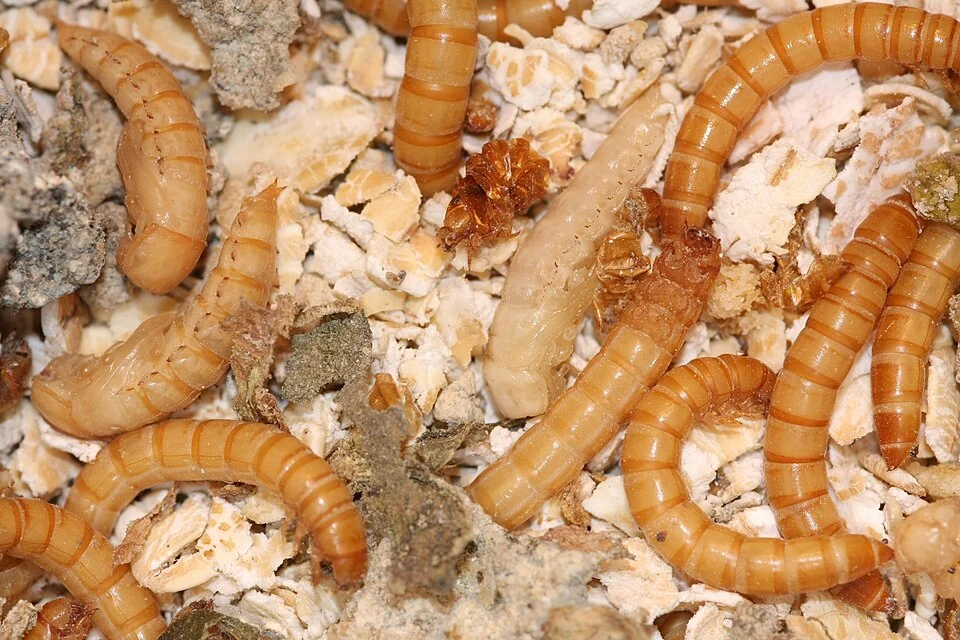
Photo: ImagePerson · Mealworm BeetleTenebrio molitor larvae, pupae, molted skin 02.jpg · CC BY 4.0. Resized for this guide.
Keep dried mealworms dry after opening
Dried food is convenient because it does not need the same live-care routine, but it still needs protection from moisture and pests. Close the package properly, store it as directed, and avoid keeping an open bag in a humid shed merely because the contents started dry.
Use a clean scoop and keep wet hands out of the container. If you prepare food outside, bring only the serving amount with you. Leaving the main bag open beside a birdbath or on a damp table creates an avoidable opportunity for contamination.
Do not mix a new batch into an old container without checking and cleaning it. Fine fragments can remain around the bottom and lid, and a label should identify the current contents. This is especially useful if several people share the feeding task.
Discard food that becomes moldy, damp in storage, or otherwise questionable. Drying it again does not establish that it is safe. Our seed-storage guide covers the broader principles of dry containers, batch rotation, and manageable purchase sizes. Apply those principles to dried mealworms while following the specific product's directions rather than assuming every bird food has the same storage life.
Choose a dish around cleaning and containment
A shallow removable dish is often a sensible starting point. For live mealworms, smooth sides can help keep the serving contained long enough for birds to find it. The dish should be stable, accessible, and easy to empty fully. Avoid deep containers that encourage birds to climb into the food.
Test the equipment before filling it. Can you lift the dish without spilling? Does rain collect in it? Is there a crack or rough edge? Can a brush reach the corners? A decorative feeder that cannot be opened properly may create more work than a plain removable cup.
If you use a covered mealworm feeder, check the actual openings and species access. Narrow entrances can exclude some birds, but dimensions must suit the intended species and the product design. Do not improvise an enclosure that could trap a bird or make escape difficult.
Keep the dish separate from seed reservoirs during the first trial. That lets you identify what was used and makes leftovers easier to remove. Mixing mealworms into a large seed supply can conceal damp fragments and prevent a clear comparison. Once you understand the visitors and maintenance, you can decide whether a different arrangement has a real advantage.
Place the serving where it can be found safely
Choose a visible location near the area where the intended birds already forage, while keeping the approach and retreat clear. A feeder in a visually convenient place for people may be remote from the birds' usual routes. Move thoughtfully rather than hanging several dishes around the yard at once.
Inspect nearby windows from outside. A bird moving quickly from a perch to the dish may encounter reflected sky or vegetation. Address hazardous glass using a complete suitable exterior treatment; distance from the window alone is not a substitute for making it visible.
Keep the serving away from cat ambush points and places where dogs repeatedly disturb feeding. Also consider where food will fall. A dish over a cleanable surface is easier to manage than one above dense groundcover where fragments disappear.
Make access easy for yourself. If removing the dish requires a ladder or reaching across a fragile planting, you may postpone cleanup. Our feeder-placement guide helps assess glass, cover, mounting, and maintenance together. The best location is one that works for the birds and can be cared for consistently by the person responsible for it.
Find your situation

Read the visual as text
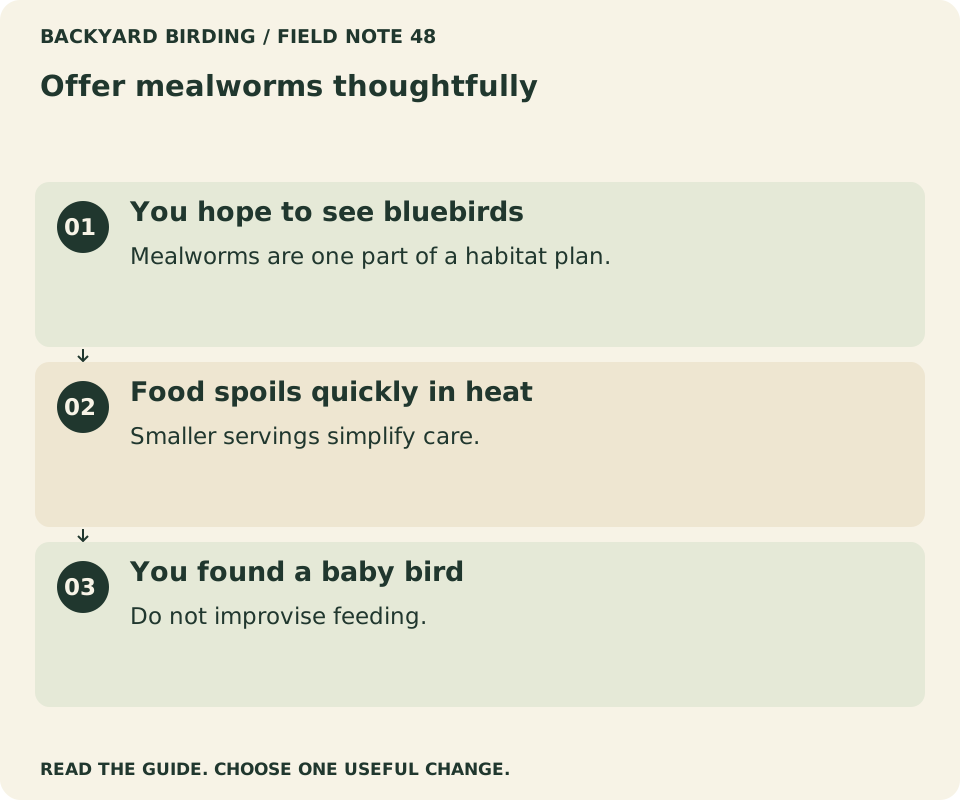
- You hope to see bluebirds. Mealworms are one part of a habitat plan.
- Food spoils quickly in heat. Smaller servings simplify care.
- You found a baby bird. Do not improvise feeding.
Start with a small attended serving
Begin with a portion you can watch and remove, not a bowl filled to capacity. There is no reliable universal number of mealworms for every yard. Species, number of visitors, other food sources, weather, and the purpose of the offering all vary.
Put out the food during a period when you can check it. Observe from a distance that allows normal approaches. If you sit immediately beside a new dish, the absence of visitors may reflect your position rather than the food.
Record whether birds actually eat, merely inspect, or carry food away. Missing mealworms alone do not identify the consumer. Other animals may be involved, and live insects can escape from an unsuitable dish. A short direct observation gives a more useful answer than comparing before-and-after quantities alone.
Remove leftovers and clean the dish after the trial. Repeat on another suitable day before drawing a strong conclusion, but avoid an endless cycle of increasing the serving. If birds consistently ignore the food, stop and reassess local species, placement, and the reason for offering it. Success can mean learning that a different resource deserves your attention.
Treat soaking as a perishable-food decision
Some people moisten dried mealworms before serving. If you choose to do so, prepare only a small portion with clean water and use it promptly. Once wetted, the food needs more immediate attention than a dry product in a sealed package. Do not soak a large batch for several days of outdoor use.
Follow any preparation directions on the product. Soaking does not make a supplement nutritionally complete, prove that every bird will accept it, or turn it into a suitable hand-feeding formula for a chick. Avoid adding milk, sugar, salt, or other household ingredients.
Keep preparation and serving containers clean. Discard unused wet food rather than returning it to the original dried supply. Rinse and wash the dish appropriately before preparing another portion. In hot weather, shorten the attended serving window and remove the offering if you cannot monitor its condition.
If you are unsure whether moistening is useful, compare a very small dry offering first and observe the intended birds. There is no need to add preparation steps merely because they appear in a generic feeding tip. Choose the simplest routine that provides appropriate food in good condition and that you can maintain without leaving leftovers outdoors.
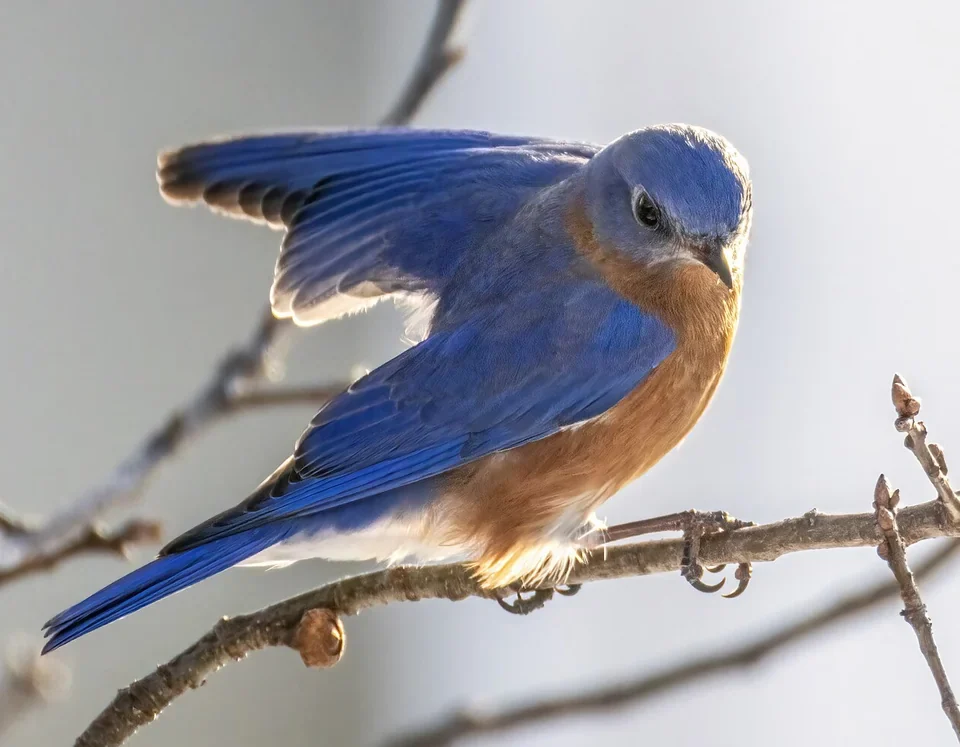
Photo: Acroterion · Eastern Bluebird MD1.jpg · CC BY-SA 4.0. Resized from the credited adaptation.
Adjust the routine for heat and rain
Weather changes the task. Rain can turn a shallow dish into a wet food container, while heat speeds deterioration of moist leftovers. A roof or shaded location can help with exposure but does not remove the need to inspect and clean.
After a shower, check the dish rather than assuming the cover kept it dry. Wind can drive water under a roof, and splashes may reach the food from nearby surfaces. If the serving is wet or contaminated, remove it. Do not hide the problem beneath a new dry layer.
In hot weather, offer less and keep the trial attended. If you will be away during the day, skip the serving rather than leaving a generous portion in the hope that birds finish it quickly. Our summer-feeding guide explains how portions, moisture, and maintenance interact across different foods.
During cold weather, keep your own access safe and follow the live product's storage instructions. An outdoor serving and the stored supply have different requirements. Avoid using a household heat source or improvised warming device at the feeder. If conditions make routine care difficult, simplify the station until you can inspect it properly again.
Keep the feeding area clean between servings
Emptying the dish and cleaning it are separate jobs. Fragments and a thin film can remain after the obvious food is gone. Wash the removable parts using the appropriate routine for the equipment, rinse thoroughly, and let them dry as needed before refilling.
Inspect the support and the ground below. Birds can carry food to a nearby rail or leave droppings around the dish. A clean cup attached to a dirty bracket is only a partial reset. Choose a setup with visible surfaces instead of hidden recesses that hold damp material.
Cornell's feeder-cleaning guidance provides the general sanitation framework. Follow current local wildlife advice when birds appear ill, and keep cleaning tools separate from kitchen food-preparation equipment. Wash your hands after handling the feeder and waste.
A second removable dish can make the routine easier: one can dry while the other is used. That convenience should support smaller, cleaner servings rather than double the amount of food offered. If cleaning becomes a chore you repeatedly defer, reduce how often you feed or pause. The birds' wider habitat should remain the foundation of the yard.
Avoid confusing breeding activity with a need for more food
An adult carrying mealworms away can be an interesting observation, but it does not tell you the whole diet of its young. Parents may be taking a variety of natural prey elsewhere. Do not interpret one visible trip as proof that the nest depends on your dish.
Keep the supplement modest and protect natural foraging. Locally appropriate plants, reduced unnecessary pesticide use, and varied vegetation can support food resources beyond the feeder. The native-plant guide helps turn that general idea into a site-specific planting decision.
Avoid positioning food immediately beside an active nest or box to obtain photographs. Repeated human visits can interfere with normal activity, and a concentrated food source may attract additional animals. Observe from a distance and let the nesting birds choose their routes.
Never feed mealworms directly to a found nestling on the assumption that its parents would do the same. Species, age, condition, hydration, and feeding method matter. A licensed rehabilitator should direct care when intervention is needed. The baby-bird guide explains how to distinguish a normal fledgling situation from one requiring professional advice.
Small mistakes. Better moves.

Read the visual as text
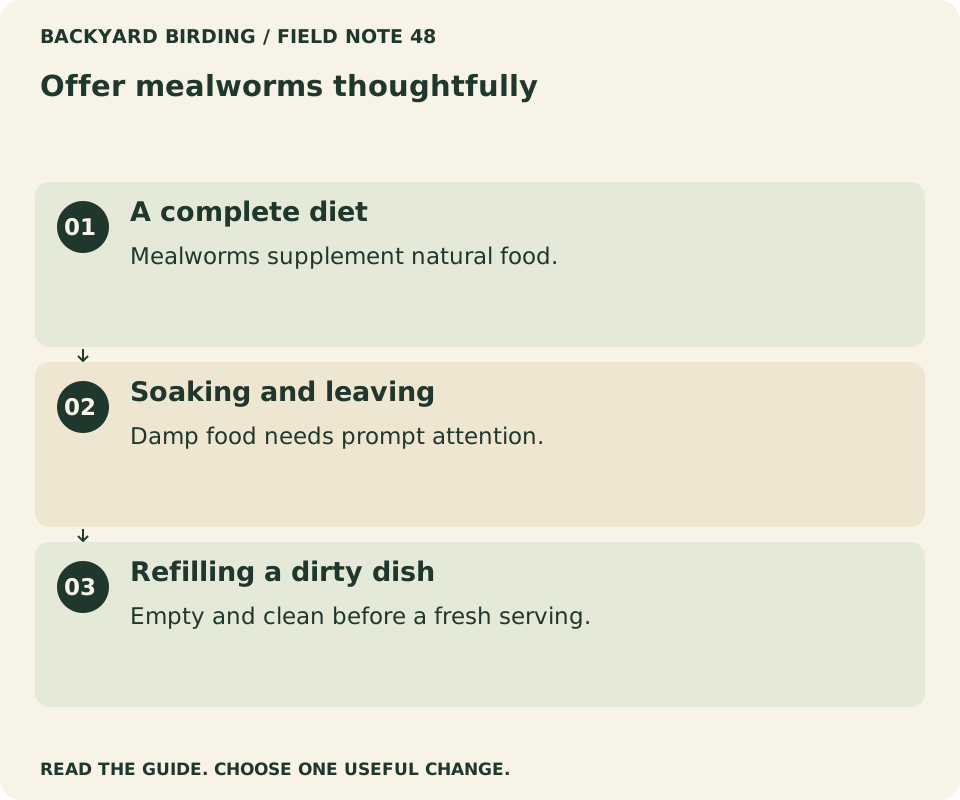
- A complete diet. Mealworms supplement natural food.
- Soaking and leaving. Damp food needs prompt attention.
- Refilling a dirty dish. Empty and clean before a fresh serving.
Troubleshoot an untouched dish in a sensible order
First check the birds, then the food, then the arrangement. Are the intended species actually present? Is the food in good condition? Can a bird see and reach it comfortably? A new dish may remain unused because it sits outside ordinary feeding routes, not because the food is defective.
Change one variable at a time. You might move the dish to a safer, more visible location near an established perch, then repeat a short observation. Do not change the food form, dish, height, and location together if you want to understand what mattered.
| What you observe | Check first | A reasonable response |
|---|---|---|
| No bird approaches | Local species and location | Observe existing foraging before moving the dish |
| Birds look but do not take food | Access and food condition | Simplify the serving and verify freshness |
| Food disappears unseen | Consumer and containment | Watch a short serving directly |
| Leftovers become wet | Exposure and serving duration | Offer less and remove promptly |
| Cleanup is repeatedly missed | Routine and equipment access | Pause or reduce the practice |
Keep expectations proportional. A few trials can guide your own setup, but they do not establish that a species never eats dried mealworms or that one feeder design is best everywhere. Stop when the information is sufficient to make a practical decision.
Manage other visitors without harmful deterrents
Mealworms may attract birds other than the species you hoped to see, as well as other animals. Identify the actual visitor before reacting. A missing serving is not evidence that a particular bird or mammal is responsible.
Reduce the amount and duration of exposure first. An attended small serving gives you more control than a permanently full dish. Remove waste and secure the stored supply. If unwanted activity continues, stop offering the food while you reassess the location.
Do not coat supports with oil or sticky substances, set loose entangling lines, or use improvised traps around a bird feeder. These can harm the birds you intended to help. Purpose-designed equipment still needs inspection and must suit the species and mounting conditions.
If you cannot accommodate the mix of visitors safely, choose another way to support birds. Water, locally appropriate planting, and safer glass can be worthwhile without concentrating food. A feeding station is optional. The ability to stop a practice that is not working is part of responsible care, not evidence that you have failed to attract the “right” bird.
Compare cost by usable servings and effort
The cheapest package is not always the cheapest routine. Consider how much you actually use, how much is discarded, the storage requirements, and the time needed to serve and clean. Live and dried products may be sold in different units, making a simple price-per-container comparison misleading.
For a first purchase, write down the amount bought, number of small servings, and whether any food spoiled or remained unused. You do not need to calculate an exact cost per bird. That would imply a precision the observations cannot support. The useful comparison is whether the purchase fits your household and produces a manageable result.
Include equipment in the decision only when it solves an observed problem. A basic removable dish may answer the first question about acceptance. A specialist feeder becomes more reasonable when you know which birds use the food and what access or weather issue needs improvement.
Set a stopping point for the trial. If the food remains unused, the storage is inconvenient, or cleanup is repeatedly missed, finish the trial and reconsider. Spending more to rescue an unsuitable routine is rarely helpful. The money may serve the yard better as a suitable plant, a window treatment, or a simpler clean water source.
Plan for travel and shared household care
Mealworms are easiest to manage when everyone knows the routine. Leave a short instruction card with the actual serving container, storage location, and cleanup steps. Make clear that leftovers do not go back into the main supply and that a missed serving should not be compensated for with a double portion.
Before a trip, decide whether another person can genuinely maintain the practice. If not, stop the supplemental offering and clean the equipment. Do not leave a large bowl outdoors for several days. Free-living birds use multiple resources, and a poorly maintained dish is not a helpful substitute for normal care.
Keep the stored food secure during the absence according to its directions. For live stock, arrange any required care with someone who understands it or buy a smaller quantity beforehand. For dried food, check the seal and storage environment.
When you return, inspect everything before restarting. A forgotten dish may hold rainwater, debris, or insects. Clean it, check the remaining food supply, and begin again with a small serving. The restart is a good moment to ask whether the routine still fits the season and the birds currently visiting.
Work through a bluebird trial without overfeeding
Suppose you have confirmed bluebirds using an open part of the yard, but they have not approached the seed feeder. Begin by watching the perch and ground route they already use. Choose a small removable dish in a safe visible position nearby, with appropriate distance from an active nest and no untreated glass along the approach.
Offer a modest portion during a period when you can watch quietly. Record the food form, location, and whether a bird actually takes it. If the serving disappears while you are indoors, do not count that as confirmed bluebird use. Repeat with direct observation before drawing a conclusion.
If a bluebird accepts the food, keep the next serving similarly modest. You have answered the discovery question; you have not established a reason to fill a large reservoir. Watch whether the amount is consumed promptly and whether other visitors or waste create a problem.
If there is no use after several clean attended trials, remove the dish and reconsider the location or the need for feeding. The existing habitat may already be the more important resource. This is a bounded trial with a useful outcome either way, not an escalating effort to make a bird behave like a package photograph.
Keep a short serving record when problems repeat
A record is useful when it answers a specific question. You might note that dry food remains untouched but a small live serving is accepted, or that rain reaches the dish despite the roof. Record what you saw without turning a few observations into a universal rule.
Use four columns: offering, conditions, confirmed use, and cleanup. Under confirmed use, name the bird only when you saw enough to identify it. Under cleanup, note whether food remained, became wet, or reached the ground. That last column often explains whether the practice is sustainable.
Review the record after a short trial rather than collecting data indefinitely. Choose one adjustment, such as a smaller serving, a safer dish position, or stopping the offering during wet weather. If the routine already works well, stop recording every detail and enjoy the birds. Notes should make care clearer, not turn an optional supplement into an unnecessary daily administrative task.
Mealworm questions, answered briefly
Are dried mealworms as attractive as live ones?
Acceptance varies. Movement can make live food noticeable, while some birds readily take dried food once they find it. A small local trial is more useful than a universal claim. Compare the care burden as well as the number of visits.
How many should I put out?
Use a small amount you can observe and remove. There is no single serving number suitable for every species mix and yard. Keep it supplemental, watch actual use, and reduce the portion when leftovers remain.
Can I leave them out overnight?
An attended daytime serving is easier to inspect and clean. Remove leftovers rather than leaving food available to unknown visitors overnight. The aim is a fresh manageable offering, not a permanent outdoor food store.
Should I raise mealworms myself?
That is a separate husbandry project with containment and care requirements. It is not necessary for backyard birding. First establish whether a small purchased supply has a useful place in your routine before considering a more involved system.
What is the most useful first step?
Identify the birds already foraging nearby. Then choose one clean removable dish, one small appropriate supply, and one short observation period. Use the result to decide whether mealworms deserve a continuing place in the yard.
Watch it. Then try it.
Review the steps and common mistakes in two short, silent animations. Each has a complete text transcript below.
Your four-step action map
Read the complete video transcript
Offer mealworms thoughtfully.
- Choose a suitable product. Compare live and dried storage requirements.
- Set a small trial. Use a clean dish while you can observe.
- Watch actual visitors. Record use before increasing the amount.
- Clean and store correctly. Remove leftovers and follow product directions.
Try the steps, then note any problem that still needs attention.
Three mistakes to avoid
Read the complete video transcript
Offer mealworms thoughtfully.
- A complete diet. Mealworms supplement natural food.
- Soaking and leaving. Damp food needs prompt attention.
- Refilling a dirty dish. Empty and clean before a fresh serving.
Try the steps, then note any problem that still needs attention.
Both animations use this real photograph by Raimond Spekking. Photo source · CC BY-SA 4.0. The photo is adapted into original educational animations, not recordings of a field test.
At a glance
| First check | Useful response |
|---|---|
| Choose a suitable product | Compare live and dried storage requirements. |
| Set a small trial | Use a clean dish while you can observe. |
| Watch actual visitors | Record use before increasing the amount. |
| Clean and store correctly | Remove leftovers and follow product directions. |
Sources & evidence
Our standard: real evidence before ratings. Corrections follow our editorial process.
Our verdict & your next actions
Choose the row that describes your setup, then follow the suggested check or adjustment.
| Your situation | Our verdict | Your next action |
|---|---|---|
| You hope to see bluebirds | Mealworms are one part of a habitat plan. | Build a bluebird-friendly yard |
| Food spoils quickly in heat | Smaller servings simplify care. | Plan summer feeding |
| You found a baby bird | Do not improvise feeding. | Find the appropriate first response |
Your pocket field checklist
Tick off the steps as you go.
0 of 4 steps completed
Keep building your knowledge in bird seed, or search the full backyard library.