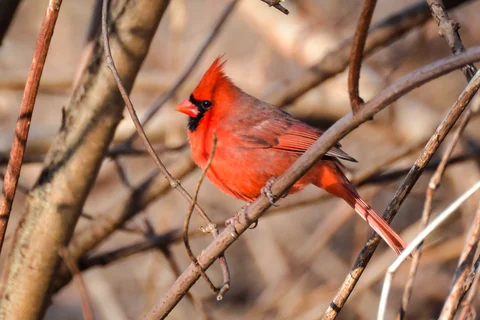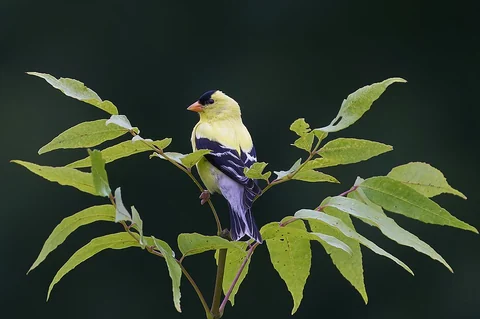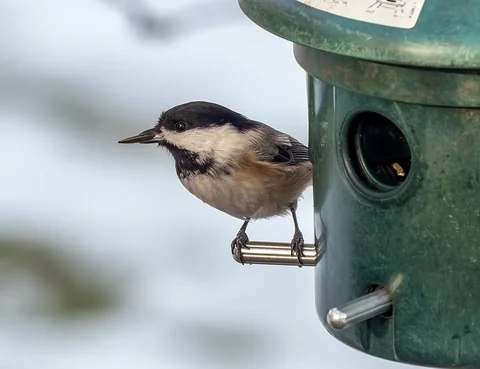
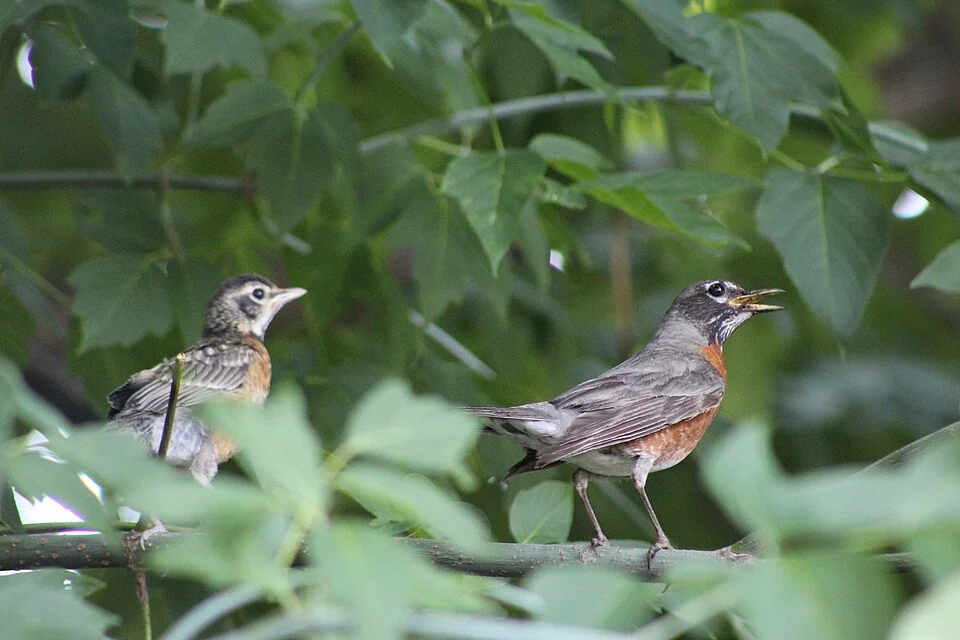
Photo: Rawaha Alam · American Robin parent with Fledgling in a tree.jpg · CC BY-SA 4.0. Resized for this guide.
The short answer
Look for a gray-brown back, orange breast, broken white eye ring, and upright stance. Young robins have spotted breasts. Support natural insects and fruit, provide clean shallow water, and give nesting birds and fledglings space.
Meet the robin beyond the lawn
An American Robin crossing a lawn is an easy bird to recognize and a surprisingly good bird to study. Watch one for a minute and the familiar orange breast becomes only part of the picture. The bird runs, stops, turns its head, searches the ground, then lifts into a tree. A second robin may be feeding on fruit above the same lawn. Later in the year, a whole flock may arrive without showing much interest in the feeder.
The American Robin is a thrush, with the scientific name Turdus migratorius. It is different from the small European Robin often pictured on British greeting cards. Advice written simply for “robins” can therefore describe the wrong bird, especially when it recommends particular foods or nesting equipment. This guide concerns the widespread North American species.
A useful robin-friendly yard provides several things at once: accessible natural food, appropriate vegetation, clean shallow water, and fewer avoidable hazards. A large supply of seed is not the main attraction. Start by learning how robins already use your property, then improve one resource they actually need.
You do not need a nest to make the observation worthwhile. A robin bathing after a dry morning, taking berries during migration, or pausing in a tree before moving on is using the yard in a meaningful way. Treat those visits as different parts of its life rather than judging success only by whether a pair stays all summer.
Identify an adult from shape and pattern
Begin with the silhouette. An American Robin has a rounded body, fairly long legs, a medium-length tail, and a straight bill that looks much slimmer than a cardinal's seed-cracking bill. Its upright stance is especially noticeable when it stops on open ground. A bird stretched forward while pulling prey can look longer and lower than the same individual standing alert.
The familiar adult combination is a warm orange breast, gray-brown back, darker head, yellowish bill, and pale markings around the eye. Look beneath the tail as well: a pale lower belly and undertail area help separate the robin from some other orange-and-black birds. Cornell's American Robin identification account provides photographs across ages and viewing angles.
Avoid making sex identification depend on one patch of color. Males often look more strongly contrasted, but lighting, feather condition, and individual variation complicate the comparison. A shaded male may look duller than a female in direct morning light. If your purpose is simply to identify the species, there is no need to add a confident male or female label to an uncertain view.
For a quick field note, record three visible features before opening an app: orange across the breast, yellowish straight bill, and the run-and-stop movement. Then add the date and setting. This sequence gives you something to compare with a field guide instead of relying on the overall impression of a “red bird.”
Recognize young robins and similar birds
Young American Robins can surprise people who know the adults well. Their spotted underparts and less finished-looking plumage may suggest an unfamiliar thrush. Look for the developing robin proportions and the connection with nearby adults. A short-tailed youngster hopping under a shrub is not necessarily a separate species or an abandoned bird.
Several other birds can create a quick orange-breasted impression. In parts of the West, Varied Thrush deserves attention; its bold dark breast band and contrasting wing pattern are useful distinctions. Eastern and Spotted Towhees usually show orange concentrated along the sides, with a contrasting pale central belly and a heavier-looking bill. Compare more than the warm color.
| What you notice | A useful next view | Why it helps |
|---|---|---|
| Orange breast and dark head | Bill, belly, and wing pattern | Several species share warm underparts |
| Spotted young bird on the lawn | Overall shape and nearby adults | Juvenile plumage differs from adult plumage |
| Dark band across an orange chest | Wings and head pattern | Consider Varied Thrush where locally plausible |
| Orange sides with a white center | Bill and tail | A towhee may fit better |
A photograph should support the observation, not replace it. Keep an uncropped version that includes the perch or ground surface; size and posture may be clearer there. Our bird journal guide explains how to preserve useful details when a fleeting view does not justify a complete identification.
Your visual action map

Read the visual as text
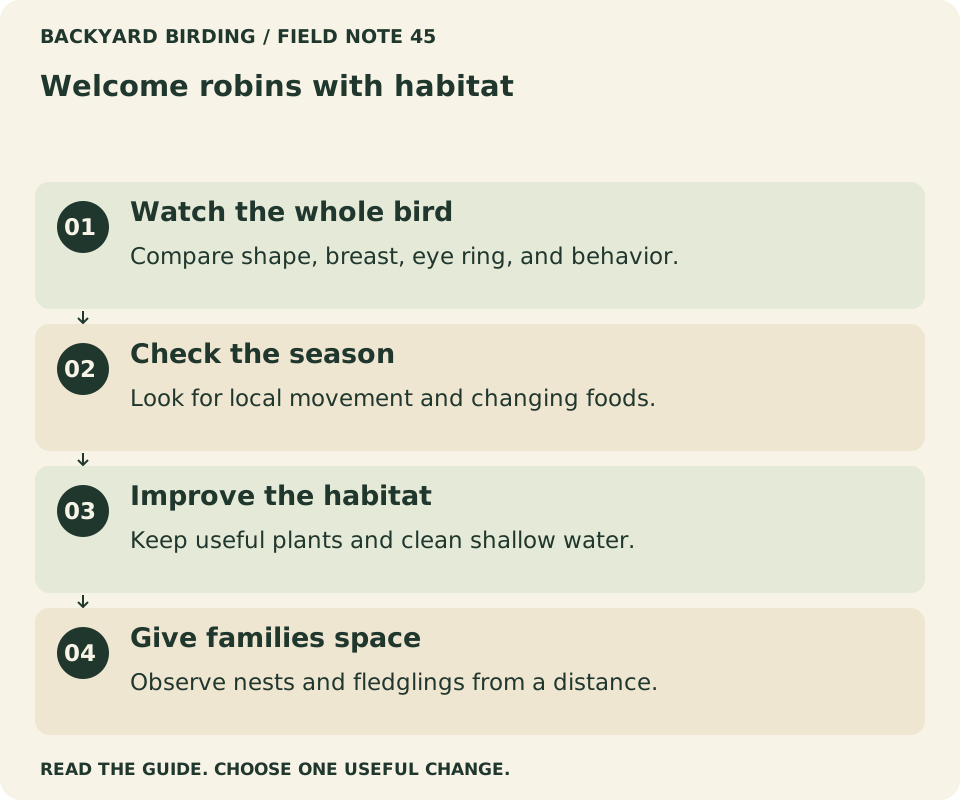
- Watch the whole bird. Compare shape, breast, eye ring, and behavior.
- Check the season. Look for local movement and changing foods.
- Improve the habitat. Keep useful plants and clean shallow water.
- Give families space. Observe nests and fledglings from a distance.
Learn the difference between song and activity
A singing robin and a feeding robin tell you different things about the yard. A bird on a high exposed perch may be advertising or interacting with other robins. A bird working through leaf litter is occupied with food. Neither behavior proves that a nest is in the nearest tree.
Listen before trying to imitate or play back a recording. The song has a flowing sequence of clear phrases, while other calls can be shorter and sharper. Cornell's robin sound library lets you compare recordings away from the bird. Use headphones for study so a speaker does not turn a quiet observation into an unnecessary disturbance.
In your notes, separate what happened from what you think it meant. “Robin gave repeated calls from the maple while a cat crossed the lawn” is an observation. “Robin warned its babies” is an interpretation that requires more evidence. You can keep both, but label the second as a possibility.
Try one simple listening exercise: spend five minutes noting where each sound comes from without moving toward it. Then look at the occupied perches. You may discover that two robins are answering from opposite sides of the property, or that the bird you assumed was in your tree is across the street. That spatial picture often explains more than a louder recording or a closer photograph.
Understand what robins eat through the year
Robins eat both invertebrates and fruit. Earthworms are conspicuous because people can watch them being pulled from lawns, but they are only part of the diet. Insects and other small invertebrates matter, while berries and other fruits become especially noticeable in seasonal feeding flocks. Cornell's life-history account describes this broader food pattern.
This explains why a robin may ignore a feeder that attracts finches and chickadees. The feeder can be working perfectly for seed-eating visitors while offering little that interests a robin. Replacing one sunflower mix with another is unlikely to solve a habitat question.
Observe the food source before deciding what to add. Is the robin searching a damp lawn, turning through leaves at the bed edge, or picking fruit from a shrub? Note the resource and its condition. If the bird is already finding food, protecting that area may be more useful than buying a specialist feeder.
Avoid trying to provide a complete wild-bird diet yourself. A dish of mealworms or pieces of fruit is a supplement with a cleaning obligation. It does not reproduce the changing range of food a free-living robin selects. The most durable plan makes room for natural feeding opportunities, especially where those opportunities can coexist with the way you use the garden.
Make the ground useful without overmanaging it
The neatest-looking ground is not automatically the best feeding ground. Before changing the lawn or beds, watch where robins actually search. A damp patch beside a shrub, a leaf-covered border, and an open mown area can offer different opportunities. You do not have to make the whole property look or function the same way.
Consider retaining a defined leaf-litter area beneath suitable trees or shrubs. Keep it away from paths and drainage features that must remain clear, and follow local fire-safety requirements. A deliberate boundary makes the area easier to maintain and explain to other people who share the property. “Leave this bed undisturbed” is more workable than a vague request never to tidy anything.
Review lawn treatments before applying them. Identify the actual problem, read the product label, and seek local extension advice if treatment is needed. Do not spread chemicals simply because a calendar says it is time. The American Bird Conservancy robin profile discusses threats affecting this otherwise familiar species, including hazards in human-dominated landscapes.
Keep observation separate from intervention. A robin pausing after rain does not establish that additional watering will improve the yard, and watering restrictions or drainage problems may make that a poor choice. Improve the habitat within local conditions rather than trying to manufacture a constant supply of worms on the surface.
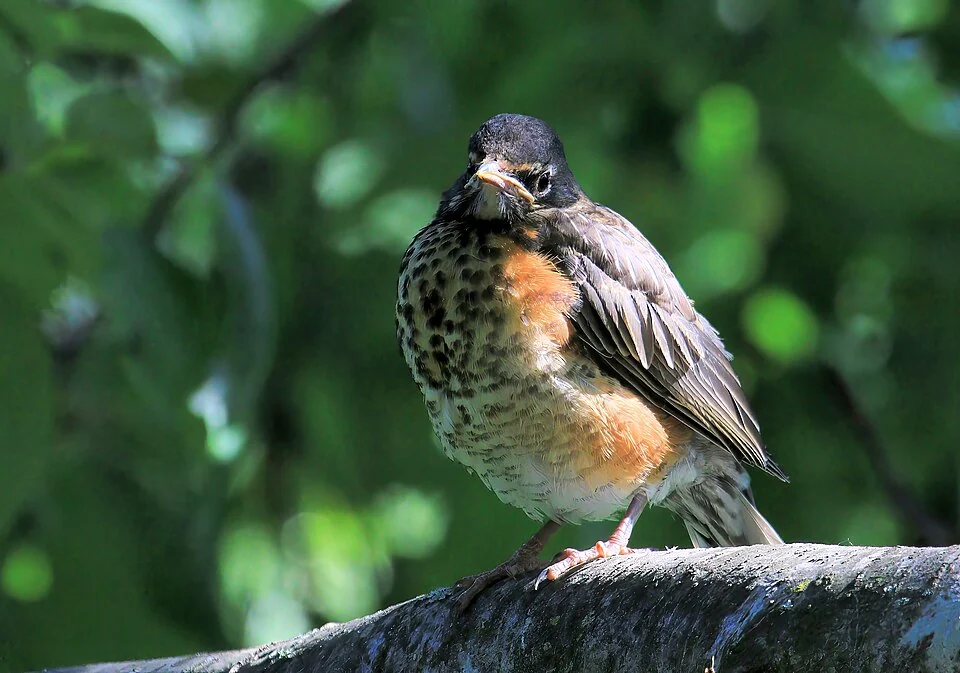
Photo: ImagePerson · American Robin Turdus migratorius fledgling 8485.jpg · CC BY 4.0. Resized for this guide.
Choose fruiting plants for your own region
A fruiting plant can contribute food, cover, and structure, but the right choice depends on where you live. A plant native somewhere in North America is not necessarily native or suitable in your county. Start with local extension resources, a regional native-plant society, or Audubon's native plant resources, then check the plant's mature size and growing requirements.
Think about the whole planting site. How much sun reaches it after nearby trees leaf out? Does water drain quickly or collect after storms? Is there room for the roots and canopy? Will fruit fall onto a busy walkway? These questions are worth answering before choosing a plant because robins have eaten its berries elsewhere.
Plan for a sequence of resources rather than a single spectacular crop. Different locally appropriate trees and shrubs may fruit at different times, while their foliage and branches serve other purposes throughout the year. A small yard may only accommodate one shrub; in that case, choose a species that fits well and can remain healthy without constant correction.
Record the scientific name when shopping. Common names can cover several species with different growth habits, and a nursery label saying “bird friendly” does not settle local suitability. Our native plants guide walks through a practical site assessment and a manageable first planting. Use it to turn a wish list into a plant you can actually establish.
Offer water with an easy approach and exit
A birdbath can attract robins even when they show no interest in supplied food. Choose a stable basin with shallow access and a surface that gives secure footing. A bird should be able to approach the water gradually, stand comfortably, and leave without climbing a steep slippery wall.
Cornell's birdbath guidance recommends shallow water, roughly an inch near the edge and no more than about two inches at the deepest point. Treat those measurements as a design check, not permission to ignore the basin's shape. A sudden deep center surrounded by a narrow rim is less forgiving than a broad gentle slope.
Place the bath where you can inspect and empty it. A beautiful basin behind dense planting may receive less care because reaching it is inconvenient. Also inspect nearby glass and potential cat ambush points. Water can draw birds into a flight route that was previously quiet.
Watch one complete visit if possible. Does the robin drink from the edge, step in to bathe, or hesitate because the surface moves? Check the water afterward; bathing can carry dirt into the basin and splash much of the water out. Fresh water and a clean surface matter more than keeping the bowl continuously full. For the detailed routine, see how to clean a birdbath.
Decide whether supplemental feeding has a purpose
Before putting out food for robins, decide what you want to learn or improve. A small attended offering can show whether local birds accept mealworms. It should not become a large permanent tray simply because the first portion attracted attention. Every added food creates another surface to clean and another opportunity for unwanted animals to visit.
Use a removable dish or suitable feeder that can be emptied completely. Offer a small quantity and observe from a distance. If the food is untouched, remove it rather than letting it weather outdoors while you wait. Repeatedly replacing a large uneaten portion is a sign to simplify the arrangement.
For mealworms, choose a product intended for animal feeding, follow its storage directions, and keep it as a modest supplement. Do not take feeder advice as instructions for hand-feeding a nestling. A young bird requiring care needs advice from a licensed wildlife rehabilitator, not a backyard feeding experiment.
Fruit needs equally close attention. Sticky remains attract insects and spoil, especially in warm conditions. A fruiting plant and a dish of cut fruit have very different maintenance demands. If you cannot attend a perishable offering, leave it out of the plan. The mealworm guide compares live and dried options, serving arrangements, and the reasons to stop or reduce an offering.
Find your situation

Read the visual as text
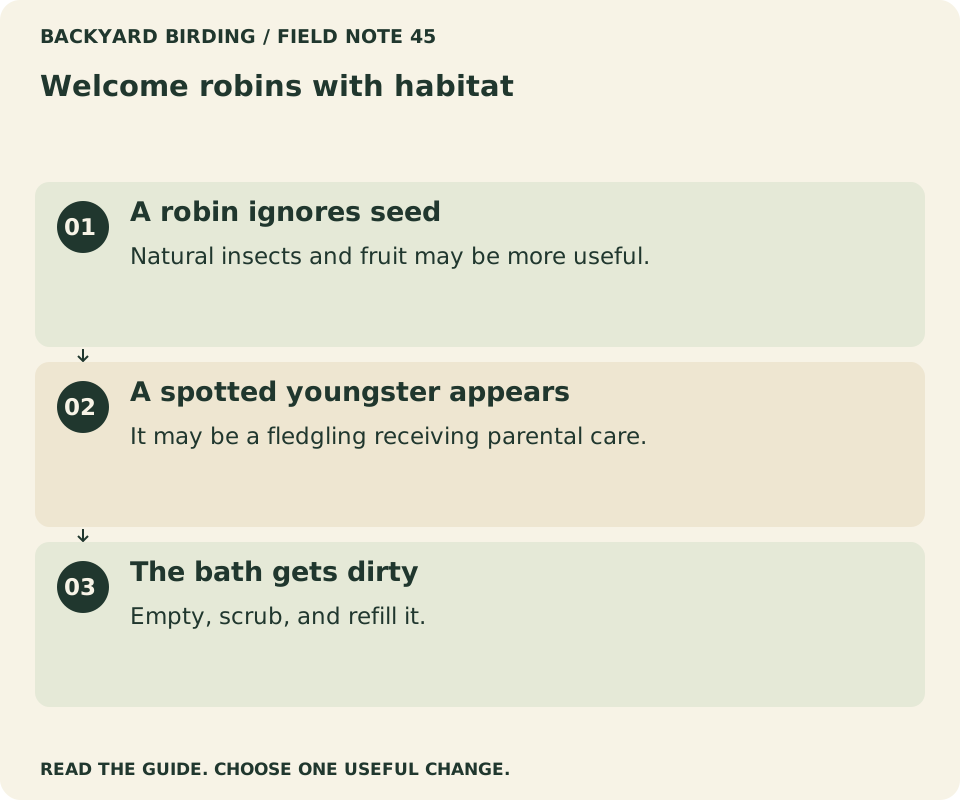
- A robin ignores seed. Natural insects and fruit may be more useful.
- A spotted youngster appears. It may be a fledgling receiving parental care.
- The bath gets dirty. Empty, scrub, and refill it.
Understand nests without approaching them
Robins usually build open cup nests rather than occupying the enclosed nest boxes used by bluebirds and chickadees. Their nests can occur in vegetation or on sheltered human structures. A ledge near a door may therefore attract a robin even when a carefully purchased birdhouse remains empty.
If a robin starts using a busy place, reduce avoidable disturbance and observe from farther away. Do not move an occupied nest to make it more convenient. The U.S. Fish and Wildlife Service guidance on bird nests explains the protections and why a nest's status matters. For a conflict involving repairs or an unsafe location, seek advice from the appropriate wildlife authority before acting.
Do not add string, yarn, dryer lint, or other household fibers to “help” the nest. Natural vegetation already provides many materials. NestWatch's nesting-material guidance explains why apparently soft materials can create problems.
A useful nesting observation can be made without seeing eggs. Record an adult carrying grass, returning to the same sheltered spot, or taking food in a particular direction. Keep enough distance that the bird continues normal activity. If it repeatedly waits with food while you stand nearby, move away. The aim is to understand the birds' use of the yard, not to obtain a close view at every stage.
Know when a young robin needs help
A feathered young robin on the ground can be in a normal stage of development. Fledglings often leave the nest before they fly strongly, and their parents may feed them outside it. Keep pets and children back, move away, and observe without surrounding the bird.
A sparsely feathered nestling, an obviously injured bird, or a bird known to have been caught by a cat calls for a different response. Contact a licensed wildlife rehabilitator promptly for case-specific instructions. Do not offer water by dropper or improvise food while trying to identify the bird.
The distinction is about condition and development, not simply location. “On the ground” does not mean orphaned; “able to hop” does not rule out injury. A photograph taken from a respectful distance, the exact location, and a description of any known accident help a rehabilitator assess the situation.
Cornell's baby-bird guidance is a good first reference. Our found-a-baby-bird guide provides a decision sequence, including what to tell a rehabilitator and how to avoid turning a normal fledgling encounter into an unnecessary rescue. If a professional gives instructions for your situation, follow those rather than a generic timetable from an article.
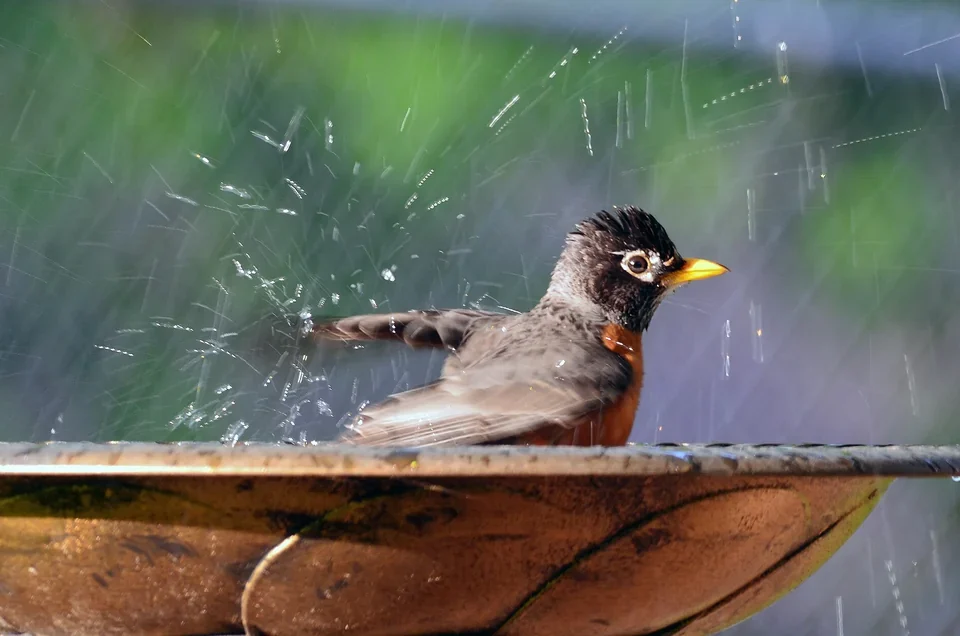
Photo: U.S. Fish and Wildlife Service - Midwest Region · American Robin (42253318841).jpg · Public domain. Resized from the credited adaptation.
Read seasonal changes without assuming departure
Robins are often treated as the first sign of spring, but their seasonal story is more complicated. Some remain in regions where people stop noticing them during winter. Others move substantial distances, and local numbers can change as birds shift between habitats and food sources. The Cornell range map is a starting point, not a record of your individual yard.
A winter flock in fruiting trees can be easy to miss if you only watch the lawn. Likewise, fewer songs later in the year do not prove every robin has left. Change the question from “Where did my robin go?” to “Where are robins feeding and gathering locally now?”
Compare equivalent observations. A five-minute look before work in July and an hour outdoors on an October weekend are not interchangeable samples. Note duration, time of day, weather, and whether you watched ground, trees, or both. Your own records become more informative when those details stay visible.
Avoid identifying an individual as a returning bird solely because it uses the same perch. Familiar locations attract multiple birds over time. You can accurately say that robins returned to the yard without claiming that the same pair came back. This small distinction keeps an enjoyable seasonal story aligned with what you actually observed.
Watch flocks and fruit use from a fixed place
When several robins visit together, resist the urge to follow every movement. Choose a stable viewing point and watch the route between cover and food. Count the largest number visible at once, then note that birds were arriving and leaving. Adding every sighting together can count the same individual repeatedly.
Look for differences within the group. Some birds may feed while others wait on higher branches. A robin carrying fruit away may disappear behind foliage before you see what happens next. Record the visible behavior rather than filling the gap with a story about feeding young or storing food.
If a flock uses a fruiting shrub, identify the plant separately. Photograph leaves, fruit, and overall growth from a place that does not disturb feeding. A bird's willingness to eat a berry does not make that berry safe for people or pets. Never use wildlife feeding as an edibility test.
Leave room for the birds to approach. A chair directly beside the shrub may provide a close view of an empty plant. Moving back often gives a better observation of normal use. Binoculars help here, but patience and a consistent viewpoint matter more than high magnification. Our backyard binocular guide explains the handling and focus questions that make equipment useful at short distances.
Reduce glass, pet, and garden hazards
A robin-friendly resource should not lead birds toward an avoidable hazard. Inspect glass from outside at bird height where practical. Reflected trees and sky can look like open habitat, and transparent corners can suggest a route through a building. A bath or fruiting plant nearby may increase the number of approaches.
Treat the whole hazardous pane with an appropriate exterior pattern or barrier. A single decorative silhouette leaves most of the glass apparently open. The American Bird Conservancy's home solutions and our window-collision guide explain the options and spacing considerations.
Keep cats indoors or in a secure outdoor enclosure. Moving a feeding dish a few feet does not remove a cat's access to birds using the ground. Supervise dogs around fledglings and active nesting areas as well. A temporary change in the pet's route can prevent repeated disturbance during a short vulnerable period.
Check practical garden hazards during routine maintenance: open containers birds could enter, loose netting, and work around occupied nests. Use purpose-designed protective materials correctly and inspect them rather than assuming installation ends the responsibility. If a bird becomes entangled, contact a wildlife professional for safe instructions. Do not pull against a trapped wing or leg in an attempt to finish quickly.
Small mistakes. Better moves.

Read the visual as text
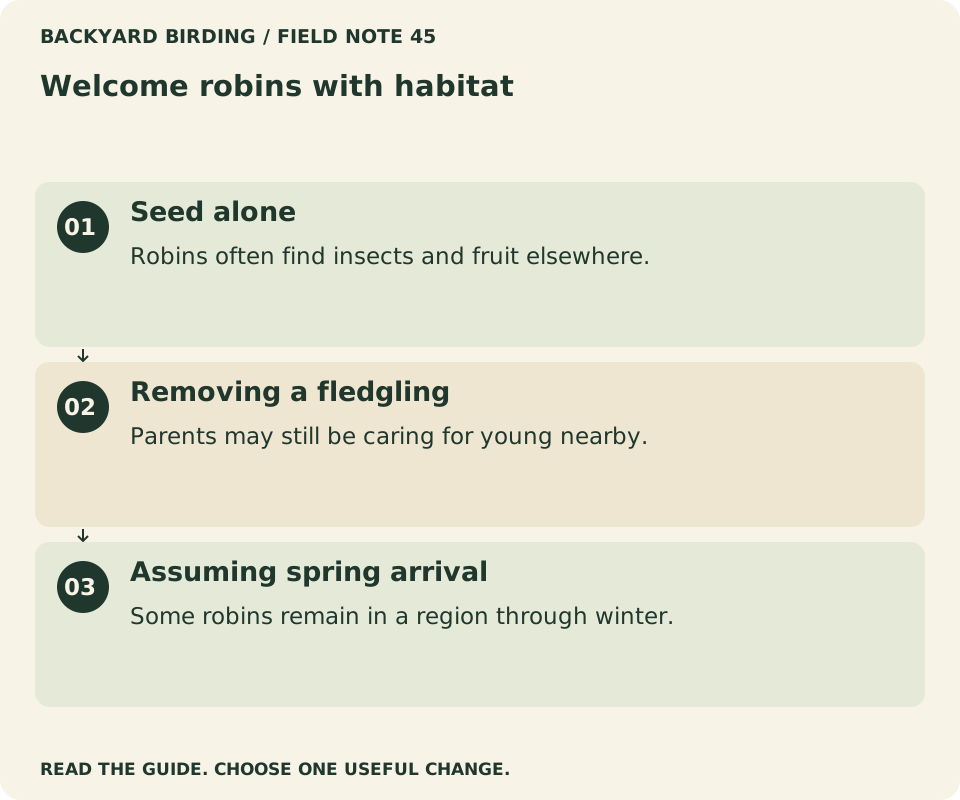
- Seed alone. Robins often find insects and fruit elsewhere.
- Removing a fledgling. Parents may still be caring for young nearby.
- Assuming spring arrival. Some robins remain in a region through winter.
Build a realistic robin observation plan
Choose one question for the next week. “What food brings robins here?” is more useful than trying to document every aspect of robin biology at once. Watch at a consistent time for a manageable interval, then add an occasional observation at a different time to see what changes.
Use a small table with columns for date, duration, location, activity, and confidence. A record might say: “Ten minutes, back lawn, two robins searching after rain, no prey identified.” Another might say: “Five minutes, dogwood, at least four robins taking fruit.” Both are useful even without photographs.
After several observations, make one practical change supported by what you saw. If the bath empties during vigorous use, adjust the checking routine. If a shrub receives visits while the food dish remains untouched, stop offering food and protect the useful planting. If glass reflects the approach route, address the glass before adding another attraction.
Keep an unchanged comparison where possible. Altering food, bath position, and vegetation together makes it difficult to understand a response. This is not a formal experiment, and weather or migration can overwhelm a small change, but a simple record helps you avoid buying equipment in reaction to one quiet afternoon. The reward is a clearer picture of how a familiar bird uses an ordinary space.
Work through a yard with a lawn, one tree, and a patio
Consider a common small-yard arrangement: a mown lawn, one established tree, a patio beside a sliding door, and a narrow planting bed. Robins already search the lawn after rain, but the owner sees few visits during dry weather. The first response need not be a new feeder.
Map the existing use. Watch the lawn and tree during two or three short periods, and note whether the bird leaves toward a neighboring shrub or stays on the property. The yard may provide one part of a route rather than everything the bird uses. That is a realistic starting point, not a defect to eliminate.
Next inspect the patio glass. If the tree is reflected clearly, address that pane before placing water nearby. Then consider a shallow removable basin in a position with an open view and convenient cleaning access. Try the basin only if you can keep it fresh and stable. Watch how birds approach rather than moving it repeatedly to obtain a closer photograph.
The narrow bed may offer a longer-term improvement. Check light, soil, and mature space, then investigate one locally appropriate shrub. Keep the lawn area that serves household needs while giving the bed a defined habitat role. This is a site plan built from actual constraints, not a demand to convert the whole yard.
After a month, compare what changed. Perhaps robins use the bath but still feed mostly next door. That is a useful outcome. Perhaps the bath receives little use while the existing tree attracts seasonal fruit-eating visitors from nearby plantings. Keep the record and adjust the routine to what the yard can support.
Photograph robins without disturbing their activity
Robins often tolerate ordinary human presence, but that does not mean every individual or situation welcomes a close approach. Begin from a fixed place and allow the bird to continue its activity. If it repeatedly stops feeding, moves away, or waits with food while watching you, increase the distance.
Use the camera to answer a specific question. For identification, a side view showing bill, breast, and tail may be enough. For behavior, a short sequence can show the run, pause, and feeding action more clearly than one dramatic frame. Keep the wider context so you remember where the bird was and what happened before the image.
Do not clear vegetation around a nest or move a fledgling to improve the background. An uncluttered photograph is not worth changing the conditions around a vulnerable bird. Nest photographs taken through existing views from a respectful distance should still be limited by the adults' behavior.
When sharing an image, describe only what it shows. “Young robin on a branch” is safer than “orphan rescued from starvation” when no rescue or diagnosis occurred. A useful caption can draw attention to the spotted breast, short tail, or feeding posture without inventing an emotional narrative. The same care that improves identification also makes photographs more informative to other birders.
Questions that often come up
Why does a robin tilt its head on the lawn?
The posture is associated with searching for food. Watch the complete sequence: pause, head movement, short run, and a possible peck or pull. Do not assume every tilted head means the bird has located a worm. Recording what happens next is more informative than assigning a result to the posture alone.
Will a robin use a bluebird box?
An enclosed bluebird-style box does not match a robin's usual open-cup nesting habit. Keep nest-box plans focused on species that naturally use cavities. If robins are your interest, suitable vegetation, safer structures, and undisturbed observation are more relevant starting points.
Why is a robin attacking its reflection?
Birds can respond to a reflected bird as an intruder. Reduce the reflection using an appropriate exterior treatment while keeping the whole window visible to approaching birds. Avoid placing another reflective surface nearby. A collision risk and a territorial response are different problems, but both require looking at what the bird sees outside.
Should I feed robins bread?
There is no need to introduce bread into a robin habitat plan. Focus on natural food, clean water, and appropriate small supplements if you can maintain them. A tray of household leftovers creates spoilage and cleanup problems without meeting the broader goal of supporting varied foraging.
What is the best first improvement?
Choose the limiting resource you can actually address. That might be a shallow clean bath, a locally appropriate fruiting shrub, safer glass, or keeping a pet away from fledglings. Begin with the yard you have and the robins you can observe. A useful change does not have to be a purchase.
Watch it. Then try it.
Review the steps and common mistakes in two short, silent animations. Each has a complete text transcript below.
Your four-step action map
Read the complete video transcript
Welcome robins with habitat.
- Watch the whole bird. Compare shape, breast, eye ring, and behavior.
- Check the season. Look for local movement and changing foods.
- Improve the habitat. Keep useful plants and clean shallow water.
- Give families space. Observe nests and fledglings from a distance.
Try the steps, then note any problem that still needs attention.
Three mistakes to avoid
Read the complete video transcript
Welcome robins with habitat.
- Seed alone. Robins often find insects and fruit elsewhere.
- Removing a fledgling. Parents may still be caring for young nearby.
- Assuming spring arrival. Some robins remain in a region through winter.
Try the steps, then note any problem that still needs attention.
Both animations use this real photograph by Rawaha Alam. Photo source · CC BY-SA 4.0. The photo is adapted into original educational animations, not recordings of a field test.
At a glance
| First check | Useful response |
|---|---|
| Watch the whole bird | Compare shape, breast, eye ring, and behavior. |
| Check the season | Look for local movement and changing foods. |
| Improve the habitat | Keep useful plants and clean shallow water. |
| Give families space | Observe nests and fledglings from a distance. |
Sources & evidence
- American Robin identification account
- robin sound library
- life-history account
- American Bird Conservancy robin profile
- native plant resources
- birdbath guidance
- U.S. Fish and Wildlife Service guidance on bird nests
- nesting-material guidance
- baby-bird guidance
- Cornell range map
- American Bird Conservancy's home solutions
Our standard: real evidence before ratings. Corrections follow our editorial process.
Our verdict & your next actions
Choose the row that describes your setup, then follow the suggested check or adjustment.
| Your situation | Our verdict | Your next action |
|---|---|---|
| A robin ignores seed | Natural insects and fruit may be more useful. | Choose habitat plants |
| A spotted youngster appears | It may be a fledgling receiving parental care. | Check the first steps |
| The bath gets dirty | Empty, scrub, and refill it. | Follow a bath-care routine |
Your pocket field checklist
Tick off the steps as you go.
0 of 4 steps completed
Keep building your knowledge in birds, or search the full backyard library.