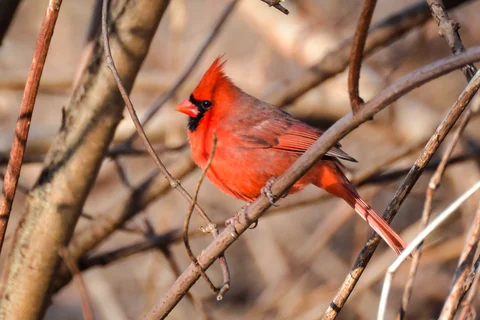
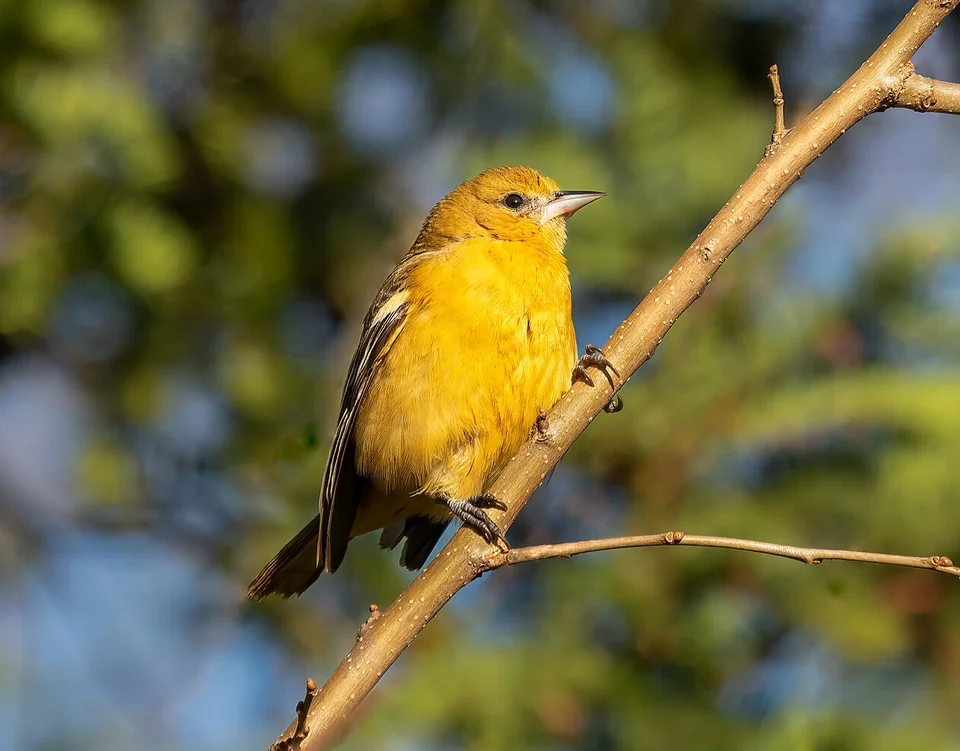
Photo: Rhododendrites · Baltimore oriole in GWC (21861).jpg · CC BY-SA 4.0. Cropped, gently adjusted, and resized for this guide.
The short answer
Check which orioles occur locally and when they arrive. Support suitable trees and natural insects, then offer a small clean serving of fresh fruit or an appropriate nectar feeder. Jelly is optional and should be offered only in very small amounts with careful cleanup.
Build an oriole-friendly yard, then offer a small invitation
To attract orioles, start with the species expected in your region, trees and vegetation that support their natural food, and a clean feeding opportunity during the appropriate season. Fresh orange halves or a suitable nectar feeder may encourage a visit. They work best as supplements to habitat, not as a promise that every yard can host a resident pair.
Orioles spend much of their time in vegetation, often above eye level. A bird can be present nearby without visiting a feeder. Listen for song, watch the outer branches of trees, and learn the local species before concluding that an untouched orange means your setup failed.
The Cornell Lab's Baltimore Oriole account describes a diet that includes insects, fruit, and nectar. Western and other oriole species have their own ranges and habitat associations. This guide keeps those differences visible while offering a practical backyard routine for the common questions about fruit, jelly, feeders, water, and seasonal timing.
Begin with one manageable offering. If you put out fruit, nectar, mealworms, and jelly together, you create several cleaning jobs before learning which resource is useful. A small station that you can inspect is more informative than a large display that becomes sticky or spoiled between visits.
Your first goal is to make the invitation appropriate and safe. The bird decides whether to use it. Keep natural food, clean equipment, safer windows, and realistic expectations at the center of the plan. A brief migration visit can be worthwhile, even when the bird moves on and never builds a nest in your trees.
Know which oriole belongs on your local list
Baltimore Orioles are familiar across much of eastern North America, while Bullock's Orioles are associated with the West. Orchard Orioles occur across much of the central and eastern United States in season. Other species, including Hooded, Scott's, and Audubon's Orioles, are relevant in particular regions. Check a current range map and local records rather than treating one orange bird as the national model.
Adult males are often easier to identify than females and immature birds. A male Baltimore has extensive black on the head and upperparts with bright orange below. A male Bullock's has an orange face crossed by a dark eye line and a conspicuous pale wing patch. A male Orchard is smaller-looking and combines black with rich chestnut rather than vivid orange.
| Species | Useful adult male clue | Regional question |
|---|---|---|
| Baltimore Oriole | Black head with orange underparts | Is it a regular seasonal bird locally? |
| Bullock's Oriole | Orange face, dark eye line, broad white wing patch | Are suitable western open woodlands nearby? |
| Orchard Oriole | Chestnut body with black head and upperparts | Does local habitat support this smaller oriole? |
Use several marks together and compare equivalent ages and sexes. A yellowish oriole is not automatically a female Baltimore. Some immature males look very different from the familiar adult male, and identification needs extra care where Baltimore and Bullock's Orioles overlap. Record the visible wing, face, and body patterns before choosing a species.
Record the bill, head pattern, wing markings, tail, body color, and behavior when possible. A clear description is better than a confident guess from one orange patch. Our bird journal guide provides a simple way to keep those observations useful without forcing every sighting into a species label.
Time the first offering around local arrival
Set up a clean feeder shortly before orioles normally appear in your area, using several years of local observations as a guide. There is no single national date. Latitude, elevation, species, and weather all influence the period when you might first notice them.
Use county or nearby regional records and look for a pattern, not the earliest exceptional sighting ever reported. An unusually early individual does not establish the normal arrival window. Recent reports can help you stay attentive, but a few records from a neighboring state do not guarantee birds will reach your street the next morning.
Prepare equipment before filling it. Clean the feeder, confirm its mounting, and check nearby glass. Have a small amount of fruit or nectar ready rather than leaving perishable food outdoors for days while waiting for the season to begin. A prepared empty feeder is better than spoiled food offered too early.
Keep the initial quantity modest. One fresh orange half during a period when you can observe may be enough to learn whether the station is being used. Remove uneaten food before it spoils and clean the holder. If visits increase, adjust the amount gradually without extending the care interval.
Do not judge the season from one quiet day. Observe at comparable times, listen in nearby trees, and note local weather. A feeder is only one sampling point in a moving population. Migration visitors may stop briefly, while local breeders may spend much of their time elsewhere.
Record the first confirmed sighting, the first feeder visit, and the last observation separately. These are different events. After a few seasons, your own notes will provide a much more useful starting window than an unqualified date copied from a nationwide feeding calendar.
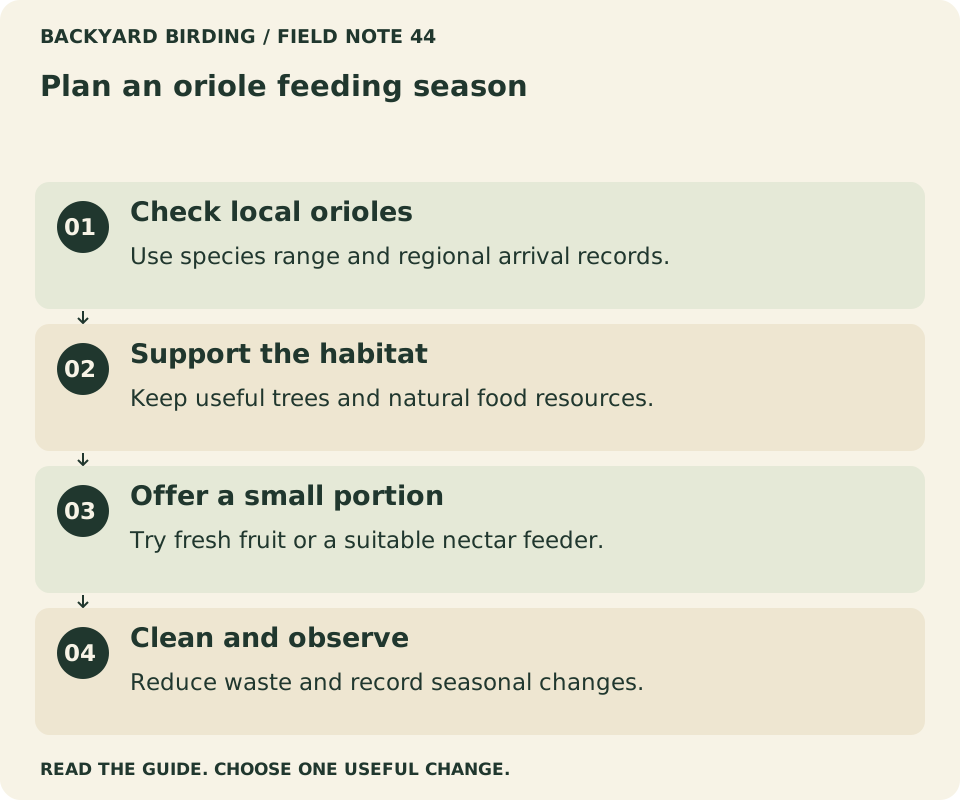
Your visual action map

Read the visual as text
- Check local orioles. Use species range and regional arrival records.
- Support the habitat. Keep useful trees and natural food resources.
- Offer a small portion. Try fresh fruit or a suitable nectar feeder.
- Clean and observe. Reduce waste and record seasonal changes.
Use trees and insects as the foundation
Orioles forage for insects in foliage and branches, and many nest in trees. Mature vegetation therefore matters in a way that a bright feeder cannot replace. Before adding equipment, identify the trees and shrubs already providing structure around your property.
Preserve healthy, appropriate mature trees where possible and seek qualified arboricultural advice when safety concerns arise. Avoid assuming that a neat lawn with a feeder offers the same resources as a yard with varied vegetation. The canopy, mid-level plants, and surrounding landscape each contribute to the setting birds encounter.
Choose new native plants for your region and site conditions. Consider mature size, soil moisture, overhead wires, foundations, and available space. A tree that does not fit the property can become a future removal problem. Smaller native shrubs may be the more realistic contribution in a compact garden.
Review broad pesticide use. A plan intended to attract insect-eating birds should not simultaneously aim to eliminate every insect from the vegetation. Identify actual plant problems, tolerate reasonable cosmetic damage, and consult local extension guidance when treatment is necessary.
The Bullock's Oriole life-history account and Orchard Oriole account illustrate why regional habitat matters. Their use of open woodlands, tree edges, and other vegetation should guide observation more than a generic instruction to buy something orange.
For a first improvement, map existing trees and one potential planting area. Choose a change you can maintain through establishment. A thriving appropriate plant and a reduced chemical routine can contribute over many seasons, even if the first year's feeder visits remain occasional.
Offer fresh orange halves with easy cleanup
Orange halves are a familiar oriole offering, especially during spring migration. Cut a fresh orange with clean kitchen utensils and secure it in a suitable holder so the cut surface is accessible. Use a design you can remove and wash without struggling around sharp or awkward fittings.
Start with a small amount and watch who uses it. The orange may attract other birds as well as insects. Record actual visits rather than assuming that missing pulp means an oriole fed. A brief observation can tell you more than a photograph of the fruit at the end of the day.
Inspect frequently and remove the fruit before it spoils. Heat, rain, insect activity, and repeated handling change how quickly an offering becomes unsuitable. Do not keep an old half outdoors until it is completely hollow simply to avoid wasting the remaining pulp.
Clean the holder and any surface below it. Juice can run into grooves, around fasteners, and onto a railing. A feeder may look empty while still carrying a sticky film that attracts insects. Choose materials and shapes that make these areas visible and reachable.
Do not add jelly to a deteriorating orange as a way to prolong its use. That combines two maintenance problems and hides the condition of the fruit. Replace the food and clean the equipment instead. Use a smaller offering next time if you repeatedly discard most of it.
Cornell's guide to fruit and other bird foods notes both the appeal of fruit and the need for frequent cleanup. Treat fruit feeding as a short, attended supplement. It should not become an open-ended outdoor storage method for produce you no longer want in the kitchen.
Treat jelly as optional and keep quantities very small
Jelly can attract orioles, but it is not necessary for a successful habitat plan. Cornell cautions that it is highly concentrated and sticky, and that small birds can become trapped in larger amounts. Our default is to begin with fruit or an appropriate nectar feeder rather than assuming jelly must be part of every station.
If you choose to offer it, use only a very small amount in a shallow, removable container and supervise the condition of the feeding area. Avoid deep dishes, large pools, or containers that let birds stand in the food. Keep the rim and surrounding surface clean.
Do not refill over an old sticky layer. Empty and clean the container, then decide whether another small offering is appropriate. If ants, wasps, or other visitors make the setup difficult to manage, remove it. A bird's interest in sweet food does not require you to continue an offering that cannot be maintained safely.
Read ingredient information and avoid improvised substitutes, alcohol-containing preparations, or sugar-free products. Do not use jelly as a vehicle for vitamins, medicines, or supplements. If you cannot establish that a product is appropriate, choose a simpler offering instead.
Keep the nutritional claim modest. Jelly is a supplement, not a complete diet and not a replacement for insects used by breeding birds and their young. Do not infer that a bird visiting often is receiving everything it needs from your dish.
The practical decision is about care capacity. If you can inspect a small offering, clean it thoroughly, and remove it when conditions change, it may fit your routine. If you are away for long stretches, habitat and a more manageable seasonal plan are better choices than leaving a large bowl unattended.
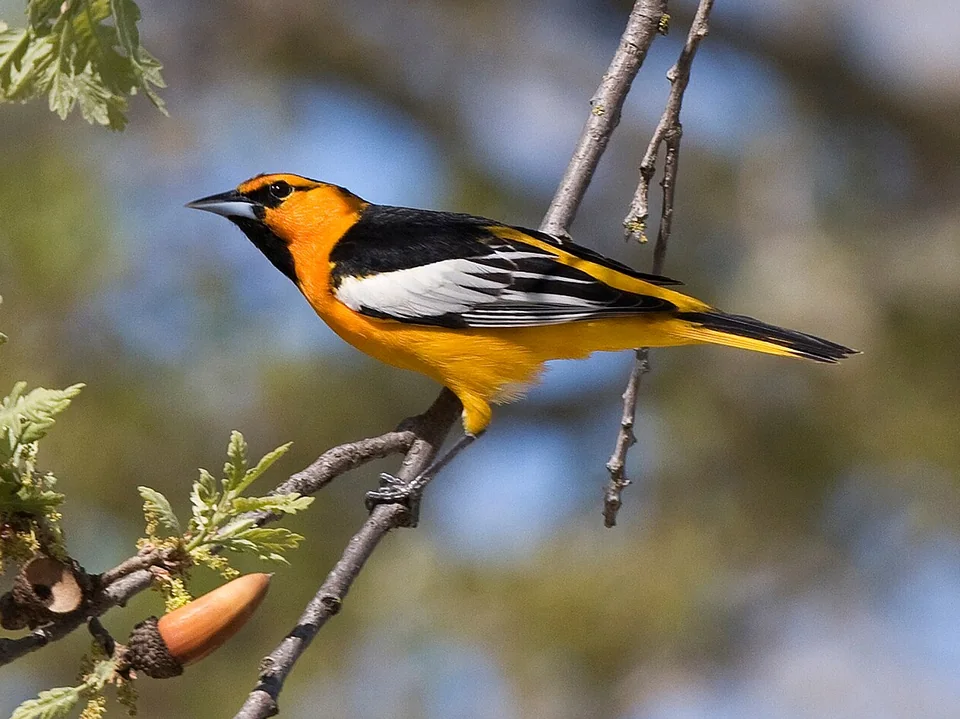
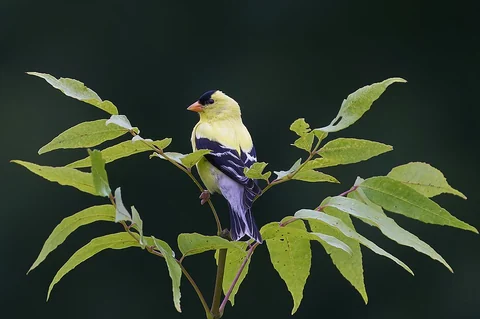
Photo: Kevin Cole from Pacific Coast, USA ( en:User:Kevinlcole ) · Bullock's Oriole.jpg · CC BY 2.0. Cropped, gently adjusted, and resized for this guide.
“Make one fresh, manageable invitation and keep watching the trees; habitat supports the part of an oriole’s life you cannot see at a feeder.”
Backyard Birding — editorial takeaway
Use nectar equipment that fits an oriole
Orioles may visit nectar feeders, but their size and access needs differ from those of hummingbirds. Choose a feeder intended to accommodate them, with suitable perches and ports, and inspect how the bird reaches the liquid. A hummingbird feeder that occasionally receives an oriole is not automatically an ideal permanent design for both.
For an ordinary clear sugar-water offering, the familiar one-part refined white sugar to four-parts water recipe is a practical baseline. Measure ingredients by volume and leave out dye and flavorings. Our homemade nectar guide explains the mixing process and storage distinctions; follow any compatible equipment instructions for filling and assembly.
Do not enlarge a hummingbird feeder's ports casually to accommodate a larger bill. That can change insect access, leakage, and the way the feeder works. Choose appropriate equipment rather than modifying an uncertain design with a drill or knife.
Clean the reservoir, base, ports, and perches thoroughly, and replace nectar on a dependable schedule suited to conditions. A larger feeder does not allow a longer cleaning interval. Fill modestly when visits are light, and never top up old liquid as a substitute for cleaning.
Observe all users. If a larger bird's activity causes spills or makes the feeder unstable, reassess the mount and design. Separate feeding stations may be easier to manage than expecting one small unit to serve every visitor comfortably.
Nectar is an invitation, not the whole habitat. Orioles can spend long periods gleaning insects or feeding on naturally available fruit while ignoring the reservoir. That behavior is compatible with a useful yard and should not prompt stronger mixtures or added ingredients to compete with natural food.
Consider mealworms only if they fit the routine
Mealworms can be offered as another supplemental food, but they are optional. Before adding them, ask what problem they solve. If you already struggle to keep fruit holders and nectar ports clean, another food type is likely to increase the workload without improving the basic setup.
Use an appropriate clean dish and offer a modest amount while you can observe. Live and dried products differ in presentation and storage, and acceptance varies. Follow the supplier's handling instructions, keep the product in suitable condition, and avoid insects collected from areas with possible pesticide exposure.
Watch which birds take the offering. Other species may discover it first. That does not necessarily mean you need a complicated exclusion feeder; it may simply mean the food is broadly attractive. Decide whether the observed use fits your budget and care plan before increasing the quantity.
Remove wet, spoiled, or contaminated leftovers and clean the container. Do not combine old mealworms, fruit juice, and jelly into a mixed residue that is difficult to inspect. Separate removable dishes make it easier to see the condition of each food and simplify cleanup.
Keep the dietary claim restrained. A dish of mealworms does not replace the diversity of natural prey available in a functioning landscape. Supporting appropriate plants and reducing unnecessary pesticide use remain important even when supplemental insects are offered.
Never use a backyard feeding article as a guide to raising young orioles. If a bird is injured or genuinely needs rescue, contact a qualified wildlife rehabilitator. Hand-feeding, hydration, and nutritional care depend on the bird's condition and stage; those are not extensions of leaving a small dish outdoors for free-living adults.
Place the station where birds and people have room
Choose a stable, visible feeding location that you can service safely. The birds need an approach and departure route; you need room to remove food and clean the equipment without reaching awkwardly around a railing or leaning out of a window.
Consider nearby vegetation and household activity together. A place at the edge of appropriate trees may be useful, but dense cover immediately beside a low station can create a hiding place for cats. Keep pet cats indoors and assess the actual routes animals use around the property.
Look at windows from outside. Reflections of trees can draw birds toward glass that appears to offer a continuation of the habitat. Treat hazardous panes using our window-collision prevention guide. Do not choose a location solely because it produces a close photograph from inside.
Account for dripping fruit juice and nectar. A station over a hard, reachable cleaning surface may be easier to maintain than one above furniture or a delicate planting. Keep sticky foods away from frequently used doorways and outdoor dining areas if insects become an issue.
Avoid clustering every resource at one point. A bath, seed feeder, nectar feeder, and fruit holder have different care and traffic patterns. Distributing them thoughtfully can make each easier to inspect, while preserving quiet areas around any nesting activity.
Once the station is in a suitable place, give birds time to discover it. Frequent relocation makes your observations less useful. Move promptly if you identify a real hazard, but otherwise change one factor deliberately and record why. A sensible setup should be understandable as a whole, not an accumulation of accessories added after every quiet afternoon.
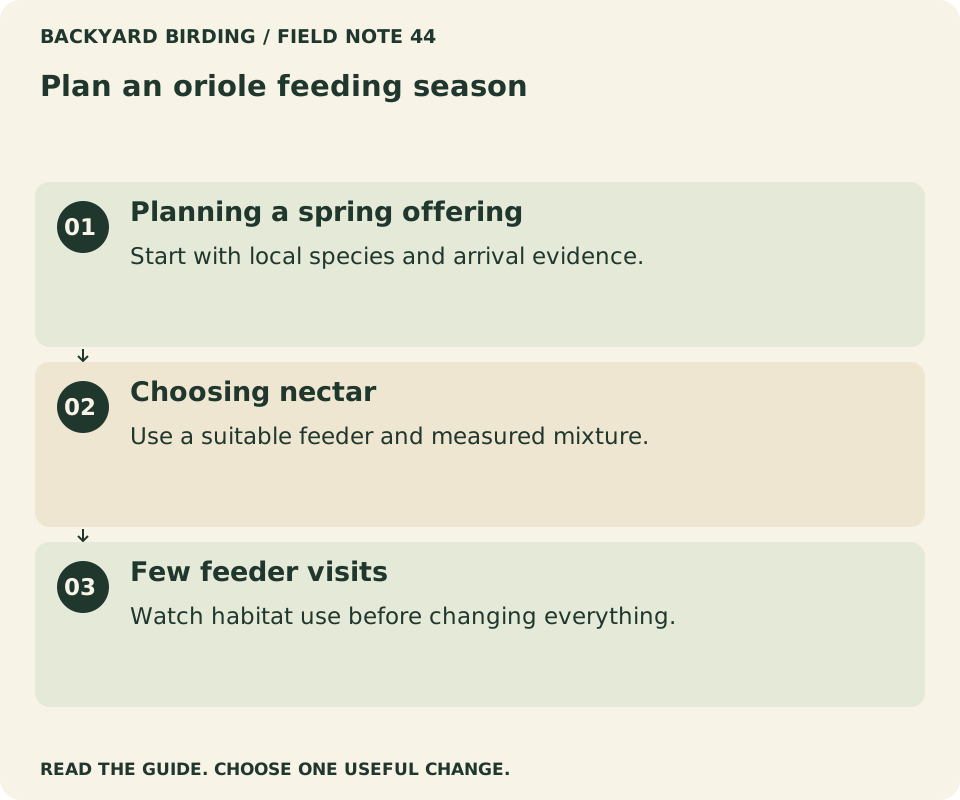
Find your situation

Read the visual as text
- Planning a spring offering. Start with local species and arrival evidence.
- Choosing nectar. Use a suitable feeder and measured mixture.
- Few feeder visits. Watch habitat use before changing everything.
Make water easy to use and easy to maintain
A clean, shallow water source can complement an oriole-friendly yard. Use a stable basin with accessible edges and secure footing. The best design is one you can inspect, empty, and scrub comfortably; a heavy decorative feature can become neglected if basic care is too difficult.
Check the depth and the approach. Birds should have a choice of shallow access, and any stones or other additions must remain stable. A deep bowl filled to the rim is not improved simply by placing one slippery object in the middle. See our birdbath depth guide for a more complete assessment.
Refresh soiled water and clean the basin on a reliable schedule. Moving water does not clean itself. Pumps, tubing, and hidden reservoirs add surfaces that may need attention, so choose them only if the additional maintenance fits your routine.
Place water where you can watch without crowding the birds. Keep the view of nearby glass and the access of pets in mind. A bath beneath a frequently used perch may accumulate droppings quickly, while one hidden deep in vegetation may be difficult to inspect.
Do not add sweeteners, vitamins, or household treatments to drinking water. Keep food offerings and plain water separate. If an algae or mosquito problem develops, review cleaning, water replacement, and the design rather than improvising a chemical addition around visiting birds.
Record actual use by all species. Orioles may visit occasionally while other birds use the bath regularly. That does not make the water project unsuccessful. A well-maintained resource can benefit a wider community, and those observations help you understand the yard beyond the single species that first motivated the setup.
Respect the nesting habitat
Orioles generally build their own woven nests rather than using ordinary enclosed birdhouses. Their nest placement varies by species, but trees and suitable supporting branches are central. Buying a small wooden box is therefore not the usual next step for attracting nesting orioles.
Preserve appropriate vegetation and avoid unnecessary disturbance around an active nest. Watch adults from a distance rather than following each food-carrying trip to locate the exact branch. You do not need a close view of eggs or young to appreciate that the birds are using the area.
Do not provide yarn, long string, dryer lint, or other household fibers because woven nests look as though they require craft supplies. NestWatch's guidance on nesting materials explains concerns with such offerings. Appropriate natural vegetation is the simpler contribution.
Plan pruning and major maintenance with nesting birds in mind. If an active nest is discovered, stop and seek appropriate guidance before work that could disturb or damage it. The U.S. Fish and Wildlife Service's nest information explains why active nests and their contents should not be moved casually; local requirements may also apply.
Keep feeding stations away from the immediate nest area. Drawing a crowd of birds, insects, and observers beneath a nesting branch is not necessary to support the pair. Maintain a quieter zone and watch through binoculars from a comfortable distance.
If fledglings appear, keep pets back and allow the adults space. A young bird outside the nest may still be receiving care. Do not assume it needs to be returned to the nest or fed by hand. Seek qualified wildlife advice when there is a clear injury, immediate danger, or genuine uncertainty about its condition.
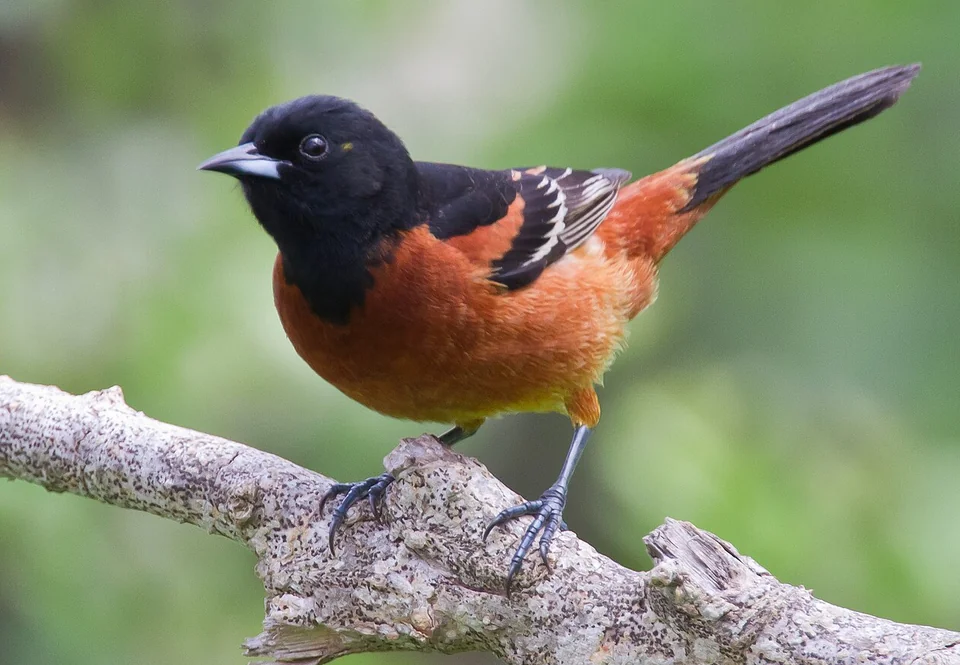
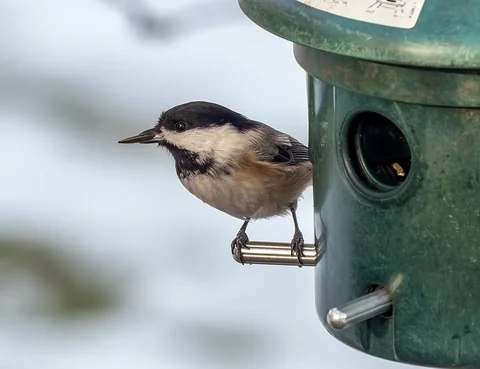
Photo: Dan Pancamo · Orchard Oriole by Dan Pancamo 2.jpg · CC BY-SA 2.0. Cropped, gently adjusted, and resized for this guide.
Understand why visits may change after spring
An oriole that visits fruit during migration may move on. A bird breeding nearby may spend more time finding insects or feeding in trees as the season develops. Reduced feeder activity does not automatically mean that the food is wrong or the bird has disappeared from the neighborhood.
Continue observing the habitat beyond the station. Listen for song, watch tree edges, and note birds moving through foliage. A feeding camera aimed at one dish gives a narrow view of daily activity. It cannot show every natural food source the bird uses.
Adjust quantities downward when demand falls. This reduces spoilage and insect attraction while keeping the remaining offering manageable. Do not compensate for fewer visits with a larger dish of jelly or a stronger nectar mixture. The natural seasonal diet and movements should not be treated as a problem to defeat.
Distinguish absence from lack of observation. Record how long you watched and at what time. A five-minute evening glance is not comparable to a long morning session during migration. Our backyard journal guide includes ways to keep effort visible in your notes.
If you decide to stop a perishable offering, clean and store the equipment properly. There is no need to leave old fruit hanging as a signal that the station exists. Habitat remains useful between feeding periods, and a clean restart is straightforward when the next appropriate season arrives.
Over several years, your records may show a brief spring window, occasional summer use, or a more regular pattern. Let that local evidence determine the routine. A short but reliable period of visits can be more satisfying than trying to force a year-round schedule onto a migratory species.
Manage insects by controlling exposed food
Fruit, jelly, and nectar can attract insects. Begin with the amount offered, freshness, spills, and cleaning access. A sticky rim or juice beneath a feeder remains available food after you remove the main serving. Inspect those surfaces before buying repellents.
Keep portions small and remove deteriorating food promptly. Clean removable dishes and check the holder's seams. If a design traps juice in inaccessible corners, consider a simpler one. The cleaning rehearsal is as useful for an oriole feeder as it is for a hummingbird reservoir.
Do not apply oil, petroleum jelly, insecticide, or scented household mixtures to bird-contact surfaces. Use appropriate physical access features where the equipment supports them and keep the offering easy to inspect. A chemical residue is not a substitute for removing spilled sugar.
Ants and flying insects use different routes. A maintained water moat may help on a suitable hanging nectar feeder, but bees and wasps can fly past it. A fruit holder has a different geometry from a guarded nectar port, so avoid assuming one accessory will protect all foods.
If stinging insects make servicing unsafe or gather near a doorway, remove the food when it can be done safely and reconsider the location. A suspected nest nearby calls for qualified local advice. Our bee and wasp feeder guide explains the distinction between exposed sugar and a separate nesting hazard.
You can choose to stop jelly or fruit feeding while retaining habitat and plain water. Every optional offering should justify its care burden. A bird-friendly yard is not measured by the number of food types kept outdoors, and reducing a troublesome station can improve the overall experience for both wildlife and people.
Troubleshoot a feeder that orioles ignore
Work through likely explanations in a useful order. First confirm that the intended species is expected locally at this time. Then assess habitat, placement, food condition, and actual access. Only after those checks should you consider whether different equipment would solve a defined problem.
| Situation | First question | Practical next step |
|---|---|---|
| No local oriole records | Is the species expected now? | Check regional timing before adding food |
| Orioles sing nearby but do not feed | Are they using natural resources? | Observe trees as well as the station |
| Fruit remains untouched | Is it fresh, visible, and accessible? | Offer less and review placement |
| Nectar disappears quickly | Did birds drink it or did it leak? | Observe and inspect the reservoir |
| Only other birds visit | Is the offering broadly attractive? | Decide whether that use fits your plan |
| Visits stop after migration | Has the seasonal window changed? | Reduce food and keep habitat observations |
Avoid changing everything at once. If you replace the feeder, change food, move the station, and alter your observation time together, a later visit will not tell you which factor mattered. Make a deliberate adjustment and leave room to learn from it.
Do not use recorded calls repeatedly to draw birds into a feeding photograph. A quiet observation routine is a better fit for a backyard station, particularly around breeding activity. Your aim is to offer a resource, not to keep birds responding to an artificial territorial stimulus.
Sometimes the honest answer is that the property is not a regular stop. That does not mean you have failed. Use the habitat you have well, enjoy the birds that arrive, and consider observing orioles in appropriate nearby public habitat instead of continually escalating the feeder setup.
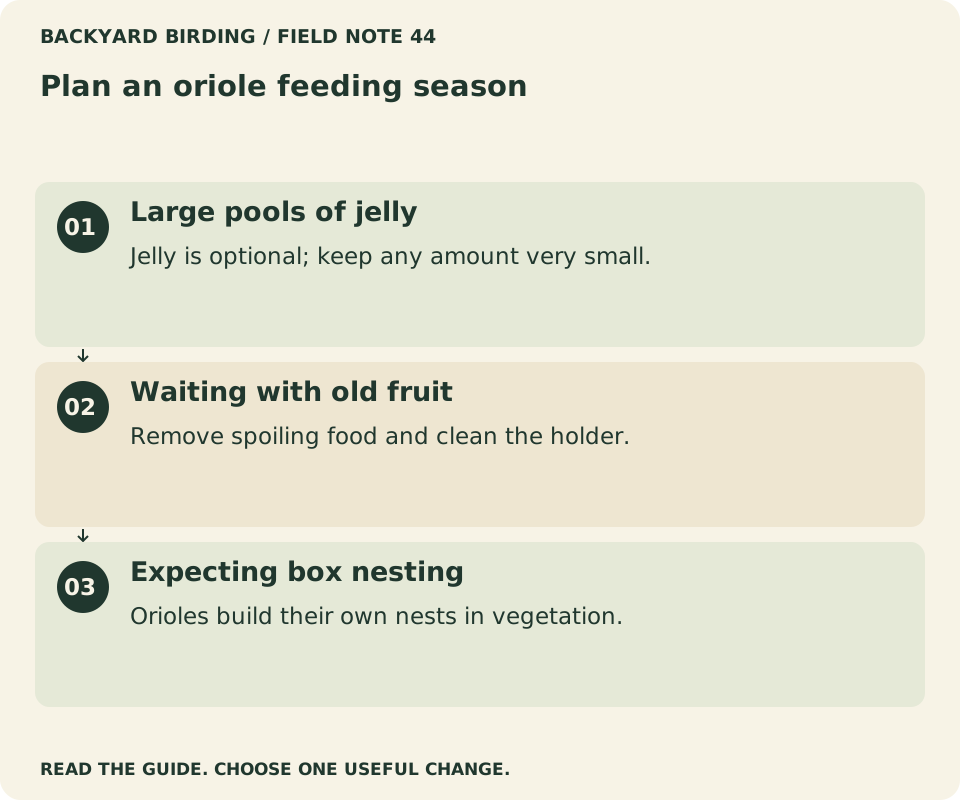
Small mistakes. Better moves.

Read the visual as text
- Large pools of jelly. Jelly is optional; keep any amount very small.
- Waiting with old fruit. Remove spoiling food and clean the holder.
- Expecting box nesting. Orioles build their own nests in vegetation.
Plan for three common backyard situations
In a mature eastern suburban yard, begin by watching the canopy and checking local Baltimore and Orchard Oriole records. An accessible fruit holder during the expected arrival period may be a reasonable experiment. Preserve useful trees, review window reflections, and keep the food quantity small until actual use is established.
In a western yard near open woodland or a stream corridor, identify which oriole species is locally regular before copying an eastern feeding calendar. Bullock's Orioles may be relevant, while other regions require different species expectations. Water, suitable vegetation, and a clean appropriately sized nectar feeder can form a manageable starting plan where conditions fit.
On a compact patio or balcony, be more selective. Check building rules, safe mounting, cleanup below the station, and hazardous glass. A fruit or jelly dish may create more maintenance and insect activity than the available space supports. Appropriate container plants and observation of nearby trees may be the better first step.
For each setting, write a simple care limit: how often you can inspect, what you can clean, and what would make you remove the offering. This turns a vague wish to attract birds into a routine that remains workable during a busy week.
Do not judge the three situations by the same outcome. A brief migrant on a patio, a bird feeding in a native tree, and a pair using a large garden are different successes. The shared standard is an appropriate resource maintained without creating avoidable hazards.
After the season, review both bird use and household effort. Keep the features that worked, simplify those that did not, and let the next planting or equipment choice answer a specific need revealed by your observations.
A first-season checklist and quick answers
What should I do before buying an oriole feeder?
Confirm the likely local species and arrival period, inspect the habitat, and choose a safe serviceable location. Decide whether fruit or nectar fits your cleaning routine. A feeder should complete that plan, not substitute for it.
Do orioles need orange-colored equipment?
Bright colors may make a station conspicuous, but color alone does not establish food quality, access, or safety. Prioritize suitable perches, reachable food, easy cleaning, and stable mounting. An orange product with inaccessible sticky corners is still difficult to maintain.
Is jelly required?
No. Habitat, natural insects and fruit, clean water, and an optional manageable feeding opportunity can form a useful plan without it. If jelly is offered, keep quantities very small and prevent birds from contacting a deep sticky pool.
Will a birdhouse encourage an oriole to stay?
An ordinary enclosed box is not the usual nesting structure for orioles. Support appropriate trees and vegetation and respect active nests. If you want a separate nest-box project, choose a local cavity-nesting species and follow its complete plan.
What should I record this season?
Note the first confirmed sighting, species confidence, first feeder visit, foods actually used, cleanup frequency, and changes in activity. Record observation effort so quiet days remain interpretable. These details will help you plan next spring more reliably than a promise that one food attracts every oriole.
Before the next arrival period, clean the holder, check its mount, and set your observation notes beside the window. Start with a small fresh offering when local timing is right, then watch the trees as well as the feeder.
Watch it. Then try it.
Review the steps and common mistakes in two short, silent animations. Each has a complete text transcript below.
Your four-step action map
Read the complete video transcript
Plan an oriole feeding season.
- Check local orioles. Use species range and regional arrival records.
- Support the habitat. Keep useful trees and natural food resources.
- Offer a small portion. Try fresh fruit or a suitable nectar feeder.
- Clean and observe. Reduce waste and record seasonal changes.
Try the steps, then note any problem that still needs attention.
Three mistakes to avoid
Read the complete video transcript
Plan an oriole feeding season.
- Large pools of jelly. Jelly is optional; keep any amount very small.
- Waiting with old fruit. Remove spoiling food and clean the holder.
- Expecting box nesting. Orioles build their own nests in vegetation.
Try the steps, then note any problem that still needs attention.
Both animations use this real photograph by Rhododendrites. Photo source · CC BY-SA 4.0. The photo is adapted into original educational animations, not recordings of a field test.
At a glance
| Option or check | Purpose | Care decision |
|---|---|---|
| Fresh orange | Small, inspectable seasonal offering | Remove before spoilage |
| Appropriate nectar feeder | Accessible supplemental energy | Clean all ports and seals |
| Jelly, if used | Very small optional supplement | Avoid deep sticky pools |
Sources & evidence
- Cornell Lab: Baltimore Oriole life history
- Cornell Lab: Bullock’s Oriole life history
- Cornell Lab: Orchard Oriole life history
- Cornell Lab: Orchard Oriole identification
- Cornell Lab: Fruit, jelly, and other bird foods
- Audubon: Attracting hummingbirds and orioles
- NestWatch: Appropriate nesting materials
- U.S. Fish and Wildlife Service: Bird nests
Our standard: real evidence before ratings. Corrections follow our editorial process.
Our verdict & your next actions
Choose the row that describes your setup, then follow the suggested check or adjustment.
| Your situation | Our verdict | Your next action |
|---|---|---|
| Planning a spring offering | Start with local species and arrival evidence. | Keep seasonal records. |
| Choosing nectar | Use a suitable feeder and measured mixture. | Review the nectar recipe. |
| Few feeder visits | Watch habitat use before changing everything. | Build useful native habitat. |
Your pocket field checklist
Tick off the steps as you go.
0 of 4 steps completed
Keep building your knowledge in birds, or search the full backyard library.