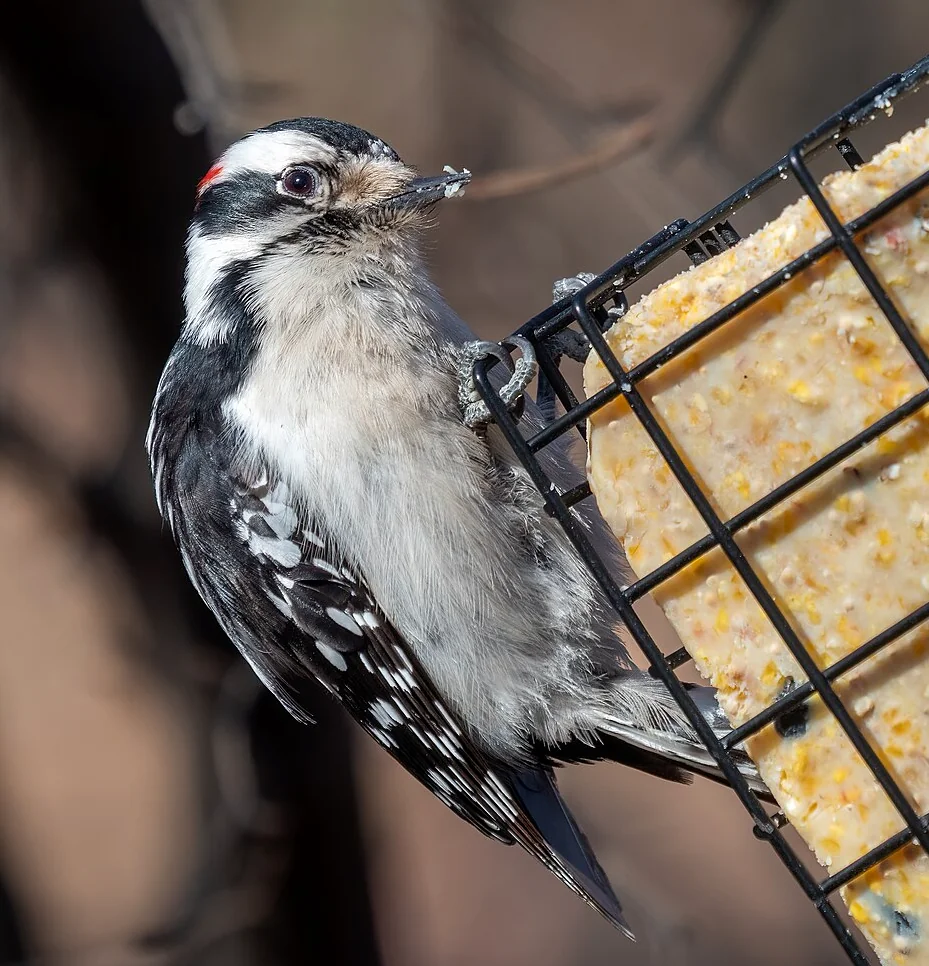
Photo: Rhododendrites · Downy woodpecker at a suet feeder (84724).jpg · CC BY-SA 4.0. Cropped, gently adjusted, and resized for this guide.
The short answer
Learn which woodpeckers occur locally, preserve suitable habitat where safe, and consider a cleanable suet feeder as a supplement. Watch natural foraging as well as the feeding station.
Attract the woodpeckers that belong in your area
To make a yard more useful to woodpeckers, start with habitat and local species, then add a suitable feeding option if you can maintain it. Trees, safe retained dead wood where appropriate, insect resources, and a quiet approach can matter more than a particular suet flavor. A feeder can offer an extra stop; it cannot make every woodpecker species appear in a yard outside its range or preferred landscape.
Begin by finding out which woodpeckers occur nearby through a regional guide or local observations. Downy, Hairy, Red-bellied, Northern Flicker, and other species have different habits and distributions. Avoid building a plan around an appealing photograph alone. This guide helps you assess the yard, choose a modest feeding setup, and observe the results without claiming that food can replace habitat or guarantee a visit. The best first improvement may be a change in maintenance rather than a purchase.
Learn to notice woodpeckers before adding equipment
Spend a few short watches looking at trunks, larger branches, and the edges of wooded areas. Follow movement around the far side of a tree rather than focusing only on the feeder pole. A bird may already use the yard while remaining easy to miss from your usual seat. Listen as well, but confirm unfamiliar sounds before assigning them to a species.
Record where a bird was, what it was doing, and which features you could see. “Small black-and-white bird working a thin branch” is a useful observation even before you settle the identification. A date and a rough location let you look again under similar conditions. This first inventory prevents a common mistake: adding a feeder and assuming every subsequent sighting proves it created a new visitor. Sometimes the improvement is simply that you have learned where and how to watch.
Separate feeding from drumming
Rapid drumming on a resonant surface can be communication rather than food excavation. A woodpecker using metal flashing is not necessarily finding insects inside it. Cornell's Downy Woodpecker account explicitly distinguishes drumming from feeding. That distinction matters because adding food is not a dependable way to stop a bird from using a loud surface.
Observe the pattern from a distance. Is the bird delivering a short repeated roll, or working at one area and removing material? Describe what happens rather than making a diagnosis about the building or tree. If you are concerned about structural damage, seek appropriate local wildlife and building advice; do not block a cavity or disturb an active nest. Understanding behavior makes the attraction plan more realistic. You can welcome woodpeckers while recognizing that different activities require different responses and may not be controlled by feeder placement.
Your visual action map

Read the visual as text
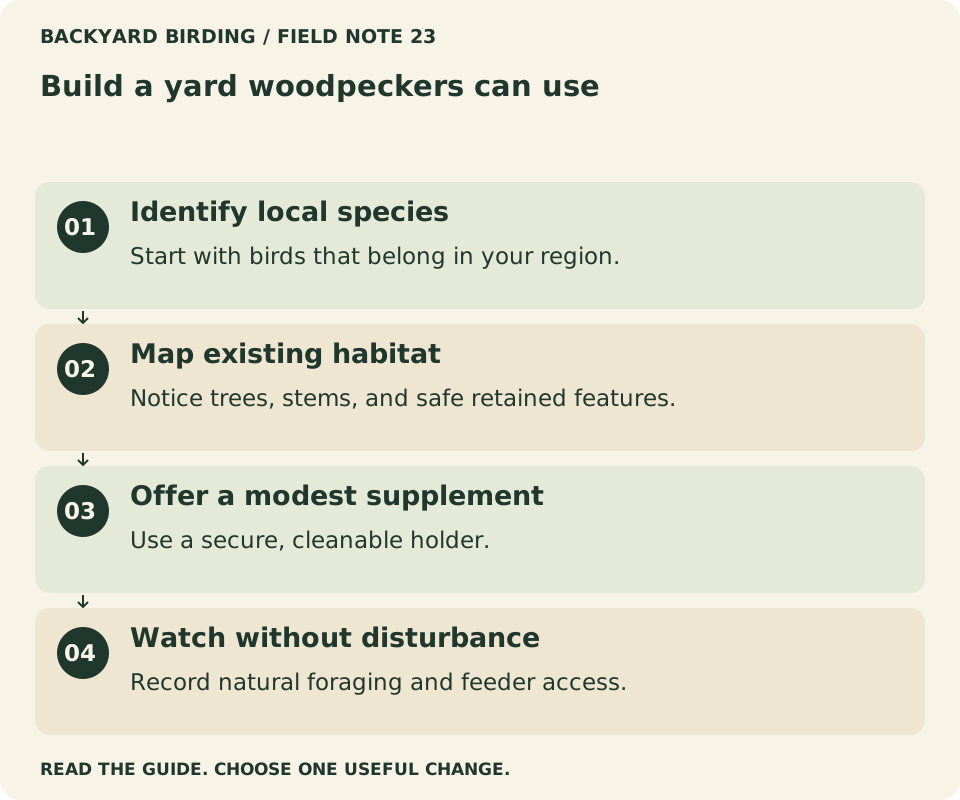
- Identify local species. Start with birds that belong in your region.
- Map existing habitat. Notice trees, stems, and safe retained features.
- Offer a modest supplement. Use a secure, cleanable holder.
- Watch without disturbance. Record natural foraging and feeder access.
Inventory the trees you already have
Draw a simple tree map with species, approximate size, and any visible features such as rough bark, dead limbs, or cavities. You do not need to identify every insect or assess tree stability yourself. The map is a way to notice resources and questions before routine pruning removes something you had not considered. Mark branches near structures or paths for professional assessment if their condition raises concern.
Safe habitat retention is a site-specific decision. A qualified arborist can help evaluate whether a tree or snag can remain, be reduced, or needs removal for safety. Do not interpret wildlife value as a reason to leave a dangerous limb over a play area. Equally, do not assume every dead branch must be removed purely for appearance. A considered plan can distinguish parts of the yard where habitat features are practical from places where people and buildings take priority.
Think beyond a perfectly tidy landscape
Woodpeckers obtain natural food in vegetation and wood, so a yard stripped of every standing stem and rough edge offers a different environment from one with varied structure. Cornell describes Downy Woodpeckers using small branches and even plant stems and galls. That does not mean you should cultivate pests or leave all debris everywhere. It means selective maintenance can preserve useful features while keeping paths and working areas clear.
Choose one manageable area where standing plants or suitable woody material can remain according to local conditions. Watch it through the season before expanding the approach. Keep notes about what uses it, including insects and birds that never visit a feeder. This gives habitat work its own measure of success. A useful yard is not defined only by the number of birds photographed on purchased equipment, and a modest planting can be worth maintaining even when visits are brief.
Choose a simple suet feeder first
If local woodpeckers use feeders, a secure suet holder is a reasonable option to investigate. Look for accessible corners, a reliable closure, and a size that fits the food you intend to buy. Take it apart before adding food. If you cannot inspect the cage or tray while it is empty, cleaning it after use is unlikely to become easier.
A tail-support extension may change how a bird braces itself, but it is not a promise of a particular species. Compare the actual landing and clinging surfaces rather than decorative names. Avoid loose net bags, fraying cords, and improvised wire loops. Start with one holder that you can remove from level ground. Our suet feeding guide explains how to match the food's condition and temperature requirements to the equipment. A modest, inspectable setup gives you a clearer first trial than a collection of specialized feeders.
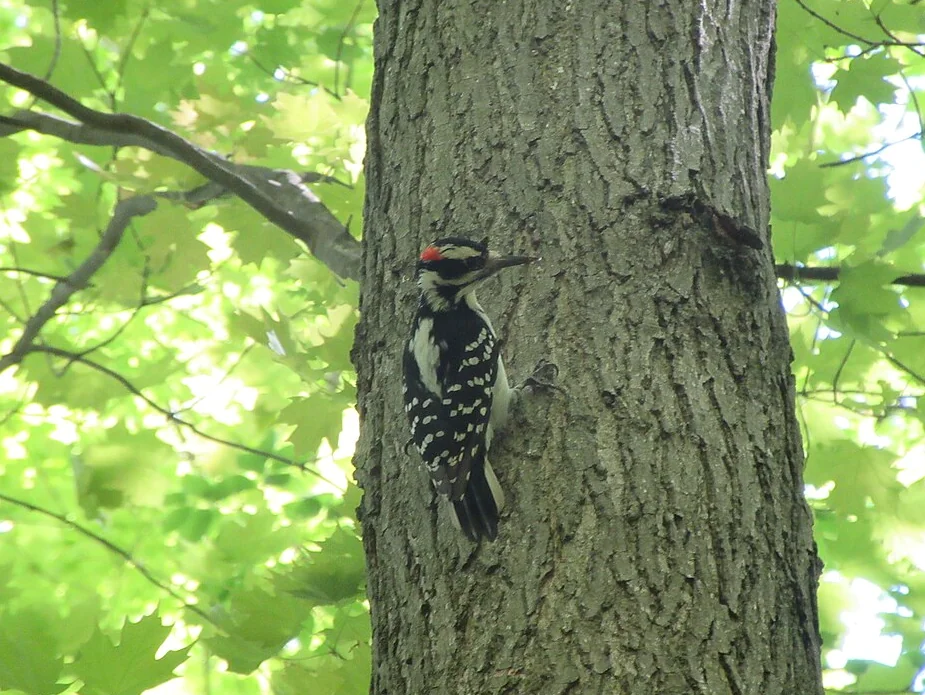
Photo: GregOberski · Hairy Woodpecker Tree.jpg · CC BY-SA 4.0. Cropped, gently adjusted, and resized for this guide.
“A feeder is one useful stop; habitat is the larger project.”
Backyard Birding — editorial takeaway
Place the feeder near a sensible approach
Look for an open route from a tree or other suitable staging point to the feeder. Avoid pressing the feeding surface into dense vegetation where you cannot inspect it or see the ground below. Assess surrounding windows from outside and address reflective glass before adding food. Close viewing is enjoyable only when the location also works as a safe, maintainable part of the yard.
Rehearse taking the feeder down and carrying it to the cleaning area. A branch that looks natural may be inconvenient to reach, weak at the attachment, or likely to move in wind. A suitable pole can make maintenance easier, but it must be installed correctly. Use our feeder placement guide to compare candidate locations. The relevant question is not whether a spot resembles a woodland photograph; it is whether the approach, support, food, and care routine work together.
Offer food in a form you can monitor
Use bird food intended for the feeder and inspect it regularly. Suet should remain in suitable condition for the product and weather; remove food that is spoiled, excessively soft, or contaminated. Follow the label's storage directions and keep unopened supplies protected. A large stock is not a benefit if you cannot use it appropriately or lose track of which package was opened first.
Some woodpeckers also visit suitable seed or peanut offerings, but preferences vary and no food is exclusive to one species. If you add an alternative, do so for a clear reason and use a dispenser designed for it. Do not smear household fats or sticky mixtures onto tree bark as an improvised shortcut. A removable, cleanable feeding surface lets you manage the supplement and remove it when necessary. Natural foraging areas should not become surfaces you cannot restore or inspect.
Make room for other visitors without promising exclusivity
A feeder intended for woodpeckers may also attract chickadees, nuthatches, starlings, jays, squirrels, and other local animals. Their presence does not mean the food is defective or that the target bird has been permanently excluded. Watch actual access: does a woodpecker wait and feed later, or is the station continuously occupied in a way that prevents use?
If crowding is a problem, first review portion size, placement, and feeding surface. Some feeder designs change which birds can reach food, but no design reliably creates a private dining room for one species. Avoid treating ordinary wildlife behavior as a contest that requires escalating deterrents. A second station also doubles some maintenance work, so add it only when you can support that routine. Record the result of one adjustment before making another, and keep the wider habitat useful regardless of which bird arrives first.
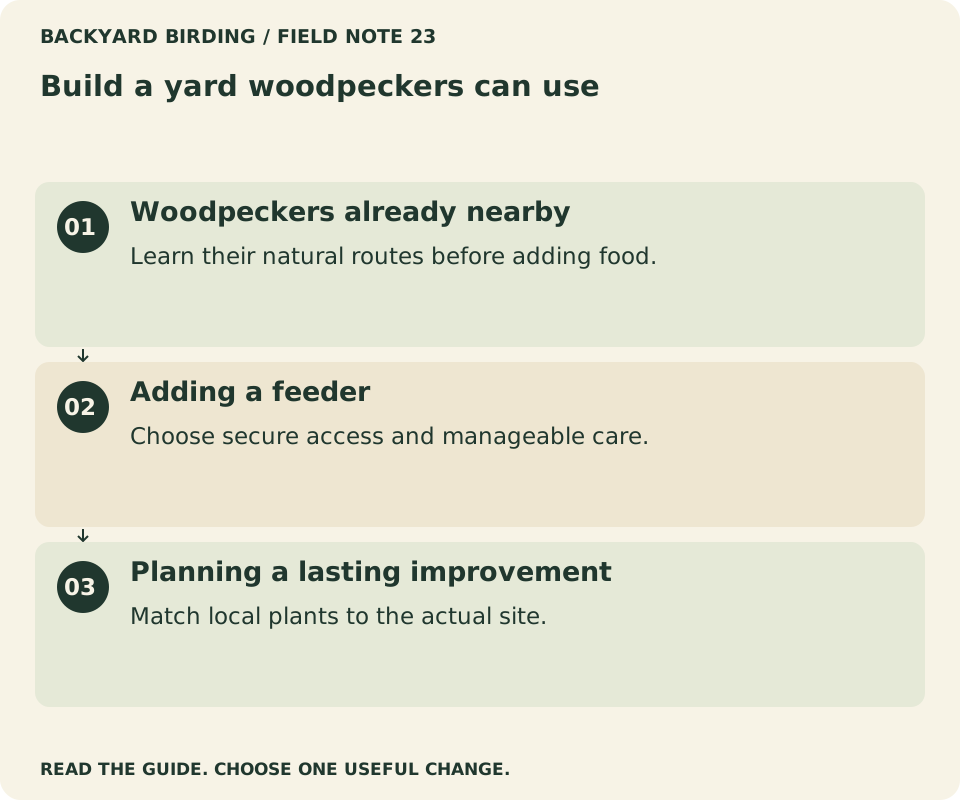
Find your situation

Read the visual as text
- Woodpeckers already nearby. Learn their natural routes before adding food.
- Adding a feeder. Choose secure access and manageable care.
- Planning a lasting improvement. Match local plants to the actual site.
Learn Downy and Hairy without relying on apparent size
Downy and Hairy Woodpeckers can be confusing because both are black and white and may visit similar settings. A clear side view of the bill relative to the head is more useful than the impression that a distant bird looks small. Tail markings can provide supporting evidence when visible, but angle and feather overlap can hide them.
Use the feeder's fixed features as context without turning them into an exact measuring device. Perspective changes when the bird moves toward or away from the camera. Save several unaltered frames if you have photographs, and look at the whole bird rather than zooming immediately into a blurred detail. Our Downy versus Hairy comparison provides a step-by-step method. An unresolved sighting is an acceptable outcome. Keeping an honest note will teach you more than forcing every visit into a confident species label.
Provide water as a separate maintenance commitment
A clean bird bath can add another resource, but it needs its own location and care routine. Keep it clear of falling food and droppings from the feeder above. Choose a stable basin with accessible shallow areas and a surface you can clean. Do not assume a deep decorative bowl becomes suitable simply because it sits beneath a tree used by woodpeckers.
Observe water use without expecting every visitor to bathe on schedule. A bird may drink briefly, investigate, or ignore the basin. The useful question is whether the water remains clean and accessible, not whether it produces a photograph during each watch. In freezing conditions, follow safe equipment and material guidance rather than adding chemicals. If maintaining both water and suet becomes difficult, simplify the arrangement. One resource cared for consistently is a sounder starting point than several features that become neglected between occasional bursts of enthusiasm.
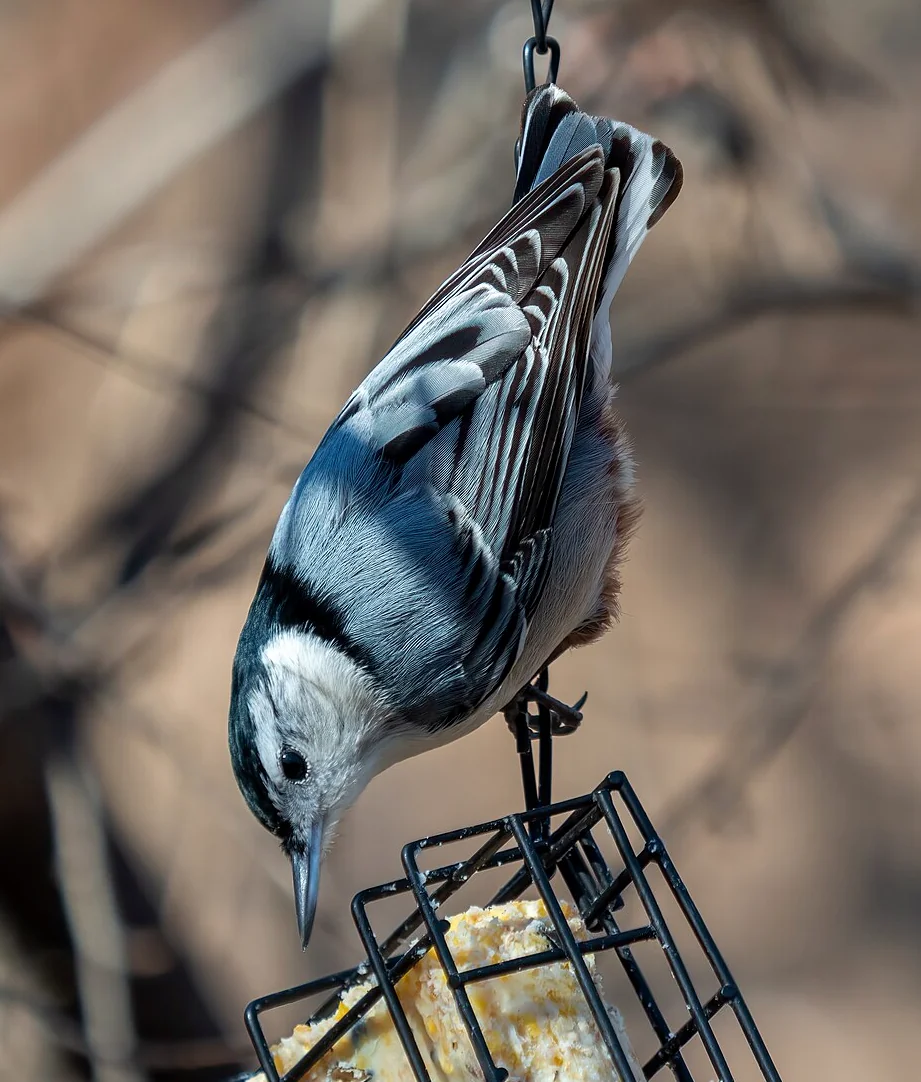
Photo: Rhododendrites · White-breasted nuthatch at a suet feeder (84756).jpg · CC BY-SA 4.0. Cropped, gently adjusted, and resized for this guide.
Give nesting activity generous space
If you suspect a cavity is being used for nesting, watch from a distance and reduce disturbance around it. Repeated approaches for a better photograph can change the situation you are trying to observe. Do not insert a camera, probe a hole, or remove material to confirm occupancy. A cavity's appearance alone does not tell you exactly what stage of use it is in.
Postpone discretionary work near active nesting activity and seek appropriate local guidance when safety or maintenance creates a conflict. A feeder is not a reason to draw attention toward a nest. Keep public photographs and location details considerate, particularly when sharing a site that others could approach. The most satisfying observation may be a brief distant view of normal behavior. Your role is to make the yard less disruptive and more useful, not to obtain access to every part of a wild bird's life.
Handle house conflicts with a separate plan
A woodpecker using siding, a vent surround, or flashing raises different questions from one eating at a feeder. Document the location, timing, and visible behavior from a distance. Distinguish noise from physical excavation as well as you can, and check whether a cavity might be active before attempting exclusion or repair. Consult a qualified local professional when the situation is uncertain.
Do not assume that more suet will redirect the behavior, and do not seal an opening merely because the bird is temporarily absent. Wildlife rules and suitable responses vary, so current local guidance is essential for a specific conflict. This article is an attraction guide, not authorization for nest removal or wildlife handling. Keeping those tasks separate prevents a helpful habitat project from turning into an improvised intervention. You can continue observing elsewhere in the yard while a particular building issue is assessed properly.
Keep a four-week observation record
A small notebook can make the first month more informative. Choose a few comparable watch periods rather than recording only dramatic sightings. Note species confidence, the surface used, food condition, and any disturbance. Include visits to trees and plants, not just the feeder, so the record reflects the yard as habitat.
| Record | Example entry | Why it helps |
|---|---|---|
| Place used | Thin branch beside the border | Identifies a natural foraging area |
| Feeder access | Landed, waited, then fed | Describes use without guessing motives |
| Identification | Downy likely; bill view brief | Preserves uncertainty |
| Maintenance | Cake dry and firm; holder cleaned | Connects care with the observation period |
These are illustrative entries, not field results from our testing. At the end of the month, look for a practical next step. You may discover that moving your viewing chair reveals more activity than adding another food.
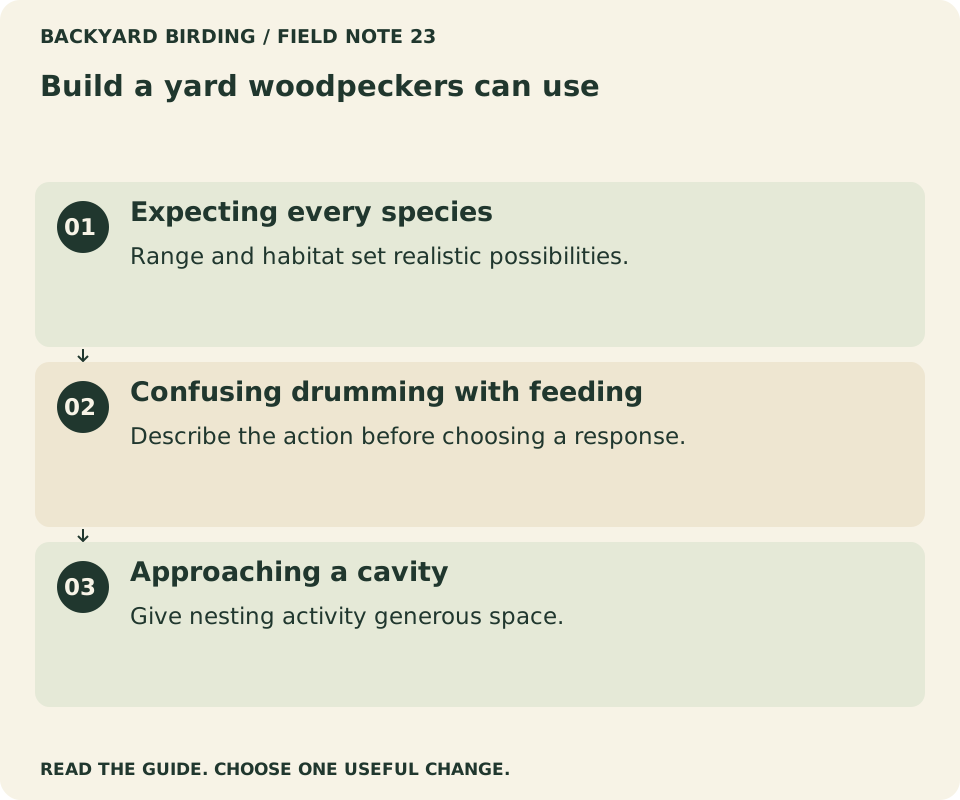
Small mistakes. Better moves.

Read the visual as text
- Expecting every species. Range and habitat set realistic possibilities.
- Confusing drumming with feeding. Describe the action before choosing a response.
- Approaching a cavity. Give nesting activity generous space.
Choose the next habitat improvement carefully
If you want a longer-term project, investigate locally appropriate trees or shrubs and the space they will need when mature. Check light, soil moisture, utilities, and nearby structures before buying. A tree planted for wildlife still needs to fit the site and receive establishment care. Ask a local native-plant nursery or extension resource about regional suitability rather than relying on a nationwide list.
Compare the improvement with what already exists. Retaining a safe, useful mature feature may matter more than adding several small decorative plants. If your yard is tiny, supporting a varied planting and minimizing disturbance can still be worthwhile without pretending it will host every woodpecker. Our native planting guide gives a planning framework. Treat the project as habitat development over time, with the feeder as one optional component rather than the center of every decision.
What a successful woodpecker yard looks like
Success means the yard offers appropriate resources without creating avoidable hazards or an unmanageable care burden. A woodpecker may visit a tree briefly, take food occasionally, or pass through in some seasons and not others. Those patterns are part of using a wider landscape. No feeder model or food recipe can make wild birds follow a fixed appointment.
After a month, compare the feeding station with the trees and stems you watched before setting it up. Note which places woodpeckers used, which food remained in sound condition, and which maintenance steps were awkward. Keep the equipment that works and correct a specific problem before adding more. If the feeder stayed quiet, return to the natural foraging areas in your notes; watching those can help you decide whether another feeding option has a purpose.
Watch it. Then try it.
Review the steps and common mistakes in two short, silent animations. Each has a complete text transcript below.
Your four-step action map
Read the complete video transcript
Build a yard woodpeckers can use.
- Identify local species. Start with birds that belong in your region.
- Map existing habitat. Notice trees, stems, and safe retained features.
- Offer a modest supplement. Use a secure, cleanable holder.
- Watch without disturbance. Record natural foraging and feeder access.
Try the steps, then note any problem that still needs attention.
Three mistakes to avoid
Read the complete video transcript
Build a yard woodpeckers can use.
- Expecting every species. Range and habitat set realistic possibilities.
- Confusing drumming with feeding. Describe the action before choosing a response.
- Approaching a cavity. Give nesting activity generous space.
Try the steps, then note any problem that still needs attention.
Both animations use this real photograph by Rhododendrites. Photo source · CC BY-SA 4.0. The photo is adapted into original educational animations, not recordings of a field test.
At a glance
| Before your next step | Your practical check |
|---|---|
| Woodpeckers already nearby | Learn their natural routes before adding food. |
| Adding a feeder | Choose secure access and manageable care. |
| Planning a lasting improvement | Match local plants to the actual site. |
Sources & evidence
- Cornell Lab: Downy Woodpecker overview
- Cornell Lab: Downy Woodpecker life history
- Cornell Lab: Suet and other bird foods
- Audubon: Native plants for birds and regional plant database
Our standard: real evidence before ratings. Corrections follow our editorial process.
Our verdict & your next actions
Choose the row that describes your setup, then follow the suggested check or adjustment.
| Your situation | Our verdict | Your next action |
|---|---|---|
| Woodpeckers already nearby | Learn their natural routes before adding food. | Start a useful observation record. |
| Adding a feeder | Choose secure access and manageable care. | Plan a suet trial. |
| Planning a lasting improvement | Match local plants to the actual site. | Build a native planting plan. |
Your pocket field checklist
Tick off the steps as you go.
0 of 4 steps completed
Keep building your knowledge in birds, or search the full backyard library.