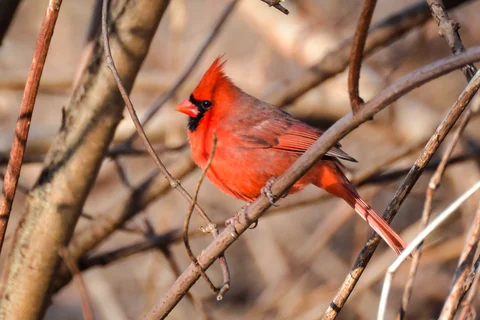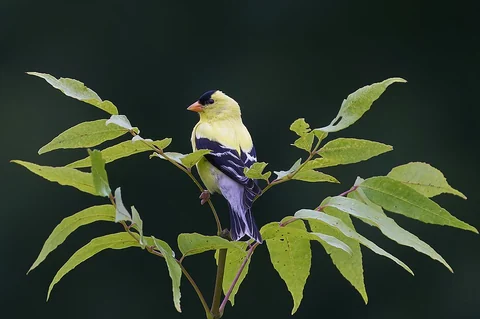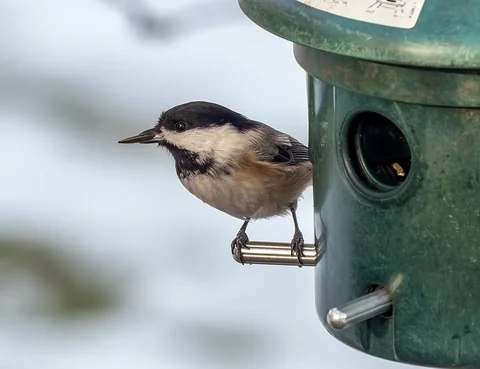
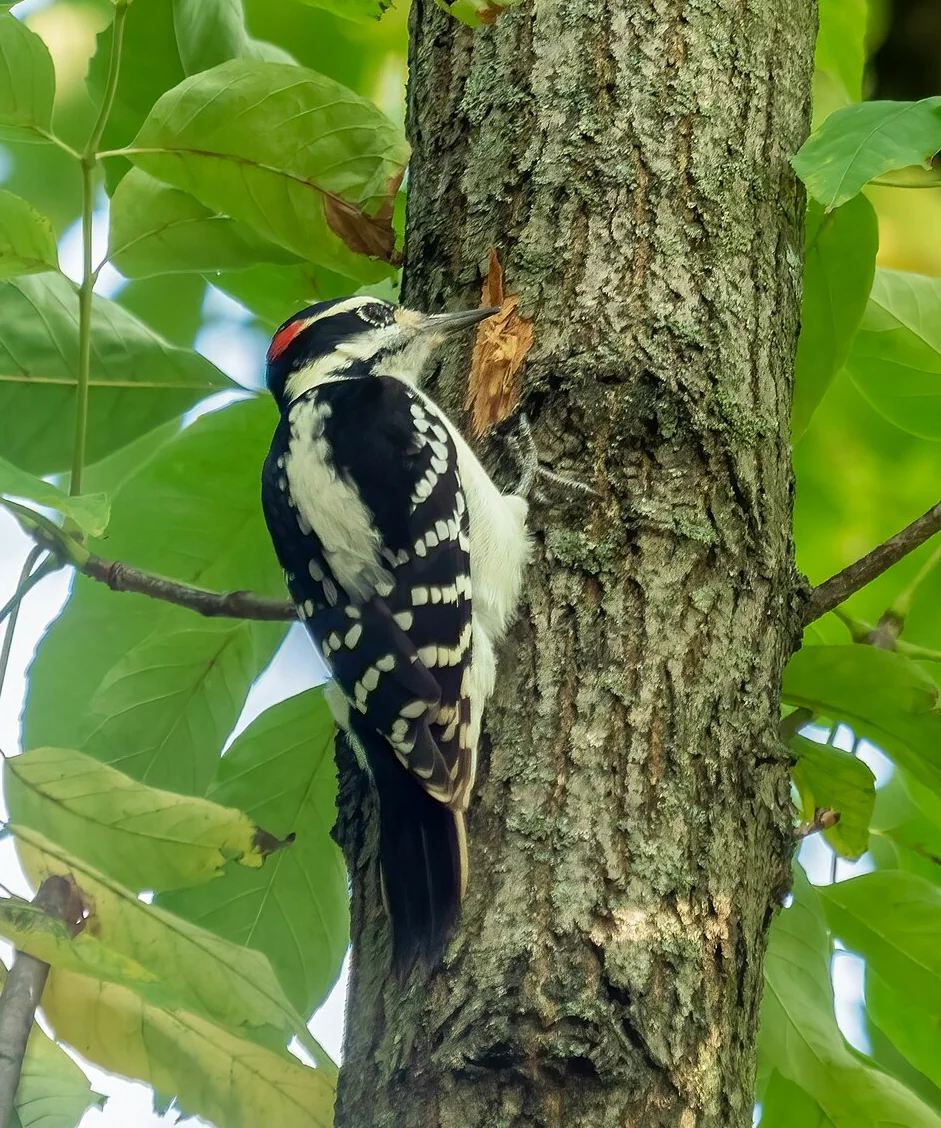
Photo: Rhododendrites · Hairy woodpecker (44546).jpg · CC BY-SA 4.0. Cropped, gently adjusted, and resized for this guide.
The short answer
Seek a clear side view of the bill relative to the head, then use visible outer-tail markings and size context as support. Red on an adult male does not separate the species.
Use proportions before apparent size
The quickest useful distinction between a Downy and a Hairy Woodpecker is the bill in a clear side view. A Downy's bill looks short relative to its head; a Hairy's looks long and substantial, approaching the head's length. Overall size and outer-tail markings can support that impression, but a distant bird beside an unfamiliar branch is difficult to measure reliably. Start with the bird's own proportions.
Both species are black-and-white woodpeckers with overlapping appearances and broad North American distributions. The red patch on an adult male's head does not separate the species, because males of both can show it. This guide gives you a repeatable way to observe the bill, head, tail, and context without pretending that every photograph permits a certain answer. A confident identification should rest on visible evidence, not on how strongly a bird resembles your expectation.
Give yourself a useful view
When a woodpecker first appears, keep it in view rather than immediately reaching for a field guide. Note the tree or feeder feature beside it so you can find it again if it moves around the trunk. A few seconds of continuous observation can reveal a side profile that a single rushed photograph misses. Stand or sit still and let the bird turn naturally.
Do not approach a nest or use repeated playback to obtain a better angle. Identification practice should fit around the bird's ordinary behavior. If you are watching from indoors, reduce glare by changing your own viewing position rather than moving the feeder toward untreated glass. Binoculars can help, but a steady view matters more than maximum magnification. Your first task is to see the relevant features clearly enough that a comparison means something, not to collect the largest possible image of the bird.
Read the bill against the head
Look at the distance from the bill's base near the face to its tip, then compare it with the visible head behind that base. You are making a proportional judgment, not measuring pixels to a decimal place. In a true side profile, the contrast between a short, delicate bill and a longer, chisel-like one is often more persuasive than the bird's apparent body size.
Be cautious when the head points toward or away from you. Foreshortening can make a long bill look shorter, and feathers near the base can blur the boundary you are trying to compare. Wait for another angle if possible. If you save a photograph, preserve the uncropped original so you can reconsider the head position later. A tightly enlarged crop can make an uncertain feature feel more definite without adding any actual information.
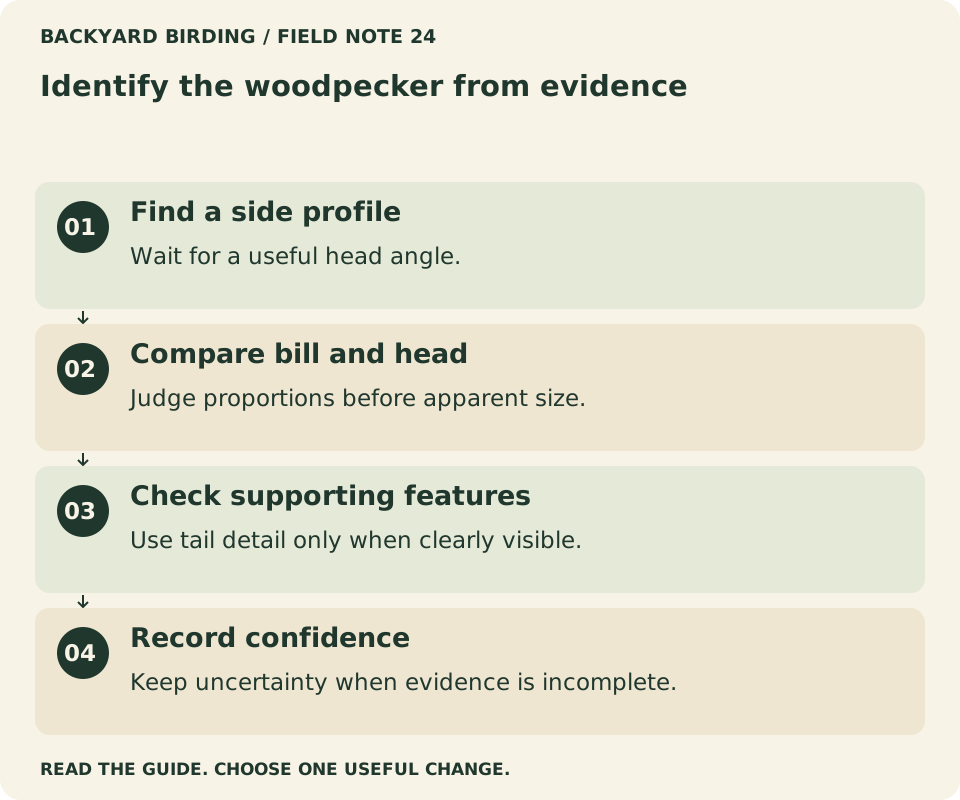
Your visual action map

Read the visual as text
- Find a side profile. Wait for a useful head angle.
- Compare bill and head. Judge proportions before apparent size.
- Check supporting features. Use tail detail only when clearly visible.
- Record confidence. Keep uncertainty when evidence is incomplete.
Use overall size only with honest context
Hairy Woodpeckers are generally larger than Downies, but scale is difficult when the bird is alone. A close Downy can look larger on screen than a distant Hairy. Feathers fluffed in cold weather can also change the outline. A familiar feeder part provides context only if you understand where the bird is relative to it; a perch behind the bird is not a ruler lying in the same plane.
When both species are present together, the size contrast can be valuable supporting evidence. Otherwise, write “appeared small” as an impression rather than treating it as proof. Cornell's identification pages provide measurement ranges, but knowing those ranges does not let you measure a bird by eye at an unknown distance. The practical skill is recognizing proportion and structure while remaining aware of perspective. That skill transfers to many other difficult backyard identifications.
Inspect the outer tail when it is genuinely visible
Downy Woodpeckers commonly show dark markings on the white outer tail feathers, whereas Hairy Woodpeckers usually have unmarked white outer tail feathers. This can support a bill-based identification, but the word “visible” matters. Tail feathers overlap, a branch can hide them, and shadow may look like a marking. Regional variation also means you should compare the bird with an appropriate regional guide.
Do not declare a tail unmarked merely because a photograph is blurred. Absence of visible detail is not the same as a clearly observed absence of markings. Look through several frames if available, especially when the bird changes position. Record the view honestly: “outer tail obscured” is useful. A good identification process can tolerate a missing feature; it should not fill that gap with whatever detail would make the preferred answer work.
Stop using the red patch as the species shortcut
Adult males of both species can show red toward the back of the head, while adult females lack that male patch. The presence of red therefore does not answer the Downy-versus-Hairy question. Young birds can show different head markings, so age also matters before you interpret the pattern too narrowly. Begin with species structure and treat head color as another observation.
The exact view can hide red even on a male. A bird facing you, a raised feather, or a branch behind the head can conceal a small patch. Avoid confidently calling a bird female from a single view that never shows the back of its head. You can record the species without assigning sex or age. Leaving those fields open is often more accurate than turning a brief backyard sighting into a complete biography that the evidence does not support.
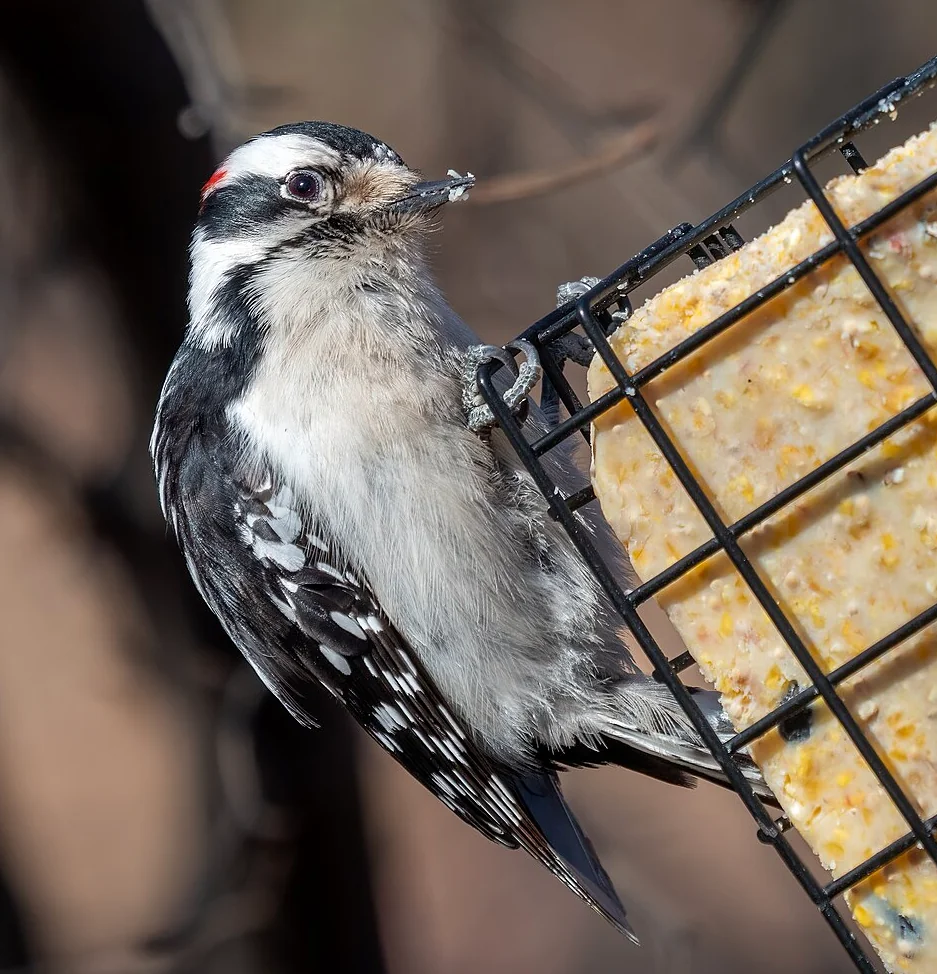
Photo: Rhododendrites · Downy woodpecker at a suet feeder (84724).jpg · CC BY-SA 4.0. Cropped, gently adjusted, and resized for this guide.
“An unresolved sighting is more useful than a confident guess.”
Backyard Birding — editorial takeaway
Compare the whole pattern without overvaluing one spot
Both birds have contrasting black-and-white plumage and a pale central back area, so those broad features place you in a useful group without settling the species. Wing spotting, facial stripes, and underpart tone can vary with geography and light. Cornell's Hairy account notes substantial regional differences, including darker western forms; one eastern reference photograph is not a universal template.
Use a regional set of photographs that includes more than one individual and more than one angle. Ask which features remain consistent across those examples and which vary. This is more instructive than memorizing the exact arrangement of spots on a single model bird. If the bird looks wrong for both expected species, widen the comparison to other local woodpeckers. A two-choice guide is helpful only after you have reasonable evidence that the bird belongs in that pair.
Treat behavior as support, not a verdict
A Downy working a slender stem may look characteristically small and agile, while a Hairy on a substantial trunk may fit your expectation of a larger woodpecker. Those observations can help direct attention, but behavior overlaps. A bird at a suet cage is not automatically a Downy, and a bird excavating wood is not automatically a Hairy. Food location alone does not identify the visitor.
Write down the action in ordinary language: moving along a thin branch, bracing on a trunk, taking food from a cage, or pausing on the pole. Then combine that context with visible bill and tail evidence. This prevents a familiar scene from becoming a shortcut that overrides contradictory features. Our woodpecker habitat guide explains how to observe natural foraging as well as feeder visits, giving you more opportunities to see the birds from different angles.
Learn calls separately and connect them to sightings
Sound can be useful, especially when a woodpecker moves behind a tree. Cornell's species accounts provide recordings that let you study the calls before trying to apply them outdoors. Listen to several examples at home and pay attention to quality, rhythm, and the shape of a series rather than memorizing a word intended to imitate the sound.
When you hear a call in the yard, try to connect it with a bird you can also see. A recording app may suggest a species, but background birds and noisy conditions can confuse automated identification. Treat a suggestion as a lead to investigate, not a substitute for observation. Do not play recordings repeatedly outside to provoke a response. You can improve your ear through reference listening and naturally occurring calls without changing the behavior you are hoping to understand.
Find your situation

Read the visual as text
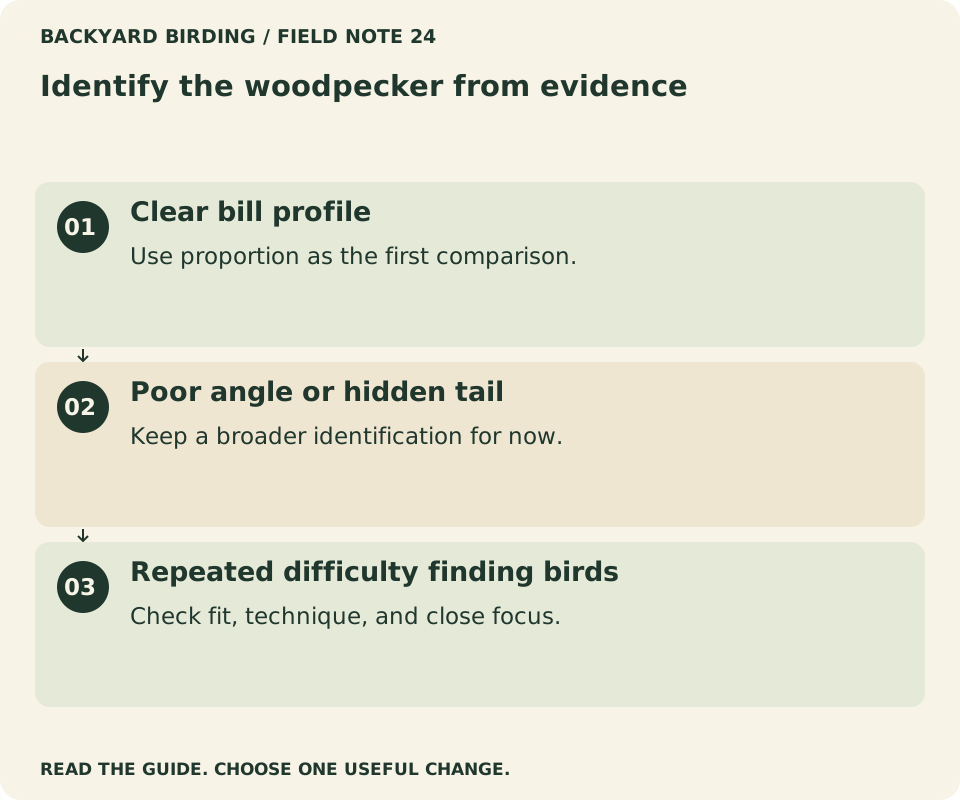
- Clear bill profile. Use proportion as the first comparison.
- Poor angle or hidden tail. Keep a broader identification for now.
- Repeated difficulty finding birds. Check fit, technique, and close focus.
Use a comparison table in the right order
The table below prioritizes features by how useful they are in an ordinary backyard view. It is a prompt for observation, not a scoring system that mechanically guarantees an answer. One clear structural feature can be more informative than several weak impressions.
| Feature | Downy tendency | Hairy tendency | Main limitation |
|---|---|---|---|
| Bill compared with head | Noticeably short | Long, near head length | Needs a good side view |
| Overall build | Smaller and finer | Larger and more substantial | Distance changes apparent size |
| White outer tail | Often dark-marked | Usually unmarked | Overlap and regional variation |
| Adult male red patch | May be present | May be present | Does not separate the species |
| Feeding setting | Trees, stems, feeders | Trees and feeders | Considerable behavioral overlap |
Work down the table while keeping the limitations visible. If the bill view is poor and the tail is hidden, the honest result may remain unresolved even when the setting feels familiar.
Photograph evidence rather than just a portrait
If you have a camera, prioritize an unobstructed side view and a frame showing the whole bird. A beautiful close portrait can omit the tail and make body proportions impossible to assess. Several modest frames from one visit may provide better identification evidence than one heavily cropped image. Keep the date and original file information associated with them.
Avoid editing that changes feather patterns or body shape. Exposure correction can reveal detail, but aggressive sharpening and generative repair can invent edges that were never recorded. For identification, preserve an original version and explain any crop when sharing. A useful request for help includes location, date, visible size context, and what you noticed directly. It does not need a confident proposed answer. Giving other observers the evidence before your conclusion makes it easier for them to assess the bird independently.
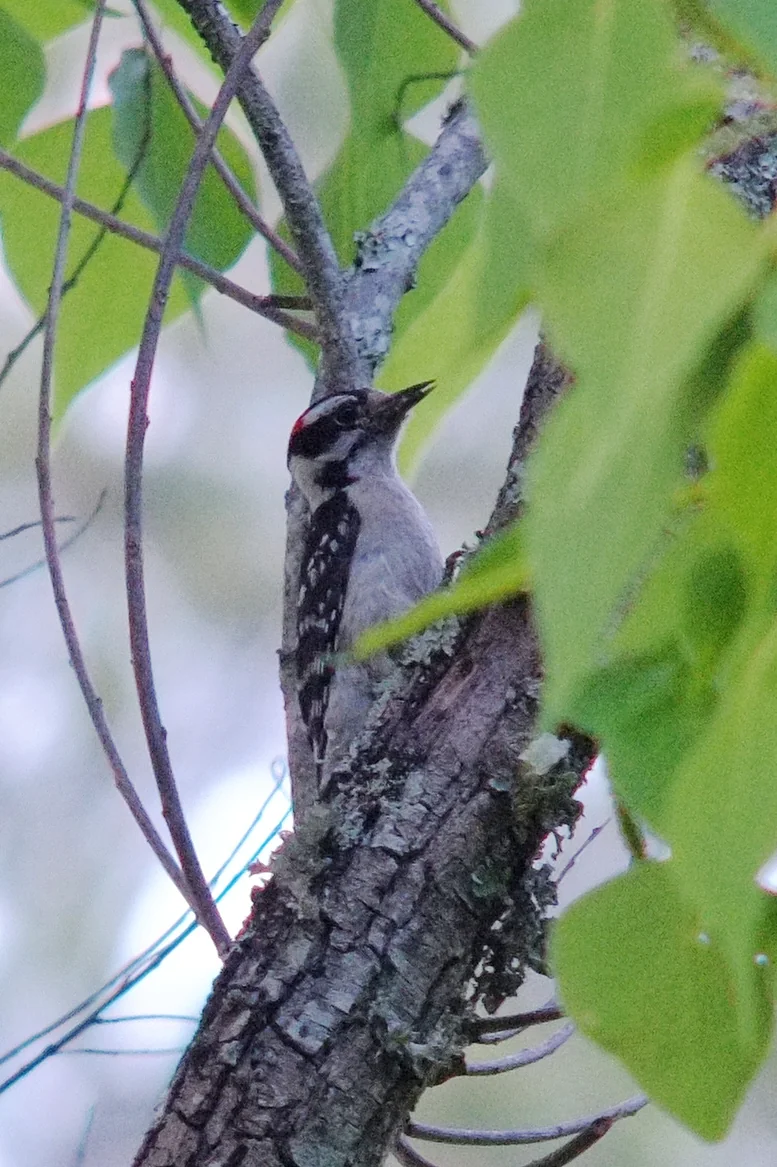
Photo: Simplex~enwiki · Downy Woodpecker male, Hattiesburg, Mississippi.jpg · CC BY-SA 4.0. Cropped, gently adjusted, and resized for this guide.
Handle a poor view without turning it into a failure
Sometimes the bird leaves before you see the bill properly. Sometimes a photograph is too soft to resolve tail markings. That is normal, not a reason to stretch the evidence. Record “Downy/Hairy Woodpecker” or an appropriate broader identification in your own notebook, with a short explanation of what was missing. If using a reporting platform, follow its available identification categories and guidance.
An uncertain record can create a specific practice goal. Next time, wait for the head to turn fully sideways or keep the whole tail in the frame. This is much more useful than labeling the sighting at random and building future expectations around it. Birding skill grows through recognizing the limits of a view as well as recognizing species. A notebook containing some honest uncertainty is more trustworthy than one in which every fleeting movement receives a precise name.
Try a three-pass identification exercise
Use a reference image with its label hidden. On the first pass, describe only what is visible: bill length relative to the head, body outline, tail exposure, and head angle. On the second, compare those observations with the Downy and Hairy tendencies. On the third, reveal the label and examine which feature was most useful and which you overinterpreted.
Repeat with several photographs from different regions and poses. Include difficult images, but do not expect every one to be identifiable without context. Keep a short list of your recurring errors, such as trusting size too much or treating a blurred tail as unmarked. Then use your next backyard watch to practice one correction. This deliberate method is more effective than rapidly guessing at a long gallery, because it connects each conclusion to a feature you can describe and recognize again.
Keep your reference library small and reliable
Choose a regional field guide and the Cornell species accounts as a starting set. Save links to the identification and sound pages so you can revisit them without searching through unrelated images. A large folder of unlabeled internet photographs can introduce mistakes, especially when search results include similar species or inaccurate captions. Source quality matters as much as image quality.
Keep your own confirmed photographs in a separate practice folder with date and location. Add a note explaining the evidence for the identification, not just the species name. For example, describe a clear long bill in profile and visible tail detail rather than writing “looked like a Hairy.” Over time, this creates a personal set of local examples. It also lets you revisit earlier judgments when your skills improve, without pretending that a file name is independent confirmation of what the image shows.
Small mistakes. Better moves.

Read the visual as text
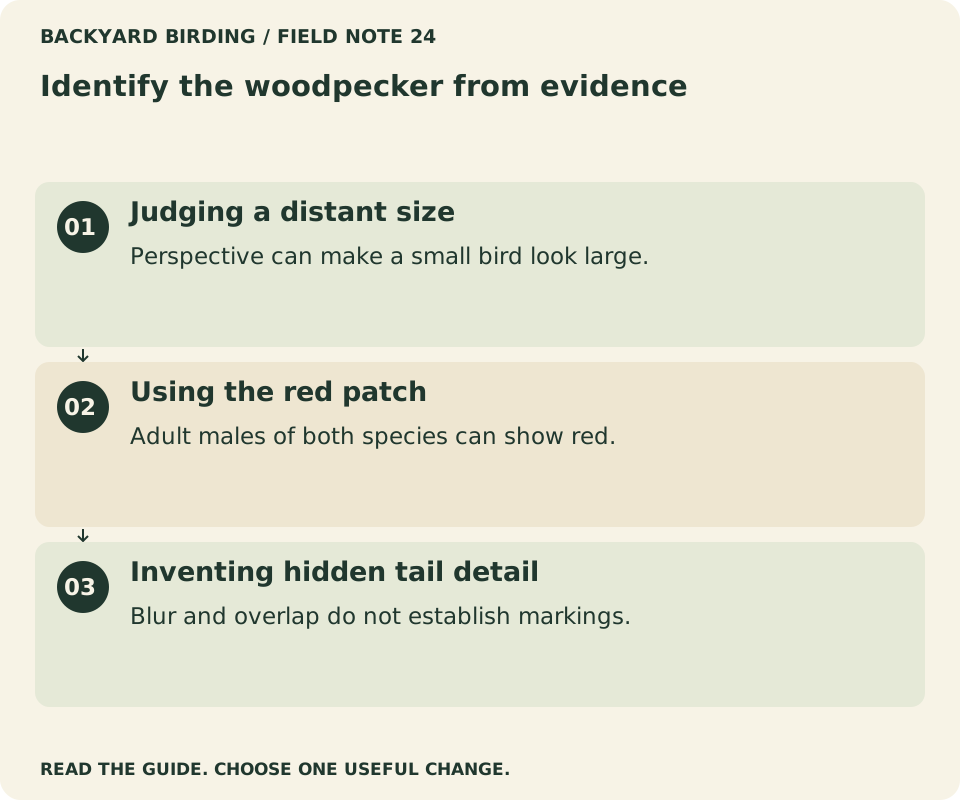
- Judging a distant size. Perspective can make a small bird look large.
- Using the red patch. Adult males of both species can show red.
- Inventing hidden tail detail. Blur and overlap do not establish markings.
Use the feeder as a repeatable observation station
A familiar feeder can help because you know its shape, viewing angle, and typical light. Keep a comfortable observation position and let birds approach normally. If a woodpecker uses the same side of a cage repeatedly, you may learn when a head turn is likely without trying to lure or disturb it. The equipment becomes a consistent background against which to practice.
Maintenance still comes first. Do not leave deteriorating food out to preserve an identification opportunity, and do not move the station toward unsafe glass for a closer photograph. A good view can also come from a better chair position or appropriately fitted binoculars. Our binocular selection guide emphasizes comfort and close focus, both useful for this kind of observation. The best identification setup supports patient watching while keeping the feeding routine sound.
Your next woodpecker sighting, step by step
When the next black-and-white woodpecker appears, locate it with your unaided eyes and keep watching. Seek a side profile, compare bill and head, then inspect the tail if it becomes visible. Use body size and behavior as context. Notice whether head angle, shadow, or an obstruction limits your judgment. Only then consult the guide or review photographs.
Write down the identification and the features that support it. For an uncertain sighting, record the missing view: bill turned toward the camera, tail behind the trunk, or body too distant to judge. Keep any photographs with that note. On the next visit, watch for the missing angle before checking the guide again; it may resolve the question that the first view could not.
For a camera-equipped setup, read How Accurate Is AI Bird Identification? Review Your Feeder Camera Labels.
Watch it. Then try it.
Review the steps and common mistakes in two short, silent animations. Each has a complete text transcript below.
Your four-step action map
Read the complete video transcript
Identify the woodpecker from evidence.
- Find a side profile. Wait for a useful head angle.
- Compare bill and head. Judge proportions before apparent size.
- Check supporting features. Use tail detail only when clearly visible.
- Record confidence. Keep uncertainty when evidence is incomplete.
Try the steps, then note any problem that still needs attention.
Three mistakes to avoid
Read the complete video transcript
Identify the woodpecker from evidence.
- Judging a distant size. Perspective can make a small bird look large.
- Using the red patch. Adult males of both species can show red.
- Inventing hidden tail detail. Blur and overlap do not establish markings.
Try the steps, then note any problem that still needs attention.
Both animations use this real photograph by Rhododendrites. Photo source · CC BY-SA 4.0. The photo is adapted into original educational animations, not recordings of a field test.
At a glance
| Before your next step | Your practical check |
|---|---|
| Clear bill profile | Use proportion as the first comparison. |
| Poor angle or hidden tail | Keep a broader identification for now. |
| Repeated difficulty finding birds | Check fit, technique, and close focus. |
Sources & evidence
- Cornell Bird Academy: Downy and Hairy Woodpeckers
- Cornell Lab: Hairy Woodpecker identification
- Cornell Lab: Downy Woodpecker overview
- Cornell Lab: Downy Woodpecker life history
Our standard: real evidence before ratings. Corrections follow our editorial process.
Our verdict & your next actions
Choose the row that describes your setup, then follow the suggested check or adjustment.
| Your situation | Our verdict | Your next action |
|---|---|---|
| Clear bill profile | Use proportion as the first comparison. | Follow the identification sequence. |
| Poor angle or hidden tail | Keep a broader identification for now. | Record the missing evidence. |
| Repeated difficulty finding birds | Check fit, technique, and close focus. | Review binocular choices. |
Your pocket field checklist
Tick off the steps as you go.
0 of 4 steps completed
Keep building your knowledge in birds, or search the full backyard library.